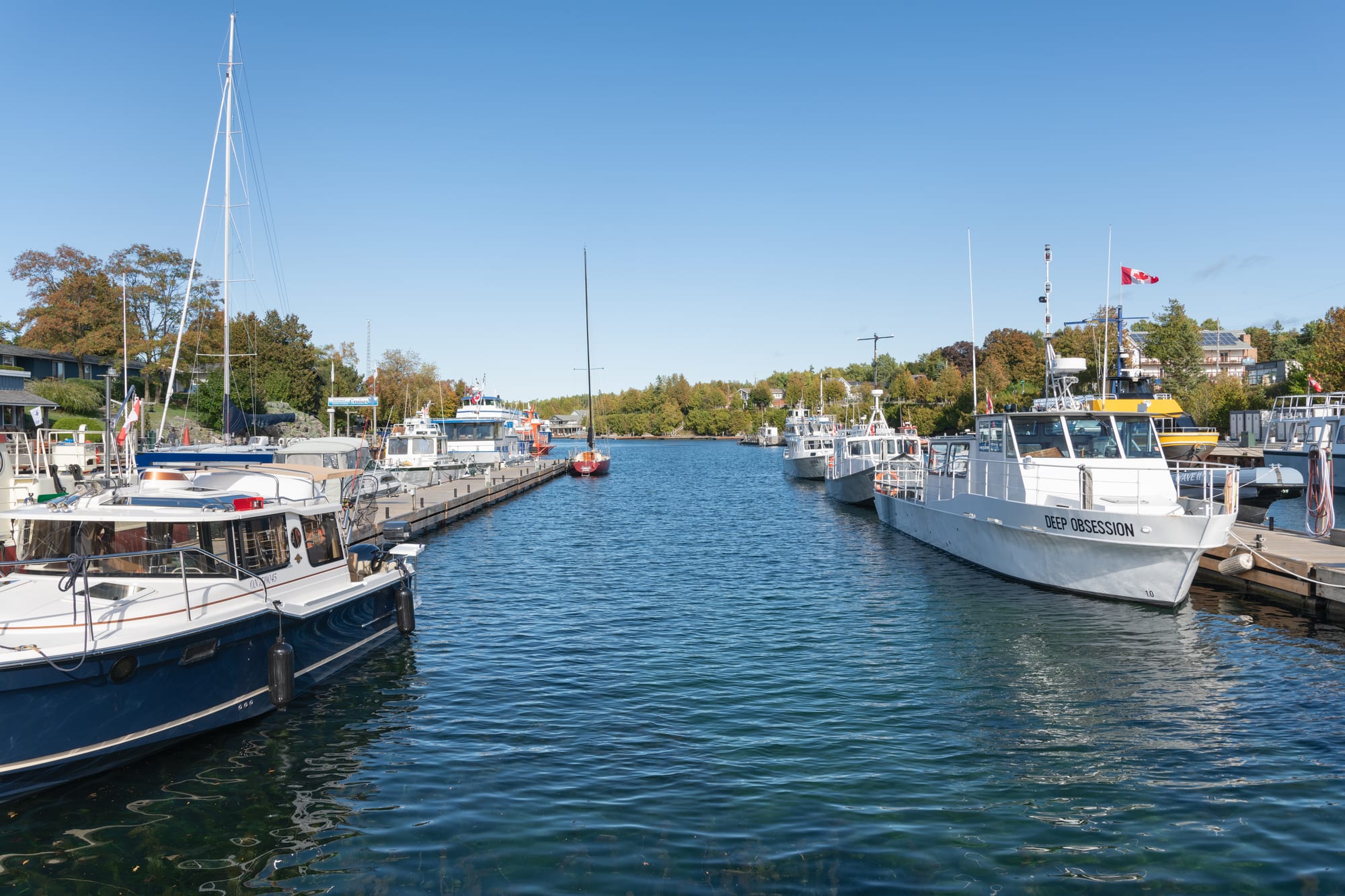
Tour boats and yachts moored along both sides of a narrow blue harbour, with trees turning autumn colours behind

Ontario, Canada

Tobermory

Boats moored in Little Tub Harbour, the centre of Tobermory, in October. (Giorgio Galeotti / Wikimedia Commons · CC BY-SA 4.0)

A small harbour village at the northern tip of the Bruce Peninsula, where the Niagara Escarpment slips under Lake Huron and Georgian Bay. Once a timber and fishing outpost, it now lives on summer visitors: divers exploring shipwrecks, boats to Flowerpot Island, hikers ending the Bruce Trail and the ferry to Manitoulin Island.

Neighbourhoods

  • Little Tub Harbour
    • First-time visitors
    • Best for food
    • Boat trips

    The narrow inner harbour that is the heart of the village, lined with tour boats, dive shops, restaurants and shops. The Bruce Trail ends at a cairn here, the ferry dock is close by, and nearly everything in the village is a few minutes' walk away.

    Open in Maps
  • Big Tub Harbour
    • Quiet and waterfront
    • Shipwrecks

    The larger, deeper harbour just west of the village, described as Canada's largest natural freshwater harbour. Cottages and lodgings line its shore, the wreck of the schooner Sweepstakes lies in shallow water in the harbour, and the Big Tub Lighthouse stands at its mouth.

    Open in Maps

Things to do

The harbour and the islands

  • Flowerpot Islandattraction

    An island of about 2 square kilometres in Fathom Five, named for the two rock pillars on its eastern shore — a third fell in 1903 — reached by cruise boats from Tobermory, with hiking trails and camping.

    Open in Maps
  • Fathom Five National Marine Parkpark

    Canada's first national marine conservation area, protecting 22 shipwrecks, islands and historic lighthouses; divers must register at the park visitor centre, and glass-bottom boats show the wrecks to everyone else.

    Open in Maps
  • Big Tub Lighthouselandmark

    A six-sided wooden lighthouse at the mouth of Big Tub Harbour, first lit in 1885 and still in use, guiding boats into the harbour.

    Open in Maps
  • Chi-Cheemaun ferrytransit hub

    The large car ferry whose Ojibwe name means 'big canoe', sailing from mid-May to mid-October across the lake to South Baymouth on Manitoulin Island.

    Open in Maps

Parks and trails

  • Bruce Peninsula National Parkpark

    A national park founded in 1987 on the Niagara Escarpment, with cliffs, coves, inland lakes and the Grotto, a sea cave on the Georgian Bay shore reached from the Cyprus Lake trails; a Dark Sky Preserve since 2009.

    Open in Maps
  • Bruce Trail northern cairntrail

    The end of Canada's oldest and longest marked hiking trail, following the escarpment for more than 890 km from the Niagara River and ending at a cairn at Little Tub Harbour, unveiled in 1967.

    Open in Maps

Short trips from the village

  • Cabot Headlandmark

    A point on the peninsula's Georgian Bay shore, where a lighthouse first built in 1896 and restored by volunteers now serves as a museum beside a nature reserve.

    Open in Maps

Seasonal events

  • Orchid festivalJune

    A celebration of the peninsula's roughly 43 species of wild orchids, with guided tours and talks.

Eat and drink

Long-standing places and food districts in Tobermory. Hours, ratings and directions come from your maps app, always current.

Tobermory classics

  • The Fish & Chip Placerestaurant

    A fish-and-chip restaurant on Bay Street South in the village.

    Open in Maps
  • Little Tub Harbour restaurantsneighborhood

    The harbourside cluster of seasonal restaurants, a microbrewery, ice-cream counters and cafés that serves the summer crowds.

    Open in Maps

Experience Tobermory

History

Naval surveyor Henry Bayfield charted the harbour in the early 19th century and named it Collins Harbour; it was later renamed after Tobermory on the Isle of Mull in Scotland, whose harbour it resembled. Officials who visited in the 1850s and 1870s judged the rocky, burnt-over land at the tip of the peninsula unfit for farming, but in the 1870s and 1880s the government sold it to settlers as farmland anyway. Some cleared fields; many gave up and left.

Timber was the real draw. Hemlock bark was shipped to tanneries in southern Ontario, the first sawmill opened in Tobermory in 1881, and within twenty years most of the valuable timber was gone; fires followed, and by the 1920s the region was nearly bare of forest. Settlers turned to fishing, setting nets in Big Tub and Little Tub in the late 1800s, until overfishing and the arrival of the sea lamprey brought decline in the 1920s. The Big Tub Lighthouse was built in 1885 to guide ships into a harbour that sheltered vessels from Georgian Bay's storms, and the wrecks of those that failed still lie offshore.

The peninsula's population fell steadily until the 1970s, when cottagers began buying land. The Chi-Cheemaun ferry began sailing in 1974, and in 1987 Bruce Peninsula National Park and Fathom Five National Marine Park were created, with Flowerpot Island moving from Georgian Bay Islands National Park into Fathom Five. Tobermory became part of the municipality of Northern Bruce Peninsula in 1999, and tourism grew by more than 200 per cent between 2003 and 2008.

Culture & Customs

Tobermory calls itself the freshwater scuba diving capital of the world, and its identity rests on the water. Divers come for the wrecks of Fathom Five, many in cold, clear water that preserves timber hulls; others see them from glass-bottom boats. The wreck of the schooner Sweepstakes in Big Tub Harbour, intact and visible from above the water, is among the village's best-known sights.

The village is also the end of the Bruce Trail, Canada's oldest and longest marked footpath, and hikers who complete the route from Niagara finish at the cairn on Little Tub Harbour. The landscape of cliffs, cedars and turquoise coves is the cultural backdrop: the area has around 43 species of wild orchids, celebrated in a June festival, and the national park's dark skies draw stargazers. The ferry's Ojibwe name, Chi-Cheemaun, "big canoe", recalls the Anishinaabe presence on the peninsula, where the Neyaashiinigmiing community runs its own radio station.

Life has a strong seasonal shape. Summer is crowded, informal and outdoors, with families from Toronto, cottagers and international visitors filling the harbour; the village has inspired a poem by James Reaney and a science fiction novel set in a future "Tober Cove". In winter the year-round residents have the place largely to themselves, and snowmobiling takes over.

Daily Life

Fewer than 1,000 people live in Tobermory year-round, yet hundreds of thousands visit its two national parks each year, and many more pass through on the ferry to Manitoulin Island. The village is part of the municipality of Northern Bruce Peninsula, a holiday area of cottages, water sports and snowmobile trails, and Owen Sound, 100 km south, is the nearest city for larger shops and services.

The economy is almost entirely tourism and its supporting trades: boat tours, dive operators, the ferry, restaurants, lodgings and shops, the parks, and the building and care of cottages. Many businesses open in May and close after the Thanksgiving long weekend in October, staying shut for the other seven months, so many jobs are seasonal. Lumber and commercial fishing, which settled the area, no longer play a major part.

Summer days revolve around the harbour: early boats to Flowerpot Island, divers suiting up on the docks, queues for the ferry and for fish and chips. Highway 6 carries heavy traffic up the peninsula on summer weekends. In the off-season the village is very quiet, with a small community, a local newspaper, the Tobermory Press, and long winter months.

Food

Tobermory's food is simple and seasonal, built for hungry hikers, divers and day trippers. The local classic is fish and chips, and harbourside restaurants serve it made with fish from the lake, often eaten on a patio or on the dock while the boats come and go. A restaurant with its own microbrewery, ice-cream counters and cafés make up most of the rest of the harbour's offer.

Fishing shaped the village from the late 1800s, when nets were set in Big Tub and Little Tub; the commercial fishery declined in the 1920s, but Great Lakes fish such as whitefish remain the obvious thing to order. Elsewhere on the menu are the province's simple classics — burgers, butter tarts filled with butter, sugar and eggs, and in spring maple syrup from sugar bushes in Ontario.

Much eating here is self-catered. Campers in the national park cook on their sites, cottagers stock up in town, and visitors heading out to Flowerpot Island or the Grotto pack a picnic, since there is little to buy once on the trail. Most restaurants close from mid-October to May along with the rest of the village.

Planning tools

Budget

Tobermory is a short-season resort, and prices for rooms and campsites are high in July and August and on long weekends. Boat trips, ferry tickets with a car and dive charters add up quickly. Ontario's 13 per cent harmonised sales tax is added at the till, and many businesses close from mid-October to May.

Daily Budget Midrange
USD 180–320 (motel or inn room, restaurant meals, a Flowerpot Island or glass-bottom boat trip, a hire car)
Daily Budget Shoestring
USD 85–135 (campsite, groceries and fish and chips, park day use, the bus up from Toronto in summer)

Book rooms, campsites and car places on the Chi-Cheemaun well ahead for summer and long weekends.

Best Time to Visit

Late May to early October, when the ferry sails, the boats run and the shops and restaurants are open; July and August are warmest and most crowded. June brings wild orchids, and September and early October are quieter, with autumn colour. From mid-October to May most of the village is shut.

Suggested Number of Days

Two or three days suit a first visit. Three to five allow time for diving, longer hikes or a ferry crossing to the next island. Weather on the water can cancel boat trips, so a spare day helps.

First Visit
2–3 days
With Surroundings
3–5 days

Transportation

The village itself is walkable, and boats are the way to the islands. Highway 6 is the main road in and runs down the peninsula. A car is the practical way to reach the national park's trailheads and the rest of the peninsula; the nearest taxi is in Owen Sound.

Check Parks Canada's current rules for the national park's trailheads before driving out in summer.

Airport & Station Connections

Tobermory lies about 300 km north-west of Toronto, at the end of Highway 6; Owen Sound, the nearest city, is about 100 km south. Most visitors drive. In summer the Parkbus coach runs up from Toronto, stopping at Cyprus Lake Campground and in the village. From the north, the Chi-Cheemaun ferry crosses from South Baymouth on Manitoulin Island between mid-May and mid-October. Tobermory Airport, south of town, is for general aviation only.

Walkability

The village around Little Tub Harbour is small and easily walked, and the Bruce Trail and Big Tub Harbour start from its edge. The national park's trails are rocky and uneven, with scrambles over boulders along the shore near the Grotto; sturdy shoes are needed.

Safety

Canada is a safe country with low levels of violent crime. Tobermory's risks are natural: cold, deep water and sudden changes of weather on the lakes, high cliff edges and slippery rocks along the escarpment, black bears, and the endangered eastern massasauga rattlesnake, which lives on the peninsula.

Stay back from cliff edges, wear a life jacket on the water, give rattlesnakes and bears plenty of room, and dive only with registration and proper training. Check current official travel advice before travelling.

Climate

A humid continental climate with four distinct seasons. Tobermory is typically a few degrees colder than Toronto; summers are mild to warm, winters are cold, and precipitation falls fairly evenly through the year. The lake water stays cold even in summer.

Summer
mild to warm, a few degrees cooler than the 24–30°C days of southern Ontario
Winter
cold and snowy, a few degrees colder than Toronto's typical −5 to −10°C

Local Customs

Tipping of 15–20 per cent is expected in restaurants and taxis, and sales tax is added at the till. Dress is casual and outdoor. On the water and in the parks, Parks Canada rules apply: wrecks are protected, and nothing may be taken from them or from the islands.

Carry out all rubbish, keep to marked trails on the fragile escarpment, and do not pick the wild orchids.

Common Payment Methods

The currency is the Canadian dollar. Cards and contactless payment are accepted almost everywhere, and cash is rarely necessary; cash totals are rounded to the nearest five cents. ATMs are few, so a little cash is useful in the village.