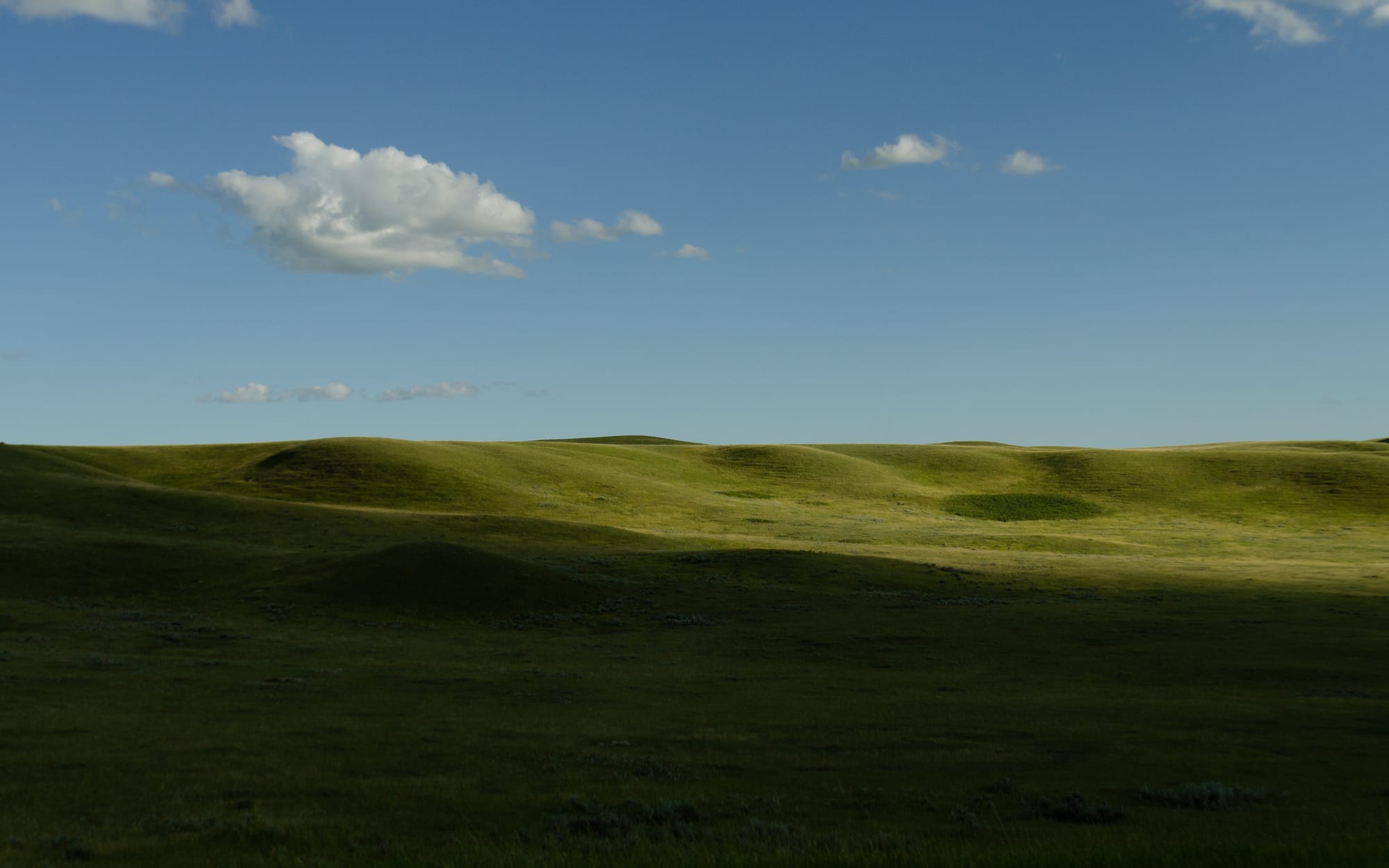
Rolling green grass-covered hills under a blue sky with small white clouds, half in the shadow of a cloud

Canada

The Prairies

Mixed-grass prairie hills in Grasslands National Park, southern Saskatchewan. (Ethan Sahagun / Wikimedia Commons · CC BY-SA 4.0)

Saskatchewan and Manitoba, the two provinces at the centre of Canada — a sweep of wheat and canola fields, mixed grassland and parkland that gives way to boreal forest, thousands of lakes and the subarctic shore of Hudson Bay, shaped by the Plains nations, the Métis of Red River and the settlers who homesteaded the West.

Explore The Prairies

History

The plains and parkland were home to the Plains Cree, the Nakoda (Assiniboine), the Saulteaux, the Dakota and, in the southwest, the Blackfoot, who lived largely from the bison; the Dene and Woodland Cree occupied the northern forests. From 1670 the Hudson's Bay Company traded from posts on Hudson Bay such as York Factory, and fur traders and Cree and Saulteaux women founded the Métis, a new people with their own language, Michif, whose home became the Red River settlement around today's Winnipeg.

When Canada bought the Hudson's Bay Company's lands in 1869 without consulting the settlement, the Métis under Louis Riel formed a provisional government, and the Red River Resistance led to the creation of Manitoba in 1870. The numbered treaties followed from 1871, beginning with Treaty 1 at Lower Fort Garry; nations agreed to share the land in return for reserves, schooling and aid, promises many say were not kept. In 1885 the North-West Resistance in what is now Saskatchewan ended in defeat at Batoche, and Riel was hanged in Regina. Saskatchewan became a province in 1905, as homesteaders from Ukraine, Germany, Scandinavia, Iceland and Britain filled the land along the railway.

The 1919 Winnipeg General Strike was a landmark of Canadian labour history, and the drought of the 1930s ruined much of Saskatchewan. The province elected Tommy Douglas's socialist government in 1944 and introduced public medical insurance, which became the model for national medicare. Residential schools operated across both provinces; in 2021 the Cowessess First Nation announced that radar surveys had found hundreds of probable unmarked graves at the former Marieval school, and the National Centre for Truth and Reconciliation, which holds the Truth and Reconciliation Commission's records, is in Winnipeg.

Culture & Customs

Prairie culture is built on community and on getting through winter together: curling rinks, hockey arenas, church suppers, fall fairs and fowl suppers remain the centre of small-town life. Many nations hold powwows through the summer, and Treaty Days are marked on reserves. The Métis keep the Red River jig, fiddle music and the woven sash as emblems, and Michif is being taught again.

The settler mix is unusually visible. Onion-domed Ukrainian churches stand in the fields, Dauphin hosts a national Ukrainian festival, Gimli on Lake Winnipeg celebrates its Icelandic founders each August, and Mennonite communities around Steinbach and Winkler keep their Low German speech. Saint-Boniface in Winnipeg is one of the largest French-speaking communities in western Canada, and its February Festival du Voyageur celebrates the fur-trade era. Winnipeg's Folklorama, where cultural groups run pavilions across the city, is a summer fixture.

Sport is close to a religion in Saskatchewan, whose fans turn out in green — and sometimes with watermelons carved into helmets — for the Saskatchewan Roughriders football team. Winnipeg supports the Jets in hockey and has a strong arts scene for its size, including the Royal Winnipeg Ballet and a tradition of homegrown musicians.

Daily Life

The two provinces together have about 2.7 million people. Winnipeg, with around 750,000, holds more than half of Manitoba's population; Saskatoon, with about 270,000, and Regina, with about 230,000, are Saskatchewan's two main cities, followed by Brandon, Prince Albert and Moose Jaw. Indigenous people make up a larger share of the population here than in any other province, and a growing share of the young.

Farming defines the economy and the landscape: wheat, canola, lentils, oats and cattle, with Saskatchewan also a major producer of potash and uranium and of oil in its southeast. Manitoba runs on hydroelectricity from its northern rivers, manufacturing, aerospace and transport in Winnipeg, and agriculture. Many rural towns have shrunk as farms have grown larger, while the cities have grown with immigration.

Life follows the seasons. Winter means plugged-in cars, indoor walkways in downtown Winnipeg and weekends at the rink; summer is spent at the cabin on the lake, and harvest in late summer takes over farm families' lives.

Food

Prairie cooking is homestyle and generous, shaped by the settlers' kitchens. Perogies — dumplings stuffed with potato and cheese, often fried with onions and served with sour cream — and holubtsi, cabbage rolls filled with rice, sit beside Mennonite farmer sausage and vareniki, and Icelandic vínarterta, a layered prune torte, is made in Gimli. Bannock is baked or fried in First Nations and Métis homes, and bison and wild rice from Manitoba's lakes are Indigenous staples.

The lakes provide pickerel, the local name for walleye, served pan-fried, and Lake Winnipeg goldeye, traditionally smoked until reddish-gold. Saskatoon berries, native purple fruits, go into pies, jams and syrups, and Winnipeg has its own list of local foods: the chili-topped "fat boy" burger, honey dill dipping sauce and schmoo torte, a cake layered with whipped cream, brown sugar and nuts.

Fields of canola, mustard and lentils make the region a major exporter of all three, though little of it appears on local plates. Crown Royal whisky is distilled at Gimli, and craft breweries and prairie distillers have multiplied in the cities.

Attractions & Natural Wonders

Winnipeg's centre is The Forks, the old meeting place at the junction of the Red and Assiniboine rivers, now a market and park beside the Canadian Museum for Human Rights. The Exchange District's early-1900s warehouses, the Manitoba Museum, the Saint-Boniface Cathedral ruins where Louis Riel is buried, and Assiniboine Park's polar-bear exhibit fill a few days; Lower Fort Garry lies to the north. Lake Winnipeg's beaches and Gimli, and the lakes of Whiteshell Provincial Park, are the city's summer escapes.

Far north on Hudson Bay, Churchill is one of the best places in the world to see polar bears from tundra vehicles in October and November; beluga whales crowd the Churchill River estuary in summer, and the aurora can be seen on clear nights, most often in February and March. To the west, Riding Mountain National Park rises from the farmland on the Manitoba Escarpment, with Clear Lake, Wasagaming and a bison enclosure.

In Saskatchewan, Saskatoon's river valley trails lead to the Remai Modern gallery, and Wanuskewin Heritage Park presents thousands of years of Northern Plains life. Regina has the Legislative Building on Wascana Lake and the RCMP Heritage Centre. Batoche National Historic Site marks the 1885 battle, Moose Jaw has its tunnels and mineral spa, and Prince Albert National Park has lakes, forest and Ajawaan Lake, where the naturalist Grey Owl lived. In the far south, Grasslands National Park protects mixed-grass prairie, the Frenchman River valley, reintroduced bison and badlands in its east block.

Cities in The Prairies

Planning basics

Budget

The Prairies are among the cheapest parts of Canada to travel in: hotels in Winnipeg, Regina and Saskatoon cost well below Vancouver or Toronto prices, and food is good value. The big exception is Churchill, where the polar-bear season fills a small stock of rooms and most visitors come on costly packages that include flights and tundra-vehicle tours.

Daily Budget Midrange
USD 140–250 (mid-range hotel, car hire, restaurant meals and park fees)
Daily Budget Shoestring
USD 70–110 (hostel or budget motel, self-catering, city buses; a car is hard to avoid outside the cities)

Book Churchill's bear season up to a year ahead; summer beluga trips are cheaper and easier to arrange.

Safety

The main dangers are the weather and wildlife: frostbite and whiteouts in winter, summer storms and tornadoes, deer and moose on roads at dusk, and polar bears in and around Churchill, which has a bear alert system and patrols. Winnipeg, Regina and Saskatoon have higher crime rates than most Canadian cities, concentrated in certain neighbourhoods, though visitors are rarely affected.

Never walk alone on the edge of Churchill or along its shore, dress for wind chill rather than air temperature, and watch the forecast for summer storm warnings. Check current official travel advice before travelling.

Climate

The most extreme climate in southern Canada. Winters are long, dry and bitterly cold, with blizzards and wind chill that can fall below -40°C, while summers are warm to hot and sunny, with severe thunderstorms, hail and occasional tornadoes. Manitoba is more humid than Saskatchewan, and Churchill on Hudson Bay is subarctic, with snow from October to May.

Summer
22–30°C in the south, occasionally hotter; long days and mosquitoes near water
Winter
around -12 to -20°C on average, with cold snaps below -35°C

Transportation

Winnipeg, Regina and Saskatoon have airports with flights across Canada. The Trans-Canada Highway crosses both provinces — Winnipeg to Regina is about six hours by car — and Regina to Saskatoon is under three hours. A car is needed for the national parks and small towns. Churchill has no road link: it is reached by air or by VIA Rail's train from Winnipeg, which takes about two days.

Distances between services can be long on rural highways; keep fuel topped up and carry winter gear in the car from October to April.

Best Time to Visit

June to September for the cities, lakes and national parks, with festivals and long evenings; August and September bring the harvest and golden fields. Churchill's belugas peak in July and August and its polar bears in October and November. February suits winter festivals such as Winnipeg's Festival du Voyageur, for those ready for serious cold.