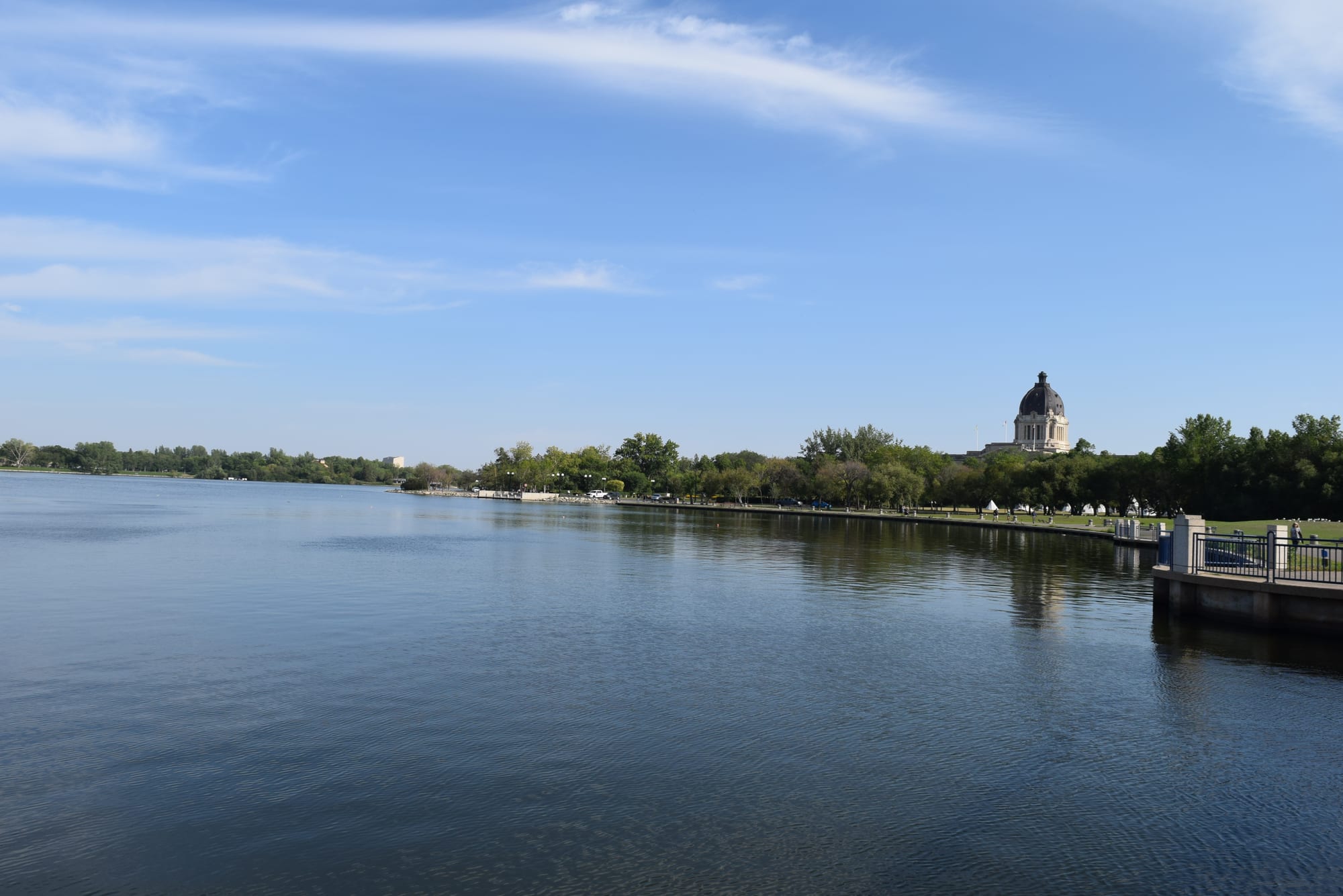
Calm blue Wascana Lake with a tree-lined shore and the domed Saskatchewan Legislative Building beyond

The Prairies, Canada

Regina

The Saskatchewan Legislative Building seen across Wascana Lake in Regina. (Haydn Blackey from Cardiff, Wales / Wikimedia Commons · CC BY-SA 2.0)

Saskatchewan's capital, set on a treeless plain where a dammed creek became Wascana Lake. Founded beside the railway in 1882 at a place called Pile-of-Bones, it grew into a government and farm-service city that gave Canada the Regina Manifesto and became a centre of public-healthcare politics, and today combines a large lakeside park, the Mounted Police academy and devoted football crowds.

Neighbourhoods

  • Downtown
    • First-time visitors
    • Close to public transport

    The central business district around Victoria Park, with the city's office towers, the Cornwall Centre shopping mall, the Globe Theatre and Casino Regina in the former railway station. The farmers' market sets up on City Square Plaza beside the park in summer.

    Open in Maps
  • Warehouse District
    • Nightlife
    • Best for food

    The old freight-reception zone just north of downtown across the railway line, where historic warehouses have been converted into flats, shops, restaurants and nightclubs.

    Open in Maps
  • Cathedral Area
    • Local life
    • Arts and culture

    A residential neighbourhood west of downtown named after Holy Rosary Cathedral on 13th Avenue, with independent shops and cafés along the avenue and its own yearly arts festival.

    Open in Maps
  • The Crescents and Lakeview
    • Quiet and residential
    • Historic homes

    Older, tree-lined residential districts directly south of downtown. The Crescents curve along the north bank of Wascana Creek west of the Albert Street Bridge, a short walk from the lake and the Legislative Building.

    Open in Maps
  • Wascana Centre
    • Parks
    • Museums

    Not a neighbourhood but the city's great park, wrapped around Wascana Lake south of downtown. The Legislative Building, the provincial museum, the art gallery, the science centre, the arts centre and the University of Regina all stand within it.

    Open in Maps

Things to do

Landmarks

  • Saskatchewan Legislative Buildinglandmark

    The domed Beaux-Arts seat of the provincial assembly on the shore of Wascana Lake, built between 1908 and 1912 and faced with Manitoba Tyndall stone.

    Open in Maps
  • Government Houselandmark

    Built for the lieutenant governor of the North-West Territories when Regina was their capital, now the office of Saskatchewan's lieutenant governor, with tours led by guides in period costume.

    Open in Maps
  • Victoria Parkpark

    A two-block square in the centre of downtown, set aside in 1883 and named after Queen Victoria in 1907, with the city's cenotaph at its heart.

    Open in Maps
  • Holy Rosary Cathedrallandmark

    The Roman Catholic cathedral on 13th Avenue that gives the Cathedral Area its name, known for its Casavant Frères pipe organ.

    Open in Maps

Museums

  • RCMP Heritage Centremuseum

    A museum of the Royal Canadian Mounted Police at the edge of Depot, the academy where every RCMP cadet is trained; it opened in 2007, replacing an older museum on the same grounds.

    Open in Maps
  • Royal Saskatchewan Museummuseum

    The province's natural history museum, founded in 1906 as the first museum in Saskatchewan, in Wascana Centre.

    Open in Maps
  • MacKenzie Art Gallerymuseum

    An art museum at the south-western edge of Wascana Centre, grown from Norman MacKenzie's private collection, with more than 5,000 works in its permanent collection.

    Open in Maps
  • Saskatchewan Science Centremuseum

    A hands-on science museum in the former power plant in the eastern part of Wascana Centre, with an IMAX theatre attached.

    Open in Maps

Parks and the lake

  • Wascana Centrepark

    A park of about 930 hectares around Wascana Lake, laid out from 1912 to a plan by Thomas Mawson, with walking and cycling paths, boating in summer and skating on the cleared lake in winter.

    Open in Maps

Sport and performance

  • Mosaic Stadiumattraction

    The open-air home of the Saskatchewan Roughriders since 2017, at the REAL District exhibition grounds; it hosted the Grey Cup in 2022.

    Open in Maps
  • Conexus Arts Centreattraction

    The theatre and concert complex overlooking Wascana Lake, opened as the Saskatchewan Centre of the Arts and home of the Regina Symphony Orchestra.

    Open in Maps

Short trips from the city

  • Moose Jawattraction

    A smaller city to the west, known for the tunnels beneath its downtown and its mineral spa.

    Open in Maps

Seasonal events

  • Queen City ExAugust

    The city's summer agricultural exhibition, dating from 1884 and known as Buffalo Days until 2009, held at the REAL District grounds.

  • RCMP Sunset Retreat CeremoniesJuly and August

    Summer ceremonies held at Depot, the RCMP training academy on the west side of the city.

  • Canadian Western Agribitionlate November

    A large agricultural trade show and livestock marketplace at the REAL District, with cattle, horses, bison and sheep on display.

Eat and drink

Long-standing places and food districts in Regina. Hours, ratings and directions come from your maps app, always current.

Food districts and markets

  • Regina Farmers' Marketmarket

    A summer market on City Square Plaza beside Victoria Park, selling vegetables and fruit, bison and lamb, bread, baking and crafts.

    Open in Maps
  • Warehouse District restaurantsneighborhood

    Converted warehouses north of downtown now hold many of the city's restaurants, bars and clubs.

    Open in Maps
  • 13th Avenue in the Cathedral Areaneighborhood

    The Cathedral Area's main street, with locally owned shops and boutiques and a spring farmers' market.

    Open in Maps

Experience Regina

History

The site was known in Cree as Oskana kâ-asastêki, "Pile-of-Bones", after the heaps of bison bones beside a small creek on a treeless plain. In 1882 Lieutenant-Governor Edgar Dewdney chose it for the capital of the North-West Territories, beside the route of the Canadian Pacific Railway, and it was renamed Regina, Latin for "queen", in honour of Queen Victoria — a name suggested by her daughter Princess Louise. In 1883 Wascana Creek was dammed to provide water for the railway's locomotives, creating the lake that would shape the city. In 1885, after the North-West Rebellion, the Métis leader Louis Riel was tried and hanged here.

Regina became a city in 1903 and the capital of the new province of Saskatchewan in 1905. The domed Legislative Building rose beside the lake between 1908 and 1912, with Thomas Mawson's plan for the park around it. On 30 June 1912 a tornado, the Regina Cyclone, tore through the residential streets, downtown and the rail yards, killing 28 people — still the deadliest tornado in Canadian history.

The Depression and drought of the 1930s hit hard. In 1933 the Co-operative Commonwealth Federation adopted its Regina Manifesto here, and in 1935 the On-to-Ottawa Trek of unemployed men ended in the Regina Riot. From the 1930s the city became known as a centre of co-operative and public-healthcare politics, and in 1944 Tommy Douglas led the CCF to power. After the war, suburban malls drained the downtown; since then the Warehouse District has been converted to homes, shops and clubs, and a new Mosaic Stadium opened in 2017.

Culture & Customs

Regina's public life centres on Wascana Centre, where the provincial legislature, the university, the First Nations University of Canada, the Royal Saskatchewan Museum, the MacKenzie Art Gallery and the Conexus Arts Centre share one park. The Regina Symphony Orchestra, which plays at the arts centre, is Canada's oldest continuously performing orchestra, and the Globe Theatre, founded in 1966, stages plays in the old Post Office building, once used as a temporary city hall. Mosaic, the city's multicultural festival, earned a 2004 Cultural Capital of Canada designation.

The Mounted Police are part of the city's identity. Regina was the headquarters of the force's predecessor before it moved to Ottawa in 1920, every RCMP cadet in the country still trains at Depot on the western edge of the city, and the Depot chapel is the oldest building still standing in Regina.

Sport is followed with unusual devotion. The Saskatchewan Roughriders, founded in 1910 and owned by the community, draw season-ticket holders from hundreds of kilometres away, and the team won the Grey Cup for a fifth time in 2025. The calendar also includes the Cathedral Village Arts Festival, a spring powwow held by the First Nations University, the Queen City Ex in summer and the Agribition in November, when the farming province comes to town.

Daily Life

Regina had about 226,000 people at the 2021 census, and its metropolitan area about 249,000. About a fifth of residents were born outside Canada, with the Philippines and India the largest countries of origin, and the city has a large Indigenous population, both First Nations and Métis.

Government is central to the city's life: the legislature and the provincial civil service are here, along with Crown corporations such as SaskPower, SaskTel and SGI, while oil and gas, potash and farming, with the grain handler Viterra headquartered here, add the rest. The downtown, once emptied by suburban malls and big-box stores, has drawn people back with new offices, the casino in the old station, the Cornwall Centre and its restaurants, and the Warehouse District has filled with flats and nightlife.

Most residents live in low-rise neighbourhoods of detached houses: the older, tree-lined Crescents, Lakeview and the Cathedral Area close to the centre, and newer subdivisions to the north and west built around ornamental ponds. The elms that line many streets are guarded against Dutch elm disease. Summer is spent at the lake, at the farmers' market and at football games; in winter Wascana Lake is cleared for skating and there are toboggan runs along the creek.

Food

Regina eats like the rest of the Prairies: homestyle and generous, shaped by the kitchens of the settlers who farmed the province. Perogies — dumplings filled with potato and cheese, often fried with onions and served with sour cream — and cabbage rolls come from the Ukrainian and Polish homesteaders, bannock from First Nations and Métis homes, and bison and Saskatoon berries, native purple fruits baked into pies and made into jam, from the land itself.

Bison and lamb from local producers are sold at the farmers' market on City Square Plaza in summer, along with vegetables, fruit, breads and baking; a spring market runs in the Cathedral Area. The province is a major grower of wheat, canola and lentils, though little of that appears on local plates.

Eating out is concentrated downtown, in the converted buildings of the Warehouse District and along 13th Avenue in the Cathedral Area. The city's immigrant communities, especially from the Philippines, India and China, have added their own restaurants and groceries, and craft breweries have multiplied in the prairie cities.

Planning tools

Budget

Regina is one of the cheaper Canadian cities to visit: hotels cost well below Toronto or Vancouver prices and food is good value. Rooms fill and prices rise on Roughriders home-game weekends and during the big exhibitions. Sales tax is added at the till rather than shown on the price.

Daily Budget Midrange
USD 140–240 (mid-range hotel, restaurant meals, museum entry, taxis or a hire car)
Daily Budget Shoestring
USD 70–110 (budget motel or hostel bed, self-catering and market food, city buses)

Many of the main sights — Wascana Centre, the Legislative Building and Victoria Park — cost nothing to visit.

Best Time to Visit

June to September, when the days are long and warm, Wascana Lake is busy with boats, the farmers' market is running and the Roughriders are playing at home. Winters are long and very cold, though the lake is cleared for skating and the late-November Agribition draws crowds.

Suggested Number of Days

The city's main sights are close together, so a day or two covers a first visit. Allow three or four days to add a football game, the smaller museums and a trip west along the highway to a neighbouring town.

First Visit
1–2 days
With Surroundings
3–4 days

Transportation

Regina is spread out and built around the car, and most visitors drive or use taxis. Regina Transit runs city buses, which cover the downtown, Wascana Centre and the main routes. Biking paths run through the city's parks, and a walkway circles Wascana Lake. Saskatoon is about two and a half hours north by car on Highway 11, and Winnipeg about five hours east on the Trans-Canada Highway.

Carry winter gear in the car from October to April; rural highways have long distances between services.

Airport & Station Connections

Regina International Airport lies on the west side of the city, about 7 kilometres west-southwest of the centre — a short taxi ride. It has flights across Canada and seasonal winter flights to sunny destinations. Many visitors arrive by road on the Trans-Canada Highway, and intercity buses run along the Trans-Canada Highway and Highway 11.

Walkability

Downtown, the Warehouse District and Wascana Centre are walkable, and the paths around the lake are the pleasantest walking in the city. Beyond the centre the city is low-rise and spread out, with long distances between districts. Winter cold and wind chill make walking hard for much of the year.

Safety

Canada is a safe country with low levels of violent crime. Regina has a higher crime rate than most Canadian cities, concentrated in certain neighbourhoods, though visitors are rarely affected. The bigger risks are the weather: severe cold and wind chill in winter, and summer storms and occasional tornadoes.

Dress for wind chill rather than air temperature, watch the forecast for summer storm warnings, and use taxis late at night outside the centre. Check current official travel advice before travelling.

Climate

A humid continental climate on the open prairie: long, cold winters and warm, sunny summers, with large swings between seasons. Heat waves can push temperatures above 30°C, and the record low is -50°C.

Summer
warm to hot and sunny, with long days; daytime averages are around 26°C, and some heat-wave days reach or pass 32°C
Winter
long and cold, with biting wind chill; the record low is -50°C, set in January 1885

Local Customs

Tipping of 15–20 per cent is expected in restaurants and taxis, and sales tax is added at the till. Dress is casual. Football is close to a religion: on game days much of the city wears Roughriders green. First Nations and Métis history are part of the city's identity, and land acknowledgements open many public events.

Ask before photographing people at a powwow or ceremony, and follow any instructions given by the organisers.

Common Payment Methods

The currency is the Canadian dollar. Cards and contactless payment are accepted almost everywhere, and cash is rarely needed; cash totals are rounded to the nearest five cents. ATMs are easy to find downtown and in shopping centres.