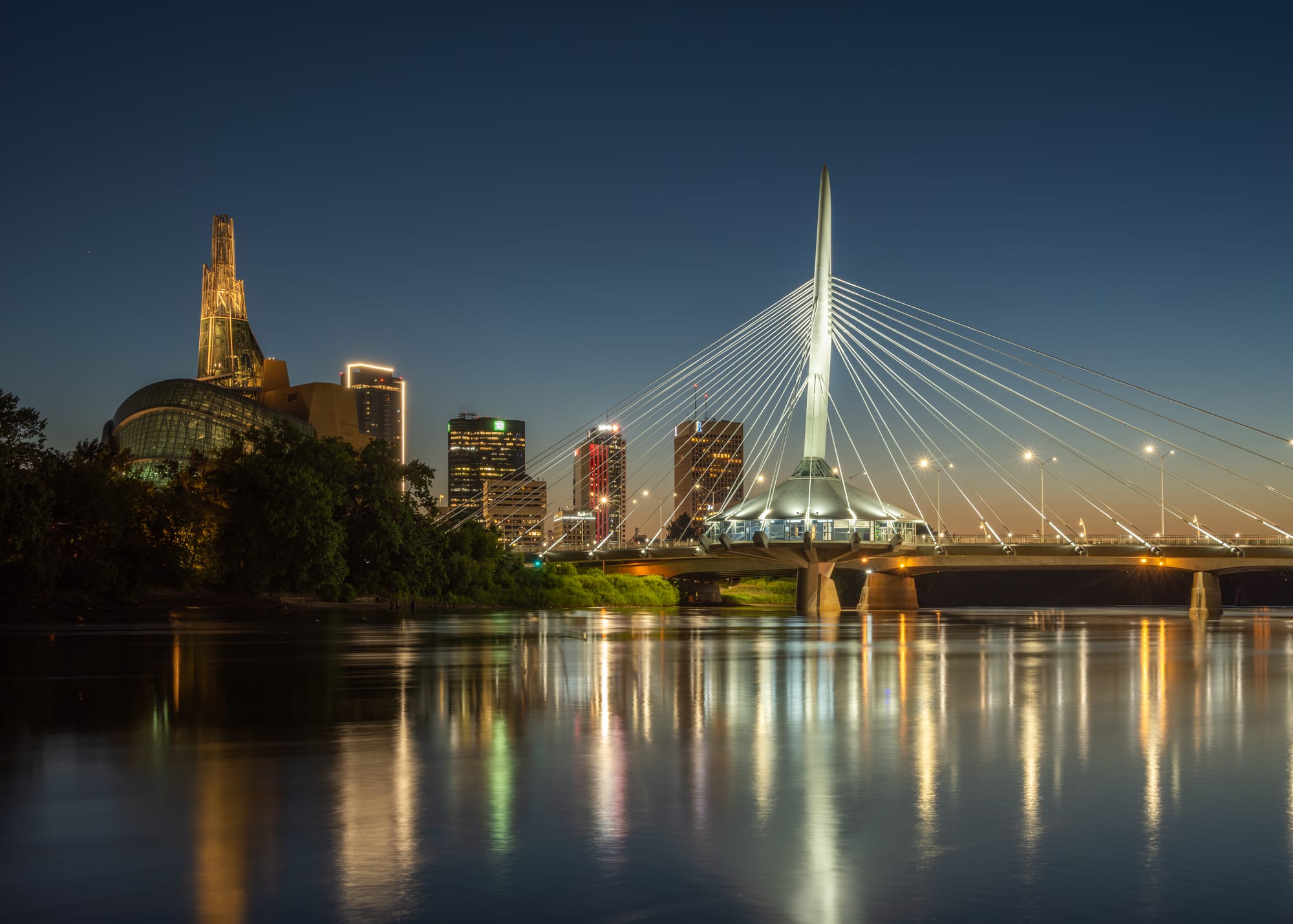
The white cable-stayed Esplanade Riel footbridge over the calm Red River at dusk, with the lit museum tower and downtown towers behind

The Prairies, Canada

Winnipeg

The Esplanade Riel over the Red River at dusk, with the Canadian Museum for Human Rights and downtown Winnipeg behind. (Ethan Sahagun / Wikimedia Commons · CC BY 4.0)

Manitoba's capital, built where the Red and Assiniboine rivers meet on the flat floor of the Red River Valley. A meeting place for Indigenous peoples for thousands of years, the birthplace of the Métis Nation and a railway boom town, it is now a city of over 750,000 with a large Indigenous population, a French quarter, an old warehouse district and a busy arts scene.

Neighbourhoods

  • The Forks
    • First-time visitors
    • Best for food
    • Riverside walks

    The National Historic Site at the meeting of the two rivers, on reclaimed railway yards beside downtown. The Forks Market, a children's museum, a theatre for young audiences, a skate plaza and river walkways sit beside the Canadian Museum for Human Rights, and in winter a skating trail runs out along the frozen rivers.

    Open in Maps
  • Exchange District
    • Historic district
    • Arts and culture
    • Nightlife

    Twenty blocks of early 20th-century warehouses, banks and terracotta-clad skyscrapers just north of Portage and Main, a National Historic Site. Galleries, theatres, the Manitoba Museum and many bars and restaurants are here, and Old Market Square is the hub of the Fringe in July.

    Open in Maps
  • St. Boniface
    • Historic district
    • French culture

    The largest francophone community in western Canada, across the Red River from The Forks by the Esplanade Riel. The ruined façade of the old cathedral, the St. Boniface Museum and Boulevard Provencher are among its landmarks, and it hosts the Festival du Voyageur each February.

    Open in Maps
  • Osborne Village
    • Nightlife
    • Best for food
    • Students and young people

    The most densely populated neighbourhood in the city, bordered by the Assiniboine River, with apartment blocks, independent shops, cafés, bars and restaurants. Downtown is about twenty minutes' walk away.

    Open in Maps
  • Wolseley
    • Quiet and residential
    • Local life

    A residential neighbourhood in the West End, on the north bank of the Assiniboine River, affectionately known as 'the Granola Belt'.

    Open in Maps

Things to do

Famous landmarks

  • Manitoba Legislative Buildinglandmark

    The neoclassical seat of the provincial assembly, completed in 1920 and topped by the Golden Boy, a gold-covered bronze statue; the building stands 77 metres tall.

    Open in Maps
  • St. Boniface Cathedrallandmark

    The principal church of the Archdiocese of Saint Boniface, facing the Red River and also serving the local Franco-Manitoban community.

    Open in Maps
  • Esplanade Riellandmark

    A cable-stayed footbridge across the Red River linking downtown and St. Boniface, named after Louis Riel.

    Open in Maps

Museums and galleries

  • Canadian Museum for Human Rightsmuseum

    A national museum beside The Forks, opened in 2014 — the first new national museum in Canada since 1967 and the first located outside the national capital region — exploring human rights with particular reference to Canada.

    Open in Maps
  • Manitoba Museummuseum

    The province's human and natural history museum in the Exchange District, with a planetarium, a science gallery and the Hudson's Bay Company's historic collection.

    Open in Maps
  • Winnipeg Art Gallerymuseum

    An art museum with over 24,000 works and the world's largest collection of Inuit art, much of it shown in Qaumajuq, the building added in 2021.

    Open in Maps
  • St. Boniface Museummuseum

    The history of the Franco-Manitoban and Métis communities, housed in the former Grey Nuns' Convent of 1846–1851, a rare large example of Red River frame log building.

    Open in Maps
  • Royal Aviation Museum of Western Canadamuseum

    An aviation museum near the airport with military jets, airliners, Canada's first helicopter and the Avrocar 'flying saucer'.

    Open in Maps

Parks and the rivers

  • The Forkspark

    The meeting of the Red and Assiniboine rivers, a gathering place for some 6,000 years and now the city's most popular attraction, with a market hall, river walkways and green space open all year.

    Open in Maps
  • Assiniboine Parkpark

    A 450-hectare park on the Assiniboine River, opened in 1909, with English-style landscape grounds, gardens, a forest, a historic pavilion and the zoo.

    Open in Maps
  • Assiniboine Park Zooattraction

    A zoo founded in 1904 in the west of Assiniboine Park, with more than 160 species, including polar bears.

    Open in Maps
  • FortWhyte Alivepark

    A reclaimed wildlife preserve and environmental education centre in the south-west of the city, on the migration path of Canada geese.

    Open in Maps
  • Nestaweya River Trailtrail

    A skating, walking and skiing trail built on the frozen rivers from The Forks each winter, as conditions allow, with warming huts designed by artists.

    Open in Maps

Music, sport and nights out

  • Canada Life Centreattraction

    The downtown arena of the Winnipeg Jets, back in the city since 2011, and of the Manitoba Moose, on the site of the old Eaton's store.

    Open in Maps
  • Burton Cummings Theatreattraction

    A downtown theatre built in 1906–07, now a National Historic Site, renamed after the local musician Burton Cummings in 2002.

    Open in Maps

Short trips from the city

  • Lower Fort Garrymuseum

    A Hudson's Bay Company fort built in 1830 on the Red River north of the city, where Treaty 1 was signed in 1871, now a National Historic Site.

    Open in Maps

Seasonal events

  • Festival du VoyageurFebruary

    Western Canada's largest winter festival, ten days in St. Boniface celebrating the fur-trade era and French heritage with music, entertainment, exhibits and crafts.

  • Winnipeg Fringe Theatre FestivalJuly

    A 12-day festival of independent theatre, mostly in the Exchange District, ranked the second-largest fringe festival in North America.

  • Winnipeg Folk Festivalsecond weekend of July

    A four-day folk music festival founded in 1974, held at Birds Hill Provincial Park just outside the city and drawing over 70,000 people.

  • FolkloramaAugust

    Two weeks of cultural pavilions across the city, each with food, song and dance from one of dozens of communities — the world's largest and longest-running multicultural festival.

Eat and drink

Long-standing places and food districts in Winnipeg. Hours, ratings and directions come from your maps app, always current.

Winnipeg classics

  • The Fat Boyrestaurant

    Winnipeg's own burger, born in the city's Greek-owned burger bars and drive-ins in the 1950s — one or more patties under a chili meat sauce, dill pickles, tomato, lettuce, mayonnaise and mustard.

    Open in Maps
  • Salisbury Houserestaurant

    A local chain founded downtown in 1931, known as 'Sals', whose founder called his hamburger a 'nip'.

    Open in Maps
  • Honey dillrestaurant

    A dipping sauce of honey, mayonnaise and dill found only in Manitoba, served with chicken fingers and sweet potato fries.

    Open in Maps

Food districts and markets

  • The Forks Marketmarket

    A market hall in a former railway stable building, with fresh and specialty food, shops and a large food hall.

    Open in Maps
  • Osborne Villageneighborhood

    Cafés, bars and restaurants in the city's densest neighbourhood.

    Open in Maps
  • Exchange Districtneighborhood

    Restaurants and bars in converted warehouses around Old Market Square.

    Open in Maps

Experience Winnipeg

History

The meeting of the Red and Assiniboine rivers was a trading centre for Indigenous peoples long before Europeans arrived, with evidence of human activity at The Forks going back about 6,000 years. It is the traditional territory of the Anishinaabe, Cree, Oji-Cree, Dene and Dakota, and the place where the Métis Nation was born, from the families of fur traders and First Nations women. French traders built Fort Rouge on the site in 1738, and in 1812 Lord Selkirk's settlers founded the Red River Colony; the Métis and the settlers clashed at the Battle of Seven Oaks in 1816.

In 1869–70 the Métis under Louis Riel formed a provisional government in the Red River Rebellion, and General Garnet Wolseley was sent west to end it. Treaty 1, covering the city and the land around it, was signed in 1871, and Winnipeg was incorporated as a city in 1873. The arrival of the Canadian Pacific Railway in 1881 turned it into the "Gateway to the West", a boom town of grain traders and warehouses, while French speakers went from a majority to a small minority. The opening of the Panama Canal let Vancouver overtake it. In May 1919 more than 30,000 workers walked off the job in the Winnipeg General Strike; two strikers were killed on Bloody Saturday.

The 1950 flood led to the building of the Red River Floodway, which protected the city in 1997. The surrounding municipalities were merged into one "unicity" in 1972, the old rail yards at The Forks were reopened to the public from 1989, the Jets returned in 2011, and the Canadian Museum for Human Rights opened in 2014. In 2025 the population was estimated to have passed 850,000.

Culture & Customs

Winnipeg punches above its weight in the arts. The Royal Winnipeg Ballet is Canada's oldest ballet company, the Winnipeg Symphony Orchestra and Royal Manitoba Theatre Centre are long-established, and the city has produced The Guess Who, Bachman–Turner Overdrive, Neil Young and the Weakerthans. The Exchange District, known for its intact early 20th-century warehouses and banks, is home to galleries, film and theatre, and hosts the second-largest fringe festival on the continent each July.

The city is a meeting of communities. Winnipeg has the highest share of Indigenous people of any major Canadian city and the largest Métis population, and Indigenous art, politics and culture are part of daily life; the Winnipeg Art Gallery holds the world's largest collection of Inuit art. St. Boniface is the largest francophone community in western Canada, and its Festival du Voyageur celebrates the fur-trade era each February. Filipino Winnipeggers make up a larger share of the population than in any other major Canadian city. Folklorama turns dozens of community halls into cultural pavilions every August.

Sport is a shared passion: the Jets in hockey and the Blue Bombers, twelve-time Grey Cup champions, in Canadian football. Winter is something to be enjoyed rather than endured, on the river skating trail, at the Festival du Voyageur and at outdoor rinks across the city.

Daily Life

At the 2021 census the city had 749,607 people and the metropolitan area 834,678; Winnipeg holds 54.9 per cent of Manitoba's population, a higher concentration in one city than in any other province. The economy is diversified rather than dominated by one industry: health care and social assistance, retail, manufacturing and public administration are the largest employers, and the city is a railway hub, the home of 17 Wing of the Canadian Forces and the headquarters of 1 Canadian Air Division.

About 12 per cent of residents are Indigenous, a young and growing population, and about 27 per cent are immigrants, most often from the Philippines and India. Many families live in the suburban neighbourhoods that spread across the flat prairie, while downtown, Osborne Village and the West End hold apartments and older houses.

The inner city carries the city's hardest problems. Winnipeg has had some of the highest violent crime rates in Canada, concentrated in inner neighbourhoods, and a methamphetamine problem since 2017 has fuelled crime. Weather governs the year: winters of plugged-in cars, skywalks and wind chill below -40°C on some days, then a short summer of patios, festivals and weekends at the lakes, interrupted in wet years by mosquitoes.

Food

Winnipeg's local food grew from its immigrant kitchens and its burger bars. The Fat Boy, a burger topped with chili meat sauce, dill pickles and plenty of mayonnaise and mustard, came out of the city's Greek-owned burger restaurants and drive-ins in the 1950s, and several of them still claim to have invented it. Salisbury House, founded downtown in 1931 and known as "Sals", sells hamburgers it calls "nips". Honey dill, a sauce of honey, mayonnaise and dill found only in Manitoba, is the standard dip for chicken fingers and sweet potato fries.

The prairie settlers' dishes are everywhere: perogies, potato and cheese dumplings served with fried onion and sour cream; holubtsi, cabbage rolls; Mennonite farmer sausage; and schmoo torte, a cake layered with whipped cream, brown sugar and nuts. From Manitoba's lakes come pickerel, the local name for walleye, served pan-fried, and Lake Winnipeg goldeye, traditionally smoked until reddish-gold.

The Forks Market, in a former railway stable, has food stalls and specialty shops beside the rivers, and Folklorama in August is the one time of year when dozens of communities serve their food in the same fortnight. Osborne Village and the Exchange District hold many of the city's independent restaurants and bars.

Planning tools

Budget

Winnipeg is one of the cheaper large cities in Canada for hotels and food. Sales tax is added at the till. Prices rise during the Folk Festival, Folklorama and big Jets or Blue Bombers games, and a car adds to the bill for anyone heading to the lakes.

Daily Budget Midrange
USD 140–240 (central hotel, restaurant meals, museum tickets, taxis or a hire car)
Daily Budget Shoestring
USD 70–110 (hostel or budget hotel, burger bars and market food, buses)

The Forks, the river walkways, the Exchange District's architecture and the Legislative Building can all be seen for free.

Best Time to Visit

June to September, for warm days, long evenings, patios and the run of summer festivals from the Fringe and the Folk Festival in July to Folklorama in August. February suits those ready for deep cold, with the Festival du Voyageur and skating on the river trail. Spring thaw and wet summers bring mosquitoes.

Suggested Number of Days

Two or three days suit a first visit to the city. Four or five allow time for the historic fort to the north and the lakes and beaches beyond. A festival or a winter visit, when the cold slows everything down, can add a day.

First Visit
2–3 days
With Surroundings
4–5 days

Transportation

Winnipeg Transit runs a large bus network, including a bus rapid transit line, the Southwest Transitway. The city is flat, which helps cyclists in summer, and many downtown buildings are linked by the Winnipeg Walkway, a network of skywalks and tunnels. Outside the centre most people drive. Streets often change name along their length, and the junction known as Confusion Corner lives up to its name.

Never leave anything visible in a parked car, and plug in the engine block heater on very cold nights if hiring a car in winter.

Airport & Station Connections

Winnipeg Richardson International Airport, in the city's west end on Wellington Avenue, has daily flights across Canada and to the United States, and seasonal flights to Mexico and the Caribbean. VIA Rail's Union Station is downtown; the Churchill train starts here, taking about two days to reach Hudson Bay. The Trans-Canada Highway links the city with Ontario to the east and Saskatchewan to the west.

Walkability

The centre is walkable and flat: The Forks, the Exchange District, the Legislative Building and St. Boniface across the Esplanade Riel are all close together, and Osborne Village is about twenty minutes on foot from downtown. In winter the Walkway and the river trail are the comfortable routes. Some streets around the inner city feel empty after dark.

Safety

The main dangers are the weather and wildlife: frostbite and whiteouts in winter, summer storms and tornadoes, deer and moose on roads at dusk, and polar bears in and around Churchill, which has a bear alert system and patrols. Winnipeg itself has had among the highest violent crime rates in Canada, but most of it is concentrated in the inner city and is rarely aimed at visitors.

Take a taxi through the inner city late at night, dress for wind chill rather than air temperature, and watch summer storm warnings. Check current official travel advice before travelling.

Climate

Extremely continental even by Canadian standards: long, bitterly cold winters and warm, sunny, sometimes humid summers. July is the sunniest month, and summer heat can feel much higher when humidity rises.

Summer
warm — July averages about 20°C, with average highs around 26°C
Winter
very cold — January averages about -16°C, with average highs around -11°C; the temperature occasionally drops below -40°C

Local Customs

Tipping of 15–20 per cent is expected in restaurants and taxis. Dress is casual. Winnipeg lies in Treaty 1 territory and is the homeland of the Métis Nation, which is acknowledged at many public events. French is heard in St. Boniface, where a 'bonjour' is welcome.

Identification is asked for when buying alcohol, and alcohol is not allowed in public places outside licensed areas.

Common Payment Methods

The currency is the Canadian dollar. Cards and contactless payment are accepted almost everywhere, and cash totals are rounded to the nearest five cents. ATMs are easy to find downtown and in shopping centres.