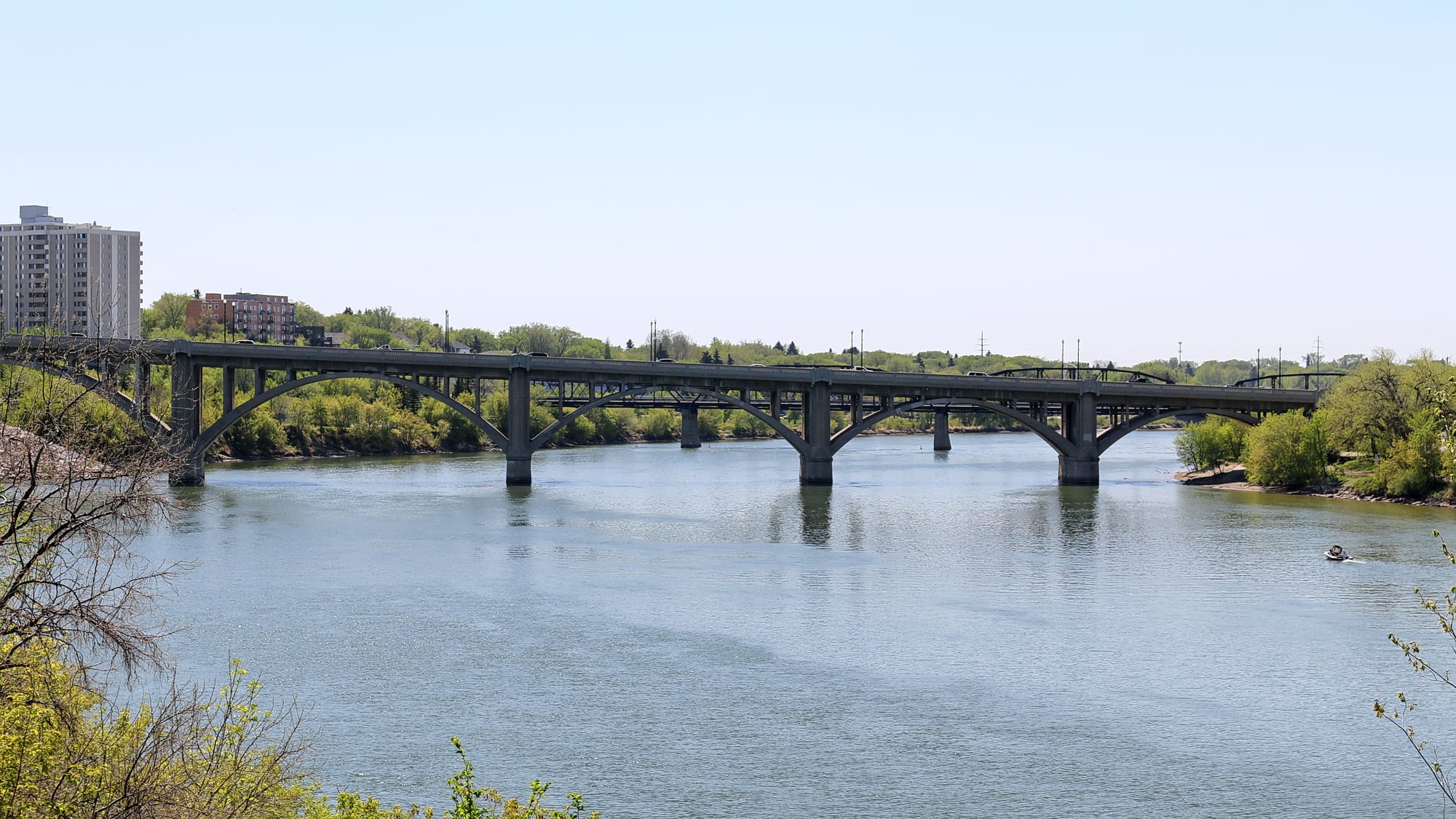
The concrete arches of the Broadway Bridge crossing the wide, calm South Saskatchewan River between leafy green banks

The Prairies, Canada

Saskatoon

The Broadway Bridge over the South Saskatchewan River in Saskatoon. (Robert Linsdell from St. Andrews, Canada / Wikimedia Commons · CC BY 2.0)

Saskatchewan's largest city, straddling a bend in the South Saskatchewan River in the centre of the province. Founded in 1882 as a temperance colony, it grew into the hub of a farming, potash and uranium region and a university city, known as the 'City of Bridges' for its river crossings and the long parkland trail along its banks.

Neighbourhoods

  • Downtown and River Landing
    • First-time visitors
    • Arts and culture
    • Close to public transport

    The business district on the west bank, bounded by the riverside park. River Landing holds the Remai Modern and the Persephone Theatre, the city's buses meet at the downtown hub, and the Meewasin trail runs along the water below the towers.

    Open in Maps
  • Nutana and Broadway
    • Best for food
    • Nightlife
    • Historic district

    The original settlement on the east bank, now a mainly residential neighbourhood of houses and apartments. Its commercial heart, the five blocks of Broadway Avenue south of the Broadway Bridge, has cafés, restaurants, bars, the Broadway Theatre and the August Fringe festival.

    Open in Maps
  • Riversdale
    • Best for food
    • Local life

    One of the city's oldest neighbourhoods, a separate town until 1906, just west of downtown. Its 20th Street business district has seen a wave of new restaurants and shops since 2012, though the area remains lower-income.

    Open in Maps
  • City Park
    • Quiet and residential
    • River walks

    An older residential neighbourhood beside downtown on the west bank, close to the river trail, where the Mendel Art Gallery stood from 1964 to 2015.

    Open in Maps
  • University of Saskatchewan
    • Students
    • Museums

    The large university campus on the east bank, with the Diefenbaker Canada Centre and the Canadian Light Source synchrotron, reached across the University Bridge from downtown.

    Open in Maps

Things to do

Museums and galleries

  • Remai Modernmuseum

    A modern art museum opened in 2017 on the riverbank at River Landing, with over 8,000 works, including the old Mendel Art Gallery's collection and more than 400 linocuts and ceramics by Pablo Picasso.

    Open in Maps
  • Western Development Museummuseum

    The Saskatoon branch of the provincial Western Development Museum network, known as 1910 Boomtown, beside the Prairieland Park grounds.

    Open in Maps
  • Ukrainian Museum of Canadamuseum

    A museum on the riverbank founded in 1941 by the Ukrainian Women's Association of Canada, preserving the culture of the Ukrainian settlers who came to the prairies.

    Open in Maps
  • Diefenbaker Canada Centremuseum

    A museum and archive on the university campus honouring Prime Minister John Diefenbaker, with replicas of his office and the Privy Council chamber of 1957–1963.

    Open in Maps

The river and parks

  • Meewasin Valley Trailtrail

    More than 100 kilometres of trail along both banks of the South Saskatchewan River, with parks, lookouts and picnic spots, and a free skating rink in winter.

    Open in Maps
  • Broadway Bridgelandmark

    The arch bridge of 1932 linking downtown with Broadway Avenue, one of the river crossings that earned Saskatoon its nickname, the City of Bridges.

    Open in Maps
  • Forestry Farm Park and Zoopark

    A former federal tree nursery that shipped 147 million trees across the northern prairie provinces between 1913 and 1966, now a National Historic Site with a zoo, gardens and a fishing pond.

    Open in Maps

Indigenous heritage

  • Wanuskewin Heritage Parkpark

    A First Nations archaeological site and cultural centre just north of the city, a National Historic Site representing nearly 6,000 years of Northern Plains history, where plains bison were reintroduced in 2019; it announced in 2016 that it intends to seek UNESCO World Heritage status.

    Open in Maps

Music, sport and nights out

  • Persephone Theatreattraction

    The city's regional theatre company, founded in 1974, performing at the Remai Arts Centre on the riverbank at River Landing.

    Open in Maps
  • SaskTel Centreattraction

    The city's main arena, opened in 1988 and home to the Saskatoon Blades junior hockey team and the Saskatchewan Rush lacrosse team.

    Open in Maps

Short trips from the city

  • Batoche National Historic Sitelandmark

    The Métis settlement where the North-West Resistance ended in defeat in 1885, now preserved as a National Historic Site.

    Open in Maps

Seasonal events

  • Shakespeare on the Saskatchewansummer

    A Shakespeare festival founded in 1985, staged in tents on the riverbank, with plays, feasts, workshops and a free community stage.

  • Saskatoon Fringe Festivalfirst half of August

    Ten days of theatre, arts and an outdoor street fair in the Broadway district, drawing tens of thousands of people.

  • Saskatoon ExhibitionAugust

    The city's annual fair at Prairieland Park, with amusement rides, product exhibitions, music, shows and displays.

Eat and drink

Long-standing places and food districts in Saskatoon. Hours, ratings and directions come from your maps app, always current.

Saskatoon classics

  • Saskatoon berry pierestaurant

    Pie made with the small purple berry that gave the city its name, also turned into jams, syrups, wine and cider.

    Open in Maps

Food districts and markets

  • Saskatoon Farmers' Marketmarket

    The city's farmers' market, which has moved from its old year-round home at River Landing to Koyl Avenue near the airport.

    Open in Maps
  • Broadway Avenueneighborhood

    The city's best-known strip of cafés, restaurants and bars, in the historic heart of Nutana.

    Open in Maps
  • 20th Street, Riversdaleneighborhood

    An older commercial street west of downtown where new restaurants and cafés have opened among long-established businesses.

    Open in Maps

Experience Saskatoon

History

The river valley was a meeting and hunting ground for Northern Plains peoples for thousands of years, as the archaeological sites at Wanuskewin, on the city's northern edge, show; bison were hunted and winter camps sheltered in its coulees. In 1882 the Toronto-based Temperance Colonization Society was granted land straddling the South Saskatchewan River for a settlement free of alcohol. The first settlers came by railway from Ontario to Moose Jaw and finished the journey by horse-drawn cart. The founder, John Neilson Lake, told several stories of how the place was named after the saskatoon berry; the name most likely comes from a Cree term for the place where saskatoon willows were cut for arrow shafts.

During the North-West Resistance of 1885, soldiers wounded at Fish Creek and Batoche were nursed in the young settlement. In 1903 the community on the west bank took a town charter as Saskatoon, the original east-bank townsite was renamed Nutana, and in 1906 Saskatoon, Nutana and Riversdale merged into a city of about 4,500 people. The University of Saskatchewan was established in the city, and railways and wheat drove its growth; Sutherland, a rail town beyond the university, was annexed in 1956.

Later decades brought potash, uranium and science. The Meewasin Valley Authority was created in 1979 to protect the riverbank, the Canadian Light Source synchrotron opened in 2004, and the Remai Modern replaced the Mendel Art Gallery in 2017. The old Traffic Bridge was demolished in 2016 and replaced by a new crossing in its likeness. Cynthia Block was elected mayor in 2024.

Culture & Customs

Saskatoon likes to call itself the "Paris of the Prairies" and the "City of Bridges", and its identity is tied to the river: the Meewasin trail and its riverside parks are where people walk, run, cycle and skate. The arts are strong for a city of its size. Joni Mitchell grew up here, the Persephone Theatre has staged plays since 1974, Shakespeare on the Saskatchewan has performed in tents on the riverbank since 1985, the Saskatchewan Jazz Festival has run since 1987, and the Fringe fills Broadway Avenue each August. The Remai Modern holds more than 400 linocuts and ceramics by Pablo Picasso.

Indigenous people make up about 11.5 per cent of the population, the second-highest share among major Canadian cities, mostly of Cree and Dakota background, and the city has a substantial Métis community close to the historic settlements of the South Branch. Wanuskewin presents Northern Plains culture with displays, events and a reintroduced bison herd. Ukrainian immigrants arrived in large numbers in the late 19th and early 20th centuries, and the Ukrainian Museum of Canada keeps their traditions.

Sport follows the prairie pattern: the Blades in junior hockey since 1964, the Saskatchewan Rush, lacrosse champions in 2016 and 2018, and the University of Saskatchewan Huskies, one of the strongest university football programmes in Canada. Many residents also follow the Roughriders, the province's football team.

Daily Life

At the 2021 census the city had 266,141 people and the metropolitan area 317,480, making Saskatoon the largest city in Saskatchewan. About a fifth of residents were born outside Canada, most often in the Philippines, India, China, Pakistan and Nigeria, and about 11.5 per cent are Indigenous.

The economy rests on resources and knowledge. The region holds nearly two-thirds of the world's recoverable potash reserves, and both Nutrien, the world's largest potash producer, and Cameco, the largest publicly traded uranium company, have their headquarters here; farming, oil and gas, and their spin-off industries add the rest of the old "POW City" nickname of potash, oil and wheat. The university, the Royal University Hospital, the Innovation Place science park and the Canadian Light Source make it a centre of research.

Most people live in suburban neighbourhoods that have spread across the flat prairie, and life is car-based outside the centre. Older inner neighbourhoods such as Nutana and Riversdale have seen heavy reinvestment, though Riversdale is still considered a lower-income area, and some west-side districts have more crime than the rest of the city. Summer life moves outdoors to the river, patios and festivals; winter brings long cold months of hockey rinks and indoor gatherings.

Food

Saskatoon takes its name from a fruit. The saskatoon berry, a small purple berry native to the prairies, is baked into pies and made into jams, syrups, wine and cider, and saskatoon berry pie is the dessert most associated with the city. Prairie farm cooking supplies the rest of the local table: beef, bison and farmer sausage, and the dishes of the Ukrainian settlers — perogies, dumplings filled with potato and cheese and served with fried onion and sour cream, and holubtsi, cabbage rolls filled with rice.

The Saskatoon Farmers' Market, which has moved from River Landing to a site on Koyl Avenue near the airport, sells local produce, and the SaskMade Marketplace sells food made in the province. The province grows canola, wheat, lentils and mustard, and is the world's largest exporter of mustard seed, though little of these crops reaches local plates.

Broadway Avenue is the established restaurant and café street, busy with students and evening crowds, and 20th Street in Riversdale has become a second food district as new restaurants have opened among older businesses. Immigration from the Philippines, South Asia and Africa has widened the choice across the city, and craft breweries and small distillers have multiplied, as in the other prairie cities.

Planning tools

Budget

Saskatoon is good value by Canadian standards, with hotel and restaurant prices well below Toronto or Vancouver. Sales tax is added at the till. Hotels fill and prices rise during summer festivals, the Exhibition and big events at SaskTel Centre.

Daily Budget Midrange
USD 140–240 (central hotel, restaurant meals, museum tickets, taxis or a hire car)
Daily Budget Shoestring
USD 70–110 (hostel or budget motel, market and café meals, city buses)

The river trail, the bridges and the riverside parks cost nothing to enjoy; a car or taxi is needed to reach Wanuskewin.

Best Time to Visit

June to September, when the river valley is green, the trail is busy and the summer festivals run, from Shakespeare on the riverbank to the Fringe and the Exhibition in August. Winters are long and very cold, though the riverside skating rink and indoor museums keep the city busy.

Suggested Number of Days

Two or three days suit a first visit to the city and its river valley. Allow three to five to add the Métis battlefield and the countryside to the north. Summer festivals can add a day, and winter visits need more time indoors.

First Visit
2–3 days
With Surroundings
3–5 days

Transportation

Saskatoon Transit buses serve most of the city, and most routes pass through the downtown City Centre hub. The centre, the riverbank and Broadway are compact and easy to explore on foot or by bicycle, but outside them distances are long and driving is the most convenient way to get around. There is no rail transit.

Pay cash for single bus fares, or buy a GoCard loaded with discounted packages of rides.

Airport & Station Connections

Saskatoon John G. Diefenbaker International Airport lies about 6 kilometres north-west of downtown, within the city limits, with flights across Canada and a city bus link. VIA Rail's transcontinental train stops at a station in the west end, away from the centre, and intercity buses run across the prairies. Regina is about three hours away by bus.

Walkability

The Meewasin riverbank, downtown, Broadway Avenue and Nutana form a compact, pedestrian-friendly core linked by the river trail and its bridges. Walking between the two banks over the Broadway or University bridges is part of the pleasure of the city. The suburbs are spread out and car-oriented, and winter cold makes long walks hard.

Safety

The main dangers are the weather and wildlife: frostbite and whiteouts in winter, summer storms and tornadoes, deer and moose on roads at dusk, and polar bears in and around Churchill, which has a bear alert system and patrols. Saskatoon's crime rate has been high by Canadian standards, concentrated in some west-side neighbourhoods, though visitors are rarely affected.

Use a taxi at night on the west side, leave nothing visible in a parked car, and dress for wind chill rather than air temperature. Check current official travel advice before travelling.

Climate

Continental and dry, with long cold winters and warm, sunny summers; parts of the inner city meet semi-arid criteria. Summer brings thunderstorms, and winter cold snaps can be severe.

Summer
warm — average daytime highs peak at about 26°C in late July and early August
Winter
long and cold — the record low is -50°C, set in 1893

Local Customs

Tipping of 15–20 per cent is expected in restaurants and taxis. Dress is casual. Saskatoon lies in Treaty 6 territory and the homeland of the Métis, and land acknowledgements open many public events. The city has urban reserves, First Nations lands within city limits. Prairie manners are friendly and unhurried.

Identification is asked for when buying alcohol; drinking in public outside licensed areas is not allowed.

Common Payment Methods

The currency is the Canadian dollar. Cards and contactless payment are accepted almost everywhere, cash is rarely needed, and cash totals are rounded to the nearest five cents. ATMs are easy to find downtown.