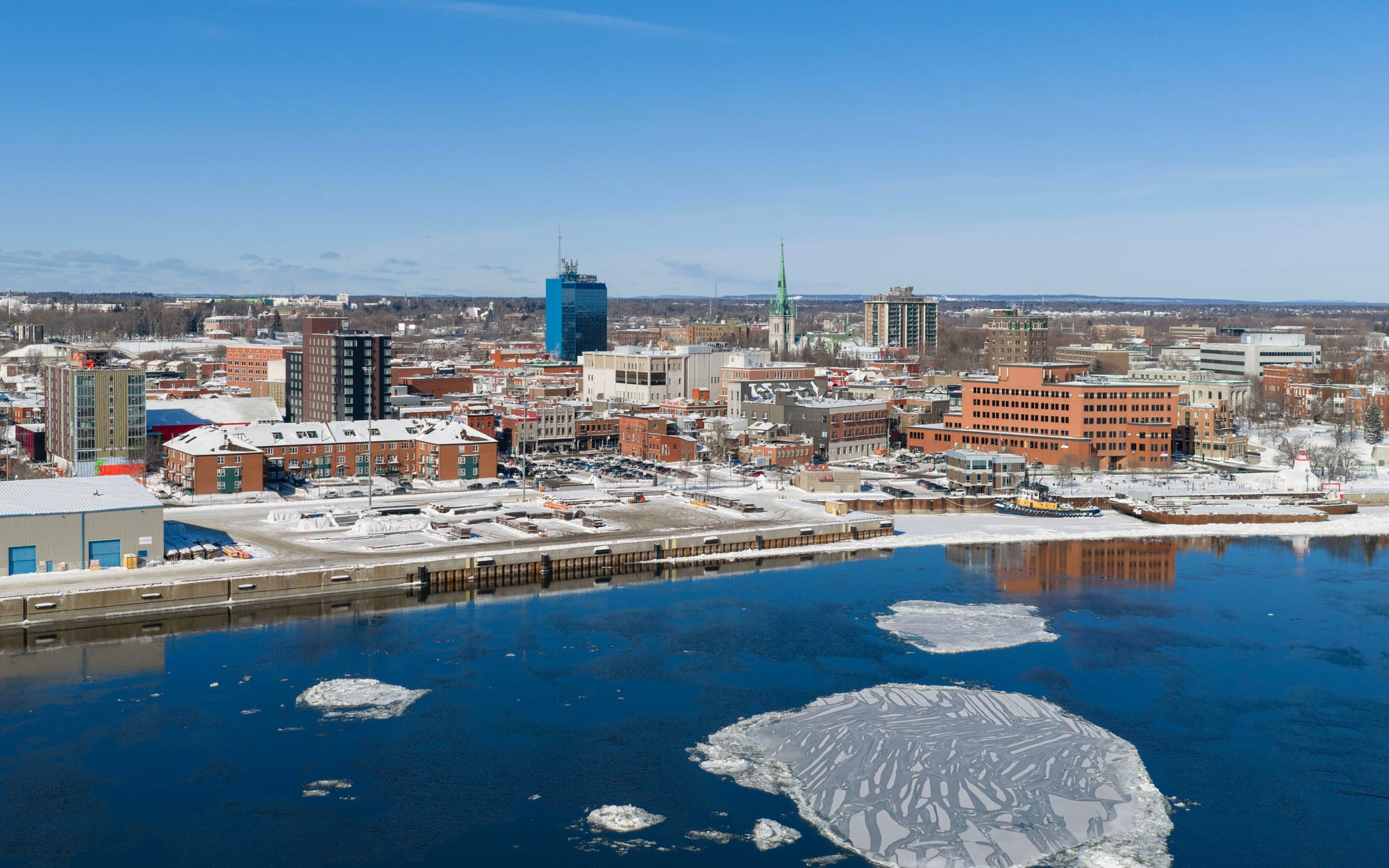
Downtown Trois-Rivières in winter seen from above the St Lawrence, with ice floes on the river, brick buildings on the waterfront and a green church spire behind

Quebec, Canada

Trois-Rivières

The skyline of downtown Trois-Rivières on the St Lawrence in winter. (Quintin Soloviev / Wikimedia Commons · CC BY 4.0)

A city on the north shore of the St Lawrence halfway between Montreal and Quebec City, at the mouth of the Saint-Maurice River. Founded in 1634 as the second permanent settlement in New France, it grew on iron and then paper, and is now a university city of about 140,000 with a small old quarter, a riverside promenade, the Forges du Saint-Maurice and a summer of festivals.

Neighbourhoods

  • Vieux-Trois-Rivières and the centre
    • First-time visitors
    • Historic district
    • Nightlife

    The small old quarter around rue des Ursulines, the part of the city that survived the fire of 1908, and rue des Forges, a few blocks west, is the city's strip of bars, terraces and restaurants running down to the waterfront. The museums, the riverfront and the amphitheatre are all within a short walk.

    Open in Maps
  • Cap-de-la-Madeleine
    • Pilgrimage
    • Quiet and residential

    The former town on the east bank of the Saint-Maurice, merged into the city in 2002, known for the Notre-Dame-du-Cap shrine on the riverbank. Beyond the sanctuary it is a residential district of modest houses, parish churches and shopping streets.

    Open in Maps
  • Trois-Rivières-Ouest and the plateau
    • Shopping

    The former city of Trois-Rivières-Ouest and the newer districts west and north of the centre, with the Les Rivières shopping centre on boulevard des Forges and commercial strips along the main roads. Convenient for drivers, with little character of its own.

    Open in Maps
  • Pointe-du-Lac
    • Quiet and residential
    • Lakeside

    The rural western end of the city on the shore of Lac Saint-Pierre, the wide stretch of the St Lawrence downstream of Montreal, with a seigneurial watermill of 1765, farms and a quieter lakeside life about 13 km from the centre.

    Open in Maps

Things to do

Famous landmarks

  • Notre-Dame-du-Cap Basilicalandmark

    Canada's national shrine to the Virgin Mary, in Cap-de-la-Madeleine, with a basilica inaugurated in 1964 beside the small fieldstone church of 1720 and a Way of the Rosary lined with bronze statues.

    Open in Maps
  • Trois-Rivières Cathedrallandmark

    The Gothic Revival stone cathedral of the Assumption, built in the 1850s, with stained-glass windows made over more than ten years by Guido Nincheri.

    Open in Maps
  • Ursuline Monasterylandmark

    The Ursulines' convent, founded after the nuns arrived in 1697, on the street that bears its name, with a chapel begun in 1699; it survived the fire of 1908.

    Open in Maps
  • Manoir Boucher de Nivervillelandmark

    A historic house on rue Bonaventure, first built around 1668 and one of the few buildings in the city from the French regime.

    Open in Maps
  • Laviolette Bridgelandmark

    The steel arch bridge of 1967 that carries Autoroute 55 over the St Lawrence to Bécancour, the only bridge over the St Lawrence between Montreal and Quebec City and the backdrop to the riverfront.

    Open in Maps

Museums

  • Musée POPmuseum

    The museum of Quebec popular culture, which includes the old prison, in use from 1822 to 1986, where former inmates lead tours of the cells.

    Open in Maps
  • Boréalismuseum

    A museum of the history of the paper industry on the site of the former filtration plant of the CIP paper mill, telling the story of the city's years as the world's paper capital.

    Open in Maps
  • Musée des Ursulinesmuseum

    The Ursulines' museum in the heart of the old quarter, housed in the order's former Hôtel-Dieu hospital.

    Open in Maps

Parks and the riverfront

  • Parc portuairepark

    The riverside park at the foot of rue des Forges, with a promenade along the St Lawrence and the port in view.

    Open in Maps
  • Île Saint-Quentinpark

    An island park at the mouth of the Saint-Maurice, where Jacques Cartier planted a cross in 1535, with a beach, a marina, an interpretive trail, a bike path and about 2 km of skating trails in winter.

    Open in Maps
  • Forges du Saint-Mauricelandmark

    A national historic site about 11 km up the Saint-Maurice, on the site of the first successful ironworks in New France, which made pots, pans and stoves from the 1730s until 1883.

    Open in Maps

Music, sport and nights out

  • Amphithéâtre Cogecoattraction

    An open-sided amphitheatre for about 9,000 at the meeting of the Saint-Maurice and the St Lawrence, opened in 2015, that stages summer concerts and shows.

    Open in Maps
  • Rue des Forgesneighborhood

    The main street running down to the river, often closed to traffic for festivals in the warmer months and lined with terraces, bars and clubs that make it the centre of the city's evenings.

    Open in Maps
  • Circuit Trois-Rivièresattraction

    A street circuit through the city's exhibition grounds and surrounding roads, used for the Grand Prix de Trois-Rivières each August since the 1960s.

    Open in Maps

Short trips from the city

  • La Mauricie National Parkpark

    A national park of about 150 lakes in the Laurentian forest, about 60 km north, popular for camping, canoeing and kayaking.

    Open in Maps
  • Shawiniganattraction

    A hydroelectric city about 30 km up the Saint-Maurice, with the Cité de l'énergie, a theme park on its industrial history with a 115-metre observation tower.

    Open in Maps
  • Bécancourattraction

    The town across the Laviolette Bridge on the south shore, with an industrial park, farmland and quiet villages along the river.

    Open in Maps

Seasonal events

  • FestiVoix de Trois-Rivièressummer

    A music festival of nine or ten days on some 15 indoor and outdoor stages in the city centre and the old quarter by the river, drawing about 300,000 spectators.

  • Grand Prix de Trois-RivièresAugust

    A weekend of motor racing on the street circuit at the exhibition grounds, held since 1967.

  • Festival international de la poésieearly October

    An international poetry festival, founded in 1985, with readings across the city centre of what is officially the Poetry Capital of Quebec.

Eat and drink

Long-standing places and food districts in Trois-Rivières. Hours, ratings and directions come from your maps app, always current.

Food districts and markets

  • Rue des Forgesneighborhood

    The main street's cafés, bistros, pubs and microbreweries, with terraces on summer evenings and the bar strip between rue Royale and the river.

    Open in Maps
  • Vieux-Trois-Rivièresneighborhood

    A few restaurants and cafés in the old quarter around rue des Ursulines, quieter than rue des Forges and closer to the museums.

    Open in Maps
  • Cap-de-la-Madeleine casse-croûtesneighborhood

    The snack bars of the east-bank district serve the Quebec basics — poutine, hot dogs, fried clams and soft ice cream — with no pretension.

    Open in Maps

Cafés and bars

  • Microbreweries of the centreneighborhood

    The city has several microbreweries and brewpubs pouring their own beers, some of them within a short walk of rue des Forges.

    Open in Maps

Experience Trois-Rivières

History

French explorers used the name Trois-Rivières from the end of the 16th century for the place where the Saint-Maurice, split by two islands into three channels, meets the St Lawrence; the Algonquin and Abenaki had long used it as a summer stopping place. In 1634 Samuel de Champlain sent the Sieur de Laviolette to build a fort there, making it the second permanent settlement in New France after Quebec City. Fur traders, Jesuits, and later the Ursulines, who arrived in 1697 to run a hospital and school, gave the small town its early institutions, and it played an important role in the fur trade.

Iron came next. From the 1730s the Forges du Saint-Maurice, a few kilometres upriver, made pots, pans and stoves, the first successful ironworks in New France, and they ran under French and then British rule until 1883. The town itself stayed small, a cathedral and market town for the farms of the north shore, until the 19th century brought timber: logs floated down the Saint-Maurice to sawmills at its mouth, and in the 1900s the mills turned to pulp and paper. From the late 1920s until the early 1960s Trois-Rivières was known as the pulp and paper capital of the world, with five mills at its peak.

A fire in 1908 destroyed most of the old centre, sparing the Ursuline monastery, the De Tonnancour manor and the small quarter around rue des Ursulines, and the city was rebuilt with wider streets. The 20th century added the Laviolette Bridge in 1967 and a university in 1969, but falling demand for newsprint closed two of the five paper mills, and unemployment reached 14 per cent in the 1990s. In 2002 the city absorbed Cap-de-la-Madeleine and four other municipalities. Today it has rebuilt the riverfront, turned a paper mill's filtration plant into a museum and leans on its university, port, technology parks and festivals.

Culture & Customs

Trois-Rivières is a thoroughly French-speaking city of the Quebec heartland, Catholic in its monuments if not in its habits, and prouder of its age than most Canadian cities: the 1634 founding is on the signs, the Ursulines left their name on a street, and the old quarter is small enough to walk in half an hour. The shrine of Notre-Dame-du-Cap, across the Saint-Maurice, is Canada's national shrine to the Virgin Mary and draws thousands of pilgrims each year.

The city calls itself the capital of poetry, thanks to a festival that has filled the centre with readings every autumn since 1985 and to plaques of verse posted around the centre. Summer belongs to FestiVoix, a music festival of nine or ten days that takes over the riverfront and the old quarter, and to concerts at the open-sided amphitheatre on the river, which has also staged summer productions by Cirque du Soleil. Dance and heavy metal have their own festivals, and the university gives the city a student population that keeps rue des Forges busy.

Sport means the Grand Prix, which has run through the exhibition grounds each August since 1967 and is the longest-running street race in North America, and hockey, from minor leagues to the professional Trois-Rivières Lions, a Montreal Canadiens farm team. Manners are warm and informal, the bonjour is universal, and conversation turns easily to the Canadiens, the weather and the price of housing.

Daily Life

About 140,000 people live in the city and about 160,000 in its metropolitan area, which reaches across the river to Bécancour. The population grew by 3.5 per cent between 2016 and 2021 and is older than the Canadian average, with a median age of 47, and students at the Université du Québec à Trois-Rivières bring younger faces. French is the sole mother tongue of about 94 per cent of residents.

The economy has moved on from newsprint. The university, health care, government offices and the port are major employers, alongside the three remaining paper mills, metal transformation, electronics and cabinet making, an aeronautical industrial park by the airport, the industrial park at Bécancour across the bridge and newer technology parks.

People live in the brick streets of the centre, in Cap-de-la-Madeleine's parishes, and in the bungalow suburbs of Trois-Rivières-Ouest and the plateau, which is where the shopping centres are. Weekdays mean short commutes by car and a lunch of a sandwich or a poutine; summer evenings mean the terraces of rue des Forges and the riverfront promenade; winters mean snow clearing, indoor arenas and weekends skiing or snowmobiling in the Mauricie. Housing costs, the state of the hospital and the health of the river are the staples of local politics.

Food

Trois-Rivières eats the food of rural Quebec. Tourtière, the spiced meat pie, pâté chinois, the layered beef, corn and potato dish, fèves au lard, baked beans with salt pork, and sugar pie are on family tables and on the menus of the casse-croûtes, the snack bars that serve poutine, hot dogs steamés and fried clams in summer. Maple is part of the regional calendar, and the sugar shacks in the surrounding countryside fill with families from March, when the sap runs, for meals drowned in syrup followed by tire d'érable, taffy rolled on snow.

Beer is a local point of pride. The city has several microbreweries, and the brewpubs pour their own ales and lagers within a few blocks of rue des Forges, with the terraces along that street the place to drink them on a summer night. Local cheeses, strawberries and sweetcorn in season fill the stalls of the summer markets.

Eating out ranges from the bistros and cafés of the old quarter, some of them letting diners bring their own wine, to the bars and pizzerias of rue des Forges and the restaurants of the hotels near the riverfront. Cap-de-la-Madeleine keeps the snack bars, and the shopping strips of Trois-Rivières-Ouest have the chains.

Planning tools

Budget

Trois-Rivières is one of the cheaper cities in Quebec for rooms and meals, well below Montreal and Quebec City, except during FestiVoix and the Grand Prix, when hotels fill and prices rise. Museums are modestly priced and the riverfront and old quarter are free. Federal and provincial sales taxes are added at the till.

Daily Budget Midrange
USD 150–260 (mid-range hotel or auberge, bistro dinners, museum entries, a hire car for the Mauricie)
Daily Budget Shoestring
USD 60–100 (hostel or budget motel, casse-croûte and bakery meals, city buses, free riverfront)

Book early for festival weeks; some bistros let diners bring their own wine, which keeps dinner cheap.

Best Time to Visit

June to September, when the terraces open, the riverfront is in use and FestiVoix and the Grand Prix fill the calendar. Late September and October bring the poetry festival and autumn colour in the Mauricie. Winter is cold and the city is quiet, though hotel prices fall and skating and cross-country skiing are close at hand.

Suggested Number of Days

A day covers the centre and a museum or two; two days are more comfortable. Allow three to add the countryside north of the city, which needs a car.

First Visit
1–2 days
With Surroundings
3 days

Transportation

The centre is compact and walkable, and city buses cover the suburbs. The Forges, Cap-de-la-Madeleine and the outer districts are easier by car or bus, and the Mauricie park and Shawinigan need a car. Cycle paths run along the riverfront and the Saint-Maurice, and bike hire is available in summer.

Parking in the centre is metered on weekdays; the riverfront car parks fill fast during festivals.

Airport & Station Connections

Trois-Rivières lies about 130 km from Montreal and 120 km from Quebec City on Autoroute 40. Intercity buses from both cities stop at the terminal in the centre and take about two hours. The nearest major airports are Quebec City, 123 km away, and Montreal–Trudeau, 177 km away; the city's own airport has no scheduled flights.

Walkability

The old quarter, rue des Forges, the museums and the riverfront fit inside a few flat blocks and are easy on foot. The shrine at Cap-de-la-Madeleine is about 4 km from the centre across the Saint-Maurice, and the university and shopping centres are further out. Pavements are icy from December to March.

Safety

A safe mid-sized city with low violent crime. Late nights on rue des Forges can be rowdy at weekends and during festivals, and the usual Quebec winter hazards — ice, snow and freezing rain — apply, along with strong currents in the St Lawrence and Saint-Maurice for anyone near the water.

Keep an eye on bags in festival crowds, use winter tyres, which are compulsory in Quebec from 1 December to 15 March, and do not swim in the rivers outside designated beaches. Check current official travel advice before travelling.

Climate

Humid continental: warm, humid summers, a short colourful autumn and long snowy winters with about 275 cm of snow a year.

Summer
warm, around 25°C by day in July, with humid spells and thunderstorms
Winter
cold, around -6°C by day in January and often below -20°C at night, with regular snowfall

Local Customs

The city is overwhelmingly French-speaking and less bilingual than Montreal; a greeting in French goes a long way, and menus and signs are in French. Tipping of about 15 per cent is expected in restaurants and bars. The basilica at Cap-de-la-Madeleine is an active pilgrimage church, so quiet and modest dress are expected inside.

The legal drinking age in Quebec is 18; some wine and beer is sold in grocery stores, while spirits are sold through the SAQ.

Common Payment Methods

The currency is the Canadian dollar. Cards and contactless payment are accepted almost everywhere, and bank ATMs are easy to find on rue des Forges and boulevard des Forges. Some casse-croûtes and market stalls prefer cash for small amounts.