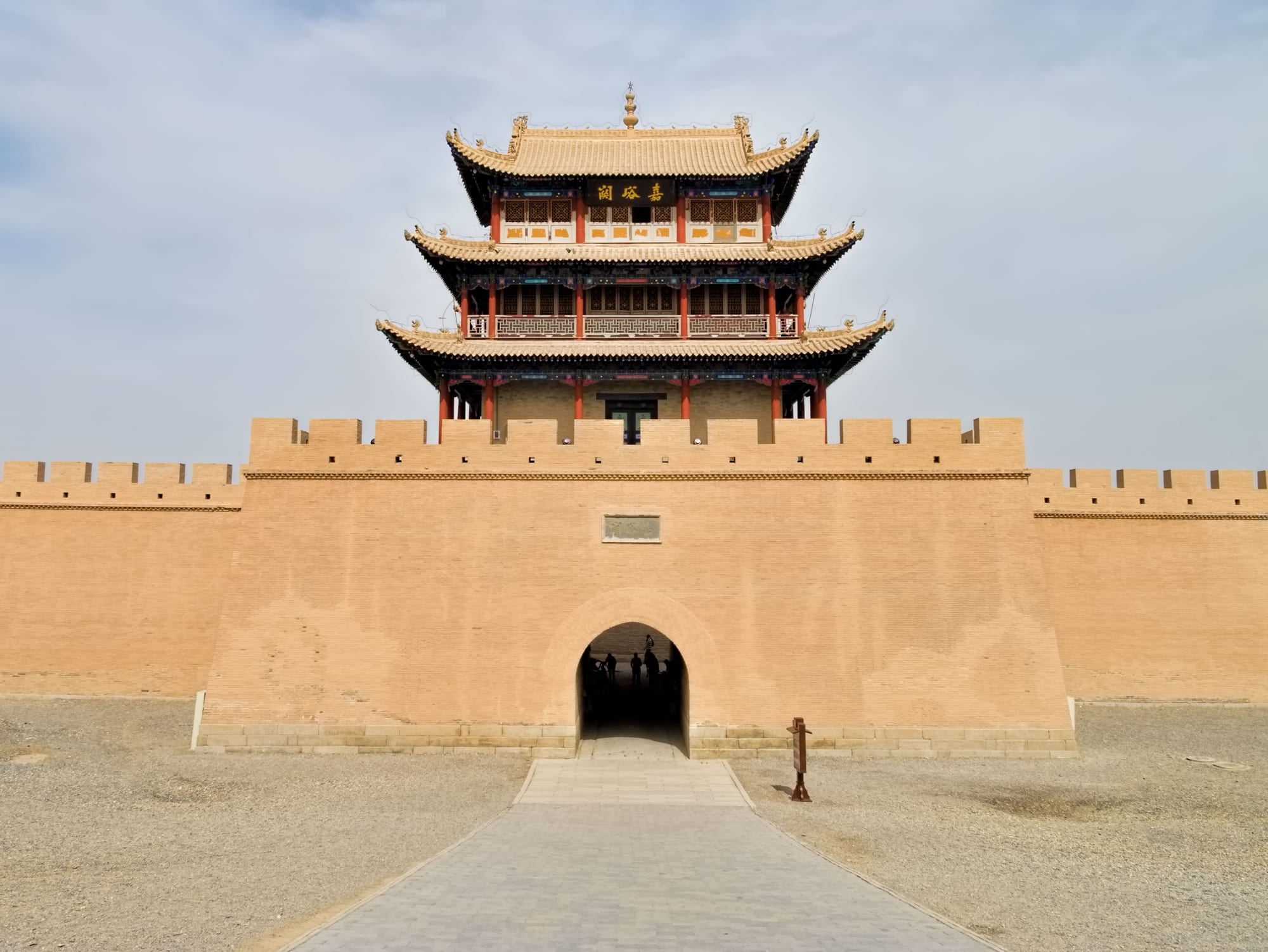
The western gate tower of Jiayu Pass fort, a three-tiered timber pavilion on a tall rammed-earth wall above an arched gateway, with bare desert ground in front

Xi'an, the Silk Road & the Northwest, China

Jiayuguan

The western gate of the Jiayu Pass fortress outside Jiayuguan, once the last gate of the Ming empire on the Silk Road. (Dan Lundberg / Wikimedia Commons · CC BY-SA 2.0)

A small industrial city in the Hexi Corridor of Gansu, laid out in the 1950s around a steel works on the desert plain between the Qilian Mountains and the Black Mountains. It takes its name from the Ming fortress of Jiayu Pass about 6 kilometres south-west of the city, the western end of the Great Wall, which travellers on the Silk Road passed through to leave the empire.

Neighbourhoods

  • The city centre
    • First-time visitors
    • Close to public transport
    • Best for food

    The planned grid of wide tree-lined avenues around Xiongguan Square and Lanxin Road, with the city's hotels, banks, restaurants and night-market streets. It is orderly and spacious, built for a steel town, and everything a visitor needs is within a few blocks.

    Open in Maps
  • Jiayu Pass and the western edge
    • Famous landmarks
    • Desert views

    The fortress and its scenic area about 6 kilometres south-west of the city, with the Great Wall Museum, on open ground with the snow of the Qilian range on the southern horizon.

    Open in Maps
  • The steel works and the east
    • Local life
    • Industrial heritage

    The works of Jiuquan Iron and Steel and the workers' housing estates around them, the reason the city exists. There is little for visitors, but the works explain the place.

    Open in Maps

Things to do

The Great Wall and the fortress

  • Jiayu Passlandmark

    The Ming fortress built around 1372 at the narrowest point of the western Hexi Corridor, with an inner fort, an outer fort, a moat and two gate towers, the most intact surviving pass on the Great Wall and part of its UNESCO World Heritage listing.

    Open in Maps
  • Overhanging Great Walltrail

    A stretch of Ming wall in two sections, each with towers, that climbs steeply up the slope of the Black Mountains about 7 kilometres from the fort, with wide views of the desert and the pass.

    Open in Maps
  • First Beacon Tower of the Great Walllandmark

    The beacon tower above the Taolai River at the southern end of the Jiayuguan wall, built in 1539 and counted as the westernmost point of the Ming Great Wall.

    Open in Maps
  • Great Wall Museummuseum

    China's first museum devoted entirely to the Great Wall and its history, inside the fort's scenic area.

    Open in Maps

Tombs, parks and the city

  • Wei-Jin Tombsmuseum

    Tombs of the Wei and Jin dynasties in the desert about 18 kilometres from the city, whose painted bricks show feasts, farming and herding; one tomb is open to visitors.

    Open in Maps
  • Xiongguan Squareattraction

    The square in the centre of the city's planned grid, a gathering place on summer evenings.

    Open in Maps
  • Jiayuguan City Museummuseum

    The city's own museum on Wuyi South Road, next door to the municipal government building.

    Open in Maps

Short trips from the city

  • Jiuquanattraction

    The older neighbouring city about 18 kilometres east, with a three-storey drum and bell tower at its central crossroads and a name, 'wine spring', taken from a legend of the Han general Huo Qubing.

    Open in Maps
  • Qilian Mountainsviewpoint

    The snow range that walls the corridor to the south, visible from the city on clear days, with glaciers and summer pasture reached by road from Jiayuguan.

    Open in Maps

Seasonal events

  • Chinese New YearJanuary or February

    Lanterns, temple visits and family feasts in a city where most residents' families arrived from elsewhere.

Eat and drink

Long-standing places and food districts in Jiayuguan. Hours, ratings and directions come from your maps app, always current.

Jiayuguan classics

  • Lamb and noodle restaurants in the centreneighborhood

    Roast leg of lamb, lamb skewers over charcoal and hand-pulled beef noodles are the staples, served in plain restaurants on the central avenues.

    Open in Maps

Food districts and markets

  • Fuqiang Market night marketneighborhood

    The night market off Xinhua South Road in the north of the centre, with street vendors, grilled lamb skewers and small street restaurants, where the city eats outdoors in the warm months.

    Open in Maps
  • Jiuquan's old centreneighborhood

    The streets of the older neighbouring city around its drum and bell tower are another place to eat the noodles and lamb of the Hexi Corridor.

    Open in Maps

Experience Jiayuguan

History

For most of its history the place was a gate rather than a town. The Hexi Corridor, the strip of oases between the Qilian Mountains and the desert, was China's road to Central Asia from the Han dynasty onward, and the narrowest point of the corridor, between the Black Mountains and the foothills of the Qilian, was a natural place to control it. Around 1372, four years after the Ming dynasty took power, a fortress was built here, and over the following century and a half it was enlarged with gate towers, watchtowers and the walls running north to the Black Mountains and south to the Taolai River gorge, finished in the 1530s. Jiayu Pass became the western terminus of the Ming Great Wall and the formal edge of the empire.

Merchants and envoys from Central and West Asia entered China through the gate, and exiles were sent out through it, many never to return. When the Qing conquered Xinjiang in the 1750s the frontier moved far to the west and the fort lost its purpose as a border post.

The modern city dates from 1958, when the plain near the pass, with iron ore in the mountains nearby, was chosen for a steel works to serve the north-west. Jiuquan Iron and Steel was built on the plain, and the city that housed its workers was formally established in 1965 and raised to prefecture-level status in 1971. The fort is part of the Great Wall's UNESCO World Heritage listing, and the high-speed railway arrived in 2014.

Culture & Customs

Jiayuguan is a company town with a monument attached. Its identity was formed by the steel works, and many residents are the children and grandchildren of workers who came from other provinces to build it from the late 1950s. That gives the city a mixed, mainland-Chinese character rather than a deep local one: Mandarin is the common language, the planned avenues and square feel like a northern industrial city, and civic pride attaches to having built a city in the desert.

The fort gives the city its symbol and its stories. The legend of the extra brick — the builder who calculated the bricks so exactly that one was left over, still displayed on a gate tower — is told to every visitor. The city is also a base for the Hexi Corridor's history tourism, alongside Zhangye and Dunhuang.

Hui Muslim cooking shapes the food, as across Gansu, and the Sunan Yugur Autonomous County borders the city to the south. Manners are north-western: plain, hospitable and loud at table, with lamb and strong spirits at celebrations. Evening life happens on the central square and in the restaurants of the centre.

Daily Life

About 313,000 people lived in the city at the 2020 census; it is by far the smallest prefecture-level city in Gansu by area. The steel works remains the backbone of the economy, and mining and mineral processing are the main industries. Tourism to the fort, services for the railway and solar power make up much of the rest.

Housing is in apartment blocks on the planned grid, many of them originally built for steel workers; the newer districts around the South station and the lake park have larger, newer estates. Daily rhythm follows the plant's shifts and the school day: an early breakfast of noodles, lunch at home or in the canteen, and the evening on the square or in the restaurants of the centre. The dry, sunny climate is a point of pride, and so is the city's tidiness.

Issues that occupy people are the long-term future of a city built for one industry, air quality on days when the works and the dust storms coincide, the loss of young people to Lanzhou and the eastern cities, and water in a place with almost no rain, where the city's lakes and street trees depend on the Taolai River and the glaciers of the Qilian range. The high-speed line has made Jiayuguan an easy stop on the corridor.

Food

The food is that of the Hexi Corridor: lamb, wheat and whatever the oases grow. Roast leg of lamb, kao yangtui, and skewers of lamb grilled over charcoal and dusted with cumin and chilli are staples, eaten with flatbread and beer at outdoor tables on summer evenings. Hand-pulled noodles in beef broth, the Lanzhou style found across Gansu, are the standard breakfast and lunch, and Hui-run shops serve them with slices of beef, radish, coriander and a spoon of chilli oil.

Cold dishes suit the dry heat: liangpi and niangpi, sheets of wheat or starch noodle cut into ribbons and dressed with vinegar, garlic and chilli, are sold from stalls and small shops. Dumplings and steamed buns, braised beef and vegetables stir-fried with the corridor's chillies fill out the menus, and the melons, apricots and grapes of the oasis towns to the west come to market in late summer.

Grapes have been grown in Gansu for centuries. Meals are hearty rather than refined, portions are large and sharing is the rule. The night-market streets near the central square are where the city eats out, and Jiuquan, twenty minutes away, has a longer tradition of restaurants in its old centre.

Planning tools

Budget

Jiayuguan is cheap by any Chinese standard. Hotels are plain and inexpensive, meals are a few dollars, and the main cost is the combined ticket for the fort and its sister sites plus a taxi or driver to reach them, which are spread around the edge of the city.

Daily Budget Midrange
USD 70–140 (mid-range hotel, restaurant meals, site tickets, a taxi or driver for the half day round the sites)
Daily Budget Shoestring
USD 25–45 (budget hotel, noodle shops and night-market stalls, buses and the fort ticket)

Hire a taxi for a half day to see the fort, the Overhanging Wall and the beacon tower together; they are too far apart to walk between.

Best Time to Visit

May to early October, when days are warm and dry; September is clearest for views of the snow mountains. Spring brings dust storms, summer afternoons are hot but dry, and winter is bitterly cold with short days, though the fort in snow is striking and empty.

Suggested Number of Days

One full day covers the fort and the other Great Wall sites around the city. A second allows the tombs and the neighbouring city at an easier pace, or a rest between the long train journeys of the Hexi Corridor.

First Visit
1 day
With Surroundings
2 days

Transportation

The city is small and taxis are cheap and plentiful; a city bus runs from the centre to the fort. The Overhanging Wall, the beacon tower and the tombs are reached by taxi, and drivers offer a fixed price for the round of sites.

Agree the price and the list of stops before setting off with a taxi for the day, and carry water; the sites have little shade.

Airport & Station Connections

Jiayuguan South station on the Lanzhou–Xinjiang high-speed line has trains to Lanzhou in about four hours, to Zhangye in about an hour and west to Urumqi; the older station in the city has slower trains, including to Dunhuang. Jiayuguan Jiuquan Airport, about 9 kilometres north-east, has flights to Lanzhou, Xi'an and a few other cities. Long-distance buses run to Dunhuang and Xining.

Walkability

The centre is flat and its wide avenues have broad pavements, so the hotels, square and night markets are an easy walk. The Great Wall sites are far apart on the city's edges and need transport. The sun is strong and the air dry on the high desert plain, and in winter the wind off the desert makes even short walks cold.

Safety

Jiayuguan is quiet and safe, with very little crime. The risks are the climate — dehydration and sunburn in summer, extreme cold in winter — and the heights at the Overhanging Wall and the beacon tower cliff. Passport checks are routine at the stations.

Do not photograph checkpoints, police or detention facilities, avoid political conversations, and carry water in the desert. Hold the rails on the steep wall sections and keep the passport to hand at the station. Check current official travel advice before travelling.

Climate

A cold desert climate with very little rain, strong sunshine and large swings between day and night. Spring is windy and dusty, summer is warm and dry, autumn is clear and short, and winter is long and severe.

Summer
warm and dry — pleasant mornings and very warm afternoons; in neighbouring Jiuquan July averages about 22°C, with almost no rain
Winter
very cold — in neighbouring Jiuquan January averages about -9°C, with essentially no snow because the air is so dry

Local Customs

Tipping is not practised. Over 97 per cent of residents are Han Chinese, and Hui Muslim restaurants, a feature of Gansu, do not serve pork or alcohol. People are direct, hospitable and curious about the few foreign visitors.

Dress is casual; cover up against the sun rather than for custom. Do not order pork or alcohol in Hui restaurants, ask before photographing people, and avoid political topics, particularly about neighbouring Xinjiang.

Common Payment Methods

The currency is the renminbi (yuan). WeChat Pay and Alipay, which accept foreign cards, are used for nearly everything; the main banks in the centre have ATMs that take international cards. Cash is useful for taxis, stalls and the site shops.