The Leshan Giant Buddha seated in a red sandstone cliff between green trees

Sichuan, Yunnan & the Southwest, China

Leshan

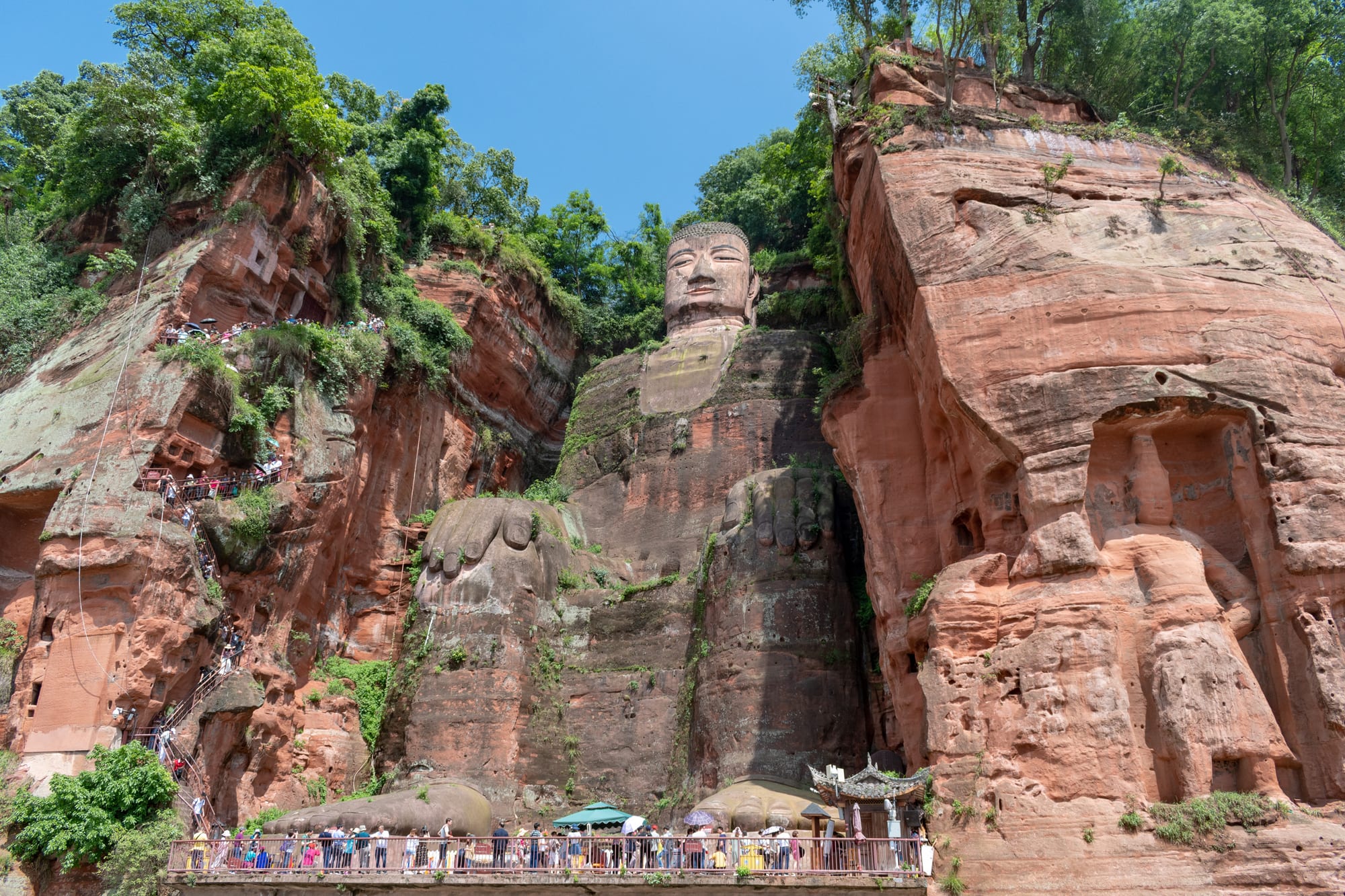
The Leshan Giant Buddha, carved into the cliff where the Min and Dadu rivers meet. (xiquinhosilva / Wikimedia Commons · CC BY 2.0)

A river city in southern Sichuan about 120 kilometres south of Chengdu, where the Min, Dadu and Qingyi rivers meet below a red sandstone cliff into which a 71-metre seated Buddha was carved in the Tang dynasty. With written records going back to around 700 BC, it is now a regional centre of southern Sichuan, the gateway to Mount Emei and noted for its street food.

Neighbourhoods

  • The old city and riverfront
    • First-time visitors
    • Best for food
    • Historic district

    The old centre facing the river confluence, where the walled town of Jiading stood, with surviving stretches of wall, old gates and lanes, the riverside promenade facing the Buddha's cliff, the ferry pier and the city's best-known food streets. Most hotels aimed at visitors are here.

    Open in Maps
  • The Giant Buddha scenic area
    • Famous landmarks
    • Walks and viewpoints

    The forested hills of Lingyun and Wuyou on the east bank across the river from the old city, where the Buddha, two temples, the cliff tombs and the pathways between them are enclosed in one ticketed park. A short bus or taxi ride, or a ferry, from the centre.

    Open in Maps
  • Zhanggongqiao and the north
    • Best for food
    • Nightlife
    • Local life

    The area around Zhanggongqiao Street, a busy place to eat and drink at night, with barbecue, skewer and noodle shops among ordinary residential blocks.

    Open in Maps
  • The new districts and the station
    • Close to public transport
    • Modern hotels

    The newer parts of the city around Leshan Railway Station and the central bus station, with newer hotels, malls and apartment blocks.

    Open in Maps

Things to do

The Buddha and its temples

  • Leshan Giant Buddhalandmark

    A 71-metre seated Maitreya carved into the cliff in the eighth century and completed in 803, the largest stone Buddha in the world and a UNESCO World Heritage Site, seen from a stairway down the cliff or from boats on the river.

    Open in Maps
  • Lingyun Templelandmark

    A Chan Buddhist temple on Lingyun hill beside the Buddha, also called the Great Buddha Temple, destroyed by war and rebuilt many times.

    Open in Maps
  • Wuyou Templelandmark

    The area's oldest temple, on top of Mount Wuyou, a small island south-west of the Buddha reached by a footbridge, with a hall of five hundred arhat statues rebuilt in the 1980s and a terrace looking over the three rivers.

    Open in Maps
  • Mahao Cliff Tombsmuseum

    More than 300 tombs, mostly of the Eastern Han, cut into the sandstone of Lingyun hill's southern slope beside the Buddha, with carvings that include images of the Buddha.

    Open in Maps
  • Oriental Buddha Parkattraction

    A privately run theme park beside the scenic area with around 3,000 reproductions of Buddhist statues, including a 170-metre reclining Buddha.

    Open in Maps

The rivers and the old city

  • River cruise past the Buddhaattraction

    Sightseeing boats cross the river and stop in front of the statue, giving a panoramic view of the whole figure and of the two guardians carved into the cliff, which cannot be seen on foot.

    Open in Maps
  • Old city walls and gateslandmark

    Remnants of the city walls, first built in the Northern Zhou and rebuilt under the Ming and Qing, survive around the centre, with gates such as the riverside Tieniu Gate, rebuilt in 1394.

    Open in Maps
  • Riverside promenadetrail

    The embankment along the Min river on the old city side looks straight across to the Buddha's cliff and is where residents walk, dance and fish in the evening.

    Open in Maps

Short trips from the city

  • Mount Emeitrail

    The highest of China's four sacred Buddhist mountains, about 40 kilometres west, rising to a 3,099-metre summit with temples at Jinding, monasteries along the trails and wild macaques; shared with the Buddha in the UNESCO listing.

    Open in Maps
  • Jiajiang Thousand Buddha Clifflandmark

    A Tang-dynasty site of Buddhist carvings in a cliff in Jiajiang County, about 30 kilometres from the city.

    Open in Maps
  • Guo Moruo's former residence in Shawanmuseum

    The family home of the poet, historian and scholar Guo Moruo, born in 1892 in the town of Shawan on the Dadu River south-west of the city.

    Open in Maps
  • Jiayang narrow-gauge steam railwayattraction

    A narrow-gauge line in Qianwei County, opened in 1959 to carry coal, which now runs passenger and heritage trains, with steam locomotives still used on part of it.

    Open in Maps

Seasonal events

  • Dragon Boat FestivalFifth day of the fifth lunar month, usually June

    Zongzi, sticky rice wrapped in leaves, are sold across town for the holiday.

  • Chinese New YearJanuary or February

    Temple visits and family feasts, with the Buddha scenic area at its busiest as visitors come to pray for good luck.

Eat and drink

Long-standing places and food districts in Leshan. Hours, ratings and directions come from your maps app, always current.

Leshan classics

  • Zhanggongqiao food streetneighborhood

    A busy street for eating and drinking at night, with barbecue skewers and other Leshan snacks.

    Open in Maps
  • Qiaojiao beef restaurantsneighborhood

    Beef and offal in a herbal broth, a dish that originated around the town of Suji within the city, where more than 70 restaurants serve it; it is listed as national intangible cultural heritage.

    Open in Maps

Food districts and markets

  • Old city snack streetsneighborhood

    The downtown streets near the riverside offer a wide variety of Leshan and Sichuan food, from sweet-skinned duck to doufu nao.

    Open in Maps
  • Xiba tofu restaurantsneighborhood

    The tofu of the town of Xiba in Wutongqiao is a Leshan speciality, served at restaurants in the city and in the town itself.

    Open in Maps

Experience Leshan

History

A settlement stood at the meeting of the three rivers long before the Buddha. Under the Qin and Han the county of Nan'an was set up here, and the cliff tombs cut into the sandstone beside the Buddha, mostly of the Eastern Han, show a prosperous local society. The town was known as Jiazhou, and later Jiading, through most of its history — a river port where the Min, Dadu and Qingyi came together on the water road from Chengdu to the Yangtze.

The confluence was also dangerous. In the eighth century the monk Hai Tong began carving a seated Maitreya into the cliff of Lingyun hill, by tradition to calm the waters that wrecked boats below; the stone cut from the cliff fell into the river and changed its currents. Hai Tong died with the work unfinished, and it was completed in 803 under the patronage of the regional governor Wei Gao. For centuries a thirteen-storey wooden shelter covered the figure, until it was destroyed in the wars at the end of the Yuan. Lingyun and Wuyou temples grew up on the hills on either side.

Jiading remained a regional centre under the Ming and Qing, when its walls and gates were rebuilt, and Leshan County was created here in 1734. In the Second World War the city took in Wuhan University, evacuated from the east, until 1946, and stored treasures of the Forbidden City from 1939 to 1947. After 1949 the city industrialised, and in 1996 the Buddha and Mount Emei were inscribed together as a World Heritage Site, bringing a tourist economy that now runs alongside the city's industry.

Culture & Customs

The Buddha is the centre of Leshan's identity, and the city treats it with a mixture of reverence and civic pride: it appears on everything from bus shelters to packaging, and the scenic area is the setting for New Year temple visits and school outings. Buddhism remains active at Lingyun, a Chan temple, and at Wuyou, and the nearness of Mount Emei, the sacred mountain of the bodhisattva Samantabhadra, means pilgrims and monks are part of the city's traffic. The Han cliff tombs and the Thousand Buddha Cliff at Jiajiang add to the area's wealth of stone carving.

Leshan is equally proud of its literary sons. The poet and historian Guo Moruo, one of the most prominent intellectuals of twentieth-century China, was born in Shawan on the Dadu river, and the city keeps his family home as a museum. The Wuhan University years during the war are remembered too, and the city today has its own university and technical colleges.

Daily culture is Sichuanese: teahouses with bamboo chairs where mahjong is played all afternoon, long evenings at outdoor barbecue tables, Sichuan opera on television and in the parks, and a food culture noted especially for its street food. People speak the Leshan dialect, which keeps the old entering tone and is hard for other Sichuanese to follow, are informal and direct, and are used to visitors from across China but see relatively few from abroad.

Daily Life

The prefecture-level city has about 3.2 million people, and is a transport hub and regional centre for southern Sichuan. Industry sits alongside tourism to the Buddha and Mount Emei, which brings millions of visitors a year, and the colleges, among them Leshan Normal University; wages are below Chengdu's and many young people commute or move to the provincial capital on the hour-long train.

Residents live in apartment blocks across the old city peninsula and the newer districts to the south and west; the lanes of the old town still hold older families and small shops. The day begins with noodles or rice jelly from a stall, the long lunch hour is kept, and evenings belong to the river promenade, square dancing and the food streets. The Buddha's crowds are something residents route around rather than join.

Issues people discuss are pollution, which has also weathered the Buddha, the cost of flats in the new districts, flooding when the rivers rise in summer, and how to keep the tourist money from passing straight through to Emei. The fast rail line has made Leshan an easy day trip from Chengdu.

Food

Leshan is noted for its food culture, and especially for the variety of its street food. Qiaojiao niurou, literally raised-foot beef, is the signature: beef and offal in a herbal broth. It originated around the town of Suji, where more than 70 restaurants serve it, and fills restaurants across the city. Bobo ji, bobo chicken, is Leshan's other export — chicken and root vegetables, often on skewers, marinated in a spicy sesame broth.

Tianpi ya, sweet-skinned duck, is a roast duck with a crisper, sweeter skin than Peking duck, sold in sealed bags as a gift to take home. Xiba doufu, the tofu of the town of Xiba, is a local speciality, and doufu nao, soft tofu with nuts and spices, is a traditional breakfast. Leshan barbecue, shaokao, grilled over charcoal and dusted with chilli and cumin, is eaten outdoors with friends and local beer.

Other local favourites include cold noodles with chilli and vinegar, sticky rice dumplings, rice jelly, liangfen, dressed in chilli oil, and the Sichuan basics of hotpot and spicy stir-fries. Tea is the daily drink in the old city's teahouses, where mahjong and the local erqishi card game are played. Meals are shared, numerous and cheap, and the best places are often the most crowded stalls.

Planning tools

Budget

Leshan is inexpensive for a city with a world-famous sight. The Buddha ticket and the river cruise are the main costs, and Mount Emei's entry and cable cars add a separate bill. Street food is very cheap, and hotels cost far less than in Chengdu.

Daily Budget Midrange
USD 70–150 (mid-range hotel, restaurant meals, Buddha and Emei tickets, taxis and a shared car)
Daily Budget Shoestring
USD 25–45 (hostel or budget hotel, street food and noodle shops, buses and the Buddha ticket)

Reach the Buddha stairway at opening time or late in the afternoon; queues at the cliff can take hours on weekends and in the May and October holidays.

Best Time to Visit

March to May and September to November, when days are mild and the cloud lifts more often. Summer is hot, humid and wet, though the river is full and the hills are green; winter is cool, grey and damp but quiet, and the rivers fall low enough for a gravel island to appear in front of the Buddha.

Suggested Number of Days

A day is enough for the Buddha, its temples and the old city. Add one to three days for the sacred mountain nearby, depending on whether the summit is reached on foot or by cable car and how the weather behaves.

First Visit
1 day
With Surroundings
2–4 days

Transportation

The city is compact and taxis are cheap. City buses connect the high-speed station, the old city and the Buddha scenic area, and ferries and cruise boats cross from the old city pier. Ride-hailing through Chinese apps is reliable, and shared bikes cover the old city. Regular buses run to Emeishan town and the mountain's trailheads.

Buses 13 and K1 run from the city to the scenic area; the boats from the dock give the river view.

Airport & Station Connections

Leshan station on the Chengdu–Leshan–Emeishan intercity line is about an hour from Chengdu East, with trains continuing to Emeishan. Chengdu's airports are the nearest with scheduled flights, and Shuangliu airport has its own station on the same line. Coaches run from Chengdu's bus stations and from Emeishan.

Walkability

The old city is flat and walked easily, and its food streets and river promenade are close together. The Buddha scenic area is a long walk of stairways and paths over two hills, hot in summer and slippery after rain; the cliff stairway itself is narrow and steep. The newer districts are spread out and need a bus or taxi.

Safety

Leshan is safe, with little crime affecting visitors. The risks are crowds and steep, wet steps at the Buddha, strong currents in the rivers, and traffic — scooters on pavements and vehicles that do not stop at crossings. Summer heat and humidity are tiring.

Avoid mountain trails on Emei in heavy rain. Hold the rail on the cliff stairway, keep out of the rivers, and carry the passport, which hotels must register. Check current official travel advice before travelling.

Climate

A humid subtropical climate in the Sichuan basin, cloudy for much of the year with short, mild winters, long hot summers and most rain in the summer months.

Summer
hot and humid — highs often exceed 30°C, with heavy rain
Winter
cool and grey — January averages around 7°C; frost may occur but snow is rare

Local Customs

Tipping is not practised. Leshan people are relaxed and sociable in the Sichuan way; meals are long, loud and shared, teahouses fill with card and mahjong players through the afternoon, and the evening is spent at outdoor barbecue tables. Visitors are expected to try the chilli but will be served milder food on request.

Cover shoulders and knees in the temples, do not photograph monks at prayer or touch the statues, and be patient in the queue at the Buddha, which can last around two hours. Toasts at a table are returned, and baijiu is strong.

Common Payment Methods

The currency is the renminbi (yuan). WeChat Pay and Alipay are used almost everywhere, including by street stalls, and accept foreign cards; the major banks in the old city have ATMs that take international cards, and a little cash is useful for ferries and small stalls.