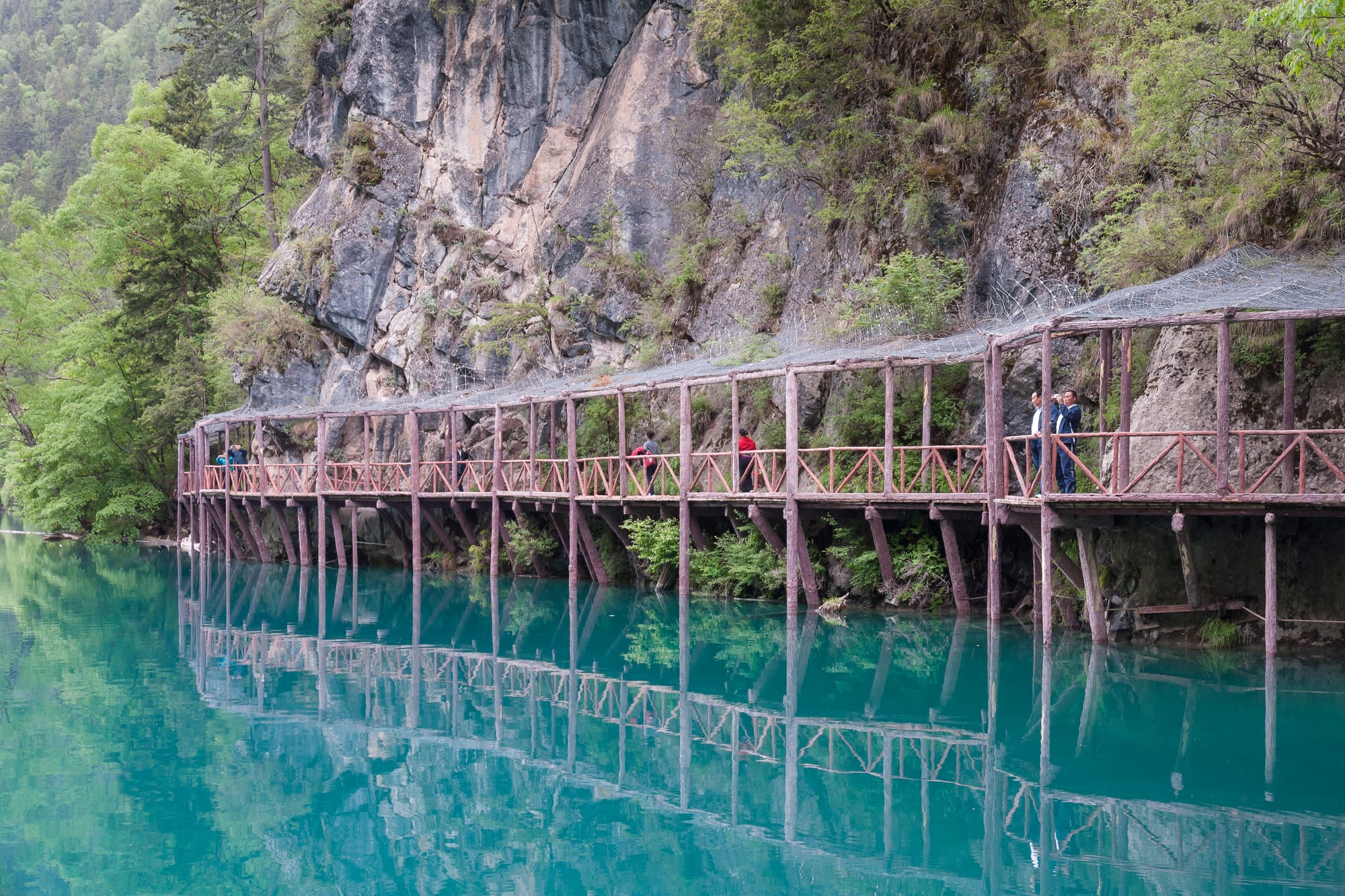
A wooden boardwalk under a grey cliff reflected in the still turquoise water of a mountain lake

China

Sichuan, Yunnan & the Southwest

The boardwalk along Panda Lake in the Jiuzhaigou Valley, northern Sichuan. (CEphoto, Uwe Aranas / Wikimedia Commons · CC BY-SA 3.0)

China's south-west, stretching from the Sichuan Basin and the Yangtze city of Chongqing over the Guizhou plateau to Yunnan's mountains and the tropical Mekong borderlands — the country's most ethnically diverse corner, home of giant pandas, chilli-and-peppercorn cooking, and old towns of the Bai, Naxi, Dai and Miao.

Explore Sichuan, Yunnan & the Southwest

History

The Sichuan Basin had its own Bronze Age civilisation: the masks and figures from Sanxingdui, near Guanghan, belong to the ancient Shu. The Qin conquered Shu in 316 BC, and around 256 BC the governor Li Bing built the Dujiangyan irrigation system, still watering the Chengdu plain. Chengdu was the capital of Shu Han in the Three Kingdoms era and a rich Tang city where the poet Du Fu lived.

Yunnan stood apart for centuries under the kingdoms of Nanzhao and Dali, based on Erhai Lake, until the Mongols conquered Dali in 1253. Ming soldiers and settlers followed, and the admiral Zheng He was a Hui Muslim born near Kunming. Guizhou became a province only in 1413, and uprisings by the Miao and other peoples recurred into the 19th century.

The modern era made the region a refuge. During the war with Japan the Nationalist government moved to Chongqing, which was bombed heavily from 1938, while the Burma Road fed Kunming and exiled universities taught there. The Long March passed through: the Zunyi Conference of 1935, in Guizhou, raised Mao's standing. After 1949 the south-west became a site for defence industry, and Chongqing was split from Sichuan as a municipality in 1997 as the Three Gorges Dam's reservoir filled. The Wenchuan earthquake of May 2008 killed about 70,000 people in Sichuan.

Culture & Customs

The south-west is home to many of China's ethnic groups. Yunnan alone has 25 recognised minorities: the Bai around Dali, the Naxi of Lijiang with their pictographic Dongba script, the Yi, the Hani of the Yuanyang terraces, and the Dai of Xishuangbanna, who follow Theravada Buddhism and splash water to mark their New Year in April. Guizhou is the heartland of the Miao and Dong, known for silver headdresses, batik, embroidery and drum towers, and western Sichuan is ethnically Tibetan, with the Yi in Liangshan.

Among Han Chinese, Sichuanese and Chongqing people speak south-western Mandarin and pride themselves on a relaxed, pleasure-loving outlook: Chengdu's teahouses, mahjong tables and ear-cleaners are part of the city's self-image, and Chongqing is brasher and faster. Sichuan opera is known for bian lian, face-changing, in which performers switch masks in a flash.

Festivals follow the minority calendars — the Yi Torch Festival in summer, the Bai Third Month Fair in Dali, Miao festivals in Guizhou — alongside Han New Year.

Daily Life

Sichuan has about 84 million people and Chengdu, with around 21 million in its wider municipality, is Sichuan's capital and a hub for electronics and software. Chongqing's municipality holds over 30 million, most of them outside the dense, hilly core, and makes cars and motorbikes. Yunnan has about 47 million, with Kunming at around 8 million, and Guizhou about 38 million, with Guiyang as its capital.

Guizhou was long one of China's poorest provinces; it has since built highways, bridges and data centres, and the FAST radio telescope sits in its karst hills. Yunnan lives on tourism, tobacco, tea, flowers and cross-border trade with Laos and Myanmar, and Kunming has a huge bird and flower market.

Life in Chengdu moves slowly, with afternoons in teahouses and hotpot suppers, while Chongqing people climb stairs, ride cable cars and eat hotpot in sweltering heat. Rural out-migration, tourist pressure on old towns, and the frailty of mountain roads in earthquakes and floods are persistent issues.

Food

Sichuan cooking pairs chillies with Sichuan peppercorn for mala, the numbing-hot flavour. Beyond mapo tofu, Chengdu dishes include huiguo rou, twice-cooked pork; gongbao jiding, diced chicken with peanuts and chillies; dan dan noodles; and fuqi feipian, sliced beef and offal in chilli oil. The base is Pixian doubanjiang, fermented broad-bean chilli paste. Chongqing claims hotpot, simmered in beef tallow, along with xiaomian spicy noodles. Sichuan distils baijiu, including Wuliangye from Yibin.

Many Yunnan dishes are spicy too. Guoqiao mixian, crossing-the-bridge noodles, has raw ingredients cooked at the table in scalding broth; the province's markets are famous for wild mushrooms in summer; Xuanwei produces cured ham; and the Bai and Yi make rubing, a firm goat's cheese, and rushan, cow's-milk 'milk fans' dried on bamboo sticks. Rose-petal flower cakes are a Kunming sweet, and Yunnan grows Pu'er tea and most of China's coffee.

Guizhou likes sour flavours: the Miao sour fish soup, suantang yu, uses fermented tomato and rice. Maotai baijiu comes from the town of Maotai in Guizhou.

Attractions & Natural Wonders

Chengdu's giant panda breeding base is best visited early, before the pandas sleep, and the city adds Wenshu Monastery, the Wuhou Shrine, Du Fu's Thatched Cottage and the Sanxingdui museum nearby. The Leshan Giant Buddha and Mount Emei are a UNESCO World Heritage Site to the south-west, Dujiangyan and Mount Qingcheng to the north-west. Jiuzhaigou's lakes and waterfalls, with the limestone pools of Huanglong nearby, lie in the northern mountains. Chongqing has river views from Hongyadong, the Dazu Rock Carvings and the start of Three Gorges cruises.

Kunming has Green Lake, Western Hills and the Stone Forest. Dali's old town sits between the Cangshan range and Erhai Lake, beside the Three Pagodas; Lijiang's canals and wooden houses lie beneath Jade Dragon Snow Mountain. Tiger Leaping Gorge follows the Jinsha, the upper Yangtze, with a high trail above the river, and Shangri-La has the Songzanlin monastery. In the south, Yuanyang's Hani rice terraces are a UNESCO World Heritage Site, and Xishuangbanna offers Jinghong's Dai temples and rainforest.

Guizhou's minority villages include the Miao settlement of Xijiang, spread across hillsides in Leishan County near Kaili, and the Dong village of Zhaoxing, with its drum towers. The Huangguoshu waterfall and the karst forests of Libo complete the province.

Cities in Sichuan, Yunnan & the Southwest

Planning basics

Budget

The south-west is good value by Chinese standards. Chengdu and Chongqing are cheaper than the coastal cities, street food and hotpot are inexpensive, and Yunnan and Guizhou have plentiful guesthouses. Scenic areas are the exception: Jiuzhaigou, the Jade Dragon Snow Mountain cable car and the big Guizhou sites charge high entry and shuttle fees, and Lijiang's old town is priced for tourists.

Daily Budget Midrange
USD 75–160 (mid-range or boutique hotel, restaurant meals, park tickets, some domestic flights)
Daily Budget Shoestring
USD 30–50 (hostel or guesthouse, noodles and street food, buses and high-speed rail)

Stay outside Lijiang's old town for better value, and budget separately for scenic-area tickets, which can exceed the day's other costs.

Safety

The region is generally safe. Natural risks are the main ones: the area is earthquake-prone, summer rain brings landslides and rockfalls, and altitude sickness can affect visitors on Jade Dragon Snow Mountain and in the Tibetan uplands. The high trail at Tiger Leaping Gorge has exposed sections. Along Yunnan's Myanmar border, drug trafficking and cross-border scam operations are a concern, and Tibetan areas of western Sichuan are occasionally closed to foreigners.

Ascend gradually on the plateau, avoid gorge and mountain trails in heavy rain, and never cross borders except at official posts. Check current official travel advice before travelling.

Climate

Varied by altitude. The Sichuan Basin is humid and overcast, and Chongqing is one of China's hottest cities in summer. Guizhou is cooler, famously cloudy and damp. Kunming, at about 1,900 metres, is mild all year and is nicknamed the Spring City, while Dali and Lijiang are higher and cooler. Xishuangbanna is tropical, and the Tibetan uplands of western Sichuan and north-west Yunnan are cold, with snow for much of the year.

Summer
hot and humid in Chongqing and Chengdu, 30–40°C; mild on the Yunnan plateau; rainy season from about June to September
Winter
damp and grey in the basin, 5–10°C; sunny and dry in Kunming and Dali; below freezing at altitude

Transportation

High-speed trains link Chengdu and Chongqing in about an hour and connect Guiyang, Kunming and the east coast. From Kunming, trains run west to Dali and Lijiang and south to Xishuangbanna on the railway to Laos. Jiuzhaigou lies in the northern mountains, reached by flights to Jiuzhai Huanglong Airport or a long road journey. Tiger Leaping Gorge is a couple of hours by bus from Lijiang, and Guizhou's minority villages are reached by bus or hired car from Kaili or high-speed stations nearby.

Allow extra days in the rainy season, when mountain roads close after landslides; book Jiuzhaigou tickets online, as daily numbers are capped.

Best Time to Visit

Spring and autumn suit most of the region. Jiuzhaigou is at its best in October, when the forests turn, and Yunnan's plateau is dry and sunny from November to April. Xishuangbanna is most comfortable in winter and holds its Water-Splashing Festival in mid-April. Summer is the rainy season, with landslides on mountain roads, and national holiday weeks crowd every major site.