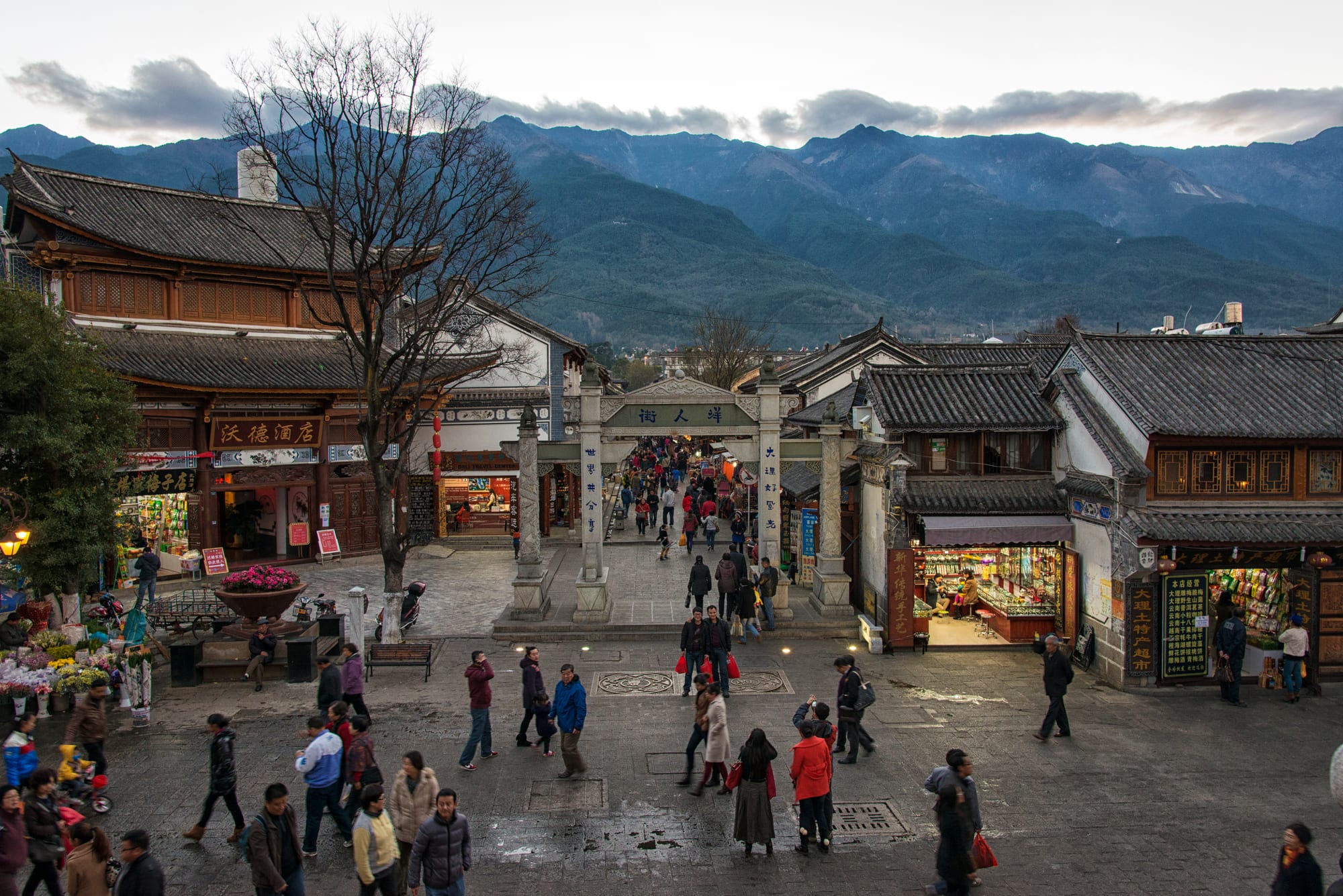
A paved square of tiled timber shopfronts and a stone archway in Dali's old town, with dark mountain ridges rising behind

Sichuan, Yunnan & the Southwest, China

Dali

A street corner in Dali's old town, below the Cangshan range in western Yunnan. (chensiyuan / Wikimedia Commons · CC BY-SA 4.0)

A city in western Yunnan set on a plain between the Cangshan range and Erhai Lake, and the historic heart of the Bai people. Capital of the Nanzhao and Dali kingdoms until the Mongol conquest of 1253, it is now two places at once: a walled old town of guesthouses, cafés and craft shops, and Xiaguan, the working modern centre and transport hub to the south.

Neighbourhoods

  • Dali Old Town
    • First-time visitors
    • Historic district
    • Cafés and bars

    The walled Ming-era town, about 10 kilometres north of the modern centre, laid out on a grid of stone streets between gate towers. Most guesthouses, craft shops, bars and travellers' cafés are here, on and around Renmin Road and Fuxing Road, with the Cangshan ridge directly above and the lake a short ride east.

    Open in Maps
  • Xiaguan
    • Close to public transport
    • Local life

    The administrative and commercial centre of Dali City at the southern end of Erhai Lake, where the railway station, long-distance buses and most offices are. It has few sights and is where residents shop, eat and work, but it is the practical arrival point for the whole prefecture.

    Open in Maps
  • Erhai west shore
    • Quiet and residential
    • Lake views
    • Cycling

    A string of Bai villages and farmland between the old town and the water, including Caicun and the lakeside lanes north of it. Guesthouses face the lake across fields of vegetables and garlic, and a shoreline path is used for walking and cycling.

    Open in Maps
  • Xizhou
    • Bai architecture
    • Best for food
    • Day trips

    A market town on the plain north of the old town, known for the courtyard houses of Bai merchant families with carved gateways and painted screen walls. Its main square is a working local market, and the fields between the town and the lake are a popular walking and cycling route.

    Open in Maps
  • Shuanglang
    • Lake views
    • Quiet stays

    A former fishing village on the north-eastern shore of Erhai, reached around the lake by road. It faces the Cangshan range across the water and has become a cluster of small lakeside hotels and restaurants.

    Open in Maps

Things to do

Famous landmarks

  • Three Pagodas of Chongsheng Templelandmark

    Dali's emblem — a tall central pagoda of the Nanzhao period flanked by two smaller ones, standing in front of a large rebuilt temple complex at the foot of the mountains.

    Open in Maps
  • Dali Old Town walls and gateslandmark

    The rebuilt Ming walls and gate towers that frame the old town, with a walkway along part of the southern rampart giving views over the tiled roofs.

    Open in Maps
  • Chongsheng Templelandmark

    The large Buddhist complex behind the pagodas, associated with the kings of Dali and rebuilt on its old site in recent decades.

    Open in Maps

Lake and mountains

  • Wuhua Towerlandmark

    A tall reconstructed tower on Fuxing Road in the centre of the old town, standing where the Nanzhao kings are said to have received envoys.

    Open in Maps
  • Erhaiattraction

    The long ear-shaped lake east of the town, about 40 kilometres from end to end, ringed by a road and shoreline paths and fringed by fishing villages.

    Open in Maps
  • Cangshanviewpoint

    The nineteen-peak range rising above the town to more than 4,000 metres, with cable cars, a high level path along the slopes and the Zhonghe Temple on the ridge.

    Open in Maps
  • Butterfly Springpark

    A clear pool beneath an old tree at the northern foot of Cangshan, tied to a Bai legend and to butterflies that gather there in early summer.

    Open in Maps

Bai towns and crafts

  • Zhoucheng tie-dye villageneighborhood

    A Bai village north of Xizhou known for indigo tie-dye, where cloth is stitched, dipped and dried in the courtyards.

    Open in Maps
  • Xizhouneighborhood

    A town of Bai merchant courtyard houses with carved gates and painted walls, on the plain north of the old town.

    Open in Maps

Short trips from the city

  • Old Town of Lijiangneighborhood

    The Naxi old town of canals and wooden houses under Jade Dragon Snow Mountain, a UNESCO World Heritage Site reachable by train north of Dali.

    Open in Maps
  • Shaxineighborhood

    A restored market town on an old tea and horse caravan route north-west of Dali, with a cobbled theatre square, a Buddhist hall and a surviving timber stage.

    Open in Maps
  • Shibao Mountainattraction

    Cliff grottoes and temples near Shaxi, carved with Buddhist figures including the bodhisattva Guanyin, and with portraits of Nanzhao rulers.

    Open in Maps
  • Jizu Mountainattraction

    A Buddhist pilgrimage mountain north-east of Erhai, on the borders of Binchuan and Heqing counties, topped by a pagoda and long visited by Chinese and Tibetan pilgrims.

    Open in Maps

Seasonal events

  • Third Month Fairfrom the fifteenth day of the third lunar month, April or May

    A Bai trading fair and festival held for several days on the slopes west of the old town, with horse racing, markets and opera, recorded for centuries.

  • Raosanlingspring

    A Bai pilgrimage in which villagers walk between temples around the Erhai plain over three days, singing and dancing along the way.

  • Torch Festivalsummer, sixth lunar month

    Bai and Yi communities raise decorated torch poles in the villages and carry burning torches through the fields at night.

Eat and drink

Long-standing places and food districts in Dali. Hours, ratings and directions come from your maps app, always current.

Dali classics

  • Rubing and rushanmarket

    Two Bai dairy foods rare elsewhere in China — rubing, a firm goat's cheese usually fried or grilled, and rushan, thin sheets of cow's milk dried on bamboo and often served toasted with rose jam.

    Open in Maps
  • Erhai fish dishesrestaurant

    Lakeside kitchens serve the local sour and spicy fish stew and casseroles cooked with pickled vegetables, a Bai speciality along the Erhai shore.

    Open in Maps
  • Xizhou babamarket

    A flat wheat pastry baked between charcoal in Xizhou and sold at street stalls in sweet rose-sugar and savoury spring onion and pork versions.

    Open in Maps

Food districts and markets

  • Renmin Road and Fuxing Roadneighborhood

    The old town's two main streets, lined with Bai restaurants, noodle shops, bakeries, bars and coffee houses, busiest in the evening.

    Open in Maps
  • Xizhou market squaremarket

    A working town market selling vegetables, cured meat, cheese and dried goods from the plain, with stalls of baba and snacks around the edges.

    Open in Maps
  • Xiaguan food streetsneighborhood

    The modern centre's everyday eating — rice-noodle shops, Muslim beef restaurants and Sichuan kitchens serving a mostly local crowd.

    Open in Maps

Experience Dali

History

The plain between Cangshan and Erhai has been settled for millennia, and by the eighth century it held a cluster of small states known as the six zhao. One of them, Nanzhao, unified the others around 738 with Tang support and then turned against its patron, defeating Tang armies sent against it and expanding into what is now Myanmar, Laos and Vietnam. Its capital, Taihe, lay just south of the present old town; the Nanzhao Dehua Stele, raised there in 766, still records the quarrel with the Tang court. Buddhism arrived early and deeply, and the Three Pagodas were begun in this period.

Nanzhao fell in 902 and was succeeded in 937 by the Kingdom of Dali, founded by Duan Siping, which ruled the region for three centuries as a Buddhist state and traded along the caravan roads between Sichuan, Tibet and Burma. In 1253 Kublai Khan's armies crossed the Jinsha and took Dali, bringing the area into the Mongol Yuan empire and, for the first time, under a government based in the Chinese heartland. Yunnan became a province, and Han settlers arrived in numbers under the Ming, who laid out the present walled town in the late fourteenth century.

Dali's later history was violent. The Panthay Rebellion of Muslim Hui and other peoples, led from Dali by Du Wenxiu between 1856 and 1873, ended in the town's capture and heavy loss of life. The modern city grew around Xiaguan, and the old town's revival began in the 1980s, when it became one of the first places in inland China where independent foreign travellers gathered.

Culture & Customs

Dali is the seat of the Dali Bai Autonomous Prefecture, and Bai culture is the town's defining feature. The Bai are one of China's larger minority peoples, long settled around Erhai, with their own language, a tradition of building in whitewashed courtyard houses decorated with ink paintings and carved timber, and a religion that mixes Buddhism with the worship of benzhu, local tutelary gods housed in village temples. Indigo tie-dye from Zhoucheng, marble worked from the Cangshan quarries — Chinese takes its word for marble, dali shi, from the town — and silver work are the crafts most associated with the area.

The festival calendar is busy. The Third Month Fair, held on the mountain slopes in spring, combines a trading market with horse racing and performance and is described in sources going back centuries. Raosanling sends villagers on a three-day circuit of temples around the plain, and the Torch Festival in summer is shared with the Yi. Bai singing, often in call and response between men and women, and dragon and lion dances accompany them.

The old town has a second, newer identity as a centre of alternative Chinese life: since the 1990s it has drawn musicians, artists, writers and people leaving the big coastal cities, and Renmin Road's bars, bookshops and small galleries owe more to them than to tourism. Bai residents, Han incomers and travellers share the same streets, not always easily.

Daily Life

The prefecture around it holds about 3.3 million people, and Dali City, which takes in both the old town and Xiaguan, a small share of that. Bai people make up the largest single group in the city, alongside Han, Hui and Yi communities. Most residents live and work in Xiaguan, a plain grid of blocks, markets and offices at the lake's southern outlet that few visitors see.

The economy rests on tourism, farming and processing. The plain grows rice, garlic, vegetables and flowers; the lake supported a fishing industry that has been heavily restricted to protect water quality; and marble, cigarettes and building materials are made around Xiaguan. Tourism now shapes the old town almost entirely, with guesthouses, cafés and craft shops occupying buildings that were homes a generation ago, and rents have pushed many families out to the villages.

The health of Erhai is the central local issue. Algal blooms in the 1990s and again in the 2010s led to sweeping controls: lakeside guesthouses were closed or demolished, sewage systems rebuilt, and fertiliser use on the plain limited. Days begin early with markets and tai chi by the water, slow through the afternoon in tea houses and courtyards, and end with evening crowds on Renmin Road. Wind off the lake, known locally as one of Dali's four famous sights alongside flowers, snow and moonlight, is a constant of daily life.

Food

Bai cooking is the reason to eat here, and it is unlike the rest of Yunnan. Dairy is central, which is rare in China: rubing, a firm fresh goat's cheese, is sliced and fried or grilled and sprinkled with salt or sugar, while rushan — milk fans — are thin sheets of cow's milk curd stretched onto bamboo sticks to dry, then toasted until they bubble and eaten with rose jam. Both come from the plain's small dairy herds and appear on almost every local menu.

Fish from Erhai has long been the other staple. Suanla yu, a sour and spicy fish stew seasoned with pickled vegetables and dried chilli, is the best-known dish, and the Bai also cook fish in clay pots and cure it for winter. Rice noodles, mixian, are the standard breakfast, served in broth with minced pork or with a plate of raw ingredients to add. Sandwiched in among them are salted pork, cured ham from the higher country, and the wild mushrooms that flood Yunnan's markets after the summer rains.

The town's street food centres on Xizhou baba, a flat wheat pastry baked between layers of charcoal and sold hot in sweet and savoury versions, and on grilled skewers and fried snacks along the old town's lanes. Three-course tea, santao cha, is served to guests and at performances: a bitter first cup, a sweet second with walnut and rushan, and a third spiced with ginger, cinnamon and Sichuan pepper, meant as a lesson about life. Local beers and fruit wines round out the table.

Planning tools

Budget

Dali is one of the better-value destinations in Yunnan. Guesthouses in the old town and the lakeside villages are plentiful and compete on price, noodles and Bai home cooking are cheap, and walking and cycling cost nothing. The main extras are scenic-area tickets for the Three Pagodas and the Cangshan cable cars, and cars or drivers for the loop around Erhai.

Daily Budget Midrange
USD 70–140 (boutique or lakeside hotel, restaurant meals, site tickets, a hired car or driver for a day)
Daily Budget Shoestring
USD 30–50 (guesthouse bed, noodle shops and market food, buses and shared minibuses)

Entry and cable-car tickets for Cangshan and the Three Pagodas can cost more than a night's room, so allow for them separately; rooms in the old town rise steeply during national holiday weeks.

Best Time to Visit

March to June and September to November are the most reliable. The dry season from about November to April brings clear skies over the lake and snow on the high peaks, while the Third Month Fair falls in spring. Summer is the rainy season, green but often cloudy, with afternoon downpours and occasional landslides on mountain roads.

Suggested Number of Days

Two to three days suit the old town, the lake shore and the mountain slopes. Four or five allow the villages of the plain and a trip further north-west. Cycling and slow days by the water are much of the appeal, so travellers often stay longer than planned.

First Visit
2–3 days
With Surroundings
4–5 days

Transportation

Buses and shared minibuses run constantly between Xiaguan and the old town, a journey of about half an hour, and continue up the west shore through the villages. A tourist bus and a road circle Erhai, and bicycles, electric scooters and hired cars with drivers are widely used. The old town itself is walked.

Agree the fare with minibus and taxi drivers before setting off, and allow half a day or more for a full circuit of the lake by road.

Airport & Station Connections

Trains from Kunming reach Dali station in Xiaguan in about two hours on the fast line, and continue north to Lijiang and Shangri-La. Dali Fengyi Airport, about 12 kilometres from Xiaguan, has flights from Kunming and several larger Chinese cities. Long-distance buses connect the prefecture and the rest of Yunnan. From the station or airport it is a further 10 kilometres or so north to the old town.

Walkability

The old town is small, flat and made for walking: its walled grid is little more than a kilometre across, and the main streets are closed or hostile to through traffic. The lakeside villages and Xizhou are pleasant on foot or by bicycle across the fields, but distances between the old town, Xiaguan and the far shore are too great to walk. Cangshan paths are steep and high, and the altitude of about 2,000 metres slows newcomers.

Safety

Dali is a safe place with very little violent crime, and the usual risks are practical rather than criminal. Strong sun at altitude, cold evenings, thin air on the Cangshan paths, and sudden weather changes on the mountain matter more than theft. Summer rain brings rockfalls on mountain roads, and the area is earthquake-prone.

Carry warm layers and sun protection for the mountain, keep to marked paths on Cangshan, and use licensed transport rather than roadside touts. Check current official travel advice before travelling.

Climate

A mild highland climate at about 2,000 metres, with strong sunshine, cool nights and a sharp split between a dry season and a summer rainy season. Wind funnels down the lake in winter and spring, and the mountain is several degrees colder than the town.

Summer
warm and wet — daytime highs around 24–26°C, heavy afternoon rain from June to September, cool at night
Winter
dry and sunny — days around 15°C, nights near freezing, with snow on the high peaks and strong winds

Local Customs

This is Bai country, and Bai language, dress and architecture are part of daily life alongside Mandarin. Guests in a Bai household may be offered three-course tea, bitter then sweet then spiced, which is accepted with both hands. Temples and village shrines are active places of worship: dress modestly, walk around shrines clockwise, and ask before photographing people, particularly older women in traditional dress.

Tipping is not customary. Ask permission before photographing craftspeople or market sellers, and buy something if photographing a stall.

Common Payment Methods

The currency is the Chinese yuan (renminbi). Payment is overwhelmingly by the mobile apps Alipay and WeChat Pay, which foreign cards can now be linked to; setting this up before arrival makes daily life far easier. Foreign cards work in some hotels and at a limited number of ATMs in Xiaguan and the old town, and small amounts of cash are useful in villages and at markets, where notes are still accepted.