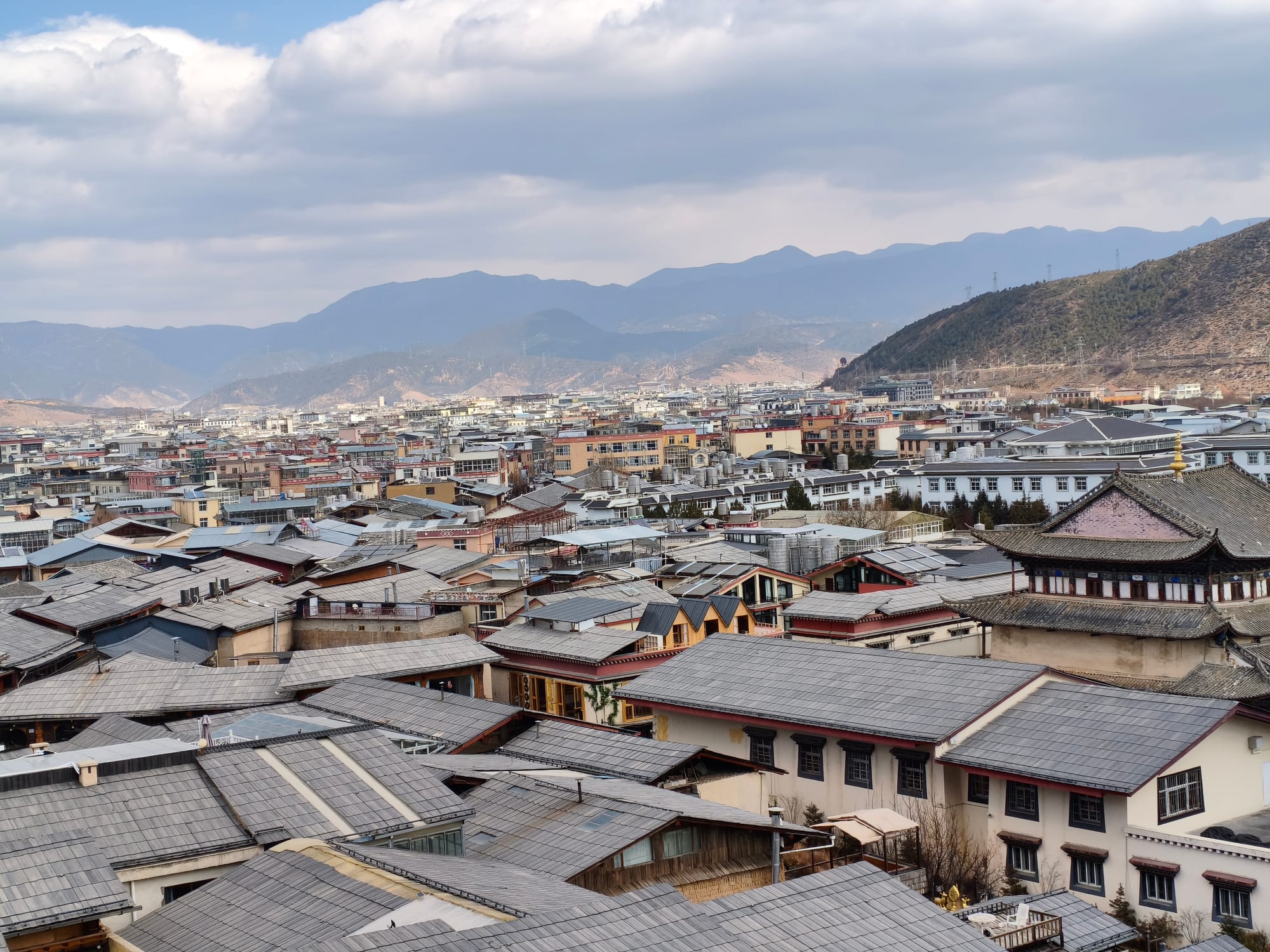
Grey slate roofs of Dukezong old town in Shangri-La with a temple's golden roof on the right and bare brown mountains behind

Sichuan, Yunnan & the Southwest, China

Shangri-La

The roofs of Dukezong old town and the newer city beyond, seen from Guishan Park in Shangri-La. (祝鱼贵 / Wikimedia Commons · CC BY-SA 4.0)

A Tibetan town at about 3,200 metres on the plateau of north-west Yunnan, seat of the Diqing Tibetan Autonomous Prefecture. Known as Zhongdian until 2001, when it took the name of the valley in James Hilton's novel, it has a rebuilt old town of wooden houses, a large monastery on a hill to the north, yak pastures, lakes and gorges around it, and a cold, thin, bright air.

Neighbourhoods

  • Dukezong old town
    • First-time visitors
    • Historic district
    • Guesthouses and cafés

    The old Tibetan quarter of stone-paved lanes and heavy wooden houses below the temple hill, about half of it destroyed by a fire in 2014 and since rebuilt. Most guesthouses, cafés and craft shops are here, and the square fills with dancing every evening.

    Open in Maps
  • Changzheng Road and the new town
    • Shopping
    • Close to public transport
    • Budget hotels

    The modern town running north from the old town along Changzheng Road to the bus station, with banks, supermarkets, Chinese restaurants and larger hotels. It is plain and functional but where residents shop and eat.

    Open in Maps
  • Songzanlin and the north
    • Monastery views
    • Quiet and residential

    The quieter area around the monastery, about four kilometres north of the old town, with Tibetan farmhouses, a few family guesthouses and views of the monastery's gilded roofs on the hill.

    Open in Maps

Things to do

Monasteries and the old town

  • Ganden Sumtseling Monasterylandmark

    The largest Tibetan Buddhist monastery in Yunnan, founded in 1679 under the Fifth Dalai Lama and sometimes called the Little Potala, with a gilded copper roof on its main hall and around 700 monks.

    Open in Maps
  • Dukezong old townneighborhood

    The historic Tibetan quarter of stone lanes and timber houses, rebuilt after the 2014 fire, with craft shops, teahouses and a central square.

    Open in Maps
  • Guishan Temple and the giant prayer wheelviewpoint

    A temple on Guishan hill above the old town, beside a giant prayer wheel; the hill looks over the old town's roofs and the newer city.

    Open in Maps

Lakes and the plateau

  • Pudacuo National Parkpark

    A protected area about 22 kilometres from town, the first in China to meet IUCN standards, with two lakes, forest, pasture and raised wooden walkways, part of the Three Parallel Rivers World Heritage Site.

    Open in Maps
  • Napa Lakepark

    A seasonal plateau lake about eight kilometres north-west of town, filled by snowmelt in summer, ringed on three sides by mountains.

    Open in Maps
  • Bita Lakepark

    One of Pudacuo's two lakes, at about 3,500 metres, ringed by dense forest, with boat rides to the island in its centre.

    Open in Maps
  • Shika Snow Mountainviewpoint

    A mountain just west of town, also known as Blue Moon Valley, with skiing in winter and views back over the plateau.

    Open in Maps

Short trips from the town

  • Tiger Leaping Gorgetrail

    One of the world's deepest river canyons, about 80 kilometres south towards Lijiang, where the Jinsha River runs between Jade Dragon and Haba snow mountains and a high trail of about 22 kilometres follows the north side.

    Open in Maps
  • Baishuitaiattraction

    White travertine terraces in the Naxi township of Sanba, about 90 kilometres by a difficult mountain road, where mineral water has built tiers of pale pools down a hillside.

    Open in Maps
  • Haba Snow Mountaintrail

    A 5,396-metre peak above the gorge whose summit is a popular goal for amateur mountaineers.

    Open in Maps

Seasonal events

  • Losar, Tibetan New YearFebruary or March

    Families gather, houses are cleaned and decorated, and the monastery holds prayers and offerings for the new year.

  • Shangri-La Horse Racing FestivalJune, from the fifth day of the fifth lunar month

    A three-day festival on a meadow south-east of town, with racing, dancing, singing and families camping in tents.

  • Gedong Festival at SongzanlinThe 29th day of the 11th month of the Tibetan calendar

    Masked cham dances by the monks in the monastery courtyard, drawing Tibetans from the surrounding valleys.

Eat and drink

Long-standing places and food districts in Shangri-La. Hours, ratings and directions come from your maps app, always current.

Shangri-La classics

  • Tibetan family restaurants in the old townneighborhood

    Yak-meat hotpot, yak-butter tea, tsampa and barley wine served at low tables in wooden rooms around the old town's lanes.

    Open in Maps
  • Cafés and bars of Dukezongneighborhood

    The old town has a string of small cafés and bakeries serving coffee and yak burgers to trekkers, and bars pouring locally brewed barley beers.

    Open in Maps

Food districts and markets

  • New town restaurants on Changzheng Roadneighborhood

    Sichuan and Yunnan rice-noodle shops, hotpot and barbecue, cheaper and busier than the old town and open later.

    Open in Maps

Experience Shangri-La

History

The plateau around the town has been Tibetan country for over a thousand years; the Tibetan name of the place, Gyalthang, means royal plain, and it lay on the eastern edge of the Tibetan world where the tea-horse caravan routes from Yunnan climbed towards Lhasa. Caravans carrying brick tea from the Pu'er region north and horses south passed through for centuries, and the town's old quarter, Dukezong, is some 1,300 years old. Its Tibetan name means white stone city and is taken to evoke a city of moonlight.

In 1679 the Ganden Sumtseling Monastery was founded under the authority of the Fifth Dalai Lama and became the largest Tibetan Buddhist monastery in Yunnan, home to hundreds of monks. Qing administrators knew the town as Zhongdian, and it remained a remote county seat under the Republic. The region came under the People's Republic in 1950, and Diqing Tibetan Autonomous Prefecture was created in 1957 with Zhongdian as its capital. The monastery was badly damaged in the 1960s and rebuilt from the 1980s.

In 2001 the county was renamed Shangri-La, after the hidden Himalayan valley of James Hilton's 1933 novel Lost Horizon, a marketing decision that beat rival claims from other towns and turned a quiet county into a tourist destination. A road from Lijiang, an airport, and the opening of Pudacuo, the first reserve in China to meet IUCN standards, in 2007 brought steadily growing numbers. In January 2014 a fire destroyed about half of Dukezong's wooden old town; it was rebuilt over the following years in traditional style, and in 2023 a railway from Lijiang linked the town to the national network.

Culture & Customs

Shangri-La is one of the Tibetan towns most easily reached by travellers, and Tibetan Buddhism shapes its calendar. Pilgrims circle the monastery and the prayer-wheel hill above the old town, prayer flags cover the passes and hilltops, and the monastery's winter festival of masked cham dances draws families from the valleys in their best clothes. Yet the area is mixed: Khampa Tibetans live in the north of the county and Naxi in the south, Han Chinese live throughout, and the wider prefecture includes a Lisu autonomous county.

The town is known for its horse-racing festival in early summer, when riders compete and families camp in tents on the racing meadow, and for the dancing that fills the old town square every evening, which draws locals of all ages and welcomes anyone who joins in. Crafts include black pottery from the village of Nixi, a tradition at least 2,000 years old, Tibetan jewellery and Yi lacquerware.

Manners are relaxed but religious courtesy matters. Clockwise is the rule for walking around anything sacred. Hospitality is generous and formal: butter tea, barley wine and tsampa are offered to guests, and refusing outright can offend. The town's identity, as its new name admits, is partly a performance for visitors, while Tibetan family life goes on in the farmhouses of the villages around.

Daily Life

About 186,000 people live in the city's whole county-level area, which covers a large stretch of plateau and valleys; the town itself is a fraction of that, and Diqing prefecture as a whole has fewer than half a million residents. Tourism is the engine of the town's economy, with hotels, guesthouses, drivers, guides and shops, and it is matched by farming and herding and by the collection of matsutake mushrooms, a registered local speciality, and of medicinal plants.

Most townspeople live in the new town's apartment blocks and in Tibetan-style houses — thick walls, carved and painted window frames, a ground floor once used for animals — in the villages on the plain. Life follows the farming and religious calendar more than the clock: early mornings around the monastery, a market and shopping in the new town, animals brought in at dusk, and the square dancing in the evening. Winter is the slow season.

The issues people discuss are the dependence on tourism and its seasonal swings, the balance between the restored old town and the commercial feel it has taken on since the fire, land and housing pressure from new building, and the cost and difficulty of moving to the lowlands for education and work. Altitude and distance make health care and schooling harder than in central Yunnan.

Food

The food is Tibetan plateau cooking with Yunnan additions. Yak is the staple meat, served as a hotpot of yak and vegetables boiled at the table, as dried jerky, and as grilled or stir-fried yak with chilli. Butter tea, suyou cha, made from brick tea churned with yak butter and salt, is the daily drink, and tsampa, roasted barley flour kneaded with tea into a dough, is the traditional breakfast and travelling food. Yak cheese is made in the town, and yak-cheese dumplings appear on menus aimed at visitors.

Barley wine, qingke jiu, a cloudy, mildly alcoholic brew, is poured for guests and at festivals, and a stronger distilled version is kept for cold nights. Summer brings the matsutake harvest, when the prized mushrooms, songrong, are sliced raw with soy or cooked with chicken and sold at the market and in restaurants across town; China's matsutake come mainly from the north-east and the south-west. Wild mushrooms of many kinds appear in the rainy season.

Lowland Yunnan food is everywhere in the new town: rice noodles for breakfast, Sichuan-style stir-fries and hotpot, and barbecue in the evening. The old town's cafés serve yak burgers and coffee to trekkers heading for the gorge, and Tibetan porridge appears on local menus.

Planning tools

Budget

Shangri-La is cheap for food and lodging by Chinese standards, but scenic-area tickets, especially for Pudacuo, and hiring a car for the gorge or the mountains add up quickly. Guesthouses in the old town range from basic dormitories to restored Tibetan houses.

Daily Budget Midrange
USD 70–150 (boutique Tibetan-style hotel, restaurant meals, park tickets, a shared car for day trips)
Daily Budget Shoestring
USD 25–45 (hostel bed or family guesthouse, noodle shops and Tibetan home cooking, buses)

Share a car with other travellers for the gorge and the lakes, and allow for scenic-area tickets, which can cost more than the rest of the day.

Best Time to Visit

May to June, when the meadows flower and the weather is mild, and September to October, when skies are clear and the larches turn gold. July and August are the rainy season, with cloud on the mountains. Winter is cold, dry and sunny, the quietest time, with the monastery's dance festival, though snow can disrupt the roads.

Suggested Number of Days

Two or three days allow the altitude to settle while seeing the town, the monastery and the nearest lakes. Add two or three more for the gorge and the mountain roads, longer if the weather closes in.

First Visit
2–3 days
With Surroundings
4–6 days

Transportation

The old town is walked, and the monastery is a short bus or taxi ride away. A local bus runs from the old town north through the new town; the lakes, gorge and mountains need a hired car, a tour minibus or the regional buses from the main station. Taxis are cheap and plentiful in the new town. Ride-hailing works through Chinese apps.

Mountain roads close after landslides in the rainy season, so leave a spare day before an onward flight or train.

Airport & Station Connections

Diqing Shangri-La Airport is about five kilometres south-west of the town, with flights from Kunming, Chengdu, Lhasa and other Chinese cities. A railway from Lijiang opened in November 2023, putting Shangri-La about 1 hour 20 minutes from Lijiang and about five hours from Kunming by train. Buses run from Lijiang in about four hours, and a hired car can stop at Tiger Leaping Gorge on the way; and north towards Deqin and the Sichuan border.

Walkability

The old town is small and easily walked in an hour, though its stone lanes are steep in places and the climb to the temple hill is short but hard in the thin air. The new town is a flat grid with wide pavements. At 3,200 metres any walk feels longer than it looks, and the sun is strong even in cold weather.

Safety

Crime is rare. The real risks are altitude — headaches, poor sleep and breathlessness are common on arrival, and the lakes and cable car go higher — and the roads, where landslides, ice and fast driving cause accidents. Stray dogs are common around villages and the monastery.

Ascend gradually on the plateau, avoid gorge and mountain trails in heavy rain, drink plenty of water, rest on arrival, do not drink alcohol the first night, and keep the passport to hand. Check current official travel advice before travelling.

Climate

A cold highland climate with a short, wet summer and a long, dry, sunny winter. Outside summer, nights are sharply colder than the days, and the sun is fierce at this altitude.

Summer
cool and showery — July averages about 14°C, and most of the year's rain falls in summer
Winter
cold, dry and sunny — January averages about −2°C, and even light snow can block roads

Local Customs

The town is Tibetan in culture, with Naxi and Han residents alongside. Tipping is not practised. At the monastery and temples walk clockwise around shrines and prayer wheels, remove hats indoors, and do not photograph inside the halls or point feet at images. Butter tea is offered as hospitality and a refill is a courtesy; it is polite to sip rather than refuse. Evening circle dancing in the old town square is open to anyone who joins the ring.

Ask before photographing monks, pilgrims or people at prayer, keep shoulders and knees covered in religious buildings, and avoid political conversation about Tibet. Barley wine is strong at altitude; drink lightly.

Common Payment Methods

The currency is the renminbi (yuan). WeChat Pay and Alipay are used for nearly everything and accept foreign cards; the main banks in the new town have ATMs that take international cards, but there are few beyond the town, so cash is needed for villages, the gorge and roadside stops.