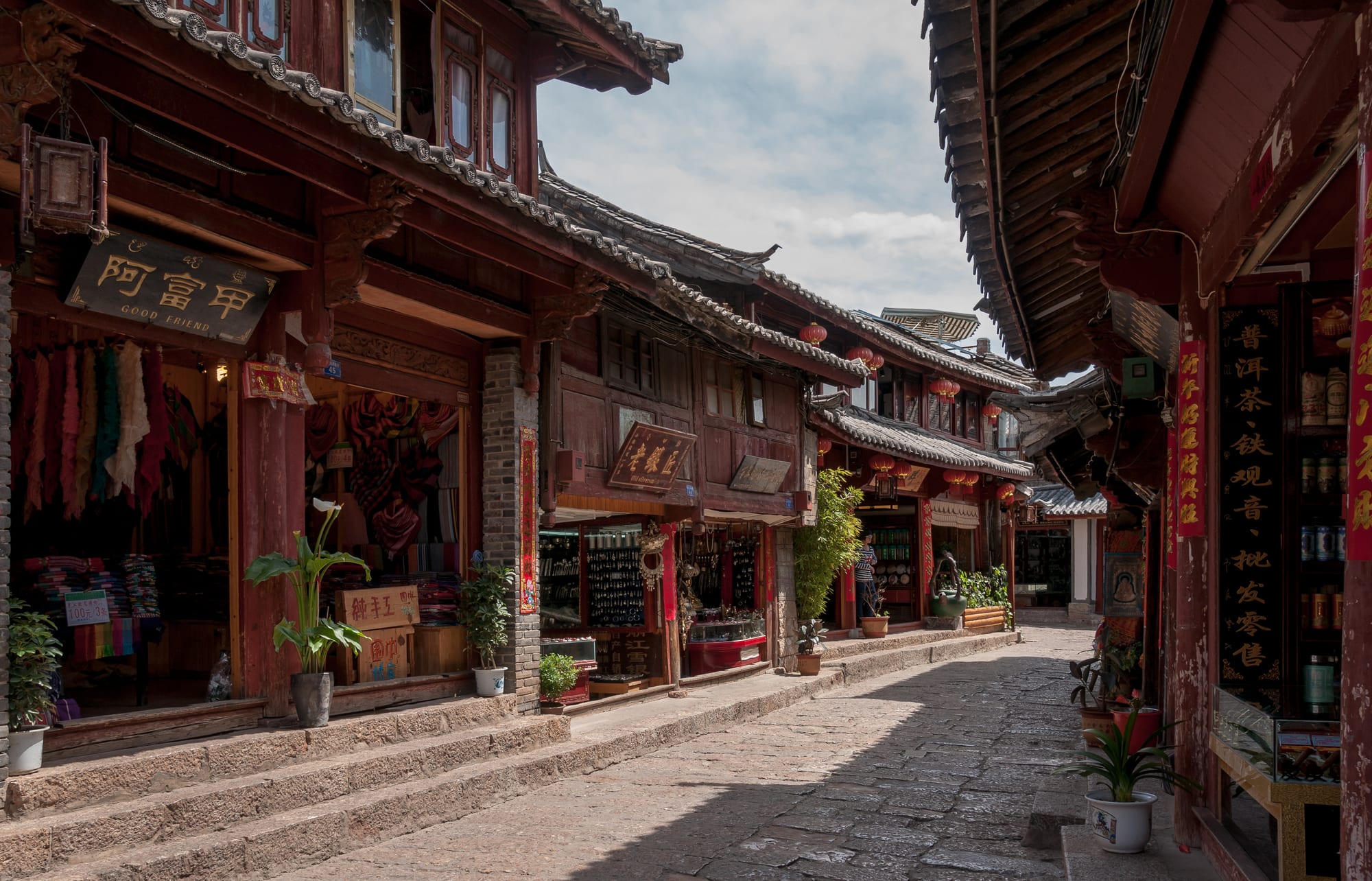
A cobbled lane between timber-fronted shops with carved eaves, red lanterns and potted plants in Lijiang's old town

Sichuan, Yunnan & the Southwest, China

Lijiang

Timber shopfronts along a stone lane in the old town of Lijiang, Yunnan. (CEphoto, Uwe Aranas / Wikimedia Commons · CC BY-SA 3.0)

A town in north-western Yunnan set on a plateau at about 2,400 metres below the Jade Dragon Snow Mountain. Its old town of cobbled lanes, timber courtyards and stone-lined water channels grew as a trading centre of the Naxi people under the hereditary Mu family, was rebuilt after an earthquake in 1996 and is a UNESCO World Heritage Site.

Neighbourhoods

  • Dayan old town
    • First-time visitors
    • Historic district
    • Walking

    The main old town, a maze of stone lanes, timber courtyard houses, bridges and channels of water running down from the springs at Black Dragon Pool. Guesthouses, bars, tea and craft shops fill it, and it is busiest in the evening around the central square.

    Open in Maps
  • Shuhe
    • Quiet and residential
    • Cafés
    • Families

    A smaller old settlement a few kilometres north-west, on the same trading route and built in the same style but with wider lanes and more space. It is calmer than Dayan and popular with visitors staying several nights.

    Open in Maps
  • Baisha
    • Local culture
    • Art and murals
    • Countryside

    The oldest of the three settlements, a village on the plain closer to the mountain, and the political and commercial centre of the area long before Dayan grew. It keeps working farmland, embroidery and painting workshops, and the Ming-era murals in its temple halls.

    Open in Maps
  • The new town
    • Transport connections
    • Everyday local life
    • Cheap rooms

    The modern grid east of the old town, where most residents actually live, with the bus stations, hospitals, supermarkets and ordinary restaurants. Plain but practical, and the base for onward travel.

    Open in Maps

Things to do

The old towns

  • Old Town of Lijiangneighborhood

    The UNESCO-listed Naxi town of timber and stone, laid out without a formal grid around a water system that once served every household.

    Open in Maps
  • Mu's Residencelandmark

    The walled compound of the Mu family, hereditary chieftains of Lijiang until 1723, restored as a museum of halls, gardens and audience rooms.

    Open in Maps
  • Shuhe Old Townneighborhood

    A quieter Naxi settlement on the old caravan route north-west of Dayan, with its own square, stream and stone bridges.

    Open in Maps
  • Baisha Muralsattraction

    Wall paintings in the temple halls at Baisha, mixing Chinese Buddhist, Tibetan and Naxi religious imagery on the same walls.

    Open in Maps

Parks and viewpoints

  • Black Dragon Poolpark

    A spring-fed pool and park on the edge of the old town, with pavilions, a moon-embracing bridge and, on clear mornings, the reflection of the Jade Dragon Snow Mountain.

    Open in Maps
  • Lion Hillviewpoint

    The wooded hill rising from the middle of the old town, topped by a tall timber pavilion and giving views over the grey tiled roofs to the mountains.

    Open in Maps

Short trips from the town

  • Jade Dragon Snow Mountainattraction

    The snow massif north of the town, rising above 5,500 metres, reached by cable cars to high meadows and glacier viewpoints where altitude is felt.

    Open in Maps
  • Tiger Leaping Gorgetrail

    One of the deepest river gorges in the world, where the upper Yangtze cuts between two snow ranges, with a high trail walked over one or two days.

    Open in Maps
  • Lashi Lakepark

    A shallow wetland west of the town, a wintering site for migratory birds, ringed by Naxi villages and horse trails.

    Open in Maps

Seasonal events

  • Sanduo Festivaleighth day of the second lunar month, usually March

    The main Naxi festival, honouring the protector god Sanduo with offerings, horse racing and gatherings at Baisha and in the villages.

  • Torch Festivalsixth lunar month, usually July or August

    Bonfires, torches and dancing held by Yi, Naxi and Bai communities across north-western Yunnan on summer nights.

  • Chinese New YearJanuary or February

    Family meals, temple visits and lanterns through the old town, and one of the busiest travel periods of the year.

Eat and drink

Long-standing places and food districts in Lijiang. Hours, ratings and directions come from your maps app, always current.

Lijiang classics

  • Lijiang babarestaurant

    The local flatbread of wheat dough fried in layers until crisp, made plain, salty with ham and spring onion, or sweet with sugar and rose petals, sold from small shops around the old town.

    Open in Maps
  • Naxi home cookingrestaurant

    Courtyard restaurants serve Naxi dishes such as chickpea jelly with chilli and vinegar, cured ham, hotpot of chicken or yak, wild mushrooms in season and stir-fried mountain greens.

    Open in Maps

Markets and eating streets

  • The old town produce marketmarket

    The produce market in the heart of Dayan, where households buy vegetables, mushrooms, ham, cheese and herbs, and stalls sell breakfast noodles and baba from early morning.

    Open in Maps
  • Shuhe lanesneighborhood

    Cafés, tea houses and small restaurants along the stream in Shuhe, generally calmer and less crowded than the eating streets of Dayan.

    Open in Maps

Experience Lijiang

History

Lijiang grew where the caravan routes between Yunnan, Tibet and Sichuan crossed a fertile basin below the snow mountain. The Naxi, whose ancestors are thought to have migrated south from the Tibetan plateau, settled the plain, and from the thirteenth century the Mu family governed it as hereditary chieftains — first under Mongol overlordship, then confirmed by the Ming, who granted them the surname Mu and considerable autonomy. Their walled compound in the old town was the centre of a small state that traded in tea, horses, salt, medicine and timber.

The old town that survives took shape in that period, built without city walls and laid out along water: a stream from the springs at Black Dragon Pool splits into three and again into channels that once reached every quarter. In 1723 the Qing replaced hereditary rule with imperial officials, and Lijiang became a frontier market town rather than a capital. In the twentieth century it drew outside attention through the Austrian-American botanist Joseph Rock, who lived in the area for much of the 1920s and 1930s and wrote about Naxi religion.

An earthquake in February 1996 killed hundreds of people and damaged much of the region. Reconstruction favoured the old timber and stone architecture, and in 1997 UNESCO inscribed the Old Town of Lijiang as a World Heritage Site. Tourism followed on a scale nobody had planned for: guesthouses, bars and shops replaced many homes, most original residents moved to the new town, and Lijiang has since become both one of China's best-known destinations and a standing argument about what heritage tourism does to a living town.

Culture & Customs

The Naxi are the defining community here, with their own language, a matrilineal strand in kinship attributed more strongly to the related Mosuo further north, and a religious tradition called Dongba after its priests. Dongba ritual uses the only pictographic writing system still in use anywhere, a script of small drawings recorded in manuscripts kept in Lijiang's museums and libraries and taught today to a small number of students.

Music is the other inheritance. Naxi ancient music draws on Taoist ritual and Chinese court repertoires preserved locally after they had faded elsewhere, and is played on old instruments by ensembles that perform regularly in the town. Naxi dress is recognisable in the women's sheepskin capes, embroidered with discs that are explained as stars, moon and sun, signifying work that begins before dawn and ends after dark.

Everyday manners here are relaxed and hospitable, shaped by centuries on a trade route where Naxi, Bai, Yi, Tibetan and Han travellers met. Bai carpenters and Tibetan traders left marks on the architecture and the religious art, and the murals at Baisha show Buddhist, Taoist and Tibetan figures on the same walls. The tension in modern Lijiang is between that inheritance and the industry built on it: staged costume, loud bars and photographic crowds beside households still living quietly behind the courtyard doors.

Daily Life

Lijiang is a prefecture-level city of roughly 1.3 million people, but most live in mountain villages and small towns across a large and rugged area; the town itself is small, and the resident population of its old quarters has fallen sharply. The plain around it is farmed for maize, potatoes, vegetables and increasingly for fruit and flowers, and herding continues on the higher ground.

Tourism is now the main employer by a wide margin. Guesthouses, restaurants, guides, drivers, craft workshops and performance venues depend on visitor numbers, which makes the local economy sensitive to travel patterns and holidays. The predictable effects have followed: rents in the old town too high for ordinary households, absentee owners, and a population that commutes into the historic centre to work and leaves at night.

Daily rhythms are set by altitude and sun. Mornings are bright and cold, the market is busiest early, afternoons are warm, and the lanes fill after dark when day-trippers return and the lanterns come on. Water still runs through the channels and is used, carefully, for washing vegetables at set points. Current concerns are water supply and drought, fire risk in dense timber quarters, the cost of maintaining old buildings, and how far commercialisation should be allowed to go.

Food

Naxi cooking is mountain food adapted to a cool plateau: cured meat, beans, potatoes, wheat and whatever grows in the basin. The best-known item is Lijiang baba, a fried wheat flatbread made in layers, crisp outside and soft within, sold plain, savoury with ham and spring onion, or sweet with sugar or rose. Jidou liangfen, a jelly made from chickpea flour, is eaten cold in summer with chilli, vinegar and coriander, or fried in slices when it is colder.

Meat is often preserved. Yunnan ham appears in stews and stir-fries, cured pork is cooked with potatoes, and yak meat, dried or hotpotted, reflects the proximity of Tibetan country to the north. A whole chicken stewed with local mushrooms and herbs is the usual celebration dish, and in summer the markets fill with wild mushrooms gathered on the hills. Rice noodles in broth are the standard breakfast, as across Yunnan, and grilled fish from the lakes is common in the villages.

Drinks lean to tea and grain alcohol. Pu'er tea from southern Yunnan is sold and drunk everywhere, butter tea appears where Tibetan influence is strong, and local barley and highland spirits are poured at gatherings. Rose and walnut sweets, honey and yak-milk products fill the shops, and bars in the old town serve fruit wines alongside ordinary beer.

Planning tools

Budget

Lijiang is one of the cheaper places in Yunnan to sleep and eat, with hundreds of guesthouses in converted courtyards, though prices in the old towns rise sharply in the summer and national holiday weeks. The costs that mount up are the excursions: entry and cable-car fares at the Jade Dragon Snow Mountain, transport to Tiger Leaping Gorge, and hired cars for the villages.

Daily Budget Midrange
USD 70–150 (courtyard guesthouse, restaurant meals, a mountain excursion with transport and cable car)
Daily Budget Shoestring
USD 25–45 (hostel or simple guesthouse, noodle shops and market food, local buses)

Staying outside the old-town core is cheaper and quieter; the mountain excursion is a full day and its cable-car tickets are limited daily.

Best Time to Visit

March to May and September to November are the best months, dry, clear and mild, with the mountain visible most days. The rains fall between June and September, often as heavy afternoon storms, and cloud hides the peaks. Winter days are sunny and cold, nights freeze, and the town is quiet apart from the new year holiday.

Suggested Number of Days

Two days covers the old towns at a slow pace. Four or five allow the mountain, the surrounding villages and a walk in the gorge, and travellers continuing north towards Shangri-La usually build Lijiang into a longer Yunnan route.

First Visit
2 days
With Surroundings
4–5 days

Transportation

The old towns are closed to cars, so walking is the only way inside them. Buses and taxis link Dayan, Shuhe, Baisha and the new town, minibuses run to the villages and the mountain, and most visitors reach the gorge or Lugu Lake by chartered car or tour bus. Roads climb and twist once out of the basin.

Agree a price before taking a minibus or chartered car, and allow extra time on mountain roads during the summer rains.

Airport & Station Connections

Lijiang Sanyi International Airport is about 25 kilometres south of the town, with flights from Kunming, Chengdu, Chongqing and other Chinese cities. Trains run from Kunming and Dali to Lijiang station south-east of the centre, taking about an hour and a half from Dali and longer from Kunming. Long-distance buses continue north towards Shangri-La and east towards Lugu Lake.

Walkability

Inside the old towns everything is walked, on uneven cobbles and stone slabs that are slippery when wet and hard on the ankles; the lanes are not laid out on a grid and getting lost is part of the experience. Distances are short but the ground rises and falls, and at 2,400 metres a steady pace matters while the body adjusts. Between the old towns and the new town it is better to take a bus or taxi.

Safety

Lijiang is safe, with little crime beyond occasional overcharging and pickpocketing in crowds. The real considerations are altitude — mild breathlessness is common on arrival and more serious at the mountain cable-car stations above 4,000 metres — along with cold nights, strong sun, slippery stone lanes and exposed sections on the gorge trail.

Allow time to adjust to the altitude on arrival, treat the mountain excursion as a high-altitude trip and descend if a headache worsens, and use sun protection at this elevation. Check current official travel advice before travelling.

Climate

A mild highland climate with strong sun, cool nights and a sharp wet season. Days are warm rather than hot, the air is dry for much of the year, and temperatures swing widely between afternoon and dawn.

Summer
warm and wet, generally 18–26°C by day, with heavy afternoon rain from June to September
Winter
sunny, dry and cold, often 12–18°C by day but around or below freezing at night

Local Customs

Tipping is not expected. The old towns are lived-in as well as visited: courtyards behind shopfronts are homes, and the water channels are still treated with care, so nothing should be washed or thrown into them. Naxi elders in traditional dress usually expect a small payment for photographs, and performances of Naxi music are ticketed concerts rather than street entertainment. Temples ask for quiet and covered shoulders and knees.

Ask before photographing people, keep noise down in residential lanes late at night, and treat Dongba manuscripts and temple objects as religious rather than decorative.

Common Payment Methods

The currency is the renminbi, counted in yuan. Payment by QR code through Alipay or WeChat Pay is normal everywhere, including market stalls, and international cards can be linked to those apps; foreign cards are otherwise little use outside hotels. Cash is worth carrying for village trips, and ATMs at major bank branches in the new town accept foreign cards.