Rippled tan sand dunes stretching to the horizon around a small blue lake fringed with green vegetation

China

Inner Mongolia

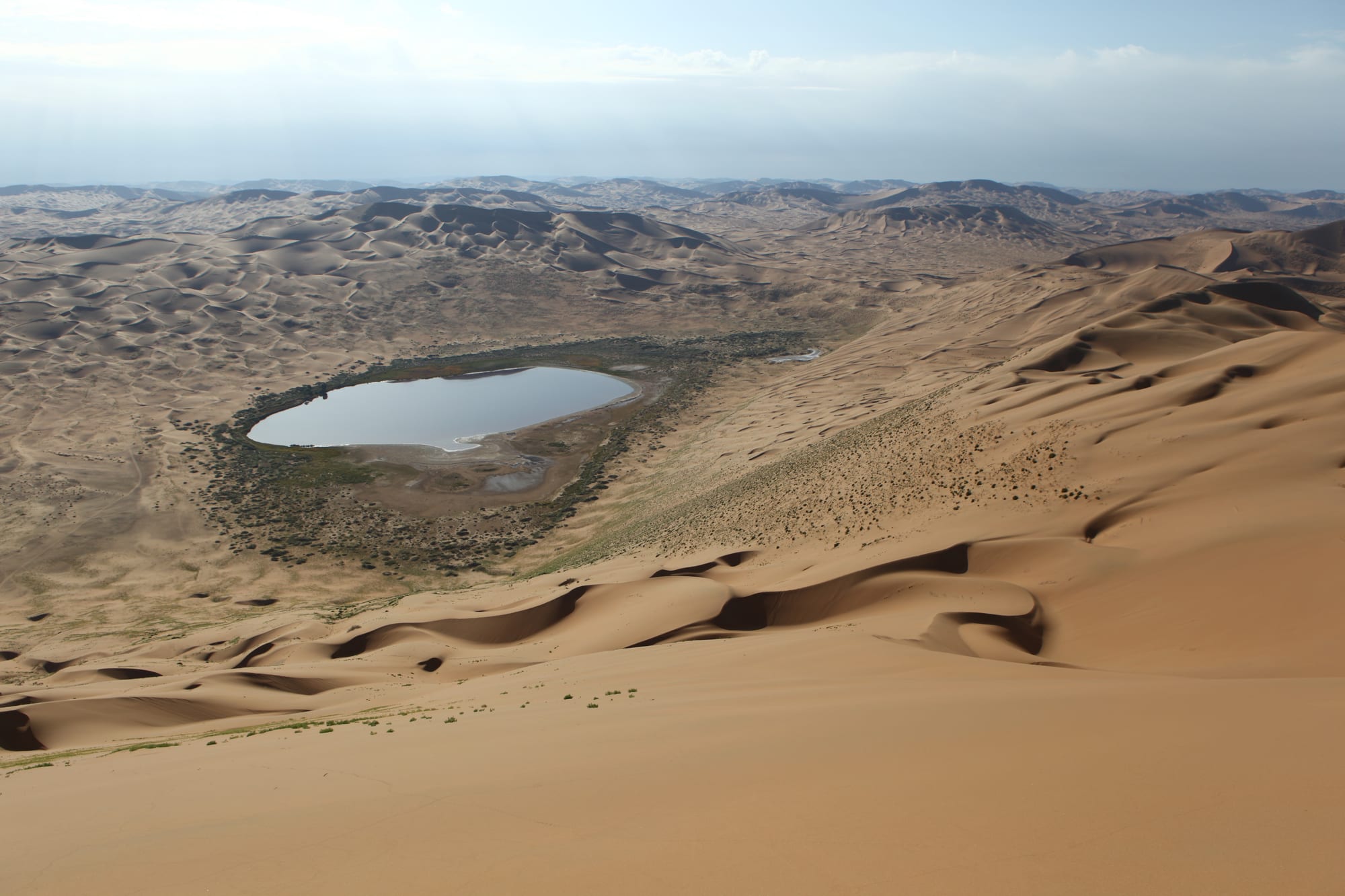
A desert lake among the giant dunes of the Badain Jaran, seen from Bilutu Peak in western Inner Mongolia. (Sjoerd van Oort / Wikimedia Commons · CC BY-SA 3.0)

China's long northern borderland, stretching along Mongolia and Russia from the forests of the Greater Khingan to the Gobi — an autonomous region of grassland, desert and coal cities where Mongol herding traditions survive alongside a large Han Chinese majority.

Explore Inner Mongolia

History

The steppe north of the Yellow River has been the meeting ground of herders and farmers for more than two thousand years. The Xiongnu confederation dominated it in the Han era, and the Han princess Wang Zhaojun, married to a Xiongnu ruler in 33 BC as a peace offering, is honoured at a tomb outside Hohhot. The Khitans rose in the east of the region and founded the Liao dynasty in the 10th century, and the Tangut Western Xia held the far west, where their city of Khara-Khoto still stands in ruins.

Genghis Khan united the Mongol tribes in 1206, and his grandson Kublai built his summer capital, Shangdu — Coleridge's Xanadu — in the south of the region. After the Yuan fell, the Mongol ruler Altan Khan founded Hohhot in the 16th century and renewed ties with Tibetan Buddhism, granting the title Dalai Lama to the Gelug leader Sonam Gyatso in 1578.

Under the Qing the Mongols were divided into Inner and Outer Mongolia, and Han farmers steadily moved onto the southern pastures. When Outer Mongolia broke away after 1911, the inner banners stayed within China. Japan ran a puppet Mongol state in the centre in the 1930s and 1940s, and in 1947 the Communists created the Inner Mongolia Autonomous Region, the first of China's autonomous regions. The Cultural Revolution brought a violent purge of alleged Mongol nationalists, and in the reform era coal and mineral wealth made Ordos and Baotou boom towns. In 2020 a reduction in Mongolian-language teaching in schools prompted rare public protests.

Culture & Customs

Mongols make up only about a sixth of the region's people, but their culture defines its image. Mongolian is written here in the traditional vertical script, not the Cyrillic used in the independent state of Mongolia, and it appears on every official sign. Many Mongols, especially in the cities, now speak mainly Mandarin, while herding families in the north and east keep the language at home. The Daur, Ewenki and Oroqen peoples of Hulunbuir have their own languages and forest and reindeer traditions.

The summer festival season revolves around the naadam, with the "three manly games" of wrestling, horse racing and archery, held at banner and county level. Music is central: the morin khuur, a two-stringed fiddle with a carved horse's head, the throat singing known as khoomei, and the Mongolian long song, recognised by UNESCO as intangible heritage. Stone cairns called oboo stand on hilltops, and travellers circle them clockwise and add a stone.

Religion is Tibetan Buddhism for most Mongols, with shamanic customs alongside, while the Han majority follow Chinese folk practice. Hospitality follows herding rules: guests are offered milk tea and a blue silk scarf, the khadag, and a bowl of spirits may be offered with a song, to be accepted with the right hand.

Daily Life

About 24 million people live in Inner Mongolia, mostly Han Chinese and heavily concentrated in the south. Hohhot, the capital, has about 3.5 million people; the steel city of Baotou and the coal city of Ordos, with its planned Kangbashi district, are the other major centres, alongside Chifeng in the east and Hailar in Hulunbuir.

The economy rests on coal, power generation, rare earths — the Bayan Obo mine north of Baotou is among the world's largest deposits — dairy and livestock. Mengniu and Yili, China's biggest dairy companies, are both based in Hohhot, and wind and solar farms now cover large stretches of the steppe. Overgrazing, mining and desertification have degraded much grassland, and tree-planting belts are part of a long campaign against the advancing sand.

Herding life has changed: most herders now live in fixed houses, fence their allotted pastures, drive motorbikes and pickups, and move to yurts only seasonally or for tourists. Young Mongols increasingly leave for the cities, while tourist yurt camps give some families a summer income.

Food

The Mongol diet is built on meat and milk, the "red foods" and "white foods". Mutton is everywhere: shouba rou, hand-held chunks of boiled lamb eaten off the bone with a knife; and whole roast lamb served at banquets. The dairy table includes suutei tsai, milk tea made with salt and sometimes toasted millet and butter, milk tofu and dried curd cheeses, and cream skin skimmed from boiled milk.

Hohhot is known for its shaomai, open-topped steamed dumplings filled with minced mutton and spring onion, traditionally eaten for breakfast with tea. The farming areas of the west share Shanxi's taste for oat-flour noodles and potatoes, and the Hetao plain along the Yellow River grows wheat and other crops. Fried dough pieces called bortsog and hotpots of sliced mutton fill winter tables.

Airag, fermented mare's milk, is a mildly alcoholic summer drink, and milk spirits are distilled from fermented milk. Baijiu is served at every banquet with toasting songs, and cold local beer accompanies the barbecue mutton skewers sold across the region's cities.

Attractions & Natural Wonders

Hohhot has the Dazhao Temple, founded under Altan Khan in the 16th century, the Five Pagoda Temple with its carved Buddhas and an old Mongolian star chart, the Inner Mongolia Museum's dinosaur and nomad galleries, and the tomb of Wang Zhaojun on the edge of the city. The Huitengxile grassland, about 135 kilometres away, is within day-trip range.

In the north-east, the Hulunbuir grasslands roll out around Hailar, with the wide Hulun Lake, the meandering Morgele river and the Argun river along the Russian border. Manzhouli, the border town, grew up around a Russian railway station, and the Greater Khingan forests and volcanic lakes of Arxan lie to the south. The ruins of Shangdu, Kublai's Xanadu, are a UNESCO World Heritage Site in the grassland of the south.

The south-west has the Mausoleum of Genghis Khan at Ejin Horo Banner near Ordos — a memorial rather than a grave, where offerings are made in a set of domed halls — and the singing sand dunes of Xiangshawan in the Kubuqi Desert. Far to the west in Alxa, the Badain Jaran Desert holds towering dunes around dozens of lakes, and Ejin combines golden poplar forests with the ruins of Khara-Khoto.

Cities in Inner Mongolia

Planning basics

Budget

Everyday costs are lower than in Beijing, and Hohhot, Baotou and Hailar have cheap hotels and canteens. The expense is distance: reaching the grasslands, the Badain Jaran or Ejin usually means a flight, a long train or bus ride and then a hired driver or 4x4 tour. Yurt camps on the grasslands vary widely in price and rise sharply in July and August.

Daily Budget Midrange
USD 90–180 (mid-range hotel or yurt camp, a hired car and driver, entry tickets)
Daily Budget Shoestring
USD 30–50 (budget hotel, noodle and mutton restaurants, buses and trains)

Share the cost of a driver or desert 4x4 with other travellers; public transport barely reaches the grasslands and dunes.

Safety

Crime is low. The risks are environmental: extreme winter cold, summer heat and dehydration in the deserts, getting lost in the dunes, and long drives on empty roads. Mongolian identity and language policy are politically sensitive, and border areas with Mongolia and Russia have restricted zones and frequent ID checks.

Enter the Badain Jaran only with an experienced local driver, carry plenty of water, and dress for the cold even in shoulder seasons. Check current official travel advice before travelling.

Climate

Harshly continental, and far colder in winter than Beijing. Hulunbuir in the north-east is one of China's coldest inhabited places, with winter nights well below −30°C; the west is arid desert with hot summer days and bitter winters. Most rain falls in July and August, when the grasslands are green. Spring is windy and dusty.

Summer
warm days of 20–30°C on the grasslands, hotter in the western deserts, with cool nights
Winter
long and severe, often −15 to −30°C in Hulunbuir and well below freezing across the region

Transportation

High-speed trains link Hohhot with Beijing in about two to three hours, and Hohhot, Baotou and Ordos are connected by rail and expressway. Hulunbuir is far to the north-east and easiest reached by flying to Hailar or Manzhouli. The Badain Jaran is entered from Alxa Right Banner in 4x4 vehicles, and Ejin has an airport and a slow rail link. Distances within the region are very large.

Plan Inner Mongolia as two or three separate trips — east, centre and west — rather than one overland journey.

Best Time to Visit

July and August for green grasslands and Naadam-style fairs, though this is also the domestic peak season. September and early October suit the deserts, and the Ejin poplars turn gold in autumn. Winter is for ice and snow festivals in Hulunbuir and Manzhouli only for those prepared for extreme cold.