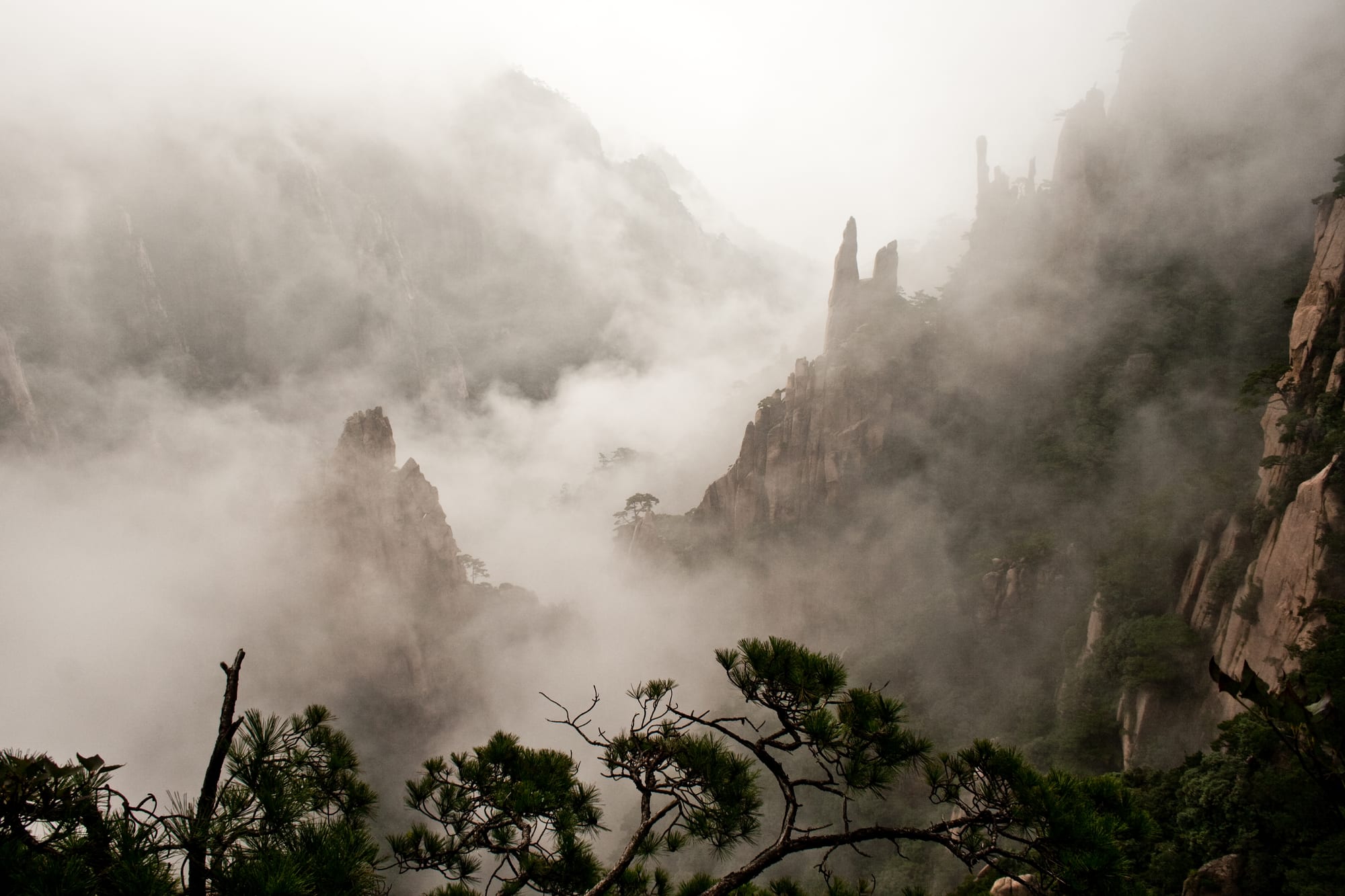
Granite pinnacles rising out of drifting mist and cloud, with twisted pine branches in the foreground

China

Central China

Mist swirling around the granite peaks and pines of Huangshan in southern Anhui. (eviltomthai / Wikimedia Commons · CC BY 2.0)

The inland heart of China between the Yellow River and the middle Yangtze — Henan, Hubei, Anhui and Jiangxi — the cradle of early Chinese dynasties and ancient capitals, home of the granite peaks of Huangshan, the Shaolin temple, the porcelain kilns of Jingdezhen and the Three Gorges Dam, with the great rail hub of Wuhan at its centre.

Explore Central China

History

Henan is often called the cradle of Chinese civilisation. The Shang dynasty had capitals near Zhengzhou and at Anyang, where oracle bones carry the earliest known Chinese writing. Luoyang served as capital for the Eastern Zhou, the Eastern Han and, from 493, the Northern Wei, who began carving the Longmen Grottoes; under the Tang it was a second capital, favoured by Empress Wu Zetian. Kaifeng was the Northern Song capital, one of the largest cities in the world, until the Jurchens took it in 1127. To the south, Hubei was the core of the state of Chu, and the Battle of Red Cliffs was fought on the Yangtze here in 208.

In the Ming and Qing eras the Huizhou merchants of southern Anhui grew rich in salt and trade and built the villages around Huangshan, while Jingdezhen's kilns produced porcelain for the imperial court and for export worldwide.

Modern Chinese history turned here repeatedly. The Wuchang Uprising in Wuhan on 10 October 1911 set off the revolution that ended the Qing. The Nanchang Uprising of 1927 is celebrated as the birth of the Red Army, and the Communists built their Jiangxi Soviet around Ruijin until 1934, when the Long March began. In 1938 Nationalist forces breached the Yellow River dykes in Henan to slow the Japanese. The Great Leap famine struck Henan and Anhui hard, and the Lushan Conference of 1959 purged Marshal Peng Dehuai for criticising the Great Leap Forward. In 1978 farmers at Xiaogang in Anhui secretly divided the land among households, an early step in rural reform. The Three Gorges Dam was built in the 1990s and 2000s, and in January 2020 Wuhan was placed under an unprecedented lockdown to contain the COVID-19 outbreak.

Culture & Customs

Speech varies across the region: Henan and most of Hubei speak Mandarin dialects, Jiangxi speaks Gan, and southern Anhui has its own Hui dialects. Regional operas are strong — Yu opera in Henan, with its high, carrying voices, and Huangmei opera from Anqing in Anhui, loved for its gentle folk melodies.

Southern Anhui is the home of Hui culture: villages of whitewashed walls, black tiles and stepped "horse-head" gables, ancestral halls and memorial arches, and the carvings in brick, stone and wood of the merchants' houses. The area produces the scholar's "four treasures" — Hui ink sticks, Xuan paper, She inkstones and brushes — for calligraphy and painting. Jingdezhen still has thousands of potters and painters, many of them young artists from across China.

Religion and martial tradition are woven into the landscape. The Shaolin Temple in Henan is linked with Chan (Zen) Buddhism and kung fu, and Chenjiagou village is honoured as the home of Chen-style tai chi. Hubei's Wudang Mountains are a centre of Daoism and Daoist martial arts, Jiuhuashan in Anhui is one of Buddhism's four sacred mountains, and Longhushan in Jiangxi is associated with the Celestial Masters of Daoism. The Hubei Provincial Museum's bronze chime bells from the tomb of Marquis Yi of Zeng are a symbol of Chu culture.

Daily Life

Some 260 million people live in the four provinces. Henan, one of China's most populous, is centred on Zhengzhou, with Luoyang, Kaifeng and Anyang among its old cities. Wuhan, with about 13 million people, is the largest city of the region, formed from the three towns of Wuchang, Hankou and Hanyang. Hefei is Anhui's fast-growing capital and Nanchang Jiangxi's.

Farming remains important — wheat in Henan, rice and freshwater fish around the Yangtze lakes — but the region has industrialised quickly. Wuhan makes cars, steel and optical fibre and has dozens of universities, Zhengzhou assembles smartphones, and Hefei has become a hub for electric vehicles, displays and research. For decades these provinces sent tens of millions of migrant workers to the coast; more now find work closer to home.

City life runs on early breakfasts eaten on the street, long commutes, humid evenings along Wuhan's riverbanks and East Lake, and square dancing. Floods on the Yangtze and Huai rivers and summer heatwaves are recurring worries, and many villages have emptied as young people leave.

Food

Central Chinese food is robust. Wuhan's breakfast culture is famous: re gan mian, "hot dry noodles" tossed in sesame paste, chilli oil and pickles, is the city's signature, along with doupi, a sticky-rice and tofu-skin pancake. Hubei also eats Wuchang fish, a steamed bream, and pork-rib soup with lotus root from the lakes, while spicy braised duck necks are a national snack.

Henan favours wheat: Zhengzhou's huimian, wide hand-pulled noodles in mutton broth, and hulatang, a peppery thickened soup eaten at breakfast. Luoyang's "water banquet" is a meal of many soupy courses, and Kaifeng's night market sells soup-filled guantang bao dumplings and grilled snacks.

Anhui's Hui cuisine uses ham, bamboo shoots and mushrooms from the hills. Its best-known dishes are chou guiyu, a deliberately fermented mandarin fish, and maodoufu, a fuzzy mould-fermented tofu that is fried. Jiangxi cooking favours strong, salty and spicy flavours, with Nanchang rice noodles and soups slow-cooked in clay jars. Tea is a regional pride: Huangshan Maofeng and Keemun black tea from Anhui, Xinyang Maojian from Henan, and Lushan's cloud-and-mist tea.

Attractions & Natural Wonders

Southern Anhui combines Huangshan — granite peaks, gnarled pines and seas of cloud, climbed by stone stairways and cable cars — with the Hui villages of Xidi and Hongcun at its feet, the old town of Shexian and the Buddhist mountain of Jiuhuashan.

Henan holds the ancient core. The Shaolin Temple and its Pagoda Forest of monks' tombs lie on Mount Song near Dengfeng; south of Luoyang, the Longmen Grottoes line both banks of the Yi river, with the great seated Vairocana Buddha of the Fengxian Temple at their centre, and the White Horse Temple is traditionally counted as China's first Buddhist temple. Kaifeng has the Iron Pagoda and its night market, and Anyang has the Yinxu ruins of the Shang capital.

In Hubei, Wuhan has the Yellow Crane Tower above the Yangtze, East Lake and the Hubei Provincial Museum. Upriver, the Xiling Gorge, the easternmost of the Three Gorges, leads to the Three Gorges Dam near Yichang, where cruises from the upper Yangtze end; the Daoist temples of the Wudang Mountains and the forests of Shennongjia lie to the north-west. Jiangxi has Jingdezhen's imperial kiln site and ceramics museums, the misty peaks and colonial-era villas of Lushan above Poyang Lake — China's largest freshwater lake and a winter refuge for cranes — the granite pillars of Sanqingshan and the villages of Wuyuan.

Cities in Central China

Planning basics

Budget

Central China is cheaper than the coast, with low prices for food, trains and city hotels in Zhengzhou, Wuhan, Hefei and Nanchang. The big costs are the scenic areas: Huangshan, Lushan, Shaolin and the Longmen Grottoes all charge substantial entry fees, and Huangshan adds cable cars and expensive summit hotels. Three Gorges cruises range from basic ferries to costly tourist ships.

Daily Budget Midrange
USD 90–180 (mid-range hotel, restaurant meals, scenic-area tickets and cable cars)
Daily Budget Shoestring
USD 30–50 (hostel or budget hotel, noodle stalls, buses and second-class high-speed rail)

Carry food and water up Huangshan; everything on the summit is hauled up by porters and priced accordingly.

Safety

The region is safe for visitors. The risks are crowds at scenic areas on holidays, steep stone stairways and slippery paths on Huangshan and Lushan, extreme summer heat, and flooding along the Yangtze in wet summers. Touts outside the Shaolin Temple sell unofficial tours and "kung fu schools".

Wear shoes with grip on mountain steps, avoid the midday heat in summer, and buy scenic-area tickets through official counters or apps. Check current official travel advice before travelling.

Climate

Humid and continental-monsoon. Summers are long and very hot, and Wuhan is counted among China's "furnace" cities. Winters are cold and damp, colder and drier in northern Henan. Spring brings heavy rain along the Yangtze, and floods are a recurring risk in summer. The mountains — Huangshan, Lushan, Wudang — are much cooler, with frost and snow in winter.

Summer
hot and humid, 32–38°C in Wuhan and Nanchang, with heavy rain; cooler on the mountain summits
Winter
cold and damp, around 0–10°C, with occasional snow; freezing and icy on Huangshan

Transportation

Zhengzhou and Wuhan are two of China's biggest high-speed rail junctions, on the Beijing–Guangzhou line, and are a couple of hours apart. Luoyang is a short high-speed ride west of Zhengzhou, with buses to the Shaolin Temple and Longmen. Huangshan North station serves the mountain and the Hui villages, and Jingdezhen and Lushan are reached from Nanchang or Jiujiang. Yichang is the base for the Three Gorges Dam and the end of many river cruises.

Stay a night on Huangshan's summit or at its foot to walk the peaks early, before the tour groups arrive by cable car.

Best Time to Visit

April to May and September to November are the best months. Spring brings the Luoyang peony festival in April and rapeseed flowers around the Anhui and Jiangxi villages; autumn has clear air and colour on Huangshan. Summer is hot everywhere but the mountains, and winter can give snow on Huangshan's pines with fewer visitors. Avoid holiday weeks at Huangshan, when the paths are jammed.