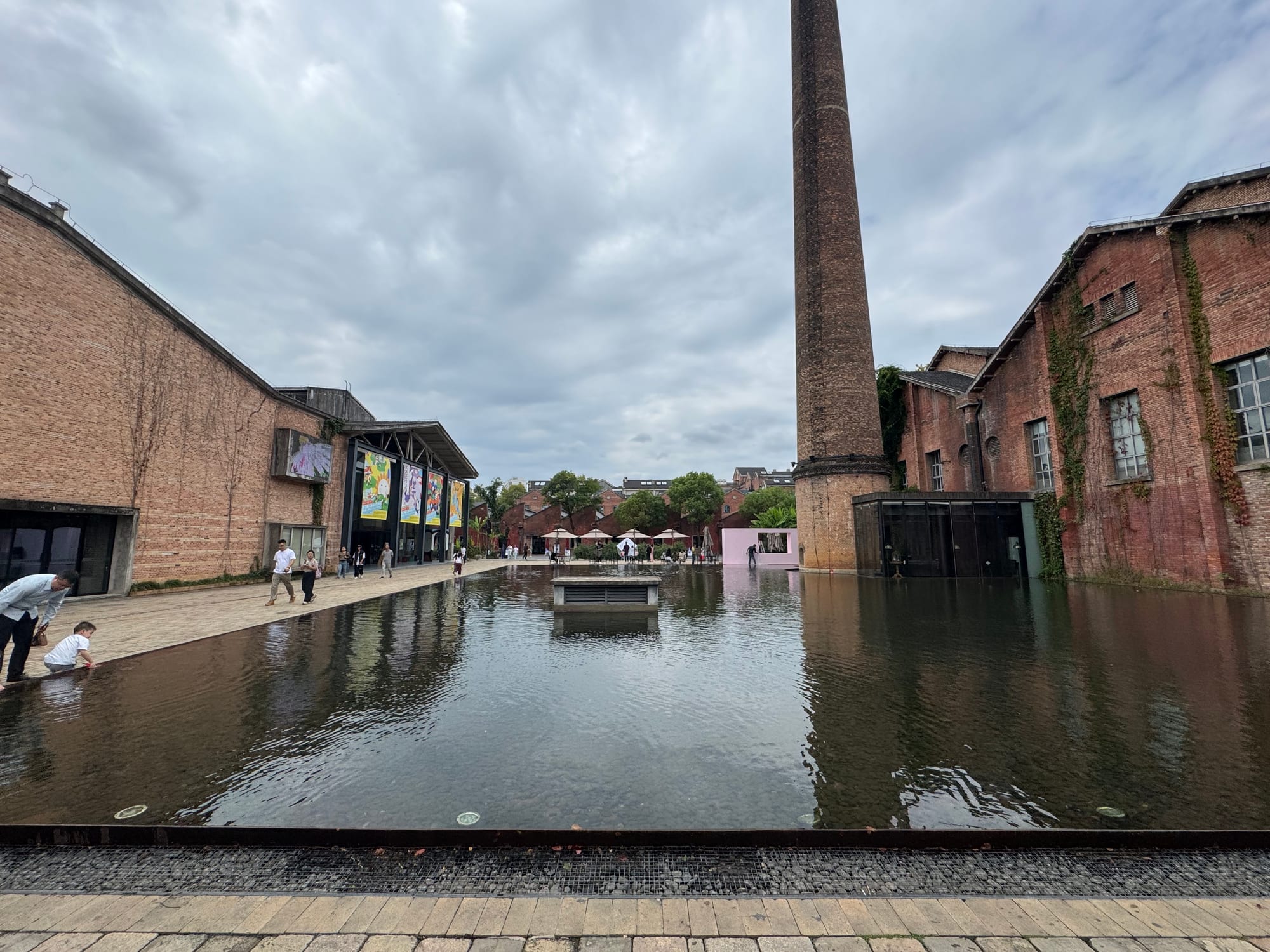
A tall brick kiln chimney between old red-brick factory sheds, reflected in a shallow pool with people walking beside it

Central China, China

Jingdezhen

The converted porcelain factory buildings and kiln chimney of the Taoxichuan district in Jingdezhen. (Simon Wade / Wikimedia Commons · CC BY-SA 4.0)

A city on the Chang River in north-eastern Jiangxi that has made porcelain for more than a thousand years, supplying the imperial court and, through Canton and the Dutch and English trading companies, much of the world. Kiln sites, converted factories and thousands of small studios still shape the town, which now draws young potters from across China; UNESCO added its porcelain industry sites to the World Heritage list in 2026.

Neighbourhoods

  • Zhushan and the old kiln quarter
    • First-time visitors
    • Historic district
    • Best for food

    The centre on the east bank of the Chang River, built around the imperial kiln site and the lanes of old kiln workshops, with the drum tower, small hotels and most of the city's restaurants. Porcelain shops and studios run along street after street here.

    Open in Maps
  • Taoxichuan
    • Arts and culture
    • Markets
    • Cafés

    A former state porcelain factory east of the centre, its brick sheds and kiln chimneys converted into studios, galleries, cafés and a weekend craft market. It is the main gathering place for the young potters who have moved to the city.

    Open in Maps
  • Changjiang
    • Local life
    • Quiet and residential

    The district on the west bank across the river, largely residential and industrial, with the older working-class housing of the porcelain factories and cheaper places to stay. It is a short taxi or bus ride from the centre.

    Open in Maps
  • Fuliang
    • Nature
    • Short trips
    • Quiet and residential

    The county that surrounds the city, with tea terraces, wooded hills, old villages and the porcelain-stone quarries that supplied the kilns. Its historic county seat, about 8 km north of Jingdezhen, was the administrative centre of the porcelain district for centuries.

    Open in Maps

Things to do

Porcelain sites and museums

  • Jingdezhen Ceramic Universitylandmark

    The only university in China devoted to ceramics, whose graduates supply much of the city's studio scene and whose campus galleries show student work.

    Open in Maps

Parks, temples and old streets

  • Fuliang Ancient Cityattraction

    The historic county seat about 8 km north of the city, for centuries the administrative centre of the porcelain district, set among the tea gardens Fuliang has farmed since the Tang.

    Open in Maps

Short trips from the city

  • Yaoliattraction

    A preserved mountain town of whitewashed houses on a stream in northern Fuliang, an early centre of porcelain-stone mining and potting, with abandoned dragon kilns nearby.

    Open in Maps
  • Wuyuan Countyattraction

    Villages of whitewashed walls and black tiles among terraced fields, Huizhou in dialect and culture, known for spring rapeseed blossom, old bridges and ancestral halls.

    Open in Maps
  • Mount Sanqingtrail

    A Daoist mountain of granite pillars, plank paths and cloud seas south-east of the city, a World Heritage Site since 2008.

    Open in Maps
  • Poyang Lakeattraction

    China's largest freshwater lake, south-west of the city, which shrinks to grassland in winter and becomes a refuge for large numbers of migrating cranes.

    Open in Maps

Getting around

  • Jingdezhen Luojia Airporttransit hub

    The city's small airport a few kilometres from the centre, with domestic flights to a handful of Chinese cities.

    Open in Maps
  • Jingdezhen North railway stationtransit hub

    The station north of the city, opened in 2017 on the Jiujiang–Quzhou line, where the fast trains most visitors arrive on call.

    Open in Maps

Seasonal events

  • Taoxichuan weekend marketsAll year, busiest April to October

    Young potters sell their own work from stalls in the converted factory yards at weekends, the city's main gathering point for studio ceramics.

  • Rapeseed flower seasonMarch and early April

    Yellow rapeseed fields fill the terraces of the surrounding hills and the Wuyuan villages, bringing the year's heaviest visitor traffic.

  • Kiln-firing demonstrationsAutumn

    Traditional wood-fired egg-shaped kilns are lit for public firings in the ancient kiln park, a practice revived to keep the old techniques alive.

  • Ceramics fair seasonOctober

    The city's autumn ceramics fair brings traders, collectors and visiting potters, and hotels fill while it runs.

Eat and drink

Long-standing places and food districts in Jingdezhen. Hours, ratings and directions come from your maps app, always current.

Jingdezhen classics

  • Lengfen and cold jelly noodlesrestaurant

    A cold starch jelly dressed with chilli oil, garlic, vinegar and pickles, sold from small shops and stalls and eaten as a snack or a light lunch.

    Open in Maps
  • Jiangxi rice noodlesrestaurant

    Thin rice noodles stir-fried with chilli and pickled vegetables, or served in a clay-jar soup, the province's everyday staple.

    Open in Maps
  • Clay-jar soupsrestaurant

    Small earthenware jars of soup — lotus root and pork rib, mushroom, pigeon — slow-cooked overnight in a large communal urn, a Jiangxi habit the porcelain city takes seriously.

    Open in Maps

Markets and café districts

  • Taoxichuan cafés and market stallsneighborhood

    Coffee houses, bakeries and beer stalls fill the old factory sheds alongside the craft market, busiest on weekend evenings.

    Open in Maps
  • Old town food streetsneighborhood

    The lanes around the old kiln quarter hold noodle shops, skewer grills and small family restaurants used mainly by residents and studio workers.

    Open in Maps

Experience Jingdezhen

History

Pottery was made in this valley long before the town had its present name: the combination of porcelain stone in the surrounding hills, kaolin clay from Gaoling village, pine forests for fuel and a river to carry the finished wares gave it every advantage. The place was called Changnan; in 1004 it was renamed after the reign period of the Song emperor Zhenzong, in recognition of the wares it sent to the court.

The Yuan period brought the decisive change. Cobalt imported from Persia allowed the underglaze blue-and-white painting that became the most copied ceramic style in the world, and a government office oversaw production. Under the Ming an imperial kiln factory in the centre of the town worked exclusively for the court, with a rigid division of labour in which a single vessel passed through dozens of hands; rejected pieces were smashed and buried, which is why the site has yielded so much material to archaeologists. By the eighteenth century the town, its kilns burning day and night, exported enormous quantities to Europe through Canton; its methods were described by the French Jesuit François Xavier d'Entrecolles, whose letters of 1712 and after were studied closely across Europe.

Rebellion, war and competition brought decline in the nineteenth and early twentieth centuries. After 1949 the industry was reorganised into a group of large state factories that employed most of the town; their collapse in the 1990s threw thousands out of work and left the sheds empty. Since the 2000s those buildings have been reused for studios, galleries and markets, the imperial kiln site has been excavated, and the city has rebuilt itself around craft, education and tourism. In 2026 UNESCO added the porcelain industry sites in and around Jingdezhen to the World Heritage list.

Culture & Customs

Jingdezhen is a company town where the company was porcelain, and the trade still orders daily life. The old division of labour survives in the lanes: separate workshops throw, trim, paint, glaze and fire, and a potter can have a piece finished by walking it from one door to the next. Specialised markets deal in clay, brushes, moulds, glazes and kiln furniture, and the sound of grinding and the smell of wood smoke belong to the centre as much as to the museums.

Since the 1990s the city has filled with newcomers, known locally as jingpiao, young graduates and artists from across China and abroad who come to make their own work cheaply among the suppliers and kilns. They have brought cafés, craft beer, live music and weekend markets into the former factory yards, and given a provincial city an unusually young, informal atmosphere. The ceramics university and a stream of visiting artists reinforce it.

Older traditions persist alongside. Kiln gods were once worshipped before a firing, and the wood-fired egg-shaped kiln, an entirely local design, is kept going by a small number of master builders and firemen who keep the technique alive. Local custom around buying and selling is relaxed but serious: tea is poured, the piece is discussed, and the maker's name matters. The surrounding countryside is Hui-influenced in its architecture and shares the tea and village culture of southern Anhui and Wuyuan.

Daily Life

About 1.7 million people live in the Jingdezhen prefecture, a large share of them in the urban districts along the river, making it one of the smaller cities of its region. It lies in a narrow valley along the Chang River, hemmed by wooded hills, which keeps the built-up area compact and the countryside close.

Ceramics still dominate the economy, but in a different form from the state factory era: thousands of small studios and workshops, suppliers of clay, glazes and kilns, industrial ceramics for electronics and construction, logistics firms packing and shipping fragile goods, and an increasingly large tourism and education sector. Tea, rice and bamboo come from Fuliang County, and some light manufacturing and aviation industry sits outside the centre.

The working day starts early in the workshops and the markets, and studios often run late into the evening. Weekends belong to the markets, when stallholders set up in the factory yards and crowds move between them until after dark. The city has grown younger and more transient than most inland towns, with an unusual number of people in their twenties and thirties renting studio space. The recurring local concerns are rents and studio costs rising with the city's popularity, the pressure of visitor numbers on the old kiln quarter, and river and air quality in a valley that has been firing kilns for a millennium.

Food

Jingdezhen eats Jiangxi food, which means chilli — the province is among the country's heaviest users — and rice rather than wheat. The everyday dish is rice noodles, either stir-fried with chilli, egg and pickled vegetables or served in broth, sold at shops that open at dawn. Clay-jar soups, waguan tang, are a provincial institution: small earthenware jars of lotus root and pork rib, mushroom, or pigeon soup are packed into a large urn and cooked slowly overnight over charcoal, then eaten with rice or steamed buns.

The local snack is lengfen, a cold starch jelly cut into slippery strips and dressed with chilli oil, garlic, vinegar and preserved vegetables, eaten standing at a stall on a hot afternoon. Lye-water rice cakes, springy and faintly yellow, are made in the area, and river fish, freshwater shrimp and duck appear on restaurant menus, usually braised hard with chilli and ginger. Preserved and smoked meats come down from the hill villages in winter.

Tea is the regional pride: Fuliang has grown and traded it since the Tang, and the county's green and black leaves are sold loose in the markets. The converted factory districts have added coffee, craft beer and bakeries to a city that had little of either a generation ago, and evenings there run on skewers and cold beer at outdoor tables.

Planning tools

Budget

Jingdezhen is cheap by Chinese standards, with inexpensive hotels, low restaurant prices and short distances. The variable is porcelain: studio pieces range from a few yuan at a market stall to very large sums for work by established makers, and shipping purchases home adds cost. Entry tickets to the kiln parks and museums are modest.

Daily Budget Midrange
USD 90–180 (mid-range hotel, restaurant meals, museum and kiln-park tickets, taxis and a day trip into the hills)
Daily Budget Shoestring
USD 25–45 (guesthouse or budget hotel, noodle shops and market food, buses and walking)

Studios and markets sell seconds and student work at a fraction of gallery prices; ask about packing and shipping before buying anything fragile.

Best Time to Visit

March to May and September to November. Spring brings rapeseed flowers in the surrounding hills and mild weather, though it is also the wettest season; autumn is drier and clearer and includes the ceramics fair. Summer is hot, humid and stormy, and winter is cold, damp and grey, with the studios and markets quieter but still open.

Suggested Number of Days

Two days is enough for the kiln sites, museums and studio districts. Three or four allow the villages, tea hills and mountains around the city. Anyone shopping seriously for ceramics tends to stay longer.

First Visit
2 days
With Surroundings
3–4 days

Transportation

The city is small and served by buses and cheap ride-hailing; taxis and battery rickshaws wait outside the main sites, and there is no metro. Getting into the surrounding countryside is easier with a chartered car or a tour, as rural bus services are infrequent, though Wuyuan and other nearby towns are reachable by train.

Buses, ride-hailing and most ticket counters are paid through QR codes in Alipay or WeChat Pay, so set an app up with a card before arriving.

Airport & Station Connections

Jingdezhen North station, opened in 2017 on the Jiujiang–Quzhou railway, is how most visitors arrive, with fast trains east into Zhejiang and north towards Jiujiang and connections on to Nanchang, Hangzhou and Shanghai. The older Jingdezhen station near the centre handles conventional trains. Jingdezhen Luojia Airport, a few kilometres from the city, has a small number of domestic flights.

Walkability

The old town is flat, compact and best explored on foot, with kiln workshops, shops and studios packed into a small area on the east bank. Taoxichuan and the other converted factory districts are a few kilometres out and are usually reached by taxi or bus, then walked. Pavements are shared with scooters, and summer humidity makes midday walking heavy going.

Safety

Jingdezhen is a quiet, safe provincial city with very little violent crime. The practical risks are traffic and scooters in narrow lanes, slippery stone paths in the hill villages after rain, summer heat and storms, and the usual caution needed over the authenticity and value of antique porcelain offered to visitors.

Treat claims about antique or imperial porcelain with scepticism, take care on wet village paths, and carry water in summer. Check current official travel advice before travelling.

Climate

Humid subtropical, in a basin ringed by hills. Rain is heavy from March to June, with the plum rains early in summer; autumn is the driest and most settled season, and mist is common in the hills all year.

Summer
hot and humid, often 30–36°C in July and August, with thunderstorms
Winter
cold and damp, typically 3–10°C, with occasional light snow in the hills

Local Customs

Tipping is not customary. Studios and workshops are places of work: ask before photographing potters, painters or unfinished pieces, and do not handle work on the drying boards. Bargaining is normal at market stalls but not in galleries. Tea is offered constantly in shops and studios, and accepting a cup is the usual courtesy before any conversation about a purchase.

Politics, Taiwan, Tibet and Xinjiang are sensitive subjects; avoid photographing security forces or military sites.

Common Payment Methods

The currency is the renminbi, counted in yuan. Payment is by QR code through Alipay or WeChat Pay nearly everywhere, including market stalls and studios, and the apps now let foreign visitors link an overseas card. Foreign cards are accepted at larger hotels only, and bank ATMs in the centre take international cards.