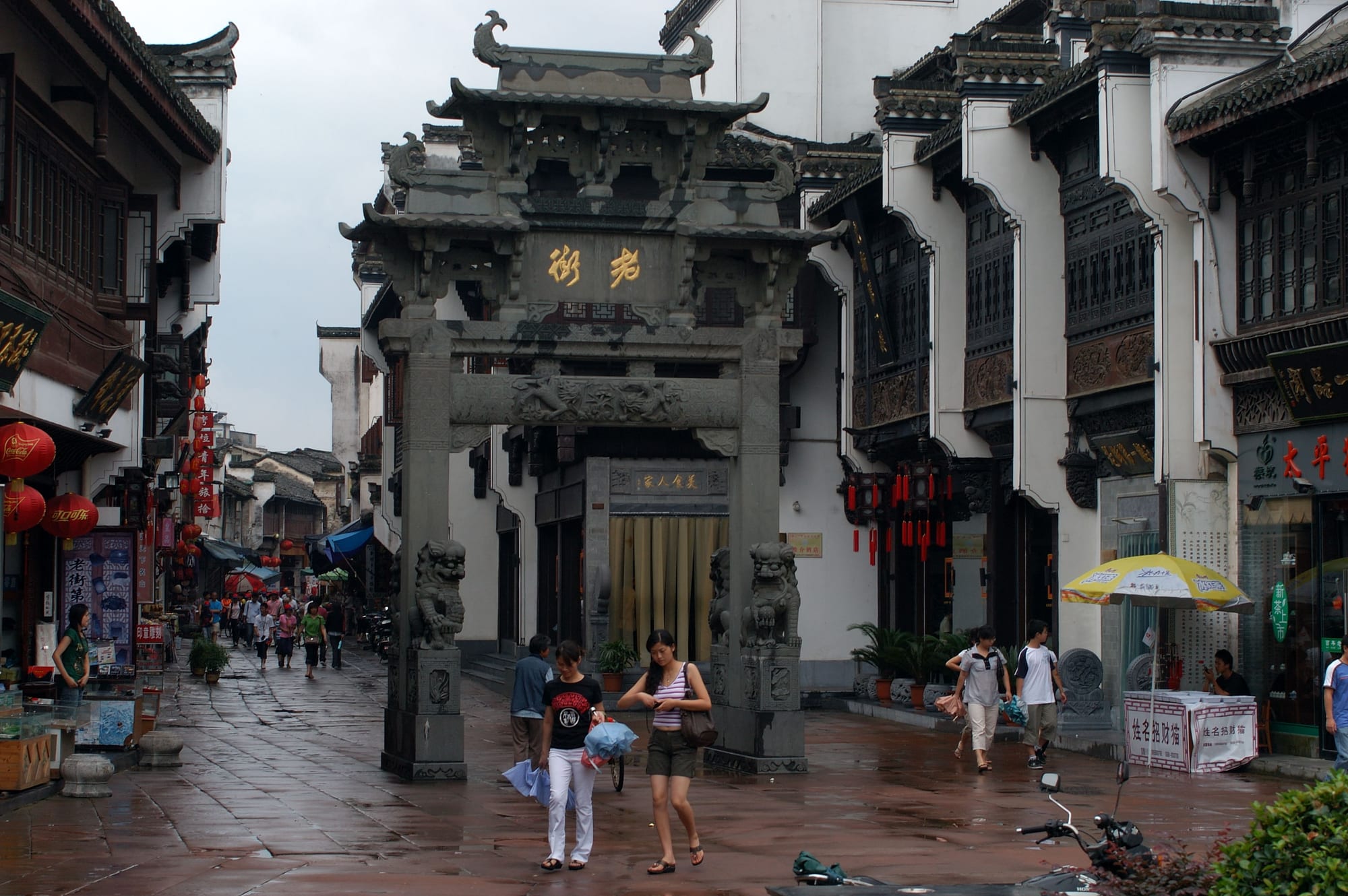
A carved stone archway across a wet paved shopping street lined with white-walled timber shops and red lanterns

Central China, China

Huangshan

The archway at the entrance to Tunxi Old Street in Huangshan, Anhui. (Emitchan / Wikimedia Commons · Public domain)

A city in the hills of southern Anhui, renamed in 1987 after the mountain range north of it. Its centre is the old river port of Tunxi, whose shop-lined old street runs beside the Xin'an River, and it is the historic Huizhou country of whitewashed villages, merchant houses, ink and tea. Most visitors use it as the base for the Yellow Mountains and the villages of Xidi and Hongcun.

Neighbourhoods

  • Tunxi Old Street
    • First-time visitors
    • Historic district
    • Shopping

    The city's centre of gravity, a long paved street of two-storey timber shops running parallel to the Xin'an River, selling tea, ink stones, brushes, antiques and snacks. Lanes drop from it to the water, and most visitor hotels and guesthouses are within a few minutes' walk.

    Open in Maps
  • Riverside Tunxi
    • Walks
    • Quiet
    • Evening views

    The embankments and bridges where the Heng River joins the Xin'an below the old street, among them the stone Zhenhai bridge, which stood for more than four hundred years, was destroyed by floods in 2020 and was rebuilt in 2021. Teahouses and small bars face the water, and the far bank is a quieter residential district.

    Open in Maps
  • The new town
    • Cheaper stays
    • Local life
    • Close to public transport

    The modern grid of avenues west and north of the old street, with the bus station, shopping centres, chain hotels and ordinary restaurants. It has little atmosphere but is where residents live and prices are lower.

    Open in Maps
  • Huangshan North and Tangkou
    • Mountain access
    • Early starts

    Not part of the city proper but where many visitors sleep — the high-speed station north of town and the village of Tangkou at the foot of the mountain, an hour or so away, with hotels, hostels and the buses up to the cable cars.

    Open in Maps
  • Shexian and the village country
    • Historic villages
    • Day trips

    The old Huizhou prefectural town east of Tunxi and the valleys around it, full of whitewashed villages with horse-head gables, memorial archways and ancestral halls, reached by bus or car in under an hour.

    Open in Maps

Things to do

In and around Tunxi

  • Huangshan Tunxi International Airporttransit hub

    The city's airport, a few kilometres west of the old street, opened in 1959, with flights to cities across China and a few regional services to Seoul, Hong Kong and Taipei.

    Open in Maps
  • Huangshan Districtattraction

    The northern district of the city, its government at Jintai, which contains Mount Huangshan itself and the hill country around Taiping Lake.

    Open in Maps
  • Xiuning Countyattraction

    The county west of Tunxi, with Mount Qiyun, old stone arch bridges, and a record of producing more top imperial examination graduates than anywhere else in China.

    Open in Maps

The Yellow Mountains

  • Huangshantrail

    A granite range of pinnacles, gnarled pines and seas of cloud, a UNESCO World Heritage Site, climbed by stone stairways said to run to tens of thousands of steps, with cable cars from the road-head to the summit paths and hotels.

    Open in Maps
  • Mount Qiyuntrail

    One of the four sacred mountains of Taoism, about 30 kilometres west of the city in Xiuning County, rising to 585 metres and known for its monasteries, cliff inscriptions and stone tablets.

    Open in Maps
  • Taiping Lakepark

    A large lake among wooded hills north of the range, crossed by the Taiping Lake bridge and used for boat trips and quieter stays.

    Open in Maps

The Hui villages

  • Xidiattraction

    A village of lanes, ancestral halls and merchant houses with carved wood and stone, inscribed with Hongcun as a UNESCO World Heritage Site.

    Open in Maps
  • Hongcunattraction

    A village laid out around a system of channels, a crescent pond and a lake, its white walls and black tiles among the most painted and filmed scenes in China.

    Open in Maps

Old Huizhou towns

  • She Countyattraction

    The historic capital of Huizhou east of Tunxi, whose county town is sometimes counted among China's four renowned ancient towns, and the home of the ink and inkstone workshops the region is known for.

    Open in Maps
  • Yi Countyattraction

    The rural county north-west of Tunxi that holds Xidi, Hongcun and dozens of lesser villages among rice terraces and bamboo.

    Open in Maps
  • Qimen Countyattraction

    The tea county west of the city, home of Keemun black tea, with plantations on misty slopes.

    Open in Maps

Seasonal events

  • Rapeseed blossom seasonMarch and April

    The valleys around the Hui villages turn yellow with flowering rapeseed, drawing photographers and painters to Xidi, Hongcun and the terraces nearby.

  • Spring tea pickingApril and May

    The Maofeng and Keemun harvests fill the hill villages with pickers and the towns with the smell of firing leaf, and fresh tea appears on the old street.

  • Autumn drying seasonOctober and November

    Villages spread chillies, maize and persimmons on round trays on their roofs and window ledges, a sight associated with the hill villages of old Huizhou.

  • Winter snow on the rangeDecember to February

    Snow and ice on the pines of the Yellow Mountains bring a smaller, hardier crowd, and the summit hotels stay open.

Eat and drink

Long-standing places and food districts in Huangshan. Hours, ratings and directions come from your maps app, always current.

Huizhou classics

  • Stinky mandarin fishrestaurant

    Mandarin fish cured in light brine, then braised with belly pork and bamboo shoots, one of the representative dishes of Huizhou cooking and much milder in taste than in smell.

    Open in Maps
  • Mao tofumarket

    Bean curd deliberately grown with a white mould until furred, then pan-fried and eaten with chilli paste, sold from griddles on the street.

    Open in Maps
  • Huangshan shaobingmarket

    Flaky sesame-topped pastries filled with preserved greens and pork fat, baked in a drum oven and eaten warm.

    Open in Maps
  • Huangshan Maofeng and Keemun teamarket

    A delicate green tea from the mountain slopes and the malty black tea of Qimen, both sold loose in the old street's tea shops.

    Open in Maps

Where to eat

  • Tunxi Old Street stallsneighborhood

    Snack sellers and small kitchens along the old street offering tofu, pastries, noodles and skewers through the day and evening.

    Open in Maps
  • Lao Jie riverside restaurantsneighborhood

    Restaurants on the lanes between the old street and the river, most serving Huizhou dishes of braised meat, bamboo shoots and river fish.

    Open in Maps

Experience Huangshan

History

The place now called Huangshan is old Huizhou. Settlement in these narrow valleys grew with waves of refugees from the north, particularly after the fall of the Tang, and by the Song a prefecture centred on Shexian governed six hill counties with little farmland and a great deal of ambition. Tunxi itself began as a river port where the Heng River meets the Xin'an, the head of navigation for boats down to Hangzhou.

From the Ming into the Qing, Huizhou merchants became one of the most powerful commercial networks in China, trading salt, timber, tea, ink and pawnbroking as far as the Yangtze cities and the capital. They sent their profits home, and the money built what visitors now come to see: white-walled houses with horse-head gables and carved wooden courtyards, ancestral halls, memorial archways, private academies and gardens, in villages whose men were often absent for years at a time. The region also produced scholars, the Xin'an school of painting, and the ink sticks and inkstones still made at Shexian.

The salt monopoly's end and the Taiping wars of the 19th century broke the merchant economy, and the region became poor and remote. Tunxi grew as the modern commercial centre, and in November 1987 the Huizhou prefecture was abolished and replaced by the prefecture-level city of Huangshan, named after the mountain, expressly to promote tourism. Tourism has since transformed it: the mountain was inscribed by UNESCO in 1990, Xidi and Hongcun in 2000, and the high-speed railway arrived in 2015.

Culture & Customs

Huizhou culture is a recognised field of study in China, with its own architecture, cooking, opera, medicine and merchant ethic. Its buildings are the most visible part: whitewashed walls, dark tiles, stepped gables shaped to stop fires spreading, small courtyards open to the sky to catch rainwater, and dense carving in wood, brick and stone. Clan organisation was strong, and ancestral halls, genealogies and memorial archways recording filial or charitable acts still stand at village entrances.

The region was a centre of scholarship out of proportion to its size, producing large numbers of examination graduates, the Xin'an school of landscape painting and the four treasures of the study in local form — Hui ink, She inkstones, brushes and paper. Hui opera, which took shape in Huizhou and Anqing under the Ming, was carried to Beijing in 1790 by the Four Great Anhui Troupes and became one of the roots of Peking opera. Tea culture is everywhere, from the plantations to the shops of the old street.

Modern life is a mixture of that inheritance and the tourist economy built on it. Villages restore houses as guesthouses, art students sit sketching in the lanes with folding stools, and craft workshops make ink, bamboo carving and paper for visitors as well as calligraphers. Locals speak a Hui dialect group unrelated in form to standard Mandarin, though Mandarin is universal, and a reserved, thrifty, education- minded reputation follows people from these hills.

Daily Life

About 1.3 million people live in the prefecture-level city, which covers a large area of hills and small counties; the urban core around Tunxi holds a few hundred thousand. Most residents live in the valley towns of Tunxi, Shexian, Yi County, Xiuning, Qimen and Huangshan District near the mountain, and in villages strung along the rivers.

Tourism is the leading industry, from hotels and restaurants to porters, guides, drivers and ticketing staff, with the mountain alone drawing millions of visitors a year. Tea is the other mainstay — Maofeng, Keemun and Houkui leaf from the surrounding slopes — alongside bamboo, timber, chrysanthemum and herb growing, ink and inkstone workshops, and light manufacturing in the new districts. Many families also live partly on money sent home from work in Hangzhou and Shanghai, a pattern older than the railway.

The daily rhythm in Tunxi is a small-city one: markets and tea early, shops on the old street opening late morning, coach groups through the day and a busy lit street in the evening. Villages wake early for farm work and fill with day visitors by mid-morning. Wet weather is a constant fact of life, the school system is competitive in the Huizhou tradition, and depopulation of the remoter hamlets is the standing local worry.

Food

Huizhou cooking is one of China's eight major regional traditions and the least known abroad. It is mountain food: heavy on braising and steaming, salted and preserved ingredients, ham, bamboo shoots, wild herbs and river fish, with less sugar than the delta and less chilli than the provinces west of it. The best-known dish is stinky mandarin fish, salted and left to ferment lightly for a few days before braising, which gives a strong smell and firm, layered flesh.

Other staples include mao tofu, bean curd grown furry with white mould and fried on a griddle; Wenzheng bamboo shoots from She County, boiled and dressed with sesame oil; a one-pot layered stew of pork, tofu skin, greens and egg dumplings served at banquets in the hill counties; braised pork with preserved mustard greens; and crisp shaobing pastries filled with the same greens. Villages dry chillies, beans and persimmons on roof trays through the autumn, and preserved vegetables appear on most tables.

Tea is the region's other product. Huangshan Maofeng, picked on the mountain slopes, is one of the famous green teas of China, Taiping Houkui from the northern valleys has long flat leaves, and Qimen in the west gives Keemun, the black tea that became a mainstay of English blends. Tea shops line Tunxi Old Street, along with sellers of chrysanthemum flowers, hill honey and bamboo-shoot preserves.

Planning tools

Budget

The city itself is cheap: guesthouses near the old street, bus fares and Huizhou restaurants all cost little. The mountain is the expense — its entrance ticket, the shuttle bus and the cable cars add up quickly, and summit hotels charge several times what the same room costs in town because every supply is carried up. Village entry tickets are modest but numerous.

Daily Budget Midrange
USD 90–180 (mid-range hotel, restaurant meals, mountain ticket and cable car, village tickets, taxis)
Daily Budget Shoestring
USD 30–50 (hostel or guesthouse in Tunxi, noodle and snack stalls, buses, walking up the mountain)

A night on the summit costs far more than one in Tunxi or Tangkou; anyone not set on a sunrise can climb and descend in a long day.

Best Time to Visit

Late March to May and late September to November are the best months — rapeseed and tea in spring, clear air and colour in autumn. Summer is hot, wet and crowded, though the mountain is much cooler than the valleys. Winter brings snow and ice on the pines and far fewer people. National holiday weeks overwhelm both the mountain and the villages.

Suggested Number of Days

Two or three days cover the city and the mountain. Four to six allow the Hui villages and the old Huizhou towns as well. Weather is the main variable, since a clouded-out mountain is often worth a second attempt.

First Visit
2–3 days
With Surroundings
4–6 days

Transportation

Tunxi is small enough to walk, with taxis and ride-hailing cheap for longer hops. Buses from the city's bus station serve Tangkou at the mountain foot, Shexian, Yi County and the villages, and tourist coaches run to Xidi and Hongcun. On the mountain itself there are no roads: shuttle buses climb to the cable-car stations, and everything above them is stone stairway.

Village and mountain buses thin out in the late afternoon, so check the last departure before setting out.

Airport & Station Connections

Huangshan North station, which opened in 2015 and is served by the Hefei–Fuzhou and Hangzhou–Nanchang high-speed lines, is a few kilometres from the old street and reaches Hangzhou in about an hour and a half and Shanghai in roughly three. Huangshan Tunxi International Airport lies just west of the centre, with flights across China and a few regional services. Buses run from the city to Tangkou for the mountain, and coaches connect with Hangzhou, Nanjing and Jingdezhen.

Walkability

The old street and the riverside are flat, paved and pleasant on foot, and the whole visitor area of Tunxi can be crossed in twenty minutes. The new town is wider and duller but still walkable. Beyond the city, walking is the point: the villages are car-free in their lanes, and the mountain is a long stone stairway with thousands of steps and steep drops.

Safety

Crime is not a significant concern here. The risks are on the paths — wet and worn stone steps, crowding at summit viewpoints and narrow sections, sudden fog and cold on the range even in summer, and ice in winter. Villages have unfenced ponds and channels, and summer brings heavy rain and occasional flooding along the rivers.

Wear shoes with grip for mountain steps, carry warm and waterproof layers for the summit whatever the forecast in town, and buy scenic-area tickets at official counters or through the official app. Check current official travel advice before travelling.

Climate

Humid subtropical and distinctly wet, with mist a regular feature of the hills. The mountain is far cooler than the city and can be freezing when the valleys are mild, and cloud seas form most often after rain in the cooler months.

Summer
hot and humid in the valleys, with a July mean of about 28°C and heavy rain; much cooler on the range
Winter
cool and damp, with a January mean of about 4°C in the city, and snow and ice on the range

Local Customs

Tipping is not customary. The Hui villages are lived in as well as ticketed: courtyards and halls belong to families, laundry and cooking go on in view, and it is polite to ask before photographing people or stepping into a doorway. Ancestral halls are treated as solemn places. Tea is offered constantly in shops and homes, and accepting a cup is good manners.

Ask before photographing residents or entering courtyards in the villages, and keep to marked paths on the mountain, where straying off is both dangerous and forbidden.

Common Payment Methods

The currency is the renminbi, counted in yuan. Tickets, hotels, buses and most shops are paid by QR code through Alipay or WeChat Pay, which foreign visitors can link to an overseas card before arrival; foreign cards work at larger hotels and rarely elsewhere. Carry some cash for village stalls and mountain porters' shops, and draw money in Tunxi rather than on the range.