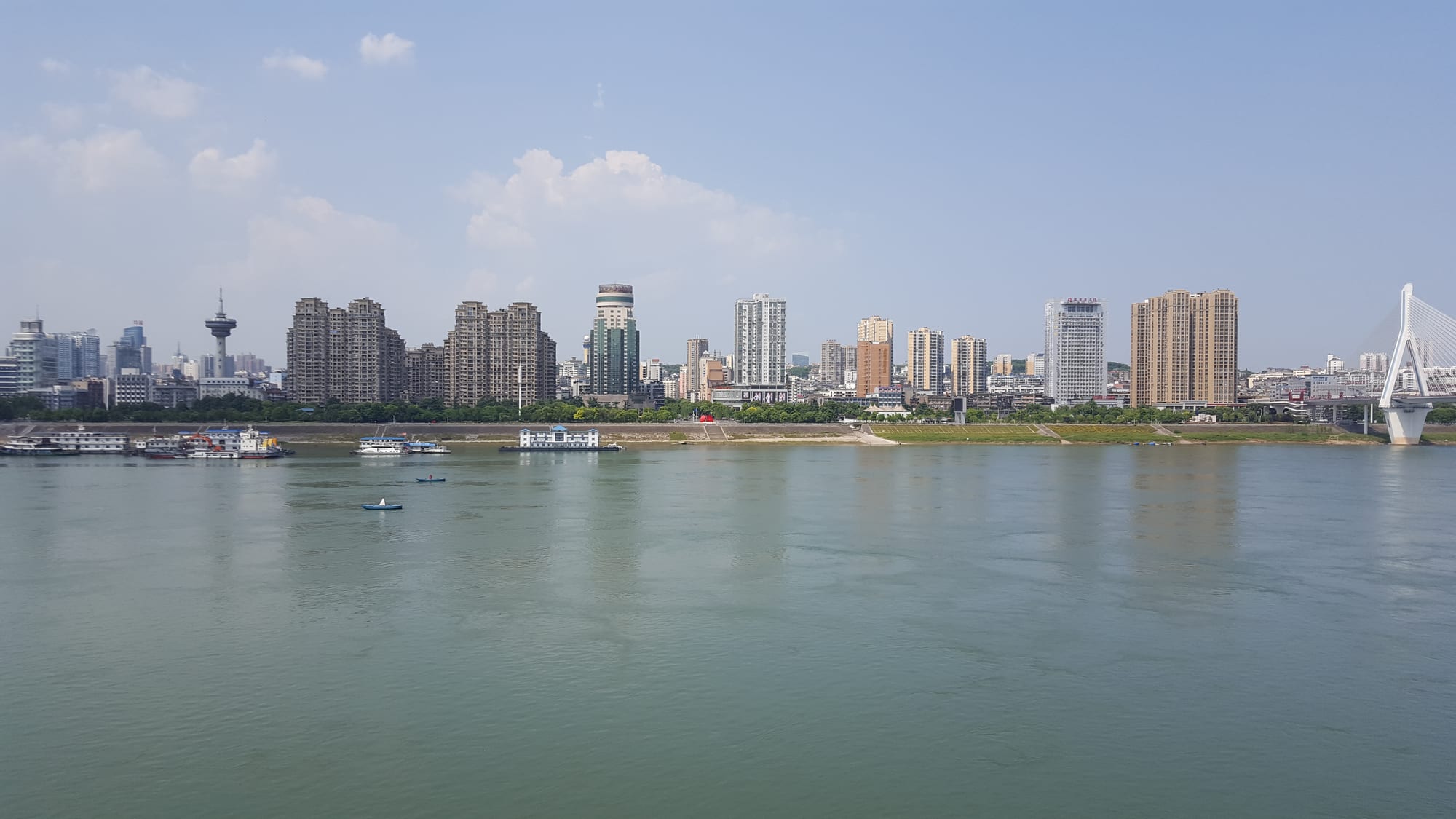
Tower blocks and a tall observation tower along a green river bank, with a white cable-stayed bridge to the right

Central China, China

Yichang

The centre of Yichang seen across the Yangtze from the south bank. (Fxqf / Wikimedia Commons · CC BY-SA 4.0)

A city in western Hubei where the Yangtze leaves the Three Gorges and spreads onto the plain. Long a transhipment port at the head of the gorges, Yichang was transformed by the Gezhouba and Three Gorges dams built upstream, and is the usual embarkation point for river cruises towards Chongqing as well as a base for the gorges themselves.

Neighbourhoods

  • Xiling
    • First-time visitors
    • Close to public transport
    • Best for food

    The central district on the north bank, holding the main shopping streets, most hotels, the riverside promenade and the passenger docks used by cruise boats. Almost everything a short visit needs is within a few blocks of the river here.

    Open in Maps
  • Wujiagang
    • Quiet and residential
    • Local life
    • Parks

    The district downstream of the centre along the north bank, largely residential, with wide newer avenues, riverside parks and the city's main sports and exhibition venues. Prices are lower than in the centre.

    Open in Maps
  • Dianjun
    • Views
    • Quiet and residential

    The south-bank district across the Yangtze, reached by bridges, where the wooded hill of Mojishan gives the standard view back over the city skyline and the river. It is quieter, greener and more spread out than the north bank.

    Open in Maps
  • Yiling
    • Short trips
    • Nature

    The large rural district upstream that contains the Gezhouba and Three Gorges dams, the entrance to Xiling Gorge and most of the scenic areas visitors come for. Sandouping, the dam town, lies about 30 km upstream of the centre.

    Open in Maps

Things to do

The river and the dams

  • Three Gorges Damlandmark

    The world's largest power station by installed capacity, at Sandouping upstream of the city, with viewing platforms over the spillway, the ship locks and the reservoir behind it.

    Open in Maps
  • Gezhouba Damlandmark

    A run-of-the-river dam in the western suburbs of the city, built between 1970 and 1988, and still the point where river traffic passes through its locks.

    Open in Maps
  • Xiling Gorgeattraction

    The largest and easternmost of the Three Gorges, a stretch of limestone cliffs and side valleys running upstream from Yichang, seen from cruise boats and from roads along its rim.

    Open in Maps

Transport and the city

  • Yichang East railway stationtransit hub

    The high-speed station on the eastern edge of the city, the arrival point for most visitors and the fastest link to Wuhan.

    Open in Maps
  • Yichang Sanxia International Airporttransit hub

    The city's airport, about 22 km from the centre, named after the Three Gorges, with flights to the main Chinese hubs.

    Open in Maps

Short trips from the city

  • Zigui Countyattraction

    The county upstream at the head of the dam reservoir, rebuilt when the water rose, traditionally regarded as the home district of the poet Qu Yuan and a centre of dragon-boat custom.

    Open in Maps
  • Changyang Tujia Autonomous Countyattraction

    Tujia country in the hills south-west of the city, on the Qing River, known for its mountain scenery, boat trips on the reservoir and folk song traditions.

    Open in Maps
  • Qing Riverattraction

    A tributary of the Yangtze that runs through steep limestone country south-west of Yichang, dammed into a chain of green reservoirs used for sightseeing boats.

    Open in Maps
  • Shennongjiatrail

    A forested mountain area north-west of the city, a UNESCO World Heritage Site for its biodiversity, with high ridges, alpine meadows and a long-running legend of a wild man.

    Open in Maps

Seasonal events

  • Dragon Boat FestivalMay or June

    Marked with unusual seriousness in the Yichang area, which claims the poet whose death the festival commemorates, with boat races on the Yangtze and in Zigui.

  • Spring on the riverMarch to May

    Mild weather, blossom in the hills and lower water on the reservoir make spring the most popular season for cruises and gorge walks.

  • Autumn cruise seasonSeptember to November

    Clear, dry weather and comfortable temperatures bring the year's second peak in river traffic, and hotel and boat prices rise accordingly.

Eat and drink

Long-standing places and food districts in Yichang. Hours, ratings and directions come from your maps app, always current.

Yichang classics

  • Yichang-style hot dry noodlesrestaurant

    Hubei's sesame-paste noodles are eaten here too, usually in a soupier version than in Wuhan, at breakfast shops that open before dawn across the centre.

    Open in Maps
  • Yangtze river fishrestaurant

    Freshwater fish, much of it now farmed in the reservoirs, is steamed or braised with chilli and pickled vegetables in restaurants along the riverside streets.

    Open in Maps
  • Tujia mountain cookingrestaurant

    Dishes from the hill counties to the south-west: cured pork, maize and potato staples, sour pickled vegetables and heavily peppered stews.

    Open in Maps

Food streets and markets

  • Central Yichang eating streetsneighborhood

    The lanes off the main shopping streets in the centre fill in the evening with skewer grills, crayfish in summer, noodle shops and small beer halls.

    Open in Maps
  • Riverside promenade cafésneighborhood

    Cafés and tea houses face the Yangtze along the embankment in the centre, busiest at dusk when the bridges and boats are lit.

    Open in Maps

Experience Yichang

History

Yichang sits at the point where the Yangtze breaks out of the gorges, and that geography has decided its history. A walled town stood here in the Warring States period under the name Yiling, in the border country between the states of Chu and Ba. In 222 the Battle of Xiaoting, fought nearby, ended the Shu emperor Liu Bei's campaign against Wu and became one of the set pieces of the Three Kingdoms story. For centuries afterwards the town lived on transhipment: cargo coming downstream had to be moved from the small, tough boats used in the rapids of the gorges into larger craft for the open river, and crews of trackers hauled junks upstream from the bank on ropes.

That trade made Yichang a target of foreign commerce. It was opened to foreign trade as a treaty port under the Chefoo Convention, agreed in 1876, gaining a customs house, missions and a small foreign quarter. The port handled tung oil, salt and cotton, and river steamers began fighting their way up the rapids in the early twentieth century. In 1938, as Japanese forces advanced, Yichang became the bottleneck through which factories, universities and refugees were evacuated upstream to Chongqing in a hurried operation remembered in China as the Yichang evacuation.

Modern Yichang was made by hydropower. The Gezhouba Dam, begun in 1970 and completed in 1988, spans the main Yangtze at the edge of the city and brought tens of thousands of workers. The far larger Three Gorges Dam at Sandouping, built through the 1990s and 2000s, drowned the rapids, raised the water level far upstream and displaced well over a million people from the reservoir area. The city grew with the projects, and hydropower remains its best-known industry.

Culture & Customs

Yichang's cultural identity leans on two things: the river and the poet Qu Yuan, traditionally held to have come from Zigui County just upstream. The Dragon Boat Festival is taken seriously here, with races on the Yangtze and on the reservoir, dragon-boat associations in the riverside villages, and zongzi made at home in the days before. Local societies keep alive the Qu Yuan legends and the recitation of his poetry.

The hill counties to the south and west are Tujia country. The Tujia are one of China's larger recognised minority peoples, and Changyang and Wufeng are autonomous counties, with their own building styles, traditions of antiphonal song and the richly patterned brocade known as xilankapu. Much of this is now performed for visitors at scenic areas, but the counties hold their own festivals as well.

River work shaped local manners. Generations of boatmen, trackers and dockers gave the city a plain-spoken, physical culture, remembered in work chants that are staged as folk performances. Everyday life follows the rest of Hubei: loud, direct speech, breakfast eaten out, tea drunk continuously, and long summer evenings on the embankment. Residents are conscious of living beside one of the country's largest engineering projects, and the dam features in local pride, local employment and local conversation alike.

Daily Life

About 3.9 million people were counted in the Yichang prefecture at the last census, most of them outside the built-up urban districts strung along the north bank of the Yangtze. The city is long and narrow, hemmed between the river and the hills, and has grown eastwards and across the water as new bridges opened.

Electricity underpins the economy: the two dams and their associated grid companies, research institutes and construction firms employ a great many people, and the cheap power they produce has drawn in chemicals, phosphate processing, aluminium and a substantial pharmaceutical industry. River freight remains important, with container and bulk terminals below the Gezhouba locks, and tourism has grown steadily around the gorges. The surrounding counties grow citrus, tea and tung trees on the terraced slopes.

The rhythm of the day is provincial and unhurried by Chinese standards. Markets and breakfast shops open before dawn, offices break for a long lunch, and the embankment fills in the evening with walkers, dancers and children. The recurring concerns are those of a city built around a single industry: what happens to employment as the big construction phase recedes, the environmental management of the reservoir, landslides and silt upstream, and the summer heat that settles in the river valley.

Food

Yichang eats like the rest of Hubei with a mountain accent. Breakfast is the serious meal: hot dry noodles with sesame paste, soupy beef noodles, fried dough sticks and sweet fermented-rice soup, taken at shops that open long before work. Freshwater fish is the centrepiece of a proper meal — steamed whole with ginger and spring onion, or braised with chilli and pickled vegetables — and although the wild catch from the Yangtze has been restricted, reservoir and pond fish are plentiful.

From the hill counties come the flavours that distinguish the city from Wuhan: cured and smoked pork hung over the kitchen fire, maize and potato staples, sour-pickled vegetables used as a cooking base, and heavy use of chilli and Sichuan pepper as the province shades towards Chongqing. Tujia dishes such as maize-and-rice staples and hotpots built on cured meat are served in restaurants across the city, not only in the countryside.

Summer belongs to crayfish, boiled with chilli and spices and eaten by hand with beer at outdoor tables, and to cold noodles. Citrus is the local crop: mandarins and navel oranges from the terraces around Zigui are sold by the sack at the roadside in autumn and winter. Tea from the hills of western Hubei, mostly green, is the everyday drink.

Planning tools

Budget

Yichang itself is inexpensive, with cheap food, buses and hotels, but the reason most people come is not: Three Gorges cruises range from basic public ferries to costly tourist ships, and the dam and gorge scenic areas charge separately for entry and for the shuttle buses inside them. Booking a cruise as part of a package usually sets the daily cost.

Daily Budget Midrange
USD 90–180 (mid-range hotel, restaurant meals, dam and gorge tickets, or a berth on a tourist cruise boat)
Daily Budget Shoestring
USD 30–50 (budget hotel or hostel, noodle shops, city buses and a public ferry upriver)

Check which pier a cruise leaves from before booking a hotel; departure points are scattered between the city centre and towns upstream near the dam.

Best Time to Visit

April and May, and September to early November, are the best months, with mild weather and the clearest views in the gorges. Summer is hot, humid and busy with domestic holidaymakers, and heavy rain can cloud the gorges. Winter is cold, damp and grey, but quiet, and the reservoir is at its highest level then, which changes the look of the canyon walls.

Suggested Number of Days

One or two days covers the city and the dam. Three or four allow a river trip through the gorges or an excursion into the hill counties. A cruise towards Chongqing adds several days on top and usually starts or ends here.

First Visit
1–2 days
With Surroundings
3–4 days

Transportation

The centre is served by city buses and by a bus rapid transit line running along the main axis; ride-hailing through Didi is cheap and simple. There is no metro. Sandouping and the Three Gorges Dam are some 30 km upstream, reached by tour coach, chartered car or a long-distance bus, and passenger boats leave from piers in the centre and from points nearer the dam.

A passport is needed for the Three Gorges Dam area and for boarding river boats; identity checks are routine.

Airport & Station Connections

Yichang East railway station, on the eastern side of the city, is about two hours from Wuhan by fast train, with services running west towards Chongqing and east towards Shanghai, and it is how most visitors arrive. Yichang Sanxia International Airport, about 22 km from the centre, has flights to the main Chinese hubs. Many people arrive or leave by river, ending a cruise from Chongqing at a pier near the dam and continuing by coach into the city.

Walkability

The central district is compact and flat along the river, and the promenade makes an easy walk of several kilometres past the docks and parks. Beyond the centre the city spreads along the bank for 20 km and climbs into hills, so buses or ride-hailing are needed. Everything to do with the gorges and the dams involves a drive and then a good deal of walking on steps and slopes.

Safety

Yichang is a safe city with very little violent crime. The practical risks are around water and hills rather than people: slippery steps and boardwalks in the gorges, strong currents and busy shipping on the Yangtze, summer heat, and landslides or road closures after heavy rain in the mountain counties.

Wear shoes with grip for gorge paths and dam viewing platforms, follow boat crews' instructions on the river, and allow extra time in wet weather on mountain roads. Check current official travel advice before travelling.

Climate

Humid subtropical, sheltered by the mountains upstream. Rain is concentrated between May and September, and mist is common in the gorges in the cooler months, which can hide the scenery for days at a time.

Summer
hot and humid, often 30–36°C in July and August, with heavy downpours
Winter
cold and damp, typically 3–10°C, with fog and little snow at river level

Local Customs

Tipping is not customary, including on cruise boats where service is included in the fare. Photography is restricted at the Three Gorges Dam: follow the signs and the guides, and do not photograph security staff or checkpoints. In the Tujia counties, festivals and funeral songs are local traditions rather than performances, so ask before filming.

Politics, Taiwan, Tibet and Xinjiang are sensitive subjects; avoid photographing security forces or military sites.

Common Payment Methods

The currency is the renminbi, counted in yuan. Payment is by QR code through Alipay or WeChat Pay almost everywhere, including buses, boats and small restaurants; the apps now let foreign visitors link an overseas card. Foreign cards are accepted at larger hotels, and bank ATMs in the centre take international cards.