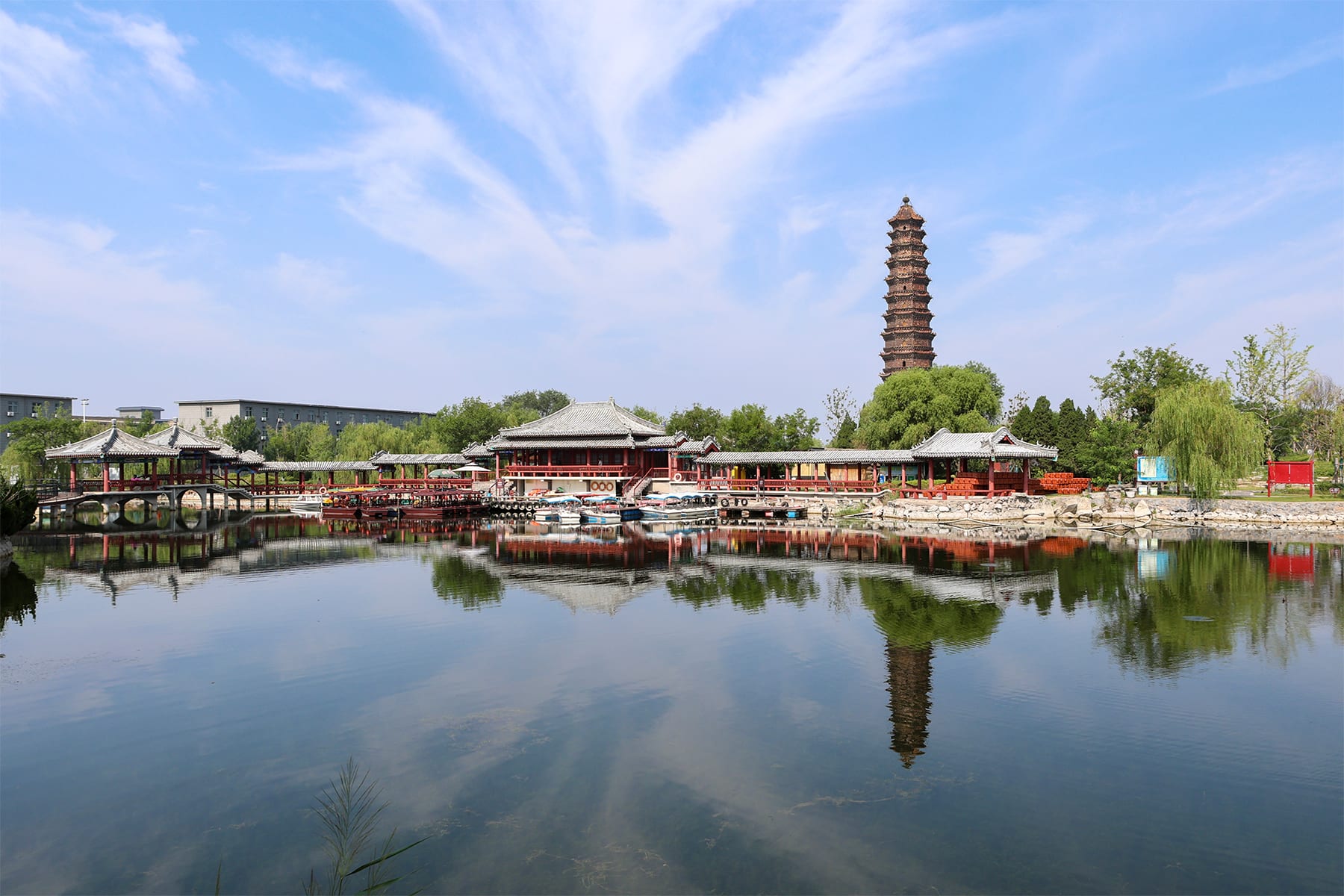
A tall brown brick pagoda rising behind tiled pavilions and willows, all reflected in a calm lake under a blue sky

Central China, China

Kaifeng

The Iron Pagoda above the lake and pavilions of its park in Kaifeng. (Windmemories / Wikimedia Commons · CC BY-SA 4.0)

A city on the Yellow River plain in eastern Henan that was the capital of the Northern Song dynasty and, for a time, one of the largest cities in the world. Repeated floods buried the old city under silt; what stands today is a low-rise town of pagodas, lakes, a restored city wall and night markets, with a reconstructed Song-themed riverside quarter.

Neighbourhoods

  • Gulou and the old centre
    • First-time visitors
    • Night markets
    • Best for food

    The heart of the walled city around the rebuilt drum tower, where the night markets set up after dark and the main shopping streets meet. Most small hotels and guesthouses are within walking distance, and the streets stay low-rise by local rule.

    Open in Maps
  • Longting and the lakes
    • Historic district
    • Parks
    • Quiet and residential

    The northern part of the old city, built around Dragon Pavilion and the two lakes that flank its causeway, with the Iron Pagoda park and the Song-themed riverside quarter nearby. It is the greenest and quietest part of central Kaifeng.

    Open in Maps
  • Shunhe
    • Local life
    • Best for food

    The eastern district of the old city, historically the quarter of Kaifeng's Hui Muslim community, with mosques, halal butchers and beef and mutton kitchens among ordinary residential lanes.

    Open in Maps
  • Outside the wall
    • Close to public transport
    • Modern city

    The newer districts spreading west and south beyond the city wall towards the high-speed railway station and the expressway to Zhengzhou, where the modern flats, malls and university campuses are. It is convenient rather than atmospheric.

    Open in Maps

Things to do

Famous landmarks

  • Iron Pagodalandmark

    A thirteen-storey brick pagoda of 1049 in the north-east of the old city, 57 m tall and faced in glazed tiles the colour of iron, and the oldest surviving landmark in the city.

    Open in Maps
  • Daxiangguo Templelandmark

    A Buddhist temple founded in the sixth century that was the imperial temple of the Song capital, rebuilt in the Qing era, with a wooden Guanyin statue in its octagonal hall of arhats.

    Open in Maps
  • Dragon Pavilionlandmark

    A Qing-era hall raised on a high terrace over the buried site of the Song imperial palace, reached by a causeway between two lakes.

    Open in Maps

Parks and reconstructed quarters

  • Yuwangtai Parkpark

    A park in the south of the city around an ancient terrace named for the musician Shi Kuang, with a Ming shrine to Yu the Great, the legendary tamer of floods, above it.

    Open in Maps

Museums and the modern city

  • Henan Universitylandmark

    The university's old Ming-lun campus on the eastern side of the old city, whose early twentieth-century halls mix Chinese and Western styles.

    Open in Maps
  • Kaifeng North railway stationtransit hub

    The high-speed station north of the old city, opened in 2016 on the Xuzhou–Lanzhou line, and the way most visitors now arrive.

    Open in Maps
  • Kaifeng Museummuseum

    The city's collection of Song-period material, stone inscriptions and finds from the layered capitals buried beneath the modern town.

    Open in Maps

Short trips from the city

  • Zhengzhouattraction

    Henan's capital, about 60 km west and half an hour by high-speed train, with the Henan Museum and the remains of a Shang-dynasty city wall.

    Open in Maps

Seasonal events

  • Chrysanthemum seasonOctober and November

    Kaifeng's civic flower fills the parks, temple courtyards and streets with displays for several weeks in autumn, the city's busiest tourist period.

  • Lunar New Year and lantern displaysJanuary or February

    Temple fairs at Daxiangguo Temple and lantern displays on the lakes and city wall run through the Spring Festival to the Lantern Festival.

  • Qingming FestivalEarly April

    Marked with particular attention in the city whose Song-era life is shown in the famous Qingming scroll, with performances in the themed park.

  • Night market seasonApril to October

    The markets run all year, but the warm months bring the largest crowds and the longest hours, with stalls filling the streets around the drum tower after dark.

Eat and drink

Long-standing places and food districts in Kaifeng. Hours, ratings and directions come from your maps app, always current.

Kaifeng classics

  • Guantang baozirestaurant

    Soup dumplings steamed in bamboo baskets, a Kaifeng speciality of thin-skinned buns filled with pork and a hot, jellied broth that liquefies in cooking.

    Open in Maps
  • Hui beef and mutton kitchensrestaurant

    The city's Hui Muslim quarter supplies much of its everyday food: peppery mutton soups, braised beef, sesame flatbread and hand-pulled noodles.

    Open in Maps
  • Hulatangrestaurant

    Henan's breakfast soup, thickened with starch and heavily seasoned with white pepper, often mixed half and half with sweet fermented rice soup.

    Open in Maps

Night markets and food streets

  • Drum Tower night marketmarket

    The best-known of the city's night markets, where stalls are wheeled into the square after dark to sell dumplings, grilled skewers, almond tea and fried snacks.

    Open in Maps
  • Old city food lanesneighborhood

    The lanes leading off the main streets inside the wall hold small family restaurants, noodle shops and steamed-bun counters used far more by residents than by visitors.

    Open in Maps

Experience Kaifeng

History

Kaifeng's greatness came from water and was ended by it. A canal town on the Yellow River plain, it became the capital of several short-lived states in the tenth century and then, from 960, of the Northern Song, who called it Dongjing, the Eastern Capital. Linked by canal to the rice of the south, it grew into a commercial city without precedent: markets that stayed open all night, restaurants and theatres, and a population put at six or seven hundred thousand at its height. Its life at the end of that period is recorded in the scroll Along the River During the Qingming Festival and in a memoir written by an exile after the city fell.

Fall it did, in 1127, when Jurchen armies of the Jin took Kaifeng and carried the imperial family north — the event known as the Jingkang incident. The Jin later made it their own southern capital, and the Mongols took it in 1233 after a long siege. From then on the Yellow River, running above the surrounding land between raised dykes, repeatedly destroyed the city. Floods in 1642, during the war at the end of the Ming, and again in 1841 buried the streets in silt; the Song city now lies several metres below the modern one, with successive capitals stacked beneath the same site.

Kaifeng remained the provincial capital of Henan until 1954, when the role passed to Zhengzhou, which had become the railway junction. The city has lived since as a smaller place with an outsized past, and since the 1980s has rebuilt gates, temple courtyards, the drum tower and whole quarters in Song style, capping building heights in the old town so that the pagodas stay visible.

Culture & Customs

The Song inheritance is the city's chief cultural asset and is presented very deliberately, from costumed performances in the themed parks to the woodblock New Year prints made at Zhuxian, the old market town south-west of the city. Chrysanthemums, cultivated in the city for many centuries and at their height under the Song, are the civic flower, and the autumn displays are a genuine local tradition rather than a tourist invention.

Kaifeng also held the oldest lasting Jewish community in China. Jewish traders, probably from Persia, settled here and a synagogue was established in 1163; the building did not survive the nineteenth century, but families in the city still trace descent from the community, and stone stelae recording it are preserved. Since 2015 that heritage has been treated warily by the authorities. The Hui Muslim quarter in the east of the old city is larger and more visible, with working mosques and halal kitchens.

Daily culture is that of a small Henan city: Yu opera sung in the parks, storytelling and drum ballads, morning exercise on the wall, and a night-market habit that brings families out to eat in the street rather than at home. Martial arts and acrobatics have a following. Residents are conscious of living in a place that was once the centre of the world and is now a provincial town, and the comparison comes up often in conversation.

Daily Life

About 4.8 million people were counted in the Kaifeng prefecture at the 2020 census, about 1.7 million of them in the five urban districts. Life inside the wall is compact and old-fashioned: low buildings, narrow lanes, bicycles and scooters, small shops open onto the street, and enough green space in the lake parks that the city feels quieter than its size suggests. The newer districts west of the wall, towards Zhengzhou, are where most of the recent construction and the university campuses have gone.

The economy is modest. Farming remains significant on the surrounding plain — wheat, maize, groundnuts and vegetables — alongside food processing, chemicals, light manufacturing and a growing tourism sector that peaks sharply in autumn. Kaifeng has become steadily more tied to Zhengzhou, which is half an hour away by train, and a good number of residents commute or have moved there for work, part of a deliberate policy of integrating the two cities.

Daily rhythms are early and outdoor. Markets and breakfast shops open before dawn; older residents exercise on the wall and around the lakes; the afternoons are quiet; and the evening belongs to the night markets, which pull crowds into the centre until late. The recurring concerns are those of many inland cities: young people leaving for larger ones, an ageing population, the cost of maintaining and rebuilding historic quarters, and water management on a plain where the river runs above the rooftops.

Food

Kaifeng eats well for a small city, and it does so at night. The markets around the drum tower are the stage for the local repertoire: guantang baozi, soup dumplings whose thin skins hold a scalding pork broth; huangmen chicken and stewed noodles; barbecued skewers; sesame-coated flatbreads; and xingren cha, a thin sweet almond tea stirred with dried fruit and ladled from a brass urn. Peanut cake pulled into fine white threads is sold as a local sweet.

Wheat is the staple, as across Henan. Breakfast is hulatang, a thick soup sharp with white pepper, often combined in one bowl with sweet fermented-rice soup — a pairing Henan people call two-in-one — eaten with fried dough sticks or steamed buns. Hand-pulled huimian noodles in mutton broth are the standard lunch, and braised or stewed dishes of the Yu cuisine tradition, which claims Song court cookery as its ancestor, appear in the older restaurants.

The Hui Muslim quarter in the east of the old city supplies much of the city's beef and mutton cooking, from clear peppery soups to grilled skewers, and its halal bakeries make dense sesame breads. Local produce includes the watermelons of the sandy soils nearby and the chrysanthemum tea sold everywhere in autumn, when the flower appears in cakes, wine and infusions as well as in the parks.

Planning tools

Budget

Kaifeng is one of the cheapest cities of its size in central China. Food, especially at the night markets, costs very little, guesthouses inside the old city are inexpensive, and distances are short enough that transport barely registers. The main outlay is entry tickets: each temple, pagoda park and reconstructed quarter charges separately, and the themed parks are the dearest of them.

Daily Budget Midrange
USD 90–180 (mid-range hotel, restaurant meals, entry tickets to the main sites and a taxi or two)
Daily Budget Shoestring
USD 25–45 (guesthouse or budget hotel, night-market food, buses and walking)

Combined tickets covering several of the main sites are sold at the entrances and work out cheaper than paying separately.

Best Time to Visit

Autumn is the city's season: October and November bring the chrysanthemum displays, dry air and comfortable temperatures. April and May are also pleasant, with the Qingming celebrations early in April. Summer is hot, humid and stormy, and winter is cold, dry and grey, though the lantern displays and temple fairs around the Lunar New Year draw crowds.

Suggested Number of Days

The old city is small enough to see in a day or two, and one evening at the night markets is part of the point. Adding the surrounding plain and a neighbouring city makes a comfortable two or three days in total.

First Visit
1–2 days
With Surroundings
2–3 days

Transportation

Everything inside the wall is close together, and walking, bicycles and cheap ride-hailing cover it easily; city buses run to the newer districts and the railway stations, and battery-powered rickshaws wait outside the main sites. Zhengzhou is about half an hour away by high-speed train and is linked by an intercity line with several stations, so many people stay in one city and visit the other.

Buses, ride-hailing and most ticket counters are paid through QR codes in Alipay or WeChat Pay, so set an app up with a card before arriving.

Airport & Station Connections

Kaifeng North station, outside the old city to the north, is on the Xuzhou–Lanzhou high-speed line, putting Zhengzhou around half an hour away and Xi'an or Nanjing within a few hours. The older Kaifeng station south of the wall handles conventional trains, and an intercity line also runs to Zhengzhou. The nearest airport is Zhengzhou Xinzheng International, south-west of the city beyond Zhengzhou, with coaches and trains onward.

Walkability

Unusually walkable for a Chinese city. The old town is flat, compact and built to a low height limit, and the main sights sit within a few kilometres of one another inside the wall; the wall walk itself is the easiest way to get a sense of the layout. Pavements are busy with scooters, and the newer districts beyond the wall are built to a much larger scale.

Safety

Kaifeng is a safe, low-key provincial city with very little violent crime. The usual issues are crowds at the night markets and in the parks during chrysanthemum season and holiday weeks, scooters moving quickly and quietly on the pavements, and summer heat in the middle of the day.

Keep bags closed in crowded markets, watch for electric scooters when stepping off the kerb, and drink plenty of water in summer. Check current official travel advice before travelling.

Climate

A continental monsoon climate on an open plain, with four clear seasons. Most rain falls from July to September; spring is dry and sometimes dusty, and autumn is the clearest and most settled part of the year.

Summer
hot and humid, commonly 30–36°C in July and August, with thunderstorms
Winter
cold and dry, around minus 2 to 8°C in January, with occasional light snow

Local Customs

Tipping is not customary. The temples are working religious sites: dress modestly, keep quiet inside the halls, and look for signs before photographing statues. Kaifeng has a long-standing Hui Muslim community, and many restaurants in the eastern quarter are halal, serving no pork or alcohol. Night-market stalls expect quick decisions and cash-free payment.

Politics, Taiwan, Tibet and Xinjiang are sensitive subjects; avoid photographing security forces or military sites.

Common Payment Methods

The currency is the renminbi, counted in yuan. Payment is by QR code through Alipay or WeChat Pay almost everywhere, including market stalls, and the apps now allow foreign visitors to link an overseas card. Foreign cards work at larger hotels but rarely elsewhere; bank ATMs in the centre accept international cards.