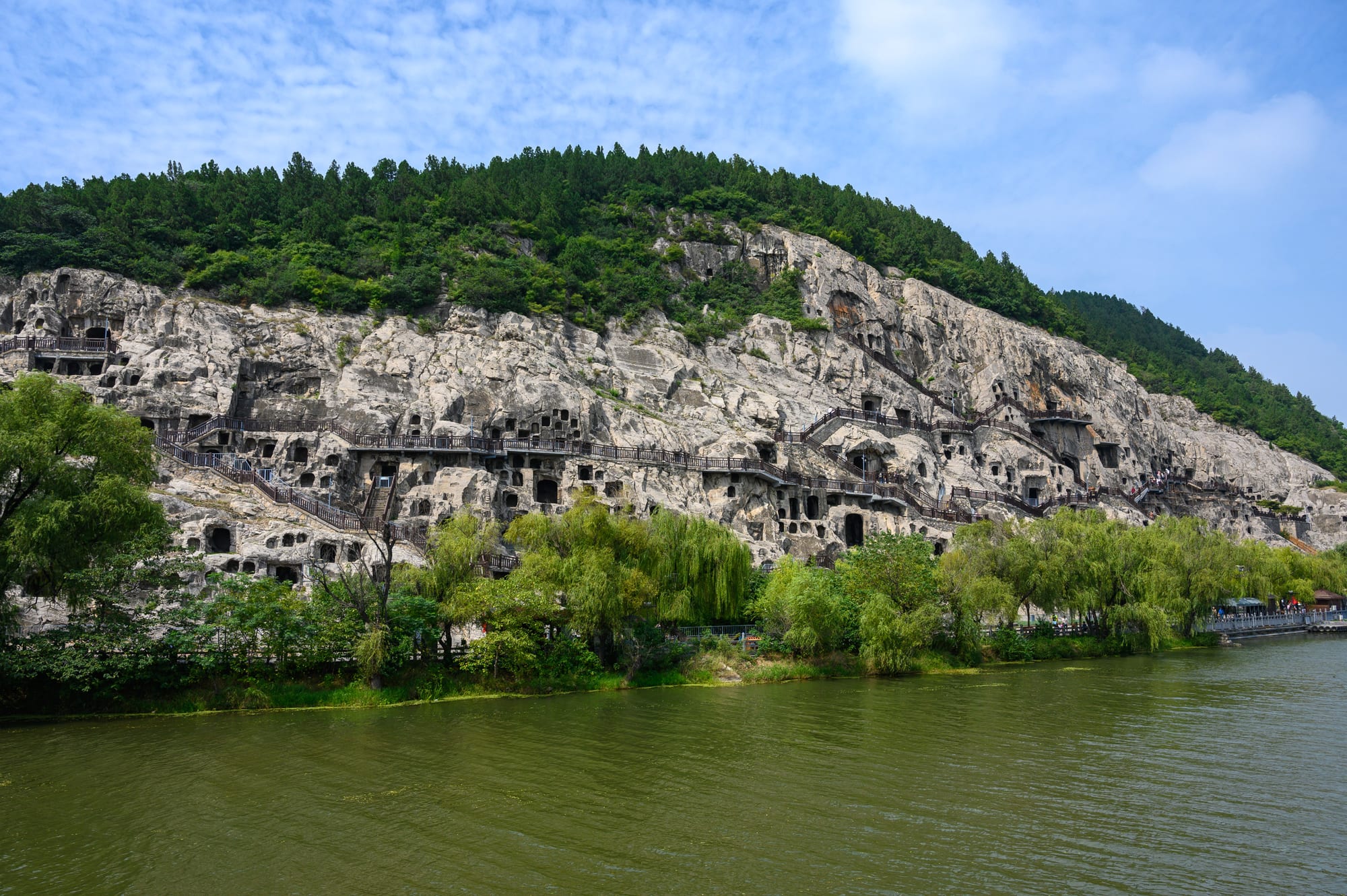
A limestone cliff honeycombed with carved Buddhist niches and caves rising above the green water of a river lined with willows

Central China, China

Luoyang

The carved cliffs of the Longmen Grottoes above the Yi river south of Luoyang. (xiquinhosilva / Wikimedia Commons · CC BY 2.0)

A city on the Luo River in western Henan that served as the capital of a succession of Chinese dynasties, from the Eastern Zhou and Eastern Han to the Northern Wei and, under the Tang, as a second capital. Its Buddhist cliff carvings at Longmen are a UNESCO World Heritage Site, and it is the usual base for the Shaolin and White Horse temples.

Neighbourhoods

  • Laocheng (the Old City)
    • Historic district
    • Best for food
    • Night markets

    The walled old town on the east side of the modern city, rebuilt around Ming and Qing street patterns, with restored gate towers, a drum tower and a pedestrian street of snack stalls and shops. Evenings are the busiest time, and many visitors come for the food rather than the shopping.

    Open in Maps
  • Xigong
    • First-time visitors
    • Close to public transport
    • Parks

    The central business district between the old city and the western suburbs, with the main shopping streets and hotels. Wangcheng Park, at 67 hectares the largest public park in Luoyang and its best-known peony garden, lies at its western edge.

    Open in Maps
  • Jianxi
    • Quiet and residential
    • Local life

    Built from the 1950s around Soviet-assisted tractor and machinery works, with wide avenues, grid-planned worker housing blocks and mature trees. It feels like a separate town from the old city and shows the industrial side of Luoyang.

    Open in Maps
  • Luolong
    • Museums
    • Close to public transport
    • Modern city

    The newer district south of the Luo River, holding museums, government offices and wide new boulevards. Luoyang Longmen station, on the high-speed line, is here, and the grottoes are a short ride further south.

    Open in Maps

Things to do

Famous landmarks

  • Longmen Grottoeslandmark

    Tens of thousands of Buddhist statues and inscriptions carved into limestone cliffs on both banks of the Yi river from the late fifth century onwards, a UNESCO World Heritage Site.

    Open in Maps
  • Luoyang Longmen railway stationtransit hub

    The high-speed station south of the Luo River, the arrival point for most visitors and the nearest rail stop to the grottoes.

    Open in Maps
  • White Horse Templelandmark

    Traditionally counted as the first Buddhist temple established in China, founded in AD 68 under the Eastern Han, with a Thai hall built in 1992 and an Indian-style temple added in the international garden beside it.

    Open in Maps

Museums and ancient sites

  • Luoyang Museummuseum

    The city's main collection, first opened in 1958, covering the Xia, Shang, Zhou, Han and Tang periods with bronzes, tomb figures and Buddhist sculpture from excavations around Luoyang.

    Open in Maps
  • Luoyang Ancient Tombs Museummuseum

    A museum on Mang Hill north of the city, opened in 1987, built around dozens of excavated brick burial chambers reassembled underground and entered along a corridor.

    Open in Maps
  • Erlitouattraction

    The excavated Bronze Age capital in Yanshi District east of the city, with palace foundations and a site museum opened in 2019, linked by some Chinese archaeologists with the Xia dynasty.

    Open in Maps

Short trips from the city

  • Shaolin Monasterylandmark

    The Chan Buddhist monastery on Mount Song associated with Chinese martial arts, with its Pagoda Forest of monks' memorial stupas alongside.

    Open in Maps
  • Mount Songtrail

    One of the Five Great Mountains of China, a ridge of peaks, temples and stone stairways above Dengfeng with cable cars and long walking routes.

    Open in Maps
  • Songyue Pagodalandmark

    A twelve-sided brick pagoda of 523 on the slopes of Mount Song, the oldest surviving brick pagoda in China.

    Open in Maps
  • Dengfeng Observatorylandmark

    A stone and brick observatory built in 1276 for Kublai Khan, designed by Guo Shoujing to measure the shadow of the sun, and listed by UNESCO in 2010 with the other historic monuments of Dengfeng.

    Open in Maps
  • Longtan Grand Canyonattraction

    A 12-kilometre valley of purplish-red quartz sandstone walls, pools and waterfalls in Xin'an County, about 70 kilometres from the city, part of a UNESCO Global Geopark and walked on boardwalks.

    Open in Maps
  • Xiaolangdi Damattraction

    A dam on the Yellow River about 20 kilometres north-west of the city, 154 metres high and more than a kilometre wide, with a hydroelectric station of six turbines.

    Open in Maps

Seasonal events

  • Luoyang Peony FestivalApril

    The city's biggest annual event, when peony gardens across Luoyang open their displays and hotels fill; the flower is counted with the Longmen Grottoes and the water banquet as one of the wonders of the city.

  • Lunar New Year lantern displaysJanuary or February

    The old city and the reconstructed gate towers are lit with lantern displays over the Spring Festival period, ending at the Lantern Festival.

  • Longmen autumn visiting seasonSeptember to November

    Clear, dry weather and thinner crowds make autumn the most comfortable time for the grottoes and the Mount Song temples.

Eat and drink

Long-standing places and food districts in Luoyang. Hours, ratings and directions come from your maps app, always current.

Luoyang classics

  • Luoyang Water Banquetrestaurant

    A traditional local banquet of eight cold and sixteen warm dishes served in bowls one after another like flowing water, most of them cooked in broths and gravies.

    Open in Maps
  • Beef and mutton soup breakfastsrestaurant

    Luoyang eats soup for breakfast — clear beef or mutton broth with sliced meat, chilli oil and flatbread torn into the bowl, sold at small shops that open before dawn and sell out by mid-morning.

    Open in Maps

Food streets and markets

  • Old City pedestrian streetsneighborhood

    The lanes around the drum tower and Lijing Gate fill in the evening with stalls selling grilled skewers, noodles, sweet soups and pot-cooked snacks.

    Open in Maps
  • Longmen scenic-area restaurantsneighborhood

    The village strip outside the grottoes entrance has simple noodle and rice places used by visitors before or after a walk along the cliffs.

    Open in Maps

Experience Luoyang

History

Luoyang stands on the Luo River in a natural basin guarded by mountain passes, a position that made it a capital again and again. The Western Zhou built the city of Chengzhou here in the eleventh century BC, and from 770 BC the Eastern Zhou ruled from it. The Eastern Han moved the capital to Luoyang in AD 25, and the city became the eastern end of the Silk Road and the point where Buddhism is traditionally said to have entered China, with the White Horse Temple founded in its outskirts. The Confucian classics were carved on stone tablets and set up outside the imperial academy here in the second century.

The city was sacked and rebuilt repeatedly. The Northern Wei moved their court here in 493 and began carving the Longmen cliffs, work that continued under the Tang for more than four centuries. Under the Sui a vast new capital was laid out astride the river and linked to the Grand Canal; under the Tang, Luoyang was the eastern capital and, during the reign of Wu Zetian, the seat of government itself. The An Lushan rebellion of the eighth century devastated it, and when the Song chose Kaifeng, Luoyang became a secondary city of gardens and retired officials.

Centuries of decline followed. Modern Luoyang was rebuilt after 1949 as a planned industrial centre: Soviet-assisted plants in the new Jianxi district made tractors, bearings and mining machinery, and the population grew rapidly. Archaeology has run alongside the factories ever since, and a string of capital sites along the Luo valley is now protected, with Longmen inscribed by UNESCO in 2000 and the Dingding Gate site added as part of the Silk Roads listing in 2014.

Culture & Customs

The peony is Luoyang's emblem, counted with the Longmen Grottoes and the water banquet as one of the wonders of the city. It appears on shopfronts, embroidery, porcelain and painting, and the April flowering fills the parks and the hotels. Peony painting in ink and colour is a local craft with its own studios and schools.

Buddhism shaped the city's culture as much as the court did. The White Horse Temple remains a place of pilgrimage, the Longmen carvings are studied as the main record of Chinese Buddhist sculpture between the fifth and eighth centuries, and the martial tradition of Shaolin on nearby Mount Song draws students from across China and abroad. Tangsancai, the three-coloured lead-glazed pottery made for Tang tombs and excavated in quantity around Luoyang, is copied by workshops in the villages north of the city and sold as a local craft.

Spoken Luoyang Mandarin is a Central Plains dialect, flatter in tone than standard Mandarin and a source of local pride. Yu opera, Henan's own high-voiced operatic form, is performed in city theatres and informally in parks, where retired people gather in the mornings to sing, practise tai chi and play cards. Evening life is outdoors: families walk the riverside parks, and squares fill with dancing after dark. Residents tend to measure their city against Xi'an and Kaifeng, the other ancient capitals nearby, and are quick to point out how many dynasties ruled from here.

Daily Life

About seven million people live in the Luoyang prefecture, with about two and three-quarter million in the built-up urban area, making it Henan's second city after Zhengzhou. The population is spread across distinct centres: the old city and central Xigong, the industrial west in Jianxi, and the newer southern districts across the Luo River, which have grown fastest since the high-speed station opened.

Heavy industry still underpins the economy — tractors and agricultural machinery, bearings, glass, aluminium and mining equipment — although the state plants employ far fewer people than they did, and services, tourism and logistics have grown to fill the gap. Tourism is strongly seasonal, peaking in April and again in the autumn. The surrounding counties farm wheat and maize, and many households combine farming with work in the city.

The day begins early. Soup shops open before dawn and are often sold out by mid-morning; markets are busiest before the heat; offices and factories break for a long lunch. Summer evenings pull people onto the riverbanks and into the parks once the sun is down. The recurring concerns are those of many inland Chinese cities: an ageing population, young graduates leaving for Zhengzhou or the coast, air quality in winter, and water supply in a dry province.

Food

Luoyang's food is built on soup. The city eats broth for breakfast — beef, mutton, lamb offal or pork — served with chilli oil, coriander and a flatbread torn into the bowl, from shops that open before dawn. The best-known formal meal is the water banquet, shuixi, twenty-four dishes — eight cold and sixteen warm — served in bowls rather than plates and arriving one after another like flowing water, cooked in broths, gravies and juices. It is credited to the Tang dynasty and is served at weddings and for important guests.

Wheat dominates the everyday table, as it does across Henan: hand-pulled noodles in mutton broth, steamed buns, and thick soups thickened with starch and seasoned heavily with white pepper, eaten at breakfast. Sweet potato and millet appear in porridges, and pickled vegetables come with almost everything.

Street eating concentrates in the old city, where the lanes around the drum tower sell grilled skewers, fried dough, sesame pancakes and stewed snacks from early evening until late. Henan produces its own light beers and strong sorghum-based baijiu, and jasmine and chrysanthemum teas are the common accompaniment to a meal. Peony petals are used in cakes, tea and sweets sold as souvenirs during the spring festival.

Planning tools

Budget

Luoyang is inexpensive by Chinese standards for food, hotels and city transport. The main costs are scenic-area tickets — Longmen, Shaolin and the Mount Song sites each charge separately, and sightseeing buggies and cable cars are extra. Prices for hotel rooms rise sharply during the peony festival in April and in the national holiday weeks.

Daily Budget Midrange
USD 90–180 (mid-range hotel, restaurant meals, scenic-area tickets and a car or driver for Shaolin)
Daily Budget Shoestring
USD 30–50 (hostel or budget hotel, soup breakfasts and noodle shops, buses and metro)

Longmen and Shaolin each take the better part of a day, so plan tickets and transport for them separately rather than together.

Best Time to Visit

April is the signature month, when the peonies flower and the festival runs, though the city is at its most crowded and most expensive then. September to November brings clear, dry air and comfortable walking weather at the grottoes and on Mount Song. Summer is hot and humid, and winter is cold, grey and quiet, with little snow.

Suggested Number of Days

Two days covers the city and its main site. Three or four allow the temples and mountains outside town as well. Peony season and national holidays slow everything down, so allow extra time then.

First Visit
2 days
With Surroundings
3–4 days

Transportation

A metro network of two lines, both opened in 2021, crosses the city from east to west and north to south, linking the old city, the centre and the museum district, and city buses reach the grottoes and the White Horse Temple. Ride-hailing through Didi is cheap and widely used. Shaolin and Mount Song are usually reached by chartered car, tour coach or a bus from the long-distance station, with a change at Dengfeng.

Payment on buses, metro and ride-hailing all runs through mobile apps, so set up Alipay or WeChat Pay with a card before arriving.

Airport & Station Connections

Luoyang Longmen station, south of the Luo River, is on the Xuzhou–Lanzhou high-speed line: Zhengzhou is about half an hour away and Xi'an under two hours, which is how most visitors arrive. The older Luoyang railway station north of the centre handles conventional services. Luoyang Beijiao Airport, about ten kilometres from the centre, has a limited number of domestic flights, and many travellers fly instead to Zhengzhou.

Walkability

The old city is compact and best seen on foot, and the riverside parks make easy walks. The modern city is not: it spreads for more than 20 km from Jianxi in the west to the Longmen area in the south-east, on wide avenues built for traffic, so the metro, buses or ride-hailing are needed between districts. Longmen itself involves several kilometres of walking along the cliffs and across the river.

Safety

Luoyang is a safe city with very little violent crime, and the usual issues are practical ones: crowds at Longmen and Shaolin on holidays, steep and slippery stone stairways on Mount Song, and summer heat. Touts outside the Shaolin Temple sell unofficial tours and places at "kung fu schools".

Buy scenic-area tickets at official counters or through official apps, wear shoes with grip on mountain steps, and avoid the middle of the day in summer. Check current official travel advice before travelling.

Climate

A continental monsoon climate with four distinct seasons. Most rain falls between July and September; spring is dry and windy, and autumn is the clearest season. The Luo valley is sheltered but still gets cold northern air in winter.

Summer
hot and humid, with daytime temperatures usually in the low thirties °C in July and August, and heavy downpours
Winter
cold and dry, close to 0°C at night and a few degrees above by day in January, with occasional light snow

Local Customs

Tipping is not customary and is generally refused. Temples such as the White Horse Temple and Shaolin are working religious sites: dress with shoulders and knees covered, keep quiet in the halls, and check the signs before photographing statues, as many interiors forbid it. Photography of the Longmen carvings is allowed outdoors but flash is not. Meals are shared from communal dishes, and tea is poured for others before oneself.

Politics, Taiwan, Tibet and Xinjiang are sensitive subjects; avoid photographing security forces or military sites.

Common Payment Methods

The currency is the renminbi, counted in yuan. Daily life runs on QR-code payment through Alipay and WeChat Pay, which now allow foreign visitors to link an overseas card; foreign cards are accepted at some hotels and large stores but not at most restaurants and stalls. Carrying some cash is useful, and ATMs at the big banks accept international cards.