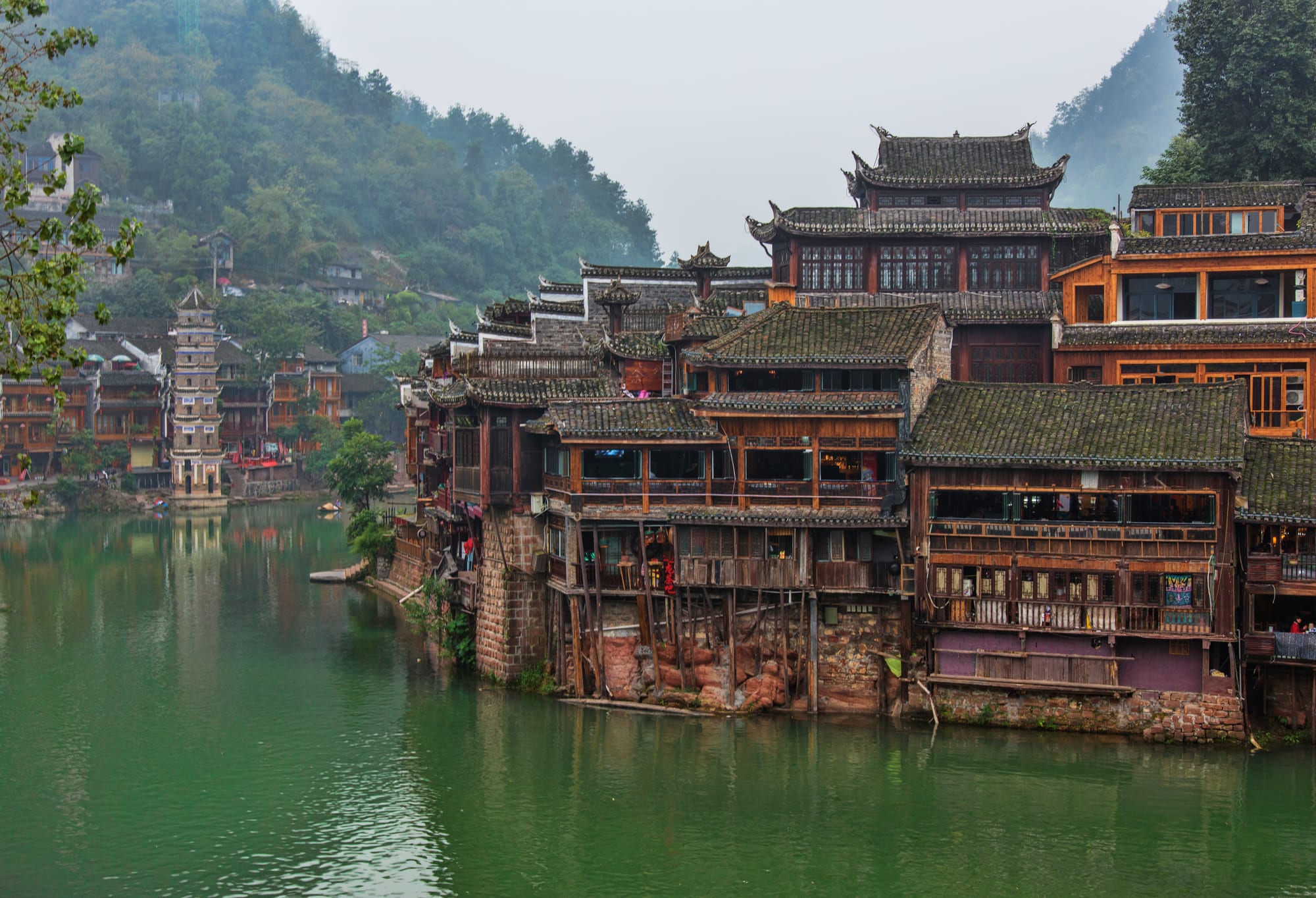
Old wooden houses with dark tiled roofs on stilts and stone footings along a green river, with a pagoda and forested hills behind

China

Hunan & Guangxi

Riverside stilt houses in the ancient town of Fenghuang, in western Hunan. (chensiyuan / Wikimedia Commons · CC BY-SA 4.0)

Two neighbouring provinces of south-central China — Hunan, the fiery-food homeland of Mao Zedong with Changsha and the sandstone pillars of Zhangjiajie, and Guangxi, the Zhuang autonomous region of karst peaks, the Li River and minority villages set among rice terraces.

Explore Hunan & Guangxi

History

Hunan was the heartland of the ancient state of Chu, whose poet-minister Qu Yuan is said to have drowned himself in the Miluo River around 278 BC — the origin story of the dragon-boat festival. The Han tombs at Mawangdui near Changsha, opened in the 1970s, preserved the body of the Marquise of Dai, silk paintings and early texts. In 214 BC the Qin cut the Lingqu Canal at Xing'an to join the Xiang and Li rivers and push armies south into what became Guangxi. Changsha's Yuelu Academy, founded in 976, made Hunan a centre of Confucian learning.

In the 19th century both provinces were at the centre of the Taiping Rebellion: it broke out at Jintian in Guangxi in 1851, and it was Zeng Guofan's Hunan Army that eventually crushed it. Hunan then became a forcing house of revolutionaries. Mao Zedong was born at Shaoshan in 1893, studied in Changsha and led the Autumn Harvest Uprising of 1927, and Liu Shaoqi, Peng Dehuai and Hu Yaobang were also Hunanese. Changsha was burned in 1938 and fought over repeatedly in the war with Japan, and Guilin fell in 1944.

Guangxi became a Zhuang autonomous region in 1958. Its border with Vietnam, the scene of the Sino-French War of the 1880s and a brief war in 1979, is now a busy trade route, and both provinces have been transformed by high-speed rail and tourism since the 2000s.

Culture & Customs

Hunanese speak Xiang dialects and are known across China for a stubborn, outspoken temperament that is often linked, half-jokingly, to their love of chillies. Changsha exports popular culture: Hunan Broadcasting System and its Mango TV streaming platform are both based in the city. The western hills, Xiangxi, are home to Tujia and Miao peoples, with silver jewellery, stilt houses and the novelist Shen Congwen's Fenghuang.

Guangxi's largest group is the Zhuang, China's biggest ethnic minority, whose language is related to Thai. Around a third of Guangxi's people are Zhuang, and the Yao, Miao and Dong live in the northern mountains. The Zhuang Sanyuesan festival, on the third day of the third lunar month, is a spring song festival, and the story of the legendary Zhuang singer Liu Sanjie was turned by Zhang Yimou into an open-air show on the Li River at Yangshuo. Dong villages around Sanjiang keep wooden drum towers and covered wind-and-rain bridges.

Across both provinces the dragon-boat races at Duanwu are a major event, and Mao's birthplace at Shaoshan remains a pilgrimage site for Chinese tour groups.

Daily Life

Hunan has about 66 million people. Changsha, with around 10 million, is a fast-growing capital known for its nightlife, tea-drink chains and construction-machinery makers such as Sany; Zhuzhou, Xiangtan, Yueyang and Hengyang are industrial and river cities. Much of the countryside still grows rice, and Hunan was the base of Yuan Longping's hybrid-rice research.

Guangxi, with about 50 million, is poorer and more rural. Nanning, the capital, is a gateway for trade with Vietnam and Southeast Asia; Liuzhou builds cars, including the small Wuling vans; Guilin lives largely on tourism, and Beihai on the coast is a port and resort. Guangxi grows most of China's sugar cane, along with tropical fruit.

Life in the cities runs late: Changsha's food streets and bars fill well after midnight in summer, and Guangxi towns gather over breakfast rice noodles. Many young people from both provinces work in Guangdong's factories and send money home, leaving older relatives and children in the villages.

Food

Xiang cuisine, Hunan's cooking, is hotter than Sichuan's and without the numbing peppercorn: fresh and pickled chillies, smoked and cured meats, and sour flavours. Duo jiao yu tou is a steamed fish head buried in chopped salted chillies; hongshao rou, red-braised pork belly, is sold as Chairman Mao's favourite; la rou is smoked cured pork stir-fried with garlic shoots or chillies. Changsha's street snacks include black, deep-fried stinky tofu, and the cooking of western Hunan leans to the sour, salty flavours of its minority peoples.

Guangxi's signature is rice noodles. Guilin mifen, the city's rice noodles, are an everyday staple; Liuzhou's luosifen, river-snail rice noodles with fermented bamboo shoots, is notorious for its smell and is now sold in packets nationwide. Lemon duck, sour and spicy from pickled lemon, is a speciality of Wuming on the edge of Nanning, and sour flavours run through Zhuang cooking.

Hunan's tea includes Junshan yinzhen from an island in Dongting Lake and the dark tea of Anhua, while Guangxi is known for osmanthus, whose scent gives Guilin its name, and for mild rice wines.

Attractions & Natural Wonders

In north-western Hunan, Zhangjiajie's stone pillars fill the Wulingyuan Scenic Area, a UNESCO World Heritage Site: the Bailong lift climbs a cliff face to Yuanjiajie, the Golden Whip Stream path runs along the valley floor, and nearby Tianmen Mountain has a cable car, a cliff walkway and a natural arch. Further south, Fenghuang's wooden stilt houses line the Tuo River below old town gates.

Changsha offers the Hunan Museum with the Mawangdui finds, Yuelu Academy at the foot of Yuelu Mountain, and Orange Isle in the Xiang River with a giant sculpture of the young Mao. Mao's birthplace at Shaoshan, the Yueyang Tower over Dongting Lake and Mount Heng, the southern of China's five sacred peaks, are within reach.

Guangxi's karst peaks crowd the Li River between Guilin and Yangshuo, a stretch included with Guilin's karst in the South China Karst UNESCO listing. Guilin has Elephant Trunk Hill and the Reed Flute Cave; Yangshuo has Moon Hill and the Yulong River. North of Guilin, the Longji rice terraces climb the slopes around the Zhuang village of Ping'an and the Yao village of Dazhai, and Sanjiang's Chengyang Wind and Rain Bridge crosses a river among Dong villages. In the far south-west, the Detian waterfall spills across the Vietnamese border, and the Zuojiang Huashan rock paintings are a UNESCO World Heritage Site.

Cities in Hunan & Guangxi

Planning basics

Budget

Both provinces are cheaper than China's coastal cities, and food is inexpensive everywhere. The big costs are scenic-area tickets: Zhangjiajie's Wulingyuan park, the Li River cruise and the Longji terraces each charge substantial entry fees on top of shuttle buses and cable cars. Yangshuo and Fenghuang have plenty of cheap guesthouses outside holiday weeks.

Daily Budget Midrange
USD 75–150 (boutique guesthouse or mid-range hotel, restaurant meals, park tickets and cable cars)
Daily Budget Shoestring
USD 30–50 (hostel or guesthouse, noodle shops, buses and high-speed rail)

Buy Zhangjiajie's multi-day park pass and stay near an entrance; a bamboo raft on the Yulong River costs less than the full Li River cruise.

Safety

The region is safe. Hazards are mostly natural: slippery steps and steep drops in the mountain parks, flash floods and landslides in the summer rains, and heat in Changsha. Crowds at holiday peaks can be crushing on narrow paths, and some Li River and Yangshuo touts overcharge for boat and raft trips.

Wear grippy shoes in the parks, avoid mountain roads after heavy rain, and agree raft and boat prices before boarding. Check current official travel advice before travelling.

Climate

Humid subtropical throughout. Changsha has some of China's hottest, stickiest summers and damp, chilly winters in homes without central heating. Guilin and Yangshuo are milder, with a long wet season from April to August when rivers run high. The mountains of Zhangjiajie and Longji are cooler and often wrapped in mist, and can see snow and ice in winter.

Summer
hot and humid, 30–38°C in Changsha, slightly cooler in Guilin and the mountains, with heavy rain
Winter
cool and damp, 3–12°C; frost and occasional snow at altitude

Transportation

High-speed lines run through Changsha between Wuhan and Guangzhou and through Guilin between Guiyang and Guangzhou, and Zhangjiajie now has a high-speed station as well as an airport. Yangshuo is about an hour from Guilin by road or train, or four to five hours downstream by boat. Longji is roughly two hours by bus from Guilin, and Fenghuang is reached by road or rail from Zhangjiajie or Huaihua. Inside Wulingyuan, free park buses link the trailheads.

Allow at least two full days for Zhangjiajie; hire a bicycle or scooter to explore Yangshuo's countryside.

Best Time to Visit

April to May and September to October give comfortable walking weather; the Longji terraces are flooded and mirror-like in spring, green in early summer and golden before the harvest in late September and October. Summer is hot and wet but brings full rivers on the Li. Avoid the May and October holiday weeks, when Zhangjiajie, Fenghuang and Yangshuo are overwhelmed.