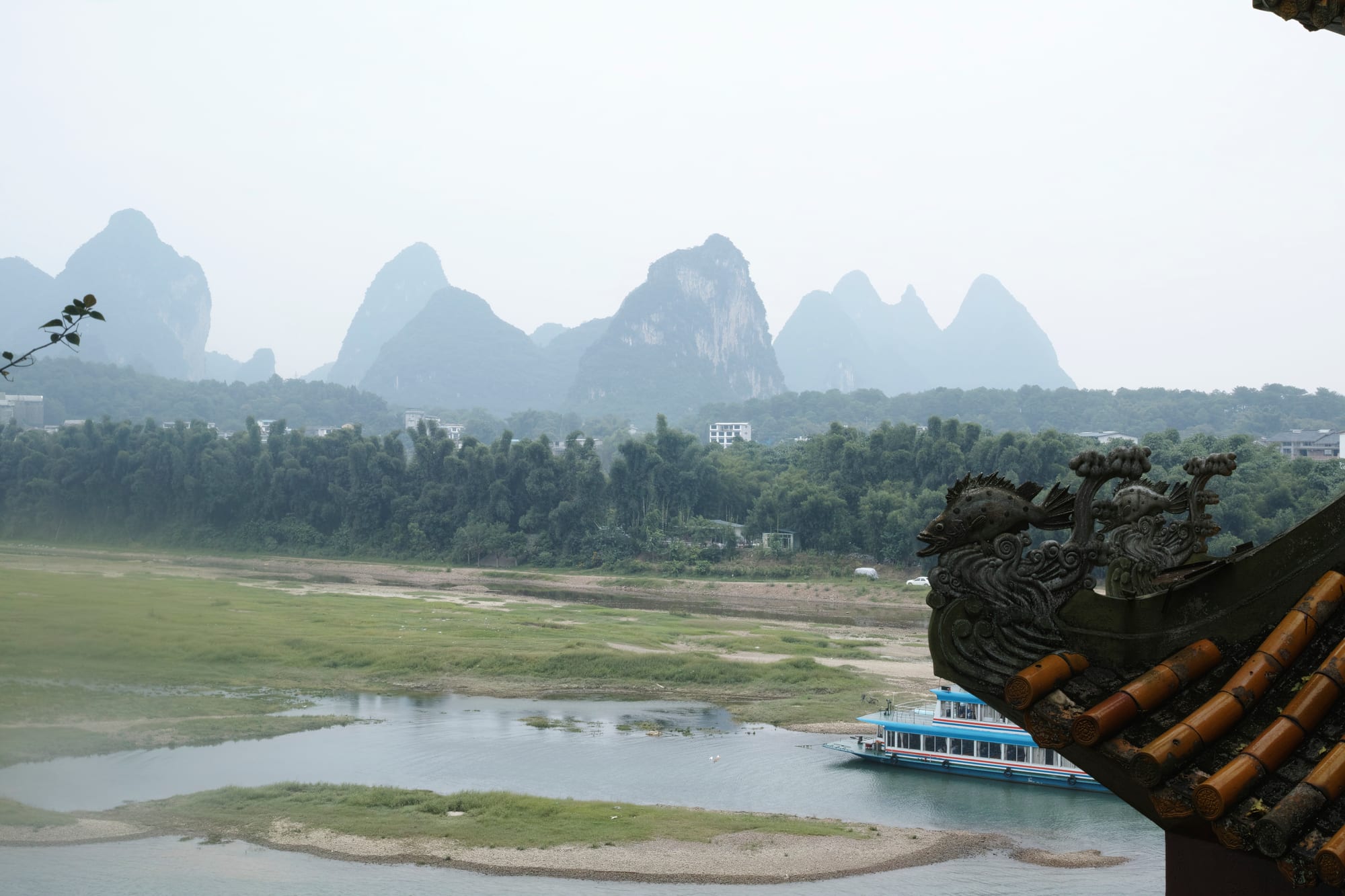
Rows of misty limestone peaks beyond a wide river with a sandbank and a passenger boat, framed by a carved temple eave

Hunan & Guangxi, China

Yangshuo

Karst peaks above the Li River seen from the pavilion on Bilian Peak in Yangshuo town. (ArishG / Wikimedia Commons · CC BY-SA 4.0)

A small riverside town in north-eastern Guangxi, ringed by limestone towers where the Li and Yulong rivers meet. It is the end of the classic boat trip down from Guilin and has grown from a farming county seat into one of China's best-known bases for cycling, rock climbing, bamboo rafting and walking among the karst hills and paddy fields.

Neighbourhoods

  • West Street and the riverfront
    • First-time visitors
    • Nightlife
    • Best for food

    The old paved street running from the Li River wharf into the town centre, lined with bars, cafés, guesthouses and souvenir shops in two-storey houses. It is the noisiest part of Yangshuo after dark and the most convenient place to stay for boats, buses and restaurants.

    Open in Maps
  • The town centre and Yangshuo Park
    • Quiet and residential
    • Parks
    • Local life

    The everyday town away from the bar street, with markets, schools, noodle shops and a small hillside park under a pointed peak. Prices are lower here and the atmosphere is ordinary small-town Guangxi.

    Open in Maps
  • The Yulong valley
    • Cycling
    • Countryside stays
    • Quiet and residential

    The farmland west of town along the Yulong River, where villages, bamboo groves and paddy fields sit between limestone towers. Guesthouses and converted farmhouses are scattered along the lanes, and it is the area people cycle and raft through.

    Open in Maps
  • Xingping
    • Riverside walks
    • Photography
    • Day trips

    An old town upstream on the Li, about an hour away, with a lane of weathered shophouses and a reach of the river of the kind pictured on the twenty-yuan note. Much quieter than Yangshuo and a common overnight alternative.

    Open in Maps

Things to do

The town and the river

  • West Streetneighborhood

    Yangshuo's oldest street, paved in stone and lined with old shophouses, which turned from a village lane into the town's centre of bars, cafés and shops as travellers arrived.

    Open in Maps
  • The Li Riverattraction

    The river that curves past the town between karst towers; boats from Guilin tie up at the wharf, and rafts and cruisers work the reaches upstream towards Xingping.

    Open in Maps
  • Yangshuo Parkpark

    A small park on the western edge of town with paths up a rock peak, giving a view over the rooftops to the surrounding hills.

    Open in Maps

The countryside

  • Moon Hillviewpoint

    A limestone hill pierced by a large natural arch, reached by a stepped path, with climbing routes on the overhanging rock that helped make the area a centre of Chinese sport climbing.

    Open in Maps
  • Yulong Riverattraction

    A shallow tributary west of town, crossed by low weirs and old stone bridges, where bamboo rafts are poled downstream between bamboo groves and paddy fields.

    Open in Maps
  • Yulong Bridgelandmark

    A single-arch stone bridge over the Yulong dating from the Ming dynasty, still in use and a landmark on the valley's cycling lanes.

    Open in Maps
  • The Big Banyanattraction

    An enormous old banyan tree beside the Jinbao River south of town, long a local landmark and the setting of a well-known Chinese film scene.

    Open in Maps
  • The Ten-Mile Gallerytrail

    The road and cycle route running south-east from town past a string of named peaks, riverside farms and viewpoints.

    Open in Maps

Short trips from the town

  • Xingpingneighborhood

    A riverside town upstream with an old street of timber and brick shophouses and the much-photographed bend of the Li beneath the peaks.

    Open in Maps
  • Guilinneighborhood

    The city upstream on the Li, about an hour away by road, with caves, hill parks, a Ming princely compound and the region's airport and main railway stations.

    Open in Maps

Seasonal events

  • Spring Festivallate January or February

    Lion dances, firecrackers and family reunions in the villages, with domestic visitors filling the town and guesthouse prices at their highest.

  • Dragon Boat Festivalfifth day of the fifth lunar month, usually June

    Boat races on the Li when the summer rains have the river high, with rice dumplings wrapped in leaves eaten at home.

  • Zhuang Sanyuesan song festivalthird day of the third lunar month, usually April

    The regional Zhuang spring song festival, a public holiday across Guangxi, marked with singing, folk games and market days in the villages.

  • Harvest seasonSeptember and October

    The paddy fields along the Yulong turn gold and are cut by hand and machine, the busiest and most photogenic weeks in the countryside.

Eat and drink

Long-standing places and food districts in Yangshuo. Hours, ratings and directions come from your maps app, always current.

Yangshuo classics

  • Beer fish restaurantsrestaurant

    Pijiu yu, the town's signature dish, is river fish fried whole then braised with beer, tomato, garlic and chillies in a shallow pan; it appears on nearly every menu in town.

    Open in Maps
  • Stuffed snails and country dishesrestaurant

    Guangxi farmhouse cooking — river snails stuffed with minced pork, taro braised with belly pork, free-range chicken and pickled vegetables — is served in the town and in the valley guesthouses.

    Open in Maps

Streets and markets

  • West Streetneighborhood

    Cafés, bars and small restaurants fill the old street, with barbecue stalls and snack counters on the lanes running off it.

    Open in Maps
  • Yangshuo marketmarket

    The town's produce market sells river fish, snails, bamboo shoots, pomelo and mandarins from the surrounding orchards, which are one of the county's main crops.

    Open in Maps
  • Village market daysmarket

    Rotating market days in the villages around Yangshuo bring farmers in with vegetables, livestock and household goods, and are the most ordinary sight in the area.

    Open in Maps

Experience Yangshuo

History

Yangshuo has been a county seat since the Sui dynasty, established in the year 590 on the bank of the Li where the river bends around a wall of limestone. For most of its history it was an unremarkable agricultural county of rice, citrus and river trade, overshadowed by Guilin upstream; its peaks and caves drew scholars who left carved inscriptions on the rock, but the town itself stayed small, built of grey brick and timber along a single main street running up from the wharf.

Its modern character was made by tourism, and unusually late. Foreign visitors began arriving in the 1980s, mostly backpackers who came down the river from Guilin and found rooms far cheaper than in the city. The main street picked up the name West Street for the foreigners who filled it, and its shops turned into cafés, guesthouses, bicycle hire and bars over the following decade. Climbers arrived in the 1990s, bolting routes on the overhanging limestone around Moon Hill and establishing Yangshuo as the centre of Chinese sport climbing.

Since the 2000s the visitors have overwhelmingly been Chinese rather than foreign. Impression Liu Sanjie, Zhang Yimou's open-air show staged on the Li against the peaks since March 2004, drew mass domestic tourism; high-speed rail arrived in the 2010s, putting Guangzhou within a few hours; and the countryside filled with guesthouses and resorts converted from farmhouses. The county has had to balance that growth against the protection of the karst landscape, with building controls and river management now a permanent part of local government.

Culture & Customs

For a town of its size Yangshuo has an unusual mix. The surrounding villages are ordinary rural Guangxi — clan surnames, ancestral halls, market days, rice and citrus, elderly residents speaking the local Guilin dialect — while the centre has spent forty years hosting travellers, with English widely understood on West Street and a long-established community of climbers, language students and guesthouse owners from elsewhere in China and abroad.

The region is part of the Zhuang autonomous region, and Zhuang traditions, including the spring song festival of Sanyuesan, are marked locally. The landscape itself is the cultural reference point: these peaks are the ones that appear in ink paintings and on the twenty-yuan note, and cormorant fishing on the Li, once a working method with trained birds on bamboo rafts, now survives mainly as an evening demonstration staged for photographers.

Outdoor sport is a large part of local identity — climbing, caving, kayaking, cycling and long-distance walking all have local operators and guides — and the seasons of farm work still set the pattern in the valley, with ploughing and flooding of the terraces in spring and the rice harvest in autumn. Manners are rural and direct: food is shared, tea is offered, and bargaining at stalls and over raft rides is normal and good-natured.

Daily Life

Yangshuo County had about 273,000 residents at the 2020 census, with only a fraction of them in the county town itself; the rest live in villages and small market towns spread through the valleys. The population swells enormously at holiday peaks, when coaches and high-speed trains deliver far more visitors in a week than the town holds residents.

Farming and tourism are the two pillars. Rice, pomelo, mandarin oranges, persimmons and chestnuts come off the land around the town, and Yangshuo kumquats are a registered geographical-indication product; tourism provides the cash, through guesthouses, restaurants, rafts, bicycle and scooter hire, guiding and performance work. Many families do both, farming through the week and renting rooms or poling rafts in season.

Days begin early with noodles and end early away from West Street, where bars run late. Life in the valley is set by the weather and the river, and the local concerns are familiar ones for a place that lives on visitors: rising rents and land prices, unevenly distributed earnings, water quality and rubbish on the rivers, traffic on lanes never built for coaches, and how much new building the protected landscape can absorb.

Food

Beer fish, pijiu yu, is the dish Yangshuo is known for across China: a whole river fish, scaled but often left unskinned, fried in a shallow pan and then braised with beer, tomatoes, garlic, ginger, spring onion and fresh chillies until the sauce thickens. It is eaten straight from the pan at the table, and almost every restaurant in town claims a version of it.

The rest of the local table is Guangxi farmhouse cooking. River snails are picked out, minced with pork and seasonings and stuffed back into their shells; taro is braised in thick slices with belly pork; free-range chicken is steamed or stewed; and stuffed vegetables — tofu, aubergine or bitter melon packed with pork — appear everywhere, as they do throughout the region. Pickled and sour flavours run through the cooking, and rice noodles are the standard breakfast, dressed with a spiced stock, peanuts and pickles in the Guilin manner.

The orchards supply the rest: pomelo, mandarins, persimmons, chestnuts and kumquats, sold fresh at the market and dried or candied as snacks. Osmanthus flowers from the hills flavour cakes and tea, villages distil their own rice wine, and West Street's cafés and bars serve coffee and imported beer alongside the local brew that gives the fish its name.

Planning tools

Budget

Yangshuo is inexpensive. Guesthouses in town and converted farmhouses in the valley are cheap outside holiday weeks, meals cost little, and the countryside itself is free to cycle and walk. The costs that mount up are river cruises, raft trips, cable cars and the evening outdoor shows.

Daily Budget Midrange
USD 60–120 (boutique guesthouse or valley hotel, restaurant meals, a river cruise or raft trip, a scooter or driver)
Daily Budget Shoestring
USD 25–45 (hostel or simple guesthouse, beer fish and noodle shops, a hired bicycle)

A bamboo raft on the Yulong costs much less than the full Li River cruise, and a hired bicycle reaches most of the valley for the price of a meal.

Best Time to Visit

April to May and September to October bring the most comfortable weather, with green paddies in early summer and the harvest in autumn. Summer is hot and wet, though the rivers are at their fullest; winter is cool, misty and quiet, and some rafting stops when the water drops. The May and October holiday weeks are extremely crowded.

Suggested Number of Days

Two or three days is the usual stay, long enough for the town, a river trip and a ride through the valley. Four or five suits anyone cycling, climbing or walking, or basing themselves in the countryside. Rain shortens most visits, as the activities here are outdoors.

First Visit
2–3 days
With Surroundings
4–5 days

Transportation

The town is small enough to cross on foot, and the standard way to see the countryside is a hired bicycle, an electric scooter or a driver for the day. Buses run along the main roads to Guilin, Xingping and the villages, boats and rafts work the two rivers, and ride-hailing is available but thin outside town.

Agree raft and boat prices before boarding, and check that a hired scooter is insured and legal for a foreign licence before riding it on main roads.

Airport & Station Connections

Most people arrive from Guilin, about an hour away by road, by train to Yangshuo's high-speed station outside town, or by cruise boat down the Li, which takes several hours. Guilin Liangjiang International Airport, beyond Guilin on the far side of the city, is the nearest airport and has direct shuttle buses. The high-speed line through the county runs between Guiyang and Guangzhou, and long-distance buses also connect towards Nanning.

Walkability

The town itself is very walkable: West Street to the wharf, the market and the park are all within a few minutes, and streets are flat. The countryside is another matter — distances between villages, bridges and hills run to several kilometres along lanes shared with scooters and tractors, so most people cycle rather than walk.

Safety

Yangshuo is safe, and the risks are practical rather than criminal: scooter and bicycle accidents on narrow lanes, river currents and slippery rocks, steep and wet steps on the hills, and heat in summer. Touts sell overpriced raft trips and tours around West Street and the wharf, and holiday crowds can make paths and boats very congested.

Wear a helmet on a scooter, keep off the rivers after heavy rain, and book trips through a guesthouse or official ticket office rather than a street tout. Check current official travel advice before travelling.

Climate

Humid subtropical, with a wet season from April to August and a cool, damp winter. Mist sits between the peaks for much of the year and is part of the landscape rather than a sign of bad weather.

Summer
hot and humid, typically 26–34°C, with heavy rain and thunderstorms
Winter
cool and damp, typically 5–14°C, with low cloud and occasional frost

Local Customs

Tipping is not expected. The valley is farmland where people work, not a park: gates, crops and drying grain on the lanes should be left alone, and villagers asked before being photographed. Older residents may offer tea or fruit, which is politely accepted. West Street's bar trade is unusually loud for rural China and is tolerated rather than shared by the town.

Ask before photographing farmers, cormorant fishermen or their boats — those posing by the river usually expect a small payment — and keep noise down in village lanes at night.

Common Payment Methods

The currency is the renminbi, counted in yuan. Payment is overwhelmingly by QR code through Alipay or WeChat Pay, which now let foreign visitors link an overseas card; setting this up before arrival is the single most useful preparation. Foreign cards work at some hotels but rarely at raft stands, village stalls or bicycle hire, where cash still helps.