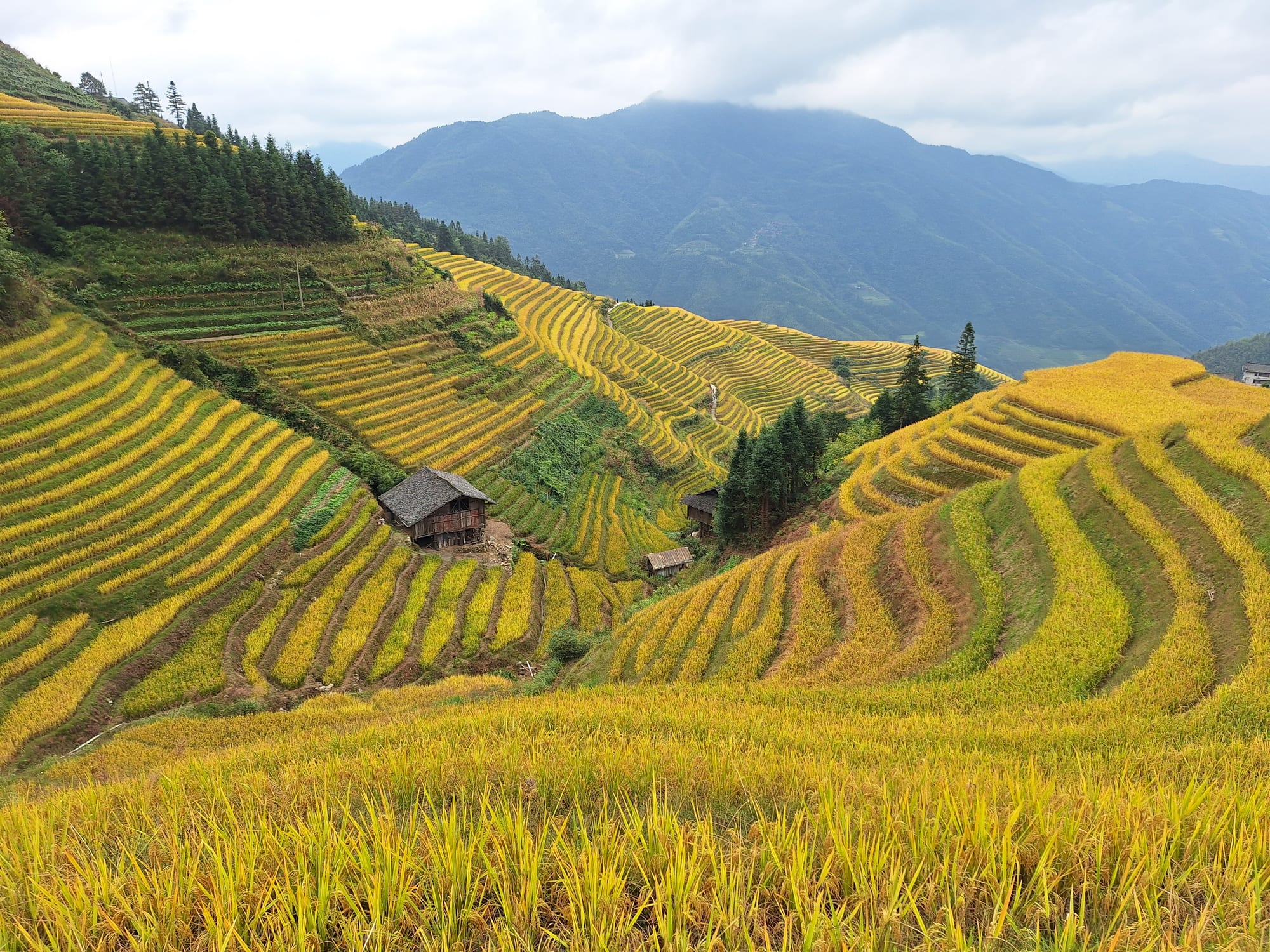
Golden terraced rice fields curving around steep hillsides with a wooden house below and blue mountains behind

Hunan & Guangxi, China

Longsheng

The Longji rice terraces above Longsheng, northern Guangxi, ripe before the autumn harvest. (Kaur Virunurm / Wikimedia Commons · CC0)

A small mountain county town in northern Guangxi, north-west of Guilin, and the seat of an autonomous county shared by Zhuang, Yao, Miao and Dong communities. It is best known as the gateway to the Longji rice terraces, carved into steep ridges over centuries and farmed from villages of wooden houses, and for the hot springs in the forested hills above the valleys.

Neighbourhoods

  • Longsheng town
    • Transport connections
    • Everyday local life
    • Cheap rooms

    The county seat in a river valley, a workaday grid of shops, markets and small hotels where buses from Guilin arrive and connections to the terrace villages leave. Most travellers pass through rather than stay, but it is the place for supplies, a bank and an ordinary Guangxi meal.

    Open in Maps
  • Ping'an
    • First-time visitors
    • Views
    • Guesthouses

    The Zhuang village set among the terraces, the most visited part of the Longji scenic area, reached by a steep lane from the road below. Wooden guesthouses climb the slope, and marked paths lead up to viewpoints over the terraces.

    Open in Maps
  • Dazhai and the Jinkeng terraces
    • Walking
    • Quiet and rural
    • Sunrise and sunset

    A Red Yao village higher up the valley, at the foot of the Jinkeng section of the terraces, with a cable car to the upper viewpoints and long paths between hamlets. It is quieter than Ping'an and better suited to a stay of more than one night.

    Open in Maps
  • Huangluo and the lower valley
    • Local culture
    • Riverside
    • Short stops

    The cluster of Red Yao villages along the river below the terraces, where women are known for their very long coiled hair. Roadside guesthouses, small restaurants and the turning for the hot springs road are here.

    Open in Maps

Things to do

The terraces and the villages

  • Longji Rice Terracesattraction

    Rice fields cut in narrow steps up the slopes between about 600 and 800 metres above sea level, mostly laid out some 650 years ago and still farmed by hand, flooded and mirror-like in spring and gold before the autumn harvest.

    Open in Maps
  • Ping'anneighborhood

    The Zhuang terrace village whose stilted wooden houses and short ridge walks make it the usual introduction to Longji.

    Open in Maps
  • Dazhaineighborhood

    A Yao village below the Jinkeng terraces, with a cable car and a network of footpaths linking viewpoints and hamlets across the slopes.

    Open in Maps

Hills, water and walks

  • Longsheng Hot Springs National Forest Parkpark

    Thermal pools in a wooded valley north-east of the town, set among streams and bamboo, long used by local people and now built up with bathing terraces.

    Open in Maps
  • Huangluo Yao Villageattraction

    A riverside Red Yao settlement where women grow their hair to an average of about 1.7 metres, worn coiled and washed in fermented rice water; in 2002 it was certified as having the longest collective hair.

    Open in Maps

Short trips from the town

  • Chengyang Bridgelandmark

    A covered wind-and-rain bridge of wood and stone completed in 1912 among Dong villages in neighbouring Sanjiang, west of Longsheng.

    Open in Maps
  • Guilinattraction

    The karst city about 90 kilometres by road to the south-east, with the Li River, Elephant Trunk Hill and the region's main railway stations and airport.

    Open in Maps
  • Sanjiang Dong Autonomous Countyattraction

    Dong country west of Longsheng, where villages keep wooden drum towers and covered wind-and-rain bridges above fast rivers.

    Open in Maps

Seasonal events

  • Sanyuesan song festivalthird day of the third lunar month, usually April

    The Zhuang spring festival of antiphonal singing, coloured glutinous rice and village gatherings, marked across Guangxi and in the Longsheng valleys.

  • Red Clothes Festivalsixth day of the sixth lunar month, usually July

    A Red Yao festival in the villages below the terraces, when embroidered clothes are aired in the sun and there is singing, dancing and feasting.

Eat and drink

Long-standing places and food districts in Longsheng. Hours, ratings and directions come from your maps app, always current.

Longsheng classics

  • Bamboo-tube rice and Longji glutinous ricerestaurant

    Guesthouse kitchens in the terrace villages cook rice, chicken and river fish inside lengths of green bamboo over a fire, alongside cured pork, bamboo shoots and mountain greens.

    Open in Maps
  • Oil teacafe

    Youcha, the pounded, bitter-salty tea of northern Guangxi, served in small bowls with puffed rice, peanuts and fried dough, and drunk through the morning in Dong and Yao households.

    Open in Maps

Markets and eating streets

  • Longsheng town marketmarket

    The county town's produce market, where villagers bring mountain vegetables, herbs, bamboo shoots, chillies and river fish, and noodle stalls open early.

    Open in Maps
  • Ping'an and Dazhai guesthouse kitchensneighborhood

    Almost all eating in the terrace villages happens in family-run guesthouses, which cook Zhuang and Yao home dishes to order for their guests and passing walkers.

    Open in Maps

Experience Longsheng

History

The valleys around Longsheng were settled by Zhuang, Yao, Miao and Dong communities who moved into the mountains of northern Guangxi over many centuries, pushed and drawn by migration from the plains. The terraces are the record of that settlement: begun in the Yuan and Ming periods by families with no flat land to farm, they were extended generation by generation until whole ridges were shaped into narrow steps, watered by channels carrying rain and spring water down from the forest above.

Imperial control of the area was loose and often resented. The mountains saw repeated uprisings by Yao and Miao communities against taxation and outside officials, and administration was frequently left to local headmen. After 1949 the district was reorganised as Longsheng Various Nationalities Autonomous County, a status that recognises the mix of peoples living in it and gives the county a measure of self-administration.

For most of the twentieth century this was a poor, remote place that lived on rice, timber, tea oil and herbs, with young people leaving for work in Guangdong. That changed from the 1990s, when photographs of the terraces spread and the county became one of Guangxi's best-known destinations. Roads were widened, a cable car was built above Dazhai, and farming families converted wooden houses into guesthouses. Tourism now supports many households and has kept terraces in cultivation that might otherwise have been abandoned.

Culture & Customs

Longsheng is an autonomous county precisely because no single group dominates it. At the 2010 census the Dong were the largest group at about a quarter of the population, ahead of the Zhuang, the Yao and the Miao, each concentrated in its own villages — the Zhuang, including Longji and Ping'an, in the west of the county, and Yao villages such as Dazhai in the east — and each with its own language, dress and building style. Houses are typically three-storey wooden structures on posts, with animals or storage below and living rooms above, built without nails by carpenters using mortise and tenon joints.

Textiles carry much of the local identity. Yao women embroider dense geometric patterns in red and black, and the Red Yao of Huangluo are known throughout China for their long hair, washed in fermented rice water and coiled in a style that signals a woman's age and marital status; by tradition it is cut only twice, at the ages of three and eighteen. Zhuang villages keep the antiphonal song tradition of Guangxi, in which two groups improvise verses back and forth, and the spring song festival of Sanyuesan remains the year's social high point.

Farming shapes the calendar more than anything else: flooding the terraces, transplanting seedlings, weeding, harvesting by sickle and drying sheaves on wooden racks. Guests are received with rice wine and oil tea, and visitors are expected to be easy company rather than formal. The strain of tourism is visible too, in ticket gates, performance shows and the difference in prosperity between villages on the main routes and those away from them.

Daily Life

The county had about 186,000 residents at the end of 2019, some two-thirds of them from ethnic minorities and the great majority counted as farming households; the county town holds only a small share of them, and most live in villages scattered up the valleys. Households combine rice farming on the terraces with vegetables, tea oil, bamboo, herbs and, increasingly, guesthouse work. Cultivating terraces is slow and largely manual — buffalo and hand tools do work that machines cannot on steps a few metres wide — and yields are modest, so income from visitors matters.

Longsheng town is the administrative and market centre, with the schools, hospital, bus station and government offices. Village life runs on a different rhythm, with early starts, midday rests and evenings around a stove; supplies reach the higher guesthouses on the backs of porters or on small cable hoists. Mobile signal and online payment reach almost everywhere, and deliveries now climb the same steps as the rice.

Out-migration remains a fact of life, with younger adults working in Guangdong's cities and sending money back, though the growth of tourism has brought some home to run family guesthouses. Current concerns are familiar ones in the Chinese uplands: crowding and building pressure in the two or three most visited villages, the cost of maintaining terrace walls and irrigation channels, and landslides after heavy summer rain.

Food

Cooking here is mountain food, built on glutinous rice, cured meat and whatever the slopes provide. Longji glutinous rice is the local staple, and the best-known dish is bamboo-tube rice, zhutong fan, in which rice with chicken, pork or river fish is packed into a green bamboo section and roasted over embers until the tube chars and the grain takes on its scent. Smoked and salt-cured pork hangs above kitchen stoves through the winter and is stir-fried with garlic shoots, dried chillies or wild bamboo shoots.

The drink that marks the region is youcha, oil tea: tea leaves fried in oil, pounded in a wooden bowl, boiled and served salty and slightly bitter with puffed rice, peanuts, fried dough and sometimes spring onion. It is offered several bowls at a time to guests. Rice wine, brewed at home and often steeped with herbs, appears at any occasion, and Yao households also make medicinal herbal baths from the same hillside plants used in cooking.

Everyday eating draws on the wider province as well. Guilin-style rice noodles in broth are the standard breakfast in the county town, chillies and pickles sharpen most dishes, and free-range chicken, river snails, wild greens, ferns and tofu made in the village fill the table. Sweet things are simple: steamed rice cakes, coloured glutinous rice dyed with plant juices at festival time, and fruit from the valley orchards.

Planning tools

Budget

Longsheng is cheap apart from the scenic-area ticket for the Longji terraces, which is charged once and covers the villages, plus separate fares for the cable car at Dazhai and for shuttle buses up the mountain road. Village guesthouses are inexpensive, and meals cost little, though prices in the terrace villages are higher than in the county town because supplies are carried up by hand or by porter.

Daily Budget Midrange
USD 70–140 (better guesthouse with a terrace view, restaurant meals, park ticket and cable car, private transfer from Guilin)
Daily Budget Shoestring
USD 25–45 (simple guesthouse room, village meals, buses and shared vans)

Bring enough cash for the villages, and take only a light bag up to Ping'an or Dazhai, as the last stretch is on foot up steps.

Best Time to Visit

The terraces change completely through the year. April and May fill them with water that reflects the sky, June to August is deep green, and late September and October turn them gold before the harvest. Winter is quiet, cold and sometimes snowy, which can be striking but closes some paths. Avoid the national holiday weeks in early May and early October.

Suggested Number of Days

One night in a terrace village is the usual visit, and two nights allow a slower pace and better light. Three days suits walkers who want to cross between villages or add the Dong country to the west.

First Visit
1–2 days
With Surroundings
3 days

Transportation

Buses run between Guilin and Longsheng town through the day, and local buses and shared vans continue up the valley to the Longji ticket gate and the villages. Roads are narrow, winding and busy with tour coaches. Inside the scenic area there are no roads to most guesthouses: access is on stone steps, with porters available for luggage, and a cable car serves the upper Jinkeng terraces.

Vans up to the villages fill as they go; allow extra time in wet weather, when the mountain road slows and steps are slippery.

Airport & Station Connections

Guilin is the gateway, about 90 kilometres away by road: its airport has flights across China and its stations are on the high-speed line between Guiyang and Guangzhou. From Guilin's bus stations the journey to Longsheng takes roughly two hours by road, and another 40 minutes to an hour up to the terrace villages. Many visitors arrive on a transfer arranged by their guesthouse.

Walkability

Longsheng town is small and flat enough to cross on foot in a few minutes. The villages are the opposite: everything is on steps and steep paths, with no vehicles, and the walks between viewpoints or between Ping'an and Dazhai take one to several hours over uneven stone. Sturdy shoes matter, and the steps are slippery after rain or frost.

Safety

The county is safe, and crime against visitors is rare. The real risks are the terrain and the weather: unfenced drops beside the terrace paths, loose or wet stone steps, landslides and rockfalls on the mountain roads during the summer rains, and cold, foggy conditions on the ridges in winter. Medical facilities are basic outside the county town.

Walk the terrace paths in daylight, carry a torch for village steps at night, and check the forecast before setting out on a long ridge walk. Check current official travel advice before travelling.

Climate

Humid subtropical but tempered by altitude, so the terraces are several degrees cooler than Guilin. Cloud and mist sit in the valleys for much of the year, and rain is heaviest between April and August.

Summer
warm and wet, generally 22–32°C on the slopes, with heavy afternoon rain and mist
Winter
cold and damp, often 2–10°C, with frost, occasional snow and ice on the steps

Local Customs

Tipping is not expected. The terrace villages are working farms as well as guesthouses, and the fields, tools and drying racks belong to households: paths through them should be kept to. Zhuang and Yao women who pose for photographs or perform hair-combing displays expect a fee, and it is polite to ask first in every case. Guesthouse hosts often eat with guests, and refusing rice wine outright can seem brusque, though a small taste is enough.

Ask before photographing people, houses or ceremonies, take shoes off where a host does, and avoid walking on planted terrace banks.

Common Payment Methods

The currency is the renminbi, counted in yuan. Payment by QR code through Alipay or WeChat Pay is normal even in village shops, and international cards can be linked to the apps, but cash is still worth carrying here: foreign cards are little use outside Guilin, and the nearest reliable ATMs are in Longsheng town rather than the villages.