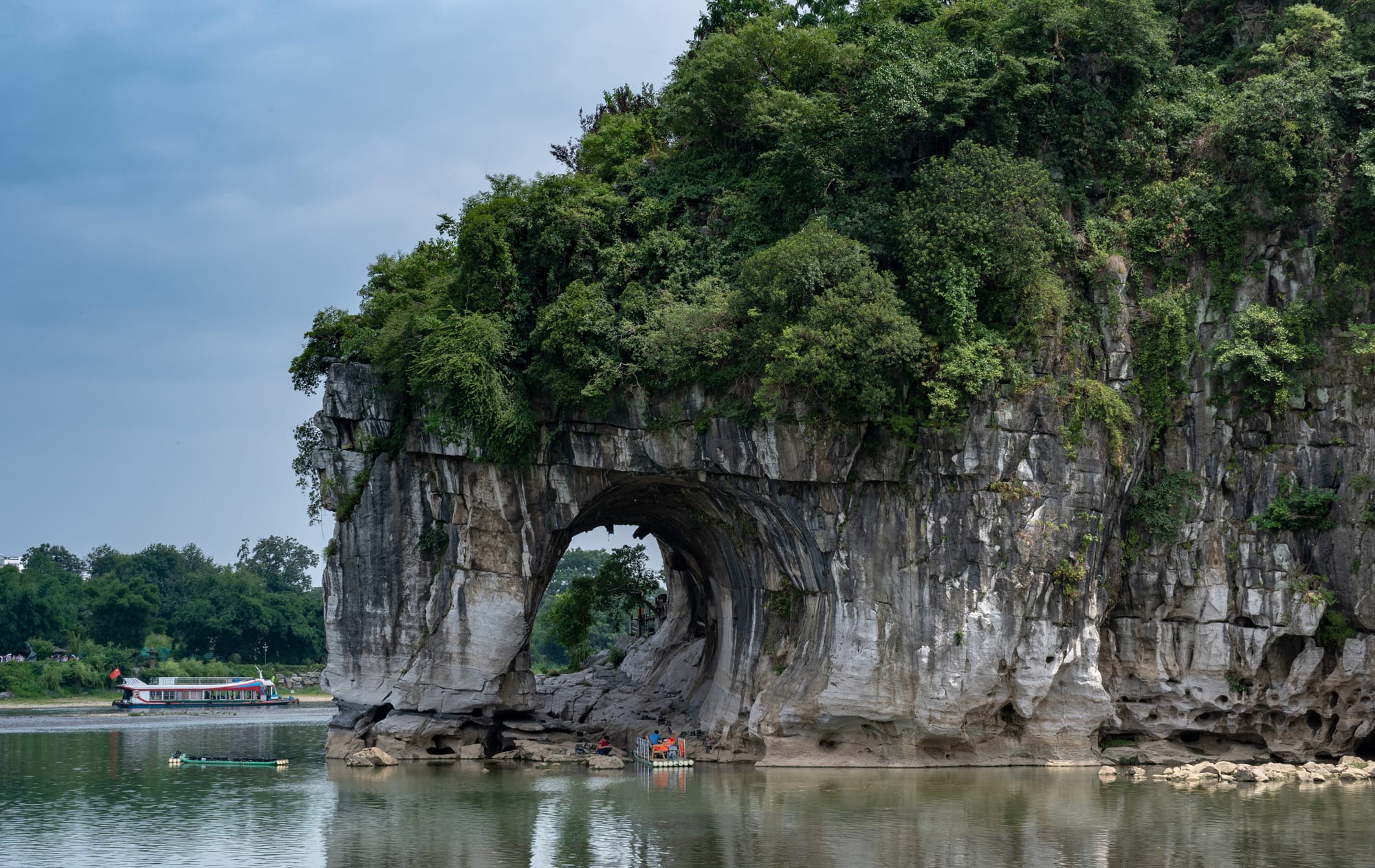
A tree-covered limestone crag with a large natural arch at its foot standing in a calm green river

Hunan & Guangxi, China

Guilin

Elephant Trunk Hill, the rock arch on the Li River that serves as Guilin's emblem. (xiquinhosilva / Wikimedia Commons · CC BY 2.0)

A city in north-eastern Guangxi built among limestone towers on the Li River, named after the osmanthus trees that scent it in autumn. Praised in Chinese poetry and painting for more than a thousand years, it is the usual base for river trips downstream to Yangshuo and for the rice terraces to the north, with caves, hill viewpoints and lake-side walks inside the city itself.

Neighbourhoods

  • The central lakes and Zhengyang Street
    • First-time visitors
    • Best for food
    • Nightlife

    The heart of the modern city, where the pedestrianised Zhengyang Street runs down to the Li River past restaurants, noodle shops and bars. A ring of connected lakes and canals, lit at night and crossed by ornamental bridges, wraps around it, and most hotels stand within a short walk.

    Open in Maps
  • Xiangshan
    • Close to public transport
    • Riverside walks
    • Landmarks

    The southern district along the Li River, taking in Elephant Trunk Hill and the riverbank promenades. It is busy, ordinary and convenient, with the main bus connections and a mix of older blocks and new towers.

    Open in Maps
  • Diecai and the northern hills
    • Viewpoints
    • Historic sites
    • Quiet and residential

    The northern part of the old city, where Folded Brocade Hill and Fubo Hill rise straight out of the streets and give the classic views over rooftops and peaks. The walled compound of the Ming princes and its university campus sit just to the south.

    Open in Maps
  • Qixing
    • Parks
    • Families
    • Caves

    Across the river on the east bank, built around the Seven Star Scenic Area, long known as Seven Star Park, with caves, ancient inscriptions and wooded hills. Quieter than the centre and a short taxi or bus ride from it.

    Open in Maps

Things to do

Peaks and caves

  • Elephant Trunk Hilllandmark

    The limestone crag on the Li River in the south of the city whose water-worn arch is said to look like an elephant drinking, and which stands as the symbol of Guilin.

    Open in Maps
  • Reed Flute Caveattraction

    A large cave of stalactites and stone columns north-west of the centre, lit in colour and carrying ink inscriptions left by visitors more than a thousand years ago.

    Open in Maps
  • Seven Star Scenic Areapark

    A large park on the east bank, formerly called Seven Star Park, taking in seven hills that give it its name, with a show cave, stone inscriptions and wooded slopes.

    Open in Maps
  • Folded Brocade Hillviewpoint

    A hill in the north of the old city climbed by steps through caves and Buddhist carvings to a pavilion with a wide view over the city and its peaks.

    Open in Maps
  • Fubo Hillviewpoint

    A riverside hill rising abruptly from the Li, with caves at its foot holding Tang and Song Buddhist carvings and a path to the summit.

    Open in Maps

History and the old city

  • Jingjiang Princes' Citylandmark

    The walled palace compound of the Ming princes of Jingjiang, begun in the 1370s, enclosing Solitary Beauty Peak and now the campus of a university.

    Open in Maps
  • Guilin Museummuseum

    The municipal museum, a large general collection on the region's history and the cultures of Guangxi's peoples, now housed in Lingui District west of the old centre.

    Open in Maps

Rivers, lakes and walks

  • The Li Riverattraction

    The river that gives the region its landscape, running south past bamboo banks and karst towers; cruise boats leave from wharves near the city for the stretch down to Yangshuo.

    Open in Maps
  • The Two Rivers and Four Lakespark

    A ring of lakes and canals reconnected to the rivers around the city centre, walkable in a loop, with willow-lined banks, bridges and a pair of tall lakeside pagodas.

    Open in Maps

Short trips from the city

  • Yangshuoneighborhood

    The small town downstream among limestone towers, the end point of the classic Li River boat trip and a base for cycling and rafting.

    Open in Maps
  • Longsheng rice terracesviewpoint

    Terraced mountainsides north of the city farmed by Zhuang and Yao villagers, flooded and mirror-like in spring and golden before the autumn harvest.

    Open in Maps
  • Lingqu Canallandmark

    A canal begun in 214 BC at Xing'an on the orders of Qin Shi Huang to link the Xiang and Li river systems, described as the first canal in the world to join two river valleys and among the best preserved.

    Open in Maps
  • Guilin Ancient South Gatelandmark

    A restored stone gate of the old city wall beside Rong Lake, standing under a banyan tree said to be many centuries old.

    Open in Maps

Seasonal events

  • Osmanthus seasonSeptember and October

    The trees that give the city its name flower in early autumn and scent whole streets; the flowers are used in cakes, tea and wine sold around the city.

  • Spring Festivallate January or February

    Lantern displays along the lakes and river, temple crowds and family reunions; travel and hotels are at their busiest and dearest.

  • Dragon Boat Festivalfifth day of the fifth lunar month, usually June

    Boat races on the Li River, held when the summer rains have the river running high.

  • Zhuang Sanyuesan song festivalthird day of the third lunar month, usually April

    A regional Zhuang spring festival of antiphonal singing and folk games, marked with a public holiday across Guangxi.

Eat and drink

Long-standing places and food districts in Guilin. Hours, ratings and directions come from your maps app, always current.

Guilin classics

  • Rice noodle shopsrestaurant

    Guilin mifen, round rice noodles dressed with a dark spiced master stock and eaten with pickled beans, peanuts and chilli, is the city's breakfast and its best-known dish.

    Open in Maps
  • Zhengyang Pedestrian Streetneighborhood

    The central walking street and the lanes off it, lined with noodle shops, snack stalls, tea sellers and restaurants serving river fish.

    Open in Maps
  • Lakeside and riverside restaurantsneighborhood

    Places around the central lakes serve Guangxi cooking — stuffed vegetables, river fish, taro and pork, and the sour flavours common across the region.

    Open in Maps

Markets and shops

  • Guilin's three treasuresmarket

    Shops sell the local trio of chilli sauce, fermented bean curd and sanhua jiu, a triple-distilled rice spirit, alongside osmanthus tea and cakes.

    Open in Maps
  • Morning wet marketsmarket

    Neighbourhood markets sell river fish, bamboo shoots, tofu skins and the pickled vegetables that season most local dishes.

    Open in Maps

Experience Guilin

History

The land around Guilin was drawn into the Chinese empire by an engineering feat: in 214 BC the Qin cut the Lingqu Canal at Xing'an, north of the present city, to join the Xiang river system flowing north with the Li flowing south, so that grain and soldiers could be moved into the far south. A county was established on the site of Guilin under the Han, and the settlement grew as the natural staging post on that route, taking its name from the osmanthus — gui — trees of the surrounding hills.

Its long stretch as a provincial capital began under the Ming, when a walled palace city was built in the 1370s for the princes of Jingjiang, a branch of the imperial family, around the isolated crag of Solitary Beauty Peak. Guilin was the provincial capital of Guangxi before 1912 and again from 1936, until the seat was moved to Nanning in 1950. Scholars, officials and poets had been inscribing the cliffs and caves for centuries by then, and the city's peaks are among the most heavily carved rock surfaces in China.

The Second World War was catastrophic. Guilin became a refuge for writers, publishers and students displaced from eastern China, its population swelling before it was bombed repeatedly and then fought over and largely destroyed in 1944. Rebuilt afterwards as a low-rise town among its hills, it became one of the country's most popular destinations, and tourism has shaped it ever since — through cruise fleets on the Li, a wave of hotel and park building, and the arrival of high-speed rail in the 2010s. In 2014 the karst around the city was added to the South China Karst World Heritage site.

Culture & Customs

Guilin's culture is bound up with its landscape. The line that Guilin's scenery is the finest under heaven was written in the Song dynasty and is still quoted on everything from banknotes to shopfronts; the towers of grey limestone rising from flat paddy and water have been a subject of Chinese ink painting for centuries, and the version of China printed on the back of the twenty-yuan note is a view of the Li River. The hills carry thousands of carved inscriptions, poems and Buddhist images cut over more than a millennium.

The city is Mandarin-speaking, with a distinct south-western dialect, and sits within an autonomous region whose largest group is the Zhuang. Zhuang, Yao, Miao and Dong communities live in the mountains around it and come into the city to trade; their festivals, silver ornaments, embroidery and antiphonal singing are part of the region's public identity, marked by the Sanyuesan holiday in spring. Cormorant fishing on the Li, once a working method, survives mainly as an evening demonstration for photographers.

Everyday customs are those of southern China: tea drunk constantly, meals shared from communal dishes, parks used from dawn for exercise, cards and chess in the shade, and singing and dancing in public squares in the evening. Osmanthus scents the autumn and turns up in cakes, tea and wine, and the city's own rice spirit, sanhua jiu, is poured at celebrations.

Daily Life

The prefecture-level city of Guilin covers a large area of countryside and counties and had about 4.9 million residents at the 2020 census, of whom some 2.1 million live in the built-up area of districts on and around the Li River. That makes the centre modest by Chinese standards — a city of mid-rise blocks that is still low enough for the hills to dominate the skyline, because building heights have long been restricted to protect the views.

Tourism is the mainstay: hotels, restaurants, boats, coaches, ticket offices and tea and souvenir shops employ a large share of the working population, with farming, food processing and some light manufacturing beyond the centre. That dependence cuts both ways, as the city discovered when travel stopped, and there is a steady debate about attracting industry and technology work so that young people do not all leave for Guangdong.

The rhythm is unhurried by Chinese urban standards. Mornings begin early with a bowl of rice noodles at a counter, the lakeside paths fill with walkers and exercise groups, afternoons slow in the summer heat, and evenings belong to the lit waterfront and the night market. Rain and flooding on the Li, crowding in the holiday weeks, and the cost of housing relative to local wages are the familiar local complaints.

Food

Guilin's signature is mifen, round rice noodles, eaten for breakfast and at any other hour. They are served dressed rather than in soup: a ladle of lu shui, a dark master stock simmered with star anise, cassia and other spices, poured over the noodles with slices of braised beef or crisp pork, then finished at the counter with pickled long beans, sour bamboo, peanuts, spring onion and chilli, with a small bowl of broth on the side. Every shop guards its own stock recipe.

The wider Guangxi table is sour, fresh and rice-based. Stuffed vegetables — aubergine, bitter melon or tofu packed with seasoned pork — are a Guilin speciality, and river fish, taro braised with belly pork, snails, bamboo shoots and mountain mushrooms appear on most menus. Pickling is everywhere, and the sour, pungent luosifen noodles of nearby Liuzhou are sold here too.

Three local products are sold as the city's treasures: Guilin chilli sauce, fermented bean curd cubes used as a condiment and a dip, and sanhua jiu, a triple-distilled rice spirit traditionally aged in caves in the limestone hills. Osmanthus flowers are candied into cakes, steeped as tea and infused into a sweet wine, and the region's other drinks include mild rice wines made in the villages.

Planning tools

Budget

Guilin is inexpensive for food and accommodation but the sights are not: the Li River cruise, the caves and the hill parks all charge separate entrance fees that add up quickly, and the Longsheng terraces need a bus or car as well as a ticket. Prices climb in the May and October holiday weeks.

Daily Budget Midrange
USD 70–140 (mid-range hotel, restaurant meals, a river cruise, park and cave tickets, taxis)
Daily Budget Shoestring
USD 30–50 (hostel or guesthouse, noodle shops, city buses, one paid sight a day)

The lake circuit, the riverbanks and the old south gate are free, and a local bus down the Li valley costs a fraction of the cruise.

Best Time to Visit

April to May and September to October are the most comfortable, and the osmanthus flowers in early autumn. The river runs highest and greenest in the summer rains, which also bring heat and occasional flooding; winter is cool, damp and often misty, which suits the karst scenery but not long walks. The May and October holiday weeks are overwhelmed.

Suggested Number of Days

Two or three days covers the city and one river trip. Four to six allows for the countryside to the south and the terraced mountains to the north, which each need most of a day of travel. Weather is the main variable, as mist and rain change what is worth doing.

First Visit
2–3 days
With Surroundings
4–6 days

Transportation

City buses are cheap and frequent, several sightseeing routes link the main parks, and ride-hailing works well and costs little. The centre is compact enough to walk. Boats down the Li leave from wharves outside the city, and buses and high-speed trains run to Yangshuo; Longsheng is reached by long-distance bus or hired car.

Buy Li River cruise and Yangshuo train tickets a day or more ahead in high season, and agree on prices before taking an unofficial boat or raft.

Airport & Station Connections

Guilin Liangjiang International Airport is about 28 kilometres south-west of the centre, with domestic flights and some regional international routes, and shuttle buses into town. High-speed trains stop at Guilin North and Guilin West stations on the line between Guiyang and Guangzhou, putting Guangzhou within about three hours; regular services also run to Nanning, Changsha and Yangshuo.

Walkability

The central district is flat, compact and pleasant on foot, and the circuit of lakes and canals makes an easy walk of a couple of hours. The hills are climbed by stone steps that are steep and can be slippery in rain. Reed Flute Cave, the cruise wharves and Seven Star Park are too far out to walk to comfortably.

Safety

Guilin is a safe city with little violent crime. The realistic problems are touts and overpriced boat, raft and tour offers around the wharves and the pedestrian street, pickpocketing in holiday crowds, slippery steps on the hills, and flooding along the river after heavy summer rain.

Book river trips through a hotel or official ticket office rather than a street tout, wear grippy shoes on the hill steps, and keep away from the riverbank when the water is high. Check current official travel advice before travelling.

Climate

Humid subtropical, with a long wet season from April to August when the rivers are full, and a cool, damp winter. Mist among the peaks is common and is part of the region's character rather than a sign of bad weather.

Summer
hot and humid, typically 26–34°C, with heavy rain and thunderstorms
Winter
cool and damp, typically 5–14°C, with frequent low cloud and occasional frost

Local Customs

Tipping is not expected. Tea is the standard courtesy, and meals are shared from the centre of the table. Guilin is thoroughly used to visitors, but the surrounding countryside is not to the same degree: Zhuang, Yao and Miao villages in the terraces are working farms rather than exhibits, and people should be asked before being photographed. Buddhist and Daoist sites in the hill caves are still used for worship.

Ask before photographing villagers or their houses in the terraces, dress modestly at temples, and expect to be offered tea rather than alcohol at an ordinary meal.

Common Payment Methods

The currency is the renminbi, counted in yuan. Almost everything is paid by QR code through Alipay or WeChat Pay, which now allow foreign visitors to link an overseas card; setting this up before arrival removes most difficulties. Foreign cards work at larger hotels and some ticket offices but rarely elsewhere, so carry some cash for small shops, buses and village stalls.