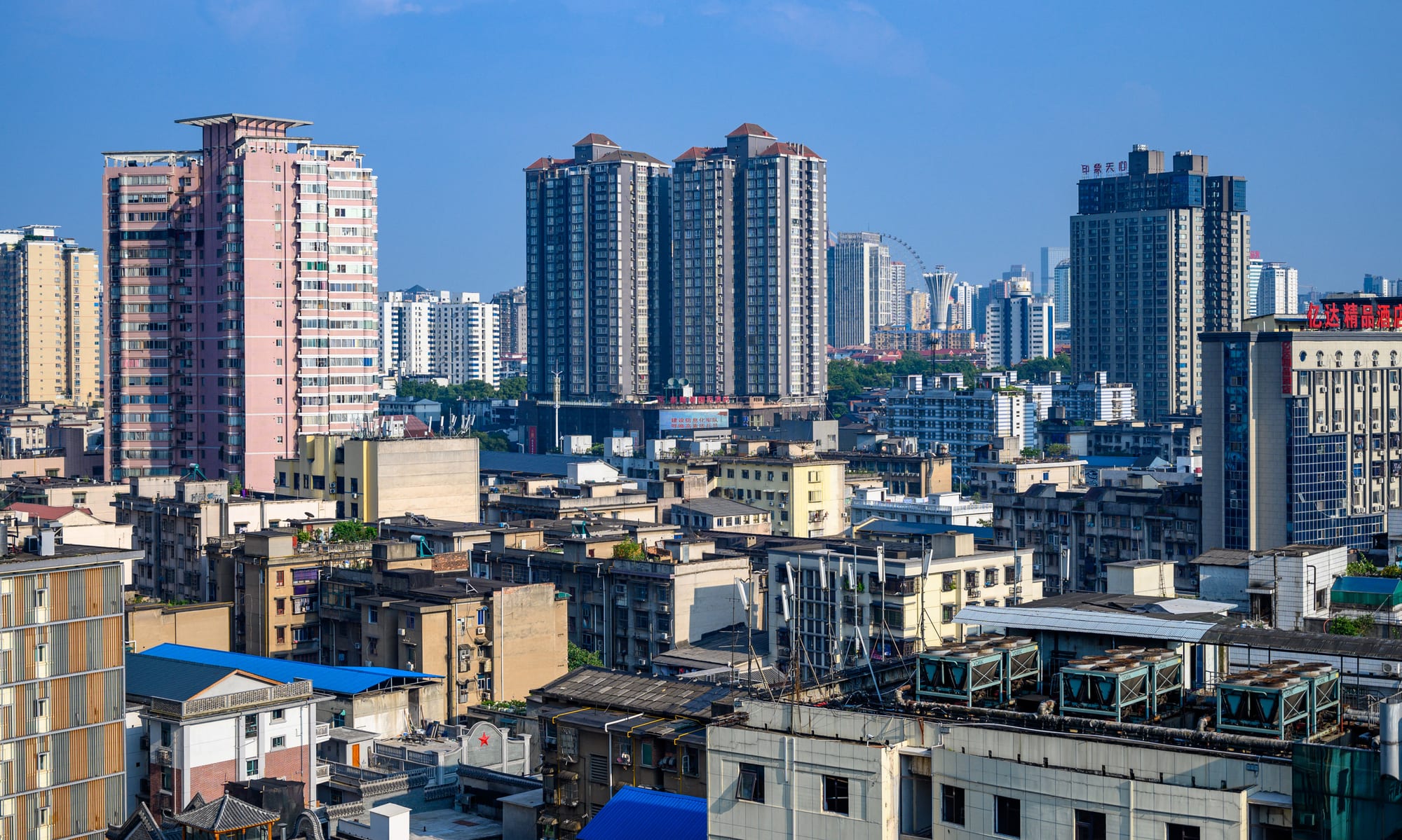
Dense low-rise city blocks with rooftop equipment in front of tall pink and grey apartment towers under a clear blue sky

Hunan & Guangxi, China

Changsha

Older blocks and apartment towers in the centre of Changsha, the capital of Hunan. (xiquinhosilva / Wikimedia Commons · CC BY 2.0)

The capital of Hunan province, on the Xiang River in south-central China. An old Chu and Han city, burned almost to the ground in 1938 and fought over in the war with Japan, it rebuilt as a provincial capital and is now known for the Mawangdui tomb finds in the Hunan Museum, the Yuelu Academy, chilli-heavy cooking and a late-night street-food culture.

Neighbourhoods

  • Furong District
    • First-time visitors
    • Shopping
    • Close to public transport

    The commercial core on the east bank, built around Wuyi Square and the Huangxing Road pedestrian street. Department stores, hotels, cinemas and the tall towers of Changsha IFS are concentrated here, and several metro lines meet beneath the square.

    Open in Maps
  • Tianxin District
    • Historic district
    • Best for food
    • Walking

    The old southern quarter, where a surviving stretch of the city wall carries the Tianxin Pavilion. Taiping Old Street and the lanes around Pozi Street keep low tiled-roof buildings, snack stalls and small shops, and it is the easiest part of Changsha to wander on foot.

    Open in Maps
  • Yuelu District
    • Students and nightlife
    • Parks and walks
    • Arts and culture

    The west bank, below the wooded slopes of Yuelu Mountain. Hunan University, Central South University and the thousand-year-old Yuelu Academy are here, along with student food streets, and the riverside path faces Orange Isle in midstream.

    Open in Maps
  • Kaifu District
    • Local life
    • Temples
    • Riverside

    North of the centre on the east bank, mixing older residential blocks with new riverfront development. Kaifu Temple, one of the city's main Buddhist sites, stands among the lanes, and the district reaches the northern stretch of the Xiang.

    Open in Maps
  • Yuhua District
    • Close to public transport
    • Business travellers

    The south-eastern district holding Changsha South railway station, the terminus of the high-speed lines and of the maglev link to the airport. Hotels and shopping centres cluster around the station, with residential streets and parks beyond.

    Open in Maps

Things to do

Famous landmarks

  • Yuelu Academylandmark

    A Confucian academy founded in 976 at the foot of Yuelu Mountain, with courtyards, lecture halls and stone tablets, now part of Hunan University.

    Open in Maps
  • Orange Islepark

    A long, narrow island in the Xiang River, about five kilometres from end to end, planted with orange trees and gardens, with a large stone sculpture of the young Mao Zedong put up in 2009.

    Open in Maps
  • Tianxin Pavilionlandmark

    A tiered wooden pavilion on the last surviving section of Changsha's city wall, looking out over the southern part of the centre.

    Open in Maps
  • Kaifu Templelandmark

    A Buddhist temple founded in the tenth century and rebuilt several times, with halls, incense burners and a quiet garden north of the centre.

    Open in Maps
  • Aiwan Pavilionlandmark

    A small Qing-dynasty pavilion on the wooded slope of Yuelu Mountain, named for a line of Tang poetry about stopping to admire maple leaves.

    Open in Maps
  • Changsha IFS Tower T1landmark

    The tallest building in Hunan, a 452-metre shopping-centre and office tower completed in 2017 above Wuyi Square.

    Open in Maps

Museums and historic sites

  • Hunan Museummuseum

    The provincial museum, rebuilt and reopened in 2017, built around the Mawangdui finds — silk paintings, lacquerware, early manuscripts and the remarkably preserved body of Lady Dai, Xin Zhui.

    Open in Maps
  • Mawangduiattraction

    The Han-dynasty burial site in the east of the city, excavated in the early 1970s, whose contents transformed knowledge of early Chinese medicine, cloth and cosmology.

    Open in Maps
  • Hunan First Normal Universityattraction

    The teacher-training college where Mao Zedong trained as a teacher in the 1910s; its restored early campus in the south of the city is open as a memorial site.

    Open in Maps

Parks, walks and the river

  • Yuelu Mountainpark

    A forested hill on the west bank with paths, temples, pavilions and a cable car, and wide views over the river and the city from the top.

    Open in Maps
  • Hunan Universityattraction

    An open campus spread along the lower slopes of Yuelu Mountain, mixing early twentieth-century buildings with the old academy and tree-lined walks down to the river.

    Open in Maps

Short trips from the city

  • Shaoshanattraction

    The town about 90 kilometres by road to the south-west where Mao Zedong was born in 1893, with his family farmhouse and a memorial museum, visited by large numbers of Chinese tour groups.

    Open in Maps
  • Mount Hengtrail

    Nanyue, the southern of China's five sacred mountains, roughly 110 kilometres south of the city, with temples along the ascent — among them the Grand Temple of Mount Heng, the largest group of old buildings in Hunan — and a road and cable car to the summit ridge.

    Open in Maps

Seasonal events

  • Chinese New YearJanuary or February

    The city empties of migrant workers and fills with family meals, temple visits and fireworks restrictions, with lanterns and decorations in the shopping streets.

  • Dragon Boat FestivalMay or June

    Hunan's own festival, tied to the poet Qu Yuan, marked with zongzi and dragon-boat racing on rivers across the province.

  • Golden Eagle TV Art Festivalautumn, in alternate years

    A television awards festival held in Changsha, home of Hunan Broadcasting System, filling the city with screenings and events.

Eat and drink

Long-standing places and food districts in Changsha. Hours, ratings and directions come from your maps app, always current.

Changsha classics

  • Huogongdianrestaurant

    A long-standing Changsha institution that grew out of a temple-fair snack market, known above all for the city's black stinky tofu and for a spread of small Hunanese dishes.

    Open in Maps

Food streets and markets

  • Pozi Streetneighborhood

    A narrow old street of snack shops and restaurants in Tianxin District, one of the traditional centres of Changsha eating, busy from late afternoon onwards.

    Open in Maps
  • Taiping Old Streetneighborhood

    A restored lane of tiled-roof shophouses near the river, lined with stalls selling stinky tofu, sugar-oil pancakes, milk teas and grilled skewers.

    Open in Maps
  • Wenyuan and the Hexi student streetsneighborhood

    The cheap, crowded food lanes around Hunan University on the west bank, good for rice noodles, claypot rice, crayfish in season and late-night skewers.

    Open in Maps
  • Huangxing Roadneighborhood

    The main pedestrian shopping street off Wuyi Square, with chain tea shops, snack counters and side alleys of small restaurants.

    Open in Maps

Experience Changsha

History

Changsha has been settled since at least the Warring States period, when it was a southern city of the state of Chu; Chu-era tombs and lacquerware have been dug from beneath the modern streets. Under the Han it was the seat of a kingdom of Changsha, and the tombs at Mawangdui, opened between 1972 and 1974, held silk paintings, medical and philosophical manuscripts and the body of Lady Dai, Xin Zhui, preserved well enough to astonish the archaeologists who found her. In 976 the Yuelu Academy was founded at the foot of Yuelu Mountain, and for centuries it made the city a centre of Confucian scholarship; the philosopher Zhu Xi lectured there in the twelfth century.

The city was besieged by Taiping forces in 1852 and held out, and it was opened to foreign trade in the first years of the twentieth century. Its schools turned out a generation of revolutionaries: Mao Zedong trained as a teacher at the First Normal School in the 1910s, and Liu Shaoqi and many others passed through the same classrooms.

The war with Japan nearly destroyed Changsha. In November 1938, fearing the city would fall, Chinese forces set it alight; the fire burned for days and left most of the old town in ruins. Three Japanese assaults between 1939 and 1942 were driven off, and the city fell in 1944, held for about a year until the Japanese surrender. Rebuilding after 1949 left a largely modern capital, and since the 1990s Changsha has grown very fast, adding towers, bridges, a metro, a high-speed station and a national reputation for television, nightlife and food.

Culture & Customs

Changsha people speak a Xiang dialect and share the reputation Hunanese have across China for bluntness, stubbornness and a fondness for argument, half-jokingly attributed to the quantity of chillies they eat. The city takes obvious pride in the Hunanese who shaped modern China, and Mao's presence is everywhere — the sculpture on Orange Isle, the restored school, the pilgrimage buses to Shaoshan.

It is also one of China's media capitals. Hunan Broadcasting System, whose entertainment channel and Mango TV streaming platform are among the most watched in the country, is based here, and the talent shows and variety programmes it makes have given Changsha a hold on Chinese popular culture out of proportion to its size. The same energy shows in a night-time economy that runs very late: bars along Jiefang West Road, music venues, and streets of food stalls still busy after midnight in summer.

Older traditions survive alongside it. Huagu xi, Hunan's flower-drum opera, is performed in local theatres; Xiang embroidery, a silk-thread tradition that originates in and is still mostly made in Changsha, was listed as national intangible cultural heritage in 2006; and the Yuelu Academy still functions as part of a university, with students walking past centuries-old stone tablets. Duanwu, the dragon-boat festival, carries extra weight in a province that claims the poet Qu Yuan as its own.

Daily Life

About 10 million people live in the Changsha municipality, and some 7.3 million of them in the continuous built-up area on both banks of the Xiang. The city has been one of the fastest-growing in inland China, drawing workers from across Hunan, and it has a reputation for housing that is cheap relative to incomes, which is often given as a reason young graduates stay.

The economy rests on heavy engineering, media and food. Changsha is a world centre for construction machinery, with Sany and Zoomlion both headquartered here, and it also makes cars, processes food and runs the broadcasting industry. Research institutions are strong: the hybrid rice work associated with Yuan Longping was based in the city, and several large universities sit on the west bank.

Daily rhythms are shaped by heat and by the river. Mornings begin early with a bowl of rice noodles; afternoons in summer are spent indoors or in shopping centres; evenings spill onto the riverside promenades, into night markets and onto restaurant terraces. Yuelu Mountain fills with walkers at dawn and at weekends. Traffic congestion, summer heat and the pressure of tourist crowds on the small historic areas are the usual complaints, along with the cost of crossing the river at rush hour.

Food

Changsha is one of the great eating cities of inland China, and its cooking is Xiang cuisine at its hottest — fresh and pickled chillies, smoked and cured meats, garlic, fermented black beans and a sour edge, without the numbing Sichuan peppercorn. Duo jiao yu tou, a steamed fish head buried under chopped salted chillies, is the dish most associated with the province; hongshao rou, red-braised pork belly, is sold everywhere as Mao's favourite; la rou, home-smoked cured pork, is stir-fried with garlic shoots or dried chillies.

The street food is what visitors remember. Changsha stinky tofu, chou doufu, is black rather than pale, deep-fried until crisp and served with chilli sauce and coriander. Kou wei xia, crayfish tumbled in chilli and spice, takes over the night markets from late spring to early autumn and is eaten by hand with a beer. Tangyou baba, small sticky rice cakes fried in sugar syrup, and grilled skewers are sold from carts. Breakfast is a bowl of Changsha rice noodles in broth, topped with braised meat and pickles.

The city has also become a centre of China's tea-drink industry, with home-grown chains selling milk teas and fruit teas from queues that stretch down the pavement. Hunan produces dark tea in Anhua and the Junshan yinzhen yellow tea grown on an island in Dongting Lake, and rice wine and baijiu appear at celebratory meals.

Planning tools

Budget

Changsha is inexpensive by Chinese standards, and eating is the cheapest part of it: rice noodles, skewers and snack stalls cost very little, and even a full Hunanese dinner is modest. Hotels around Wuyi Square and Changsha South station are reasonable outside holiday weeks, and most sights — Orange Isle, Yuelu Mountain's lower paths, the Hunan Museum — charge little or nothing, though museum entry generally has to be booked online in advance.

Daily Budget Midrange
USD 70–140 (mid-range hotel, restaurant meals, taxis and ride-hailing, day trip to Shaoshan)
Daily Budget Shoestring
USD 30–50 (hostel or budget hotel, noodle shops and street food, metro and buses)

Rooms and trains are hardest to get during the national holiday weeks in early May and early October, and around Chinese New Year.

Best Time to Visit

March to May and late September to November are the comfortable months, with mild days and lighter rain. Summer is punishingly hot and humid, though it is also crayfish season and the night markets are at their liveliest. Winter is short, damp and grey rather than freezing, and indoor heating is not standard.

Suggested Number of Days

Two days is enough for the city centre, the west bank and a museum. Allow three or four to add a trip out of the city, or if using Changsha as the gateway to the rest of Hunan, which most travellers do.

First Visit
2 days
With Surroundings
3–4 days

Transportation

A six-line metro network, the first line of which opened in 2014, links the two banks, the main railway stations and the centre, and is the simplest way to move around. Buses cover everything else, taxis are cheap, and ride-hailing apps are widely used, though drivers rarely speak English. A maglev line runs between Changsha South station and the airport. Traffic on the river bridges is heavy at peak times.

Metro and bus fares are paid by QR code in a payment app or with a local transport card; keep the destination written in Chinese characters for taxi drivers.

Airport & Station Connections

Changsha Huanghua International Airport lies east of the centre, with domestic flights across China and direct international routes to cities in Asia and beyond; the maglev line, opened in 2016, takes under 20 minutes to Changsha South railway station. That station sits on the high-speed line between Wuhan and Guangzhou, putting Wuhan and Guangzhou within about two to three hours and Beijing and Shanghai within roughly five to six.

Walkability

The centre is walkable in patches rather than as a whole: Wuyi Square, Huangxing Road, Taiping Old Street and Pozi Street form a connected area of a few kilometres, and the west bank around Yuelu Mountain and the university is pleasant on foot. Between those areas the streets are wide, the blocks long and the traffic constant, so the metro is usually quicker. Pavements can be crowded and uneven, and summer heat limits walking to mornings and evenings.

Safety

Changsha is a safe city with very little violent crime, and streets stay busy late into the night. The everyday risks are traffic — scooters and electric bikes use pavements and crossings freely — summer heat and humidity, crowding at holiday peaks, and petty theft in packed markets and metro carriages.

Traffic lights are worth waiting for, silent electric scooters come from any direction, summer heat calls for plenty of water, and a passport is needed for hotels, train tickets and museum entry. Check current official travel advice before travelling.

Climate

Humid subtropical, with one of the hottest, stickiest summers in China and a damp, chilly winter. Rain falls all year, heaviest from April to June, and skies are often overcast.

Summer
hot and very humid, typically 30–38°C in July and August, with thunderstorms and oppressive nights
Winter
cool and damp, usually 3–12°C, with occasional sleet or a light snowfall and little indoor heating

Local Customs

Tipping is not expected anywhere. Meals are shared from communal dishes, and a host will usually order for the table and press guests to eat and drink more. Hunanese food is genuinely hot, and asking for less chilli is normal and not an insult. Dress is casual, though shoulders and knees are better covered in temples, where visitors should walk around rather than through the middle of worship.

Politics, Taiwan, Tibet and Xinjiang are sensitive subjects; avoid photographing police, soldiers, government buildings or protests, and ask before photographing people.

Common Payment Methods

The currency is the renminbi, counted in yuan. Almost everything is paid by QR code through Alipay or WeChat Pay, and cash is uncommon, though small stalls and older shops will still take notes. Foreign cards are accepted at some hotels and large stores but not generally elsewhere, and international cards can be linked to the payment apps; ATMs at major bank branches accept foreign cards.