💰 Budget
Food and rooms are cheap by Chinese standards, but the scenic areas are not: the Wulingyuan park pass, the Tianmen Mountain ticket and cable car, the glass bridge, the cliff lift and the caves each carry their own fee, and together they are the largest part of a visit's cost. Prices and crowds peak in the May and October holiday weeks.
- Daily Budget Midrange
- USD 70–140 (mid-range hotel in the city or Wulingyuan, restaurant meals, park and cable-car tickets, taxis)
- Daily Budget Shoestring
- USD 30–55 (guesthouse, noodle shops and canteens, park shuttle buses, one major ticket)
The Wulingyuan pass covers several days and the park's shuttle buses, so staying at a gate and using it fully is much better value than a single rushed day.
📅 Best Time to Visit
April to June and September to November are the best months: mild, green in spring and clear in autumn. Cloud and mist among the pillars are most likely in spring and after summer rain. July and August are hot, wet and extremely busy; winter is cold and quiet, with ice and occasional snow closing some paths but a striking frosted landscape.
⏳ Suggested Number of Days
Three or four days is the usual length, because the scenic areas are large and separate and each takes most of a day, including travel and queues. Five or six allows for the caves, canyon and Tujia country. Weather is the biggest variable, as heavy cloud hides the views entirely.
- First Visit
- 3–4 days
- With Surroundings
- 5–6 days
🚆 Transportation
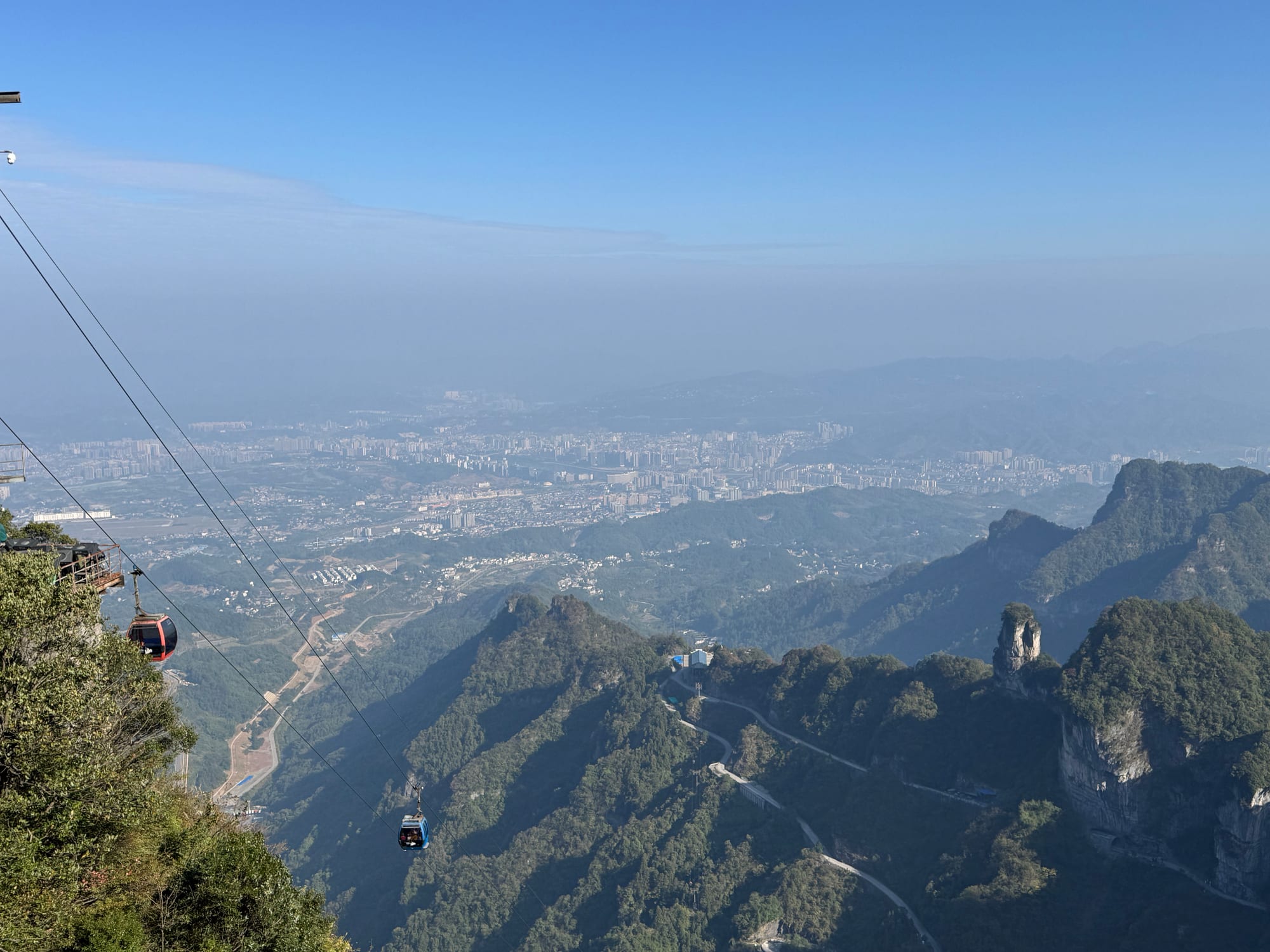
Buses and taxis link the city, the airport, the railway stations and Wulingyuan, a journey of about 40 minutes. Inside the scenic area private cars are excluded and free park shuttle buses run between trailheads, supplemented by paid cable cars, a cliff lift and a small mountain railway. Ride-hailing works in the city.
Queues for the cable cars and the cliff lift are long in season, so an early start and a pre-booked ticket save hours.
🛬 Airport & Station Connections
Zhangjiajie Hehua International Airport lies in Yongding District close to the city centre and has domestic flights and some international routes. The city has two railway stations: Zhangjiajie station, on the Jiaozuo–Liuzhou line, and Zhangjiajie West, opened in 2019 on the Qianjiang–Changde line and the northern end of the high-speed line towards Jishou and Huaihua. An expressway links the city to Changsha, long-distance buses serve it as well, and shuttle buses run on to Wulingyuan.
🚶 Walkability
The city centre is flat and walkable, with the cable-car base station in the middle of it, and Wulingyuan's hotel strip is small enough to cross on foot. The park is a different matter: distances between viewpoints run to many kilometres, and the routes involve thousands of steps, so most days there mix shuttle buses, lifts and several hours of walking.
🛡️ Safety
Zhangjiajie is a safe city, and the hazards are those of mountain sightseeing: wet stone steps, steep unfenced drops off marked paths, crowding on narrow walkways at holiday peaks, sudden fog, and landslides or flash floods after summer rain. Monkeys near viewpoints snatch food and bags.
Wear shoes with grip, stay on the marked paths and behind barriers, keep food out of sight where monkeys gather, and follow closures after heavy rain. Check current official travel advice before travelling.
🌦️ Climate
Humid subtropical and noticeably cooler and wetter than lowland Hunan because of the altitude. Mist and low cloud are frequent year-round, and the mountain tops can be several degrees colder than the city below.
- Summer
- warm to hot and humid, typically 24–33°C in the city and cooler on the peaks, with heavy rain
- Winter
- cold and damp, typically 1–10°C, with frost, ice on the walkways and occasional snow
🤝 Local Customs
Tipping is not expected. The region is home to Tujia and Miao communities, and their songs, dances and crafts are performed commercially as well as privately; performances staged for visitors are paid work rather than ceremony, but village life outside the parks is not a show and people should be asked before being photographed. Queuing at cable cars is informal and crowded.
Ask before photographing villagers or people in traditional dress, carry a light waterproof for the mountain, and expect chilli in almost every dish unless it is ordered without.
💳 Common Payment Methods
The currency is the renminbi, counted in yuan. Tickets, buses, shops and restaurants are paid by QR code through Alipay or WeChat Pay, which now let foreign visitors link an overseas card; arranging that before arrival avoids most problems. Foreign cards are accepted at larger hotels but rarely at park ticket windows, so carry some cash as a fallback.