History
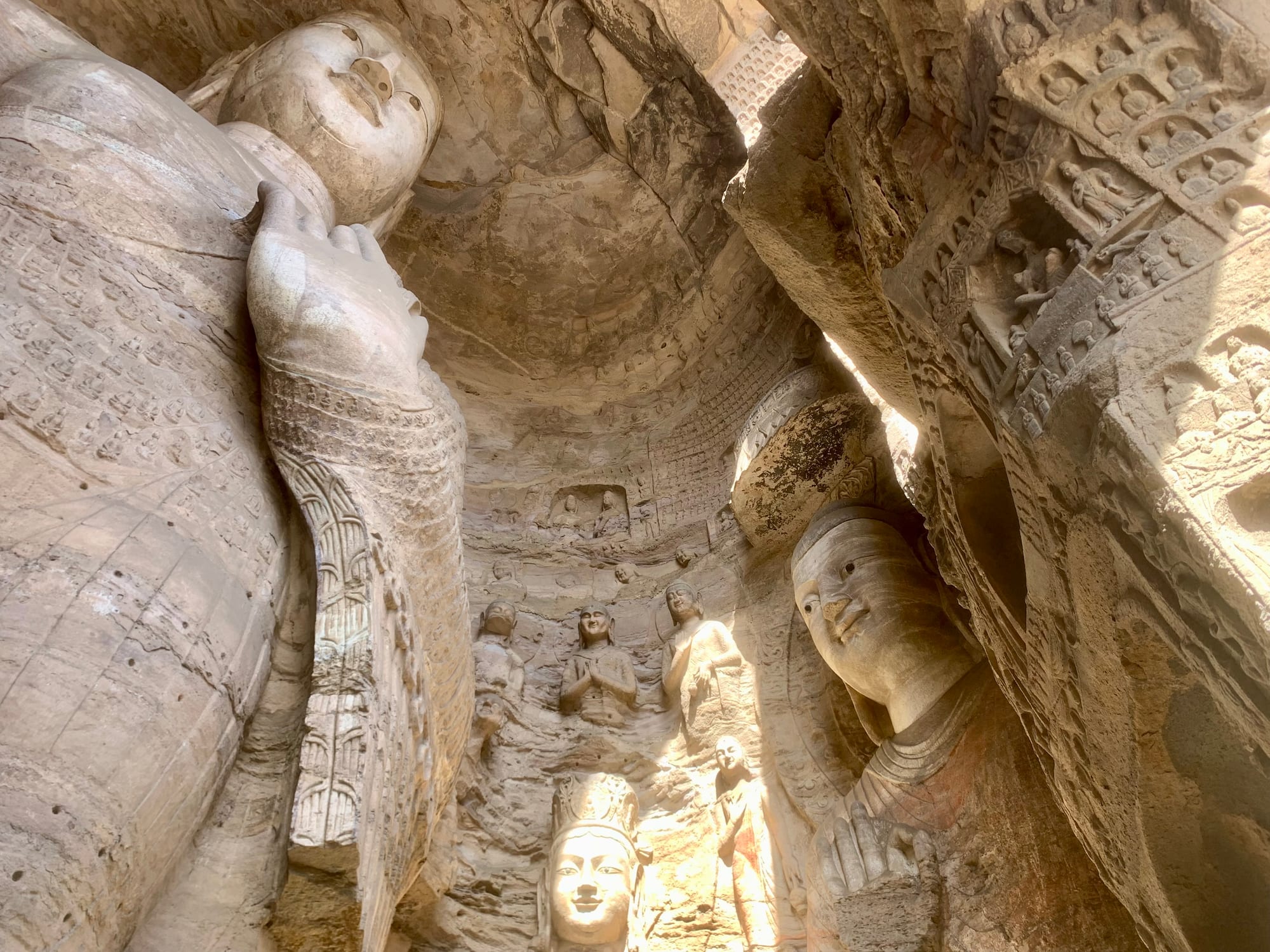
The plain around Beijing has been inhabited for a very long time: the fossils of "Peking Man", found at Zhoukoudian in the 1920s, belong to Homo erectus. In the Zhou era this was the frontier state of Yan, while Shanxi was the heartland of Jin, whose name the province still uses. Shanxi's northern town of Datong, as Pingcheng, was the capital of the Northern Wei dynasty in the 5th century, when the Yungang Grottoes were cut.
Beijing's rise came with the northern conquest dynasties. The Khitan Liao and Jurchen Jin made it a capital, and Kublai Khan built Dadu — Marco Polo's Khanbaliq — as the seat of the Yuan. The Ming Yongle emperor moved the capital here from Nanjing in the early 15th century and built the Forbidden City and the Temple of Heaven, while the Great Wall along the northern hills was rebuilt in brick and stone. In 1644 the Ming general Wu Sangui opened the pass at Shanhaiguan to the Manchus, whose Qing dynasty ruled from Beijing and summered at Chengde.
The 19th century brought foreign armies: British and French troops burned the Old Summer Palace in 1860, Tianjin became a treaty port carved into foreign concessions, and the Boxer siege of the Beijing legations in 1900 ended in occupation. Mao proclaimed the People's Republic from Tiananmen in 1949. The Tangshan earthquake of 1976 killed several hundred thousand people in Hebei, and the 1989 protests in Tiananmen Square were crushed by the army. Beijing hosted the Olympics in 2008 and the Winter Olympics in 2022, the latter shared with Zhangjiakou in Hebei.