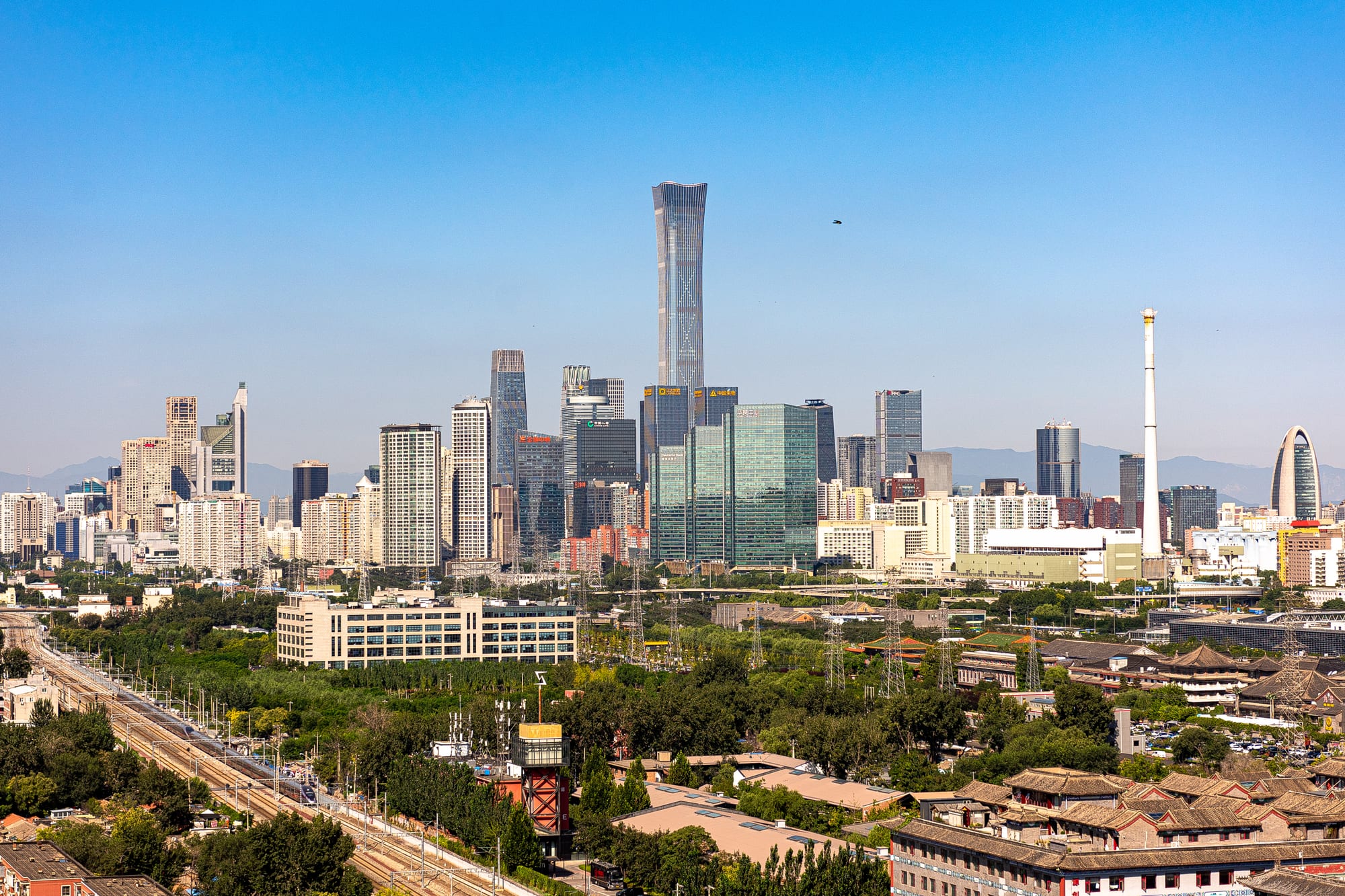
Beijing's central business district towers, including a tall tapered skyscraper, rising above low grey-tiled roofs and trees under a clear blue sky

Beijing & North China, China

Beijing

The towers of Beijing's central business district, seen from the south-east across the older low-rise city. (N509FZ / Wikimedia Commons · CC BY-SA 4.0)

China's capital, on the northern edge of the North China Plain where the hills close in. Six centuries as an imperial seat left the Forbidden City, the Temple of Heaven and the Summer Palace, and the Great Wall runs along the ridges beyond. Today it is a city of about 22 million, ringed by expressways, with grey hutong lanes surviving between glass towers.

Neighbourhoods

  • Dongcheng
    • First-time visitors
    • Historic district
    • Close to public transport

    The eastern half of the old walled city, holding the Forbidden City, Tiananmen Square, the Temple of Heaven and the Bell and Drum Towers. Behind the main avenues are lanes of single-storey courtyard houses, some restored as guesthouses and cafés, and the shopping street of Wangfujing.

    Open in Maps
  • Xicheng
    • Quiet and residential
    • Parks and lakes
    • Historic district

    The western half of the old city, quieter and more residential, built around the linked lakes of Beihai and Houhai. Government compounds, the financial street, old mosques and temples and some of the best-preserved hutongs are all here.

    Open in Maps
  • Chaoyang and Sanlitun
    • Nightlife
    • Best for food
    • Modern architecture

    The large district east of the centre, with the business towers of the CBD, most embassies and the bars, restaurants and shops of Sanlitun. It also contains the galleries of the 798 Art Zone in a disused electronics factory complex in the north-east.

    Open in Maps
  • Haidian
    • Students
    • Gardens
    • Museums

    The north-west, where Peking and Tsinghua universities and the technology firms of Zhongguancun sit near the Summer Palace and the ruins of the Old Summer Palace. Student canteens, bookshops and large parks give it a different pace from the centre.

    Open in Maps
  • Qianmen and Dashilan
    • Street life
    • Shopping
    • Close to public transport

    Immediately south of Tiananmen Square, the old commercial quarter outside the former front gate. Dashilan's narrow lanes hold long-established shops and teahouses, and the rebuilt Qianmen Street runs south with a tram line down the middle.

    Open in Maps
  • Olympic Green and the north
    • Sport
    • Families
    • Modern architecture

    The axis running north from the old city ends at the 2008 Olympic park, with the lattice-steel National Stadium and the Water Cube. Wide lawns, cycle paths and the Chinese Ethnic Culture Park make it a spacious, modern counterpoint to the centre.

    Open in Maps

Things to do

The imperial centre

  • Forbidden Citylandmark

    The walled palace of the Ming and Qing emperors, built in the early 15th century and now the Palace Museum, with courtyards, throne halls and imperial collections.

    Open in Maps
  • Tiananmen Squarelandmark

    The vast paved square south of the palace, lined by the Great Hall of the People, the National Museum and Mao's mausoleum.

    Open in Maps
  • Temple of Heavenlandmark

    A Ming ritual complex in a walled park where emperors prayed for good harvests, centred on a round triple-eaved hall of blue tiles.

    Open in Maps
  • Summer Palacepark

    A Qing imperial garden in the north-west around Kunming Lake and Longevity Hill, with a long painted corridor, bridges and a marble boat.

    Open in Maps
  • Old Summer Palacepark

    The ruined gardens and broken European-style stone pavilions of the palace burned by British and French troops in 1860, now a park.

    Open in Maps
  • Yonghe Templelandmark

    A Tibetan Buddhist monastery in a former princely residence in the north-east of the old city, known for a very tall Maitreya carved from a single trunk.

    Open in Maps

Museums and galleries

  • National Museum of Chinamuseum

    On the east side of Tiananmen Square, one of the largest museums in the world, covering Chinese history from prehistory onwards.

    Open in Maps
  • Capital Museummuseum

    Beijing's own city museum in western Xicheng, with bronzes, porcelain and displays on the growth of the capital.

    Open in Maps
  • 798 Art Zoneattraction

    Galleries, studios and cafés in the saw-toothed halls of a 1950s East German-designed electronics factory in Chaoyang.

    Open in Maps
  • Beijing Ancient Observatorymuseum

    A Ming-era brick platform near Jianguomen carrying bronze astronomical instruments made under Jesuit direction in the 17th century.

    Open in Maps
  • National Art Museum of Chinamuseum

    The national collection of modern and contemporary Chinese art, in a 1960s building with a yellow-tiled roof near Wangfujing.

    Open in Maps

Parks, lakes and viewpoints

  • Jingshan Parkpark

    The artificial hill directly north of the Forbidden City, whose pavilion gives the classic view down over the palace roofs.

    Open in Maps
  • Beihai Parkpark

    An imperial lake garden west of the palace, with a white Tibetan-style stupa on an island and boats on the water in summer.

    Open in Maps
  • Houhaineighborhood

    The Shichahai lakes, ringed by bars, courtyard houses and willow trees, where many residents come to skate once the ice is thick.

    Open in Maps
  • Temple of Earthpark

    A walled Ming altar complex north of the old city, now a public park best known for its Spring Festival temple fair.

    Open in Maps
  • Fragrant Hills Parkpark

    A wooded hill park on the western edge of the city, climbed for autumn colour and views back over the plain.

    Open in Maps

Old lanes and landmarks

  • Prince Gong Mansionlandmark

    A large Qing princely residence and garden in the hutongs near Houhai, among the best-preserved aristocratic houses in the city.

    Open in Maps
  • Nanluoguxiangneighborhood

    An 800-metre hutong lane in Dongcheng, lined with shops and snack stalls, the busiest introduction to hutong Beijing.

    Open in Maps
  • Zhengyangmenlandmark

    The surviving gate tower and archery tower of the old city wall, standing at the south end of Tiananmen Square.

    Open in Maps
  • Niujie Mosquelandmark

    Beijing's oldest mosque, founded in the 10th century and built in Chinese temple style, at the centre of the Hui Muslim quarter.

    Open in Maps
  • Beijing National Stadiumlandmark

    The steel-lattice 'Bird's Nest' of the 2008 Olympics, used again for the 2022 Winter Games opening ceremony.

    Open in Maps

Short trips from the city

  • Mutianyulandmark

    A restored stretch of Ming Great Wall on wooded ridges north-east of the city, reached by cable car or a steep climb.

    Open in Maps
  • Badalinglandmark

    The most visited section of the Great Wall, north-west of Beijing, restored and opened to visitors in 1957 and served by its own railway station.

    Open in Maps
  • Jinshanlinglandmark

    A partly restored, partly crumbling stretch of wall in Hebei, north-east of the city, with watchtowers and far fewer visitors.

    Open in Maps
  • Ming tombslandmark

    The valley north of the city where thirteen Ming emperors are buried, approached along a spirit way lined with stone animals.

    Open in Maps
  • Zhoukoudianattraction

    The limestone caves south-west of the city where Homo erectus fossils known as Peking Man were excavated from the 1920s.

    Open in Maps

Seasonal events

  • Spring Festival temple fairsJanuary or February

    Parks including Ditan and Longtan hold fairs with snack stalls, folk performances and crowds during the lunar new year holiday.

  • Beijing International Film FestivalApril

    A competitive festival with screenings across the city's cinemas each spring.

  • Modern Sky Festivalautumn

    An outdoor rock festival run by the Modern Sky record label, first held in Haidian Park in 2007 and since copied across Chinese cities.

  • Beijing Marathonautumn

    A road marathon run since 1981, starting beside Tiananmen Square.

Eat and drink

Long-standing places and food districts in Beijing. Hours, ratings and directions come from your maps app, always current.

Beijing classics

  • Quanjuderestaurant

    A roast duck house founded in 1864, which made the hung-oven style of Peking duck famous; its original branch is on Qianmen Street.

    Open in Maps
  • Bianyifangrestaurant

    The older rival tradition, roasting duck in a closed oven heated by burning straw rather than over an open fruitwood fire.

    Open in Maps
  • Zhajiangmian noodle shopsrestaurant

    Small canteens across the old city serve the city's everyday dish: wheat noodles under fried soybean paste with pork and shredded raw vegetables.

    Open in Maps

Food streets and markets

  • Guijieneighborhood

    A long strip of Dongzhimen Inner Street lined with red lanterns and restaurants, known for spicy crayfish and hotpot and busy late into the night.

    Open in Maps
  • Niujieneighborhood

    The Hui Muslim street in the south-west, with halal butchers, beef and lamb restaurants and shops selling sesame cakes and sweets.

    Open in Maps
  • Wangfujingneighborhood

    The main shopping street east of the Forbidden City, with department-store food halls, snack lanes and long-established restaurants.

    Open in Maps
  • Sanlitunneighborhood

    Beijing's best-known bar and restaurant quarter, with international kitchens, coffee roasters and rooftops around the shopping blocks.

    Open in Maps

Experience Beijing

History

The site was a frontier settlement of the Zhou-era state of Yan, and a garrison and trading town under later dynasties, guarding the passes between the North China Plain and the steppe. Its imperial career began with the northern conquest dynasties: the Khitan Liao made it a secondary capital, the Jurchen Jin a main one, and Kublai Khan laid out Dadu here as the seat of the Yuan, on a grid whose axis the modern city still follows.

The Ming Yongle emperor moved his capital north from Nanjing in the early 15th century and gave Beijing its enduring shape — the Forbidden City on the central axis, the Temple of Heaven to the south, a walled and gated grid around them, and the Great Wall rebuilt in brick along the ridges to the north. The Manchu Qing took the city in 1644 and kept the palace and the plan largely as they found them, adding garden palaces in the north-west.

The 19th and 20th centuries were harsh on it. British and French troops burned the Old Summer Palace in 1860; the siege of the foreign legations in 1900 ended in occupation; the last emperor abdicated in 1912. Mao Zedong proclaimed the People's Republic from the Tiananmen gate in 1949, and the new government demolished most of the city walls for ring roads and widened the square. Protests in the square in 1989 were suppressed by the army. Since the 1990s Beijing has grown outward through a series of ring roads, hosted the 2008 Summer Olympics and the 2022 Winter Olympics, and pushed industry and some government functions out into Hebei.

Culture & Customs

Beijing is the country's cultural as well as political capital, and it carries that with a certain self-assurance. Its Mandarin is the basis of the standard language, though locals speak it with the rolling erhua ending that outsiders imitate. Beijingers have a national reputation for talking a great deal, for dry humour and for opinions about everything, delivered to strangers without much preamble.

Peking opera took shape here in the late 18th and 19th centuries, with painted faces, falsetto singing and acrobatic combat, and is still performed in the city's theatres. Around it grew other old entertainments: storytelling, cross-talk comedy and acrobatics. Modern Beijing is equally a centre of cinema, contemporary art and rock music, with the Film Academy, the Central Academy of Fine Arts and the galleries of 798 producing much of what the rest of the country watches and argues about.

Everyday culture belongs to the hutongs and the parks. Retired residents gather early to practise taiji, sing opera arias, fly kites and walk caged songbirds, and in the evening squares across the city fill with amateur dance groups. Neighbours in a courtyard compound live close together, and life spills into the lane. Temple fairs at the Spring Festival, chess on the pavement and swimming in the lakes in all weather are part of the local self-image, as is a slightly weary awareness that the capital's rules, checks and crowds come with the address.

Daily Life

About 22 million people live in the municipality, which stretches far beyond the built-up area into farmland and mountains. The core districts of Dongcheng and Xicheng hold the old city; most residents live in blocks of flats between the third and sixth ring roads, and commutes of an hour or more each way are normal on a metro network that carries many millions of trips a day.

The economy runs on government, the headquarters of state-owned companies, banking, universities and the technology firms of Zhongguancun and the north-west. Industry has been steadily moved out to Hebei, along with some administrative offices, in an attempt to relieve the capital. Housing costs are among the highest in China, and the hukou residence permit that governs access to schools and services is famously hard to obtain, so a substantial part of the workforce lives in the city without it.

The day starts early, with soy milk, fried dough sticks or a jianbing pancake from a stall, and ends with parks full of walkers and dancers. Winter brings dry cold and, in some years, hazy air; summer brings heat and sudden downpours. The steady loss of old hutong neighbourhoods to redevelopment, the tidying-up of street-level shops, water scarcity and the pressure of school admissions are the subjects that recur in ordinary conversation.

Food

Beijing's most famous dish is roast duck, developed in imperial kitchens and refined by restaurants in the 19th century: the bird is air-dried, glazed and roasted until the skin is crisp, then carved at the table and eaten in thin pancakes with spring onion, cucumber and sweet bean sauce. Two traditions compete — the open hung oven fired with fruitwood, and the older closed oven heated by burning straw.

The everyday food is wheat-based. Zhajiangmian, thick noodles under a salty fried soybean paste with pork and heaps of shredded vegetables, is the household dish; jiaozi dumplings are boiled at the new year and eaten all year; and steamed buns, sesame flatbreads and noodle soups fill the canteens. Winter belongs to shuan yangrou, paper-thin mutton swirled in a copper pot of plain boiling water and dipped in sesame sauce, an inheritance from the northern grasslands. The Hui Muslim quarter around Niujie adds lamb skewers, beef pies and sesame sweets.

Street snacks are a local test of nerve. Tanghulu, hawthorn berries glazed in hard sugar on a stick, are easy to like; luzhu huoshao, a stew of offal and flatbread, and douzhi, a sour fermented mung-bean drink often taken with a deep-fried ring of dough, divide even Beijingers. Sweet options include aiwowo and lüdagunr, glutinous rice cakes rolled in soybean flour. The cheap local spirit is erguotou, a sharp clear grain baijiu sold in small green bottles, drunk with skewers on a summer pavement.

Planning tools

Budget

Beijing is one of China's more expensive cities for accommodation, and central hotels fill and rise in price around national holidays. Entry tickets to the imperial sites, Great Wall sections and cable cars add up, while metro fares, noodle shops and canteens are cheap. Hiring a car and driver for a day at the Wall is a common extra cost.

Daily Budget Midrange
USD 110–220 (mid-range hotel, restaurant dinners including a duck meal, entry tickets, a driver or tour for the Great Wall)
Daily Budget Shoestring
USD 35–65 (hostel or budget hotel bed, noodle shops and canteens, metro fares, one or two entry tickets)

Book Forbidden City tickets in advance with a passport number; daily numbers are capped and popular days sell out, and several other major sites also use timed online booking.

Best Time to Visit

September and October are the best months, with clear skies, mild days and autumn colour on the hills. April and May are pleasant but windy, and dust from the north-west can blow in during spring. July and August are hot, humid and wet. Winter is cold and dry, and the great sites are at their quietest, though the first week of October and the lunar new year travel weeks are best avoided.

Suggested Number of Days

Most first visits run to three or four days, since the main imperial sites are large and slow to walk. Add a day for the Great Wall and another for Chengde or the Ming valley. Crowds, queues and long distances between sights are what stretch the total.

First Visit
3–4 days
With Surroundings
5–7 days

Transportation

The metro is extensive, cheap and signed in English, and reaches almost every major sight; it is the fastest way around a city ringed by congested expressways. Buses are dense but harder to use without Chinese. Ride-hailing apps work well and licensed taxis are metered. Shared bicycles are everywhere and suit the flat grid of the old city. Great Wall sections are reached by tourist bus, hired car or organised tour.

Bags are scanned at every metro station, so allow extra minutes at busy interchanges; ride-hailing and transport apps generally need a Chinese payment method linked to a foreign card.

Airport & Station Connections

Two large airports serve the city: Capital International in the north-east, about 32 km out and linked by an express train, and Daxing to the south, about 45 km out with its own high-speed and metro connections. Beijing is also the hub of the national high-speed rail network, with several major stations; trains reach Tianjin in around half an hour and Shanghai in about four and a half hours.

Walkability

The old city is flat and the hutong lanes are a pleasure on foot, but the scale defeats walking between districts: avenues are wide, blocks are long and crossings are far apart. Individual sites are enormous — a circuit of the Forbidden City or the Summer Palace is a long walk in itself. Most visitors walk within a district and use the metro or a bicycle between them. Air quality and summer heat can shorten a day outdoors.

Safety

Beijing has very little violent crime and walking at night is generally unremarkable. The usual problems are scams aimed at foreign visitors around Tiananmen Square and Wangfujing, where strangers invite them to a tea ceremony or an art exhibition that ends in a large bill, unlicensed taxis at stations and airports, and pickpocketing in crowds. Steep, uneven steps on unrestored Great Wall sections cause more injuries than anything in the city.

Decline invitations from friendly strangers to tea houses or galleries, use metered taxis or a ride-hailing app, carry a passport for hotel check-in and ticketed sites, and note that photography and gatherings around Tiananmen Square are tightly controlled. Check current official travel advice before travelling.

Climate

Continental and monsoon-influenced, with four sharply marked seasons. Most of the year's rain falls in July and August; spring is windy and dry and autumn is clear and settled. Air quality has improved markedly since the early 2010s but still worsens in winter.

Summer
hot and humid, often 30–35°C in the afternoon, with heavy thunderstorms in July and August
Winter
cold and dry, with January averages around −3°C, frequent sunshine and little snow

Local Customs

Tipping is not customary and is often refused. Meals are shared from dishes in the middle of the table, and the host usually orders for everyone. Queue-jumping in crowds is common and not considered rude. Beijingers are talkative and direct, and their Mandarin adds a curled 'r' to the ends of words. Temples are working places of worship: dress modestly and follow signs about photography.

Carry a passport at all times, as it is checked at hotels, stations and many sites; avoid political discussion and photographing police, soldiers or security checkpoints.

Common Payment Methods

The currency is the Chinese yuan (renminbi). Mobile payment apps dominate daily life and can now be linked to foreign cards, which is the simplest way to pay for taxis, shops and small restaurants. International cards are accepted at hotels and larger stores but often not elsewhere; ATMs at major banks dispense cash, and a small amount of cash is still worth carrying.