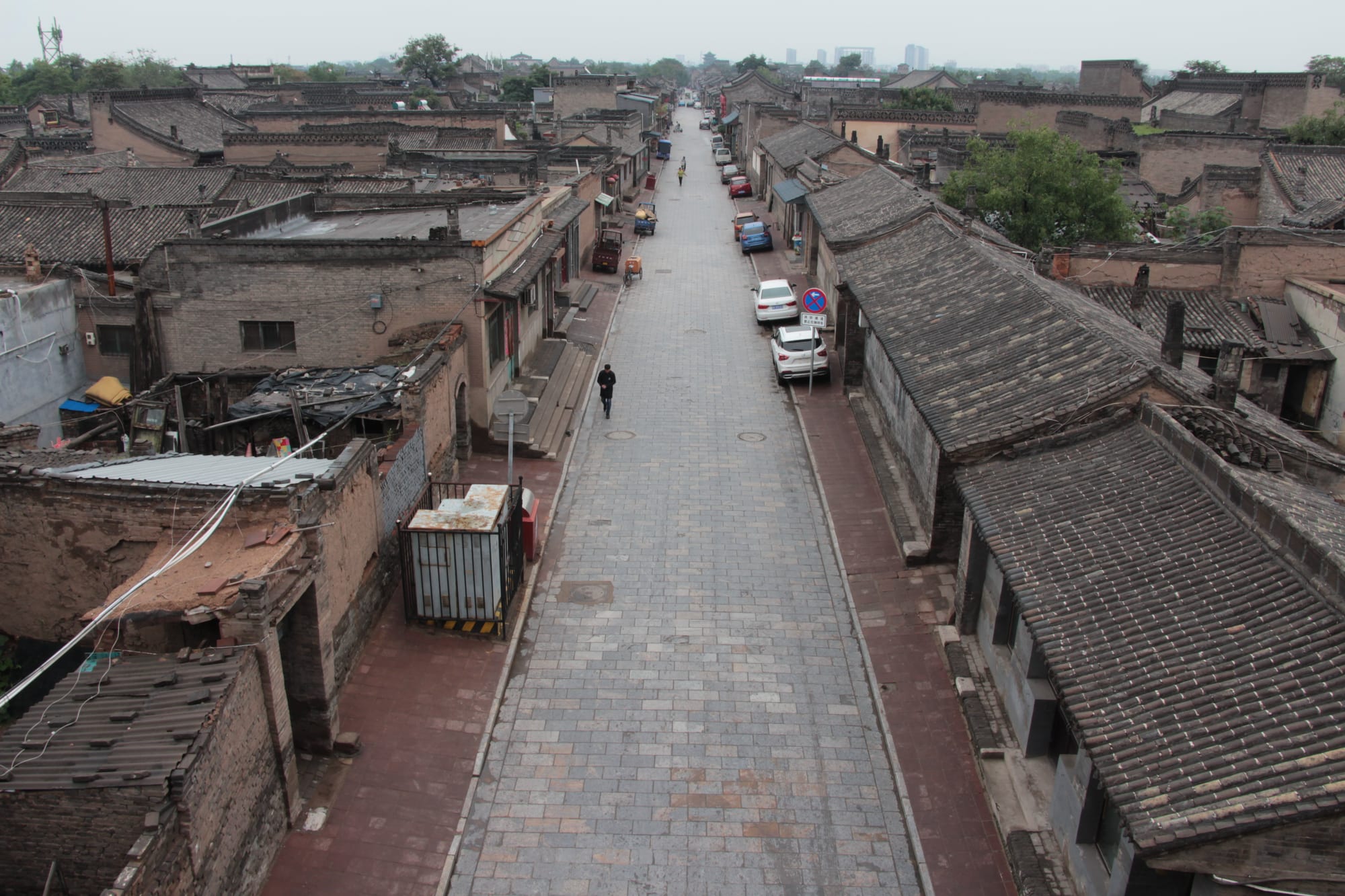
A paved street of low grey-tiled courtyard buildings inside Pingyao's old town, seen from the top of the city wall

Beijing & North China, China

Pingyao

A street of grey-tiled courtyard houses inside the walls of Pingyao, seen from the rampart. (ThomasMomas / Wikimedia Commons · CC BY-SA 4.0)

A walled county town on the loess plain of central Shanxi, whose Ming ramparts still enclose a grid of grey-brick courtyard houses, temples and shop fronts. In the 19th century its merchants ran China's first network of draft banks, and the wealth of that trade paid for the halls and mansions that make the old town a UNESCO World Heritage Site.

Neighbourhoods

  • South Street and the old town centre
    • First-time visitors
    • Historic district
    • Best for food

    The main north–south axis inside the walls, lined with restored Ming and Qing shop fronts, the old bank halls and the market tower that straddles the street. Most of the town's guesthouses, restaurants and souvenir shops are on it or a lane away, and it is busiest in the evening when the lanterns are lit.

    Open in Maps
  • The western and northern lanes
    • Quiet and residential
    • Local life

    Away from the main streets the grid becomes residential: grey brick walls, carved gateways, bicycles and washing lines, with courtyard houses still lived in rather than converted. Temples and small workshops appear without warning between the houses.

    Open in Maps
  • Outside the walls
    • Close to public transport
    • Practicalities

    The modern county town spreads east and south of the ramparts, with wide roads, blocks of flats, banks and bus connections. The high-speed railway station stands a short drive out, and this is where everyday shopping and services are found.

    Open in Maps

Things to do

Inside the walls

  • Pingyao City Walllandmark

    The rammed-earth and brick rampart of 1370 that rings the old town for about six kilometres, with gate towers and a walkway along the top.

    Open in Maps
  • Rishengchangmuseum

    The courtyard headquarters of Rishengchang, founded in 1823 and reckoned the first draft bank in China, now a museum of the trade.

    Open in Maps
  • Temple of the City Godlandmark

    A well-preserved Taoist complex of three linked temples in the east of the old town, with glazed-tile roofs and halls to the city god and to the gods of wealth and the kitchen.

    Open in Maps

Temples and sights just outside

  • Shuanglin Templelandmark

    A walled monastery a few kilometres south-west, holding more than two thousand painted clay statues made between the 12th and 19th centuries.

    Open in Maps
  • Zhenguo Templelandmark

    A small temple north-east of the town whose main hall, built in 963, is one of the few timber buildings in China to survive from the 10th century.

    Open in Maps

Short trips from the town

  • Qiao Family Compoundlandmark

    A fortified merchant mansion of linked courtyards about 30 kilometres north-east of Pingyao, built by a Qing trading family and used as a film location.

    Open in Maps
  • Wang Family Compoundlandmark

    A far larger hillside complex of walled courtyards, gates and carved screens south of Pingyao, built by another Shanxi merchant clan.

    Open in Maps

Seasonal events

  • Pingyao International Photography FestivalAutumn

    An annual festival that fills disused factories and courtyards in and around the old town with exhibitions by Chinese and foreign photographers.

  • Lunar New Year in the old townJanuary or February

    Lanterns, drum and gong troupes, stilt walkers and temple offerings mark the Spring Festival inside the walls, the coldest and most local time to visit.

  • Mid-Autumn and National Day holidayslate September and early October

    The town's busiest week of the year, when domestic visitors fill the guesthouses and the main streets are crowded from morning to night.

Eat and drink

Long-standing places and food districts in Pingyao. Hours, ratings and directions come from your maps app, always current.

Pingyao classics

  • Pingyao beefmarket

    Salt-cured and slow-cooked beef, sliced cold, is the town's best-known product and is sold vacuum-packed in shops along the main streets.

    Open in Maps
  • Shanxi noodle housesrestaurant

    Small kitchens serve the provincial repertoire — daoxiao mian shaved from a block of dough, cat's-ear pasta and oat-flour rolls — dressed with tomato and egg, minced pork or plenty of vinegar.

    Open in Maps
  • Wantuo stallsmarket

    A cold local snack of buckwheat or wheat jelly cut into strips and served with vinegar, garlic and chilli oil, sold from small street stalls.

    Open in Maps

Streets to eat in

  • South Street and West Streetneighborhood

    The restored main streets inside the walls hold most of the restaurants, courtyard guesthouse dining rooms and tea shops, along with stalls selling snacks and Shanxi aged vinegar.

    Open in Maps

Experience Pingyao

History

A settlement has stood here since the Western Zhou period, and the town was given walls of rammed earth early in its life. The present rampart dates from 1370, in the third year of the Ming Hongwu reign, when the earth wall was rebuilt and faced in brick, and the grid of streets inside it was laid out on the pattern that survives: a main cross of four streets, eight lesser streets and seventy-two lanes, with the county offices, the Confucian temple and the city god's temple in their prescribed positions.

Pingyao's fortune came later, and from finance. Shanxi merchants had grown rich on the trade in salt, silk, tea and cotton between the interior and the northern frontier, and moving silver across the country was slow and dangerous. In the 1820s a Pingyao dye firm, Rishengchang, began issuing drafts that could be cashed at its branches in other cities. The piaohao, or draft banks, that followed were run largely by men from Pingyao and the neighbouring counties, and for much of the 19th century they handled remittances for merchants and for the Qing government itself.

The system did not survive the arrival of modern banks, the fall of the Qing in 1911 and the wars and disruption that followed; the last draft banks closed in the early 20th century, and Pingyao became a poor and unimportant county town. That poverty preserved it. Without money to rebuild, the walls, the temples and the courtyard houses stayed as they were, and when demolition threatened in the 1980s the town was protected instead. UNESCO inscribed the old town, with Shuanglin and Zhenguo temples, as a World Heritage Site in 1997, and tourism has been its main business since.

Culture & Customs

Pingyao's identity is bound up with the Shanxi merchant tradition — thrift, long apprenticeships, family firms and a reputation for keeping one's word across a thousand kilometres of road. The old banking halls display the ledgers, cipher systems and partnership rules of that world, and local pride in it is considerable; the Qiao and Wang compounds nearby are shown as proof of what the trade paid for.

The town's architecture is a culture in itself. Houses are built of grey brick around narrow courtyards, often with a barrel-vaulted room at the back in the loess-country style that stays cool in summer and warm in winter, and gateways, screen walls and roof ridges carry carved brick decoration meant to bring luck or ward it off. Paper-cutting, lacquerware finished with a polished surface, and painted clay figures are the local crafts, and the lacquer workshops still sell boxes and screens along the main streets.

Shanxi opera, or jinju, is performed on festival days, along with drum troupes, stilt walking and the noise of the Spring Festival, when the town is at its most local. Since the late 1990s an outside culture has arrived with the visitors: the photography festival each September occupies old factories and courtyards, and a film festival founded in 2017 brings screenings to the town. Residents are used to strangers in their lanes, but the courtyards away from the main streets remain private homes.

Daily Life

Around half a million people live in Pingyao county, of whom only a small fraction — a few tens of thousands — live inside the walls; the rest are in the modern county town outside and in farming villages on the plain. Many families who once lived in the old town have moved to flats beyond the ramparts, where the schools, hospitals and supermarkets are, and rent or run their courtyard houses as guesthouses instead.

Tourism now sets the rhythm inside the walls. Mornings begin with deliveries by electric cart and shopkeepers sluicing the stone in front of their doors; the streets fill in the middle of the day and again after dark, and empty sharply out of season and in deep winter. Outside the walls the economy is agricultural and industrial — maize and wheat on the plain, coal and heavy industry in the wider province — and a good many younger residents work in Taiyuan or further afield.

The pressures are those of a protected town. Restoration rules limit what owners may change; ageing timber, damp and winter heating are constant problems in the courtyard houses; and the balance between a living town and a visitor attraction is argued over, especially when a lane turns entirely to shops. Part of the southern wall collapsed in 2004, a reminder of how vulnerable rammed earth is.

Food

Shanxi is the noodle province of China, and Pingyao eats accordingly. Daoxiao mian, shaved with a curved blade straight from a block of dough into boiling water, arrives with a sauce of tomato and egg, minced pork or mutton; maoerduo, small 'cat's ear' curls of pasta, and youmian kaolaolao, rolls of oat flour steamed upright in a honeycomb, are country staples. Flour here means wheat, oats, buckwheat and sorghum rather than rice, and much of it is eaten in soup.

The town's own specialities are two. Pingyao beef is cured in salt, simmered slowly and served cold in thin slices, sold in every shop on South Street and taken home as a gift. Wantuo is a cold jelly of buckwheat or wheat starch, cut into ribbons and dressed with vinegar, garlic, sesame paste and chilli oil — cheap, sour and eaten standing up. Guotuiba, a layered baked wheat pastry, and steamed buns shaped for festivals fill out the local list.

Aged vinegar, lao chencu, is the flavour that ties it all together: dark, faintly sweet, poured over noodles, dumplings and cold dishes in quantities that surprise visitors from elsewhere in China. Tea houses in the old town serve local jujube and chrysanthemum infusions, and the provincial spirit is Fenjiu, a clear sorghum baijiu distilled at Xinghuacun in Fenyang, north-west of the town and drunk at any meal that counts as an occasion.

Planning tools

Budget

Pingyao is markedly cheaper than Beijing. Courtyard guesthouses inside the walls are good value, and meals in the noodle houses cost very little. The main expense is the combined entrance ticket that covers the wall and the old town's museums and mansions, plus transport to the temples and merchant compounds outside.

Daily Budget Midrange
USD 60–120 (courtyard hotel room, restaurant meals, the combined old-town ticket, a hired car to the compounds)
Daily Budget Shoestring
USD 25–45 (guesthouse bed inside the walls, noodle houses and street snacks, local buses)

One ticket covers most sights inside the walls, so it is worth buying on arrival rather than paying separately; the temples outside charge their own entry.

Best Time to Visit

May, June, September and October are the most comfortable months, with warm days and clear light on the grey brick. Autumn is the best of them. July and August are hot and bring most of the year's rain. Winter is very cold and the town is quiet, though the Spring Festival is a rewarding time to be inside the walls. The first week of October is extremely busy.

Suggested Number of Days

The walled town is small and one full day covers it, with a second for a slower look and an evening on the wall. Add a day to reach the temples and merchant compounds nearby. Crowds in holiday weeks slow everything down.

First Visit
1–2 days
With Surroundings
2–3 days

Transportation

Inside the walls almost everything is walked; motor traffic is restricted and electric buggies shuttle along the main streets. Taxis and hired cars wait at the gates for trips to the temples, the compounds and the railway stations. Local buses run to the surrounding villages and to Taiyuan, and guesthouses arrange drivers for a day's sightseeing.

Agree a price before setting off with a driver, and keep in mind that the old town's stone streets are hard on wheeled luggage.

Airport & Station Connections

Two stations serve the town: the old Pingyao station just outside the west side of the walls, on the conventional line, and Pingyao Ancient City station on the high-speed line a few kilometres to the east. Fast trains reach Taiyuan in around half an hour and Beijing in roughly three and a half to four hours; Taiyuan's airport is the nearest, about 90 km north.

Walkability

Excellent. The old town is a compact grid a little over a kilometre across, flat and largely free of cars, and the whole circuit of the wall can be walked in a couple of hours. Surfaces are stone flags and worn brick, with steep steps up to the rampart, so sturdy shoes help. Everything outside the walls needs a taxi or a bus.

Safety

Pingyao is a very safe town with little crime beyond occasional overcharging and pushy selling in the main streets. The real hazards are physical: unlit lanes at night, uneven paving, steep unguarded steps on the city wall, and summer heat or deep winter cold on the exposed rampart.

Carry a torch for the back lanes after dark, take care on the wall's steps and edges, and use metered taxis or a ride-hailing app rather than drivers who approach at the station. Check current official travel advice before travelling.

Climate

A dry continental climate on the Shanxi plateau, with four clear seasons and an annual average around 10°C. Rain is concentrated in July and August; spring is windy and dusty; autumn is dry and bright.

Summer
hot by day, often around 28–32°C, but cooler at night than Beijing, with thunderstorms in July and August
Winter
cold and dry, with frequent hard frosts and January daily averages below 0°C

Local Customs

Tipping is not customary. Many courtyard houses inside the walls are still homes rather than attractions, so it is worth asking before walking into a gateway or photographing residents. Temples are working sites of worship; dress modestly and follow signs about photography. Shanxi people take their aged vinegar seriously and it appears on every table.

Ask before photographing people or entering private courtyards, and expect cash-only transactions at some small stalls.

Common Payment Methods

The currency is the Chinese yuan (renminbi). Mobile payment apps are used almost everywhere, including street stalls, and can be linked to foreign cards. International cards are accepted at some hotels but rarely in small shops or restaurants; there are bank branches and ATMs in the new town outside the walls, so it is sensible to carry some cash.