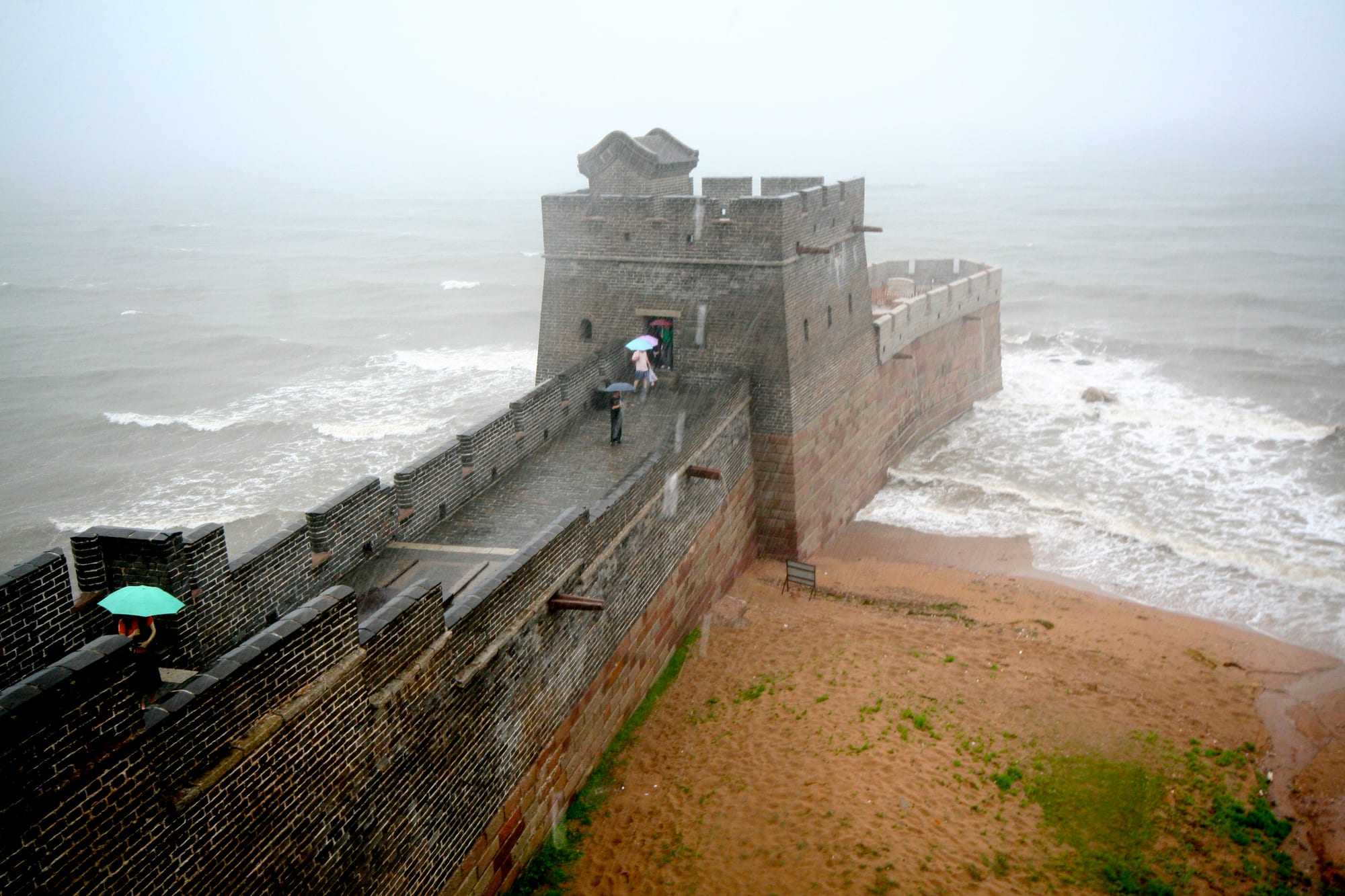
A grey brick wall with battlements running down a sandy beach and ending in a square tower in the misty grey sea

Beijing & North China, China

Qinhuangdao

Old Dragon Head, where the Ming Great Wall runs into the Bohai Sea at Shanhaiguan. (fuzheado / Wikimedia Commons · CC BY 2.0)

A coastal city in north-eastern Hebei, about 300 kilometres east of Beijing, where the Great Wall runs down to the Bohai Sea. It combines three very different places: a large coal and container port, the walled garrison town of Shanhaiguan with its 14th-century pass, and the sandy beaches and pine woods of the summer resort of Beidaihe.

Neighbourhoods

  • Haigang District
    • First-time visitors
    • Close to public transport
    • Local life

    The working centre of the city, built around the harbour that gave it its start. Offices, markets, hotels and the main railway station are here, along with a long municipal seafront of beaches and promenades east of the port.

    Open in Maps
  • Beidaihe
    • Beaches
    • Families
    • Birdwatching

    The resort district about 15 kilometres south-west of the centre, laid out among pines and low villas since the 1890s. Gentle sandy bays, seafood restaurants and wooded headlands fill in summer and empty out completely in winter, when the wetlands draw migrating birds.

    Open in Maps
  • Shanhaiguan
    • Historic district
    • Great Wall
    • Day trips

    The walled garrison town 15 kilometres north-east of the centre, where the Great Wall meets the sea. Inside the Ming ramparts is a grid of restored grey-brick streets around the great gate tower, with the wall climbing into the hills behind.

    Open in Maps
  • Funing District
    • Quiet and residential
    • Countryside

    The inland district behind the coast, a county town absorbed into the city, with farmland, orchards and stretches of the wall running through low hills. It is where much of the area's fruit and grain comes from.

    Open in Maps

Things to do

The Great Wall and Shanhaiguan

  • Shanhai Passlandmark

    The fortified Ming pass of 1381 where the wall meets the coastal plain, its gate tower inscribed 'First Pass Under Heaven'; a spur of wall runs into the sea nearby at Old Dragon Head, and steep sections climb the hills to the north.

    Open in Maps
  • Northeastern University at Qinhuangdaoattraction

    A branch campus of Northeastern University near the coast, its tree-lined grounds a common walking route for residents.

    Open in Maps

Beaches and the coast

  • Beidaihebeach

    The resort coast of gentle sandy bays, rocky headlands and pine woods, laid out from the 1890s and busy for ten weeks each summer.

    Open in Maps
  • Port of Qinhuangdaotransit hub

    China's largest coal-shipping harbour, seen from the city's seafront, where trainloads from Shanxi and Inner Mongolia are tipped into bulk carriers.

    Open in Maps

City sights

  • Qinhuangdao Olympic Sports Center Stadiumattraction

    A stadium on Hebei Avenue, completed in 2004 as the first new venue built for the 2008 Olympic Games, which hosted football matches during them and was for years a professional club's home ground.

    Open in Maps
  • Yanshan Universityattraction

    A large technical university descended from the heavy machinery school of the Harbin Institute of Technology, moved south from the north-east, with open, tree-lined grounds.

    Open in Maps
  • Qinhuangdao Wildlife Parkattraction

    A safari park opened in 1995, among the largest in China, where tigers, lions, bears and elephants are seen on foot, by car or from a park train.

    Open in Maps

Short trips from the city

  • Changliattraction

    A county south-west along the coast, one of the largest winemaking districts in China, with most of its farmland under Cabernet Sauvignon grapes on the sandy slopes behind the shore.

    Open in Maps

Seasonal events

  • Bird migration at Beidaihespring and autumn

    The wetlands, river mouths and woods around Beidaihe sit on a major East Asian flyway and draw birdwatchers from around the world during the passage months.

  • Beach seasonJune to August

    The resort districts fill with domestic holidaymakers, seafood stalls and evening promenades for the ten weeks of reliable summer heat.

  • Grape harvest around ChangliSeptember and October

    The vineyards and wineries inland from the coast bring in the crop, and wine-related events are held in the county.

Eat and drink

Long-standing places and food districts in Qinhuangdao. Hours, ratings and directions come from your maps app, always current.

Qinhuangdao classics

  • Bohai seafood restaurantsrestaurant

    The local table is built on the shallow Bohai Sea: swimming crabs, mantis shrimp, razor clams, sea snails and small fish, usually steamed or boiled plainly and eaten with vinegar and ginger.

    Open in Maps
  • Changli winerestaurant

    The sandy slopes behind the coast at Changli form one of China's largest wine districts, planted overwhelmingly with Cabernet Sauvignon, and its bottles appear on menus across the city.

    Open in Maps

Markets and food streets

  • Beidaihe seafood marketmarket

    Tanks and trays of live shellfish and fish sold by weight, with nearby kitchens that will cook a customer's purchase for a fee — a summer ritual in the resort.

    Open in Maps
  • Shanhaiguan old town lanesneighborhood

    The grey-brick streets inside the walls sell northern staples — dumplings, noodles, flatbreads, skewers and roasted sweet potatoes — to visitors coming off the wall.

    Open in Maps

Experience Qinhuangdao

History

The city takes its name from Qin Shi Huang, the first emperor, who is said to have come to this coast on his last eastern tour in 210 BC and sent expeditions out to sea in search of the elixir of immortality; the Jieshi hills in Changli County, inland from the shore, are traditionally identified with the ritual behind the name, while the 'island' of the name was a small offshore hill by the harbour, joined to the mainland by dredged silt in the late Qing. Later rulers followed the same shore.

The place that made the area matter was the pass. In 1381 the Ming general Xu Da, sent to repair older passes, built Shanhaiguan where the mountains come within a few kilometres of the water, closing the narrow corridor between the North China Plain and Manchuria; the gate tower's inscription calls it the First Pass Under Heaven, and a spur of wall was run into the sea at Old Dragon Head. In 1644, with rebels holding Beijing, the Ming commander Wu Sangui opened the pass to the Manchus, and the Qing conquest of China followed.

Modern Qinhuangdao grew from two 19th-century developments. A harbour approved by the Qing court was built at the end of the 19th century to ship coal from the province's new mines, and the railway from Beijing to the north-east ran alongside it, while foreign engineers, missionaries and diplomats began building summer villas among the pines at Beidaihe. The port grew into the country's largest coal-shipping harbour, glassmaking became an early local industry, and after 1949 Beidaihe became the summer retreat of the national leadership as well as a holiday destination for workers. The three settlements were joined into one municipality, which now also serves as a university and container-port city.

Culture & Customs

Qinhuangdao's identity is split between the wall and the water. Shanhaiguan keeps the culture of a garrison town: temple fairs, the legend of Meng Jiangnü, whose search for her conscripted husband is one of China's four great folk tales, and a long local trade in guiding visitors along the ramparts. The wall is treated less as scenery than as the town's own history, and its origins as a Ming garrison remain part of local self-image.

Beidaihe's culture is that of the seaside holiday, a century old and still recognisably formal: photographs in front of the sea, matching sun hats, dawn swims and the ritual of watching the sunrise from the rocks. The resort's early foreign villas gave it an architectural style of verandas and pitched roofs that later buildings copied. Because it has been a place of retreat for governments and work units since the 1950s, parts of the seafront are institutional rather than commercial, with sanatoria and guesthouses behind garden walls.

The city is also one of China's best-known birdwatching centres, long known to birdwatchers for the spring and autumn passage along this coast. Birding is now part of local identity, alongside sea swimming clubs and the winter swimmers who go into the Bohai in January. Hebei's northern manners prevail: direct speech, heavy hospitality and toasts with baijiu or cold beer at a dinner table covered in shellfish.

Daily Life

About 3.1 million people live in the prefecture-level city, some two million of them in the urban districts, the rest spread between the resort districts and the inland counties. Population swings with the calendar: Beidaihe's permanent residents are few, and in summer the district's numbers multiply, while in February its streets are all but empty.

The port is the economic anchor. Qinhuangdao handles enormous volumes of coal brought by rail from Shanxi and Inner Mongolia for the power stations of the south and east, along with containers, oil and grain, and the docks, railways and shipping agencies employ a large share of the workforce. Glass, food processing, metal and vehicle parts industries sit behind the harbour, and tourism, wine and fruit growing occupy the coast and countryside. Yanshan University and a campus of Northeastern University give the city a substantial student population.

Daily rhythms are coastal. Fishing boats and the seasonal moratorium on fishing set the supply of the markets; retired residents walk the promenades at first light; and the summer season dominates half the year's income for families in Beidaihe and Nandaihe. Away from the sea, life in Haigang is that of an ordinary mid-sized Chinese city of wide streets and tower blocks. Winter wind, seasonal unemployment and pressure on the coastline from development are recurring local concerns.

Food

Seafood from the shallow Bohai defines the city's cooking, and it is treated simply. Swimming crabs, mantis shrimp — known locally as pissed shrimp, pi pi xia — razor clams, sea snails, small squid and clams are steamed, boiled or stir-fried lightly, then dipped in vinegar with shredded ginger. Sea cucumber, farmed and gathered along this coast, appears braised with spring onion at more formal meals, and salted and dried fish are a winter staple.

Hebei's wheat cooking fills the rest of the table. Dumplings are eaten constantly, often filled with prawn or crab meat and leek; flatbreads called huoshao come plain or split and stuffed, including the donkey-meat version the province is known for; and cold sesame noodles, pickled vegetables and stewed pork with vermicelli are everyday dishes. The local preserved goods include shrimp paste and pickled sea snails.

Fruit and drink come from the countryside behind the shore. Changli's sandy slopes hold one of China's largest wine districts, most of its farmland under Cabernet Sauvignon, and the county's orchards supply pears, peaches and apples that turn up as juice and dried fruit. Beer is the summer accompaniment to a table of shellfish, baijiu the winter one, and stalls along the promenades sell grilled squid, roasted clams and candied hawthorn on sticks.

Planning tools

Budget

Costs are lower than in Beijing except in the resort districts in high summer, when Beidaihe and Nandaihe room rates climb steeply and seafood is priced accordingly. Outside July and August the same rooms are cheap. Entry tickets are charged separately for each Great Wall site.

Daily Budget Midrange
USD 85–170 (mid-range hotel, seafood dinners, entry tickets, taxis between the districts)
Daily Budget Shoestring
USD 30–55 (budget hotel or guesthouse, noodle shops and market seafood, local buses and trains)

Book beachfront rooms well ahead for July and August; in winter much of Beidaihe closes and the choice shrinks to the city centre.

Best Time to Visit

May, June, September and early October are the most comfortable months, with warm days, clear light on the wall and far fewer people. July and August are the swimming season and the busiest weeks of the year. Spring and autumn are the times for bird migration. Winter is cold, windy and very quiet, though the wall sites stay open.

Suggested Number of Days

Two days are enough to take in the walled town and the coast. Three or four suit a beach stay, the mountain sections of the wall and the countryside inland. Distances between the districts are the main thing that adds time.

First Visit
2 days
With Surroundings
3–4 days

Transportation

The city is really three centres strung along the coast, and moving between them is the daily task: city buses link Haigang, Beidaihe and Shanhaiguan, a local rail service and frequent trains connect their stations, and taxis or ride-hailing cover the gaps. Within each district walking works well, and bicycles suit the flat seafront roads at Beidaihe.

Check which of the city's stations a train uses — Qinhuangdao, Beidaihe and Shanhaiguan each have their own, some kilometres apart.

Airport & Station Connections

High-speed trains from Beijing take roughly two to two and a half hours and call at Qinhuangdao, Beidaihe or Shanhaiguan on the line towards Shenyang, and services from the north-east stop here too. Qinhuangdao Beidaihe Airport lies inland to the south-west in Changli County, about 45 kilometres from the centre, with a modest domestic network, and the expressway from Beijing takes about three and a half hours by road.

Walkability

Each district is easy on foot. The walled town of Shanhaiguan is small enough to cross in twenty minutes, Beidaihe's shaded roads run level between the beaches, and Haigang has a long seafront promenade. The gaps between them are too far to walk, and the Great Wall sections in the hills involve steep, uneven steps.

Safety

Crime is low and the resort areas are heavily policed in summer. The real risks are in the water — currents, sudden depth changes and jellyfish in late summer, on beaches where lifeguard cover varies — along with summer crowds, sunburn and steep, slippery steps on the mountain sections of the wall. Parts of the shoreline are restricted around the port and other installations, and photography near them should be avoided.

Swim only at supervised beaches and within the marked areas, take steady shoes for the hill sections of the wall, and observe signs barring access or photography near the port. Check current official travel advice before travelling.

Climate

A continental monsoon climate softened by the sea, which keeps summers cooler and winters slightly milder than inland Hebei. Most rain falls in July and August, sea fogs are common in early summer, and the clearest weather comes in autumn. Winter brings strong, dry north-westerly winds.

Summer
warm and humid, typically 24–30°C by day with sea breezes, and warm water from July to early September
Winter
cold and windy, usually between −9 and 2°C, with little snow and ice in the shallow bays

Local Customs

This is a holiday city for Chinese families, and its habits follow the season: early swims, afternoon naps, evening walks along the promenade and long shared seafood dinners. Meals are ordered for the table and the host pays; splitting a bill is unusual. Sunrise watching from the headlands at Beidaihe is a local institution. Temples and shrines around Shanhaiguan are working religious sites, so dress modestly and ask before photographing worshippers.

Tipping is not expected. Politics, Taiwan, Tibet, Xinjiang and the Party are sensitive subjects, and security forces, protests and military sites should not be photographed.

Common Payment Methods

The currency is the Chinese yuan renminbi, colloquially kuai. Payment is by QR code through Alipay or WeChat Pay almost everywhere, including market stalls and buses, and both apps now let foreign visitors link an overseas card. Foreign cards work at larger hotels but seldom elsewhere, so carry some cash as a fallback.