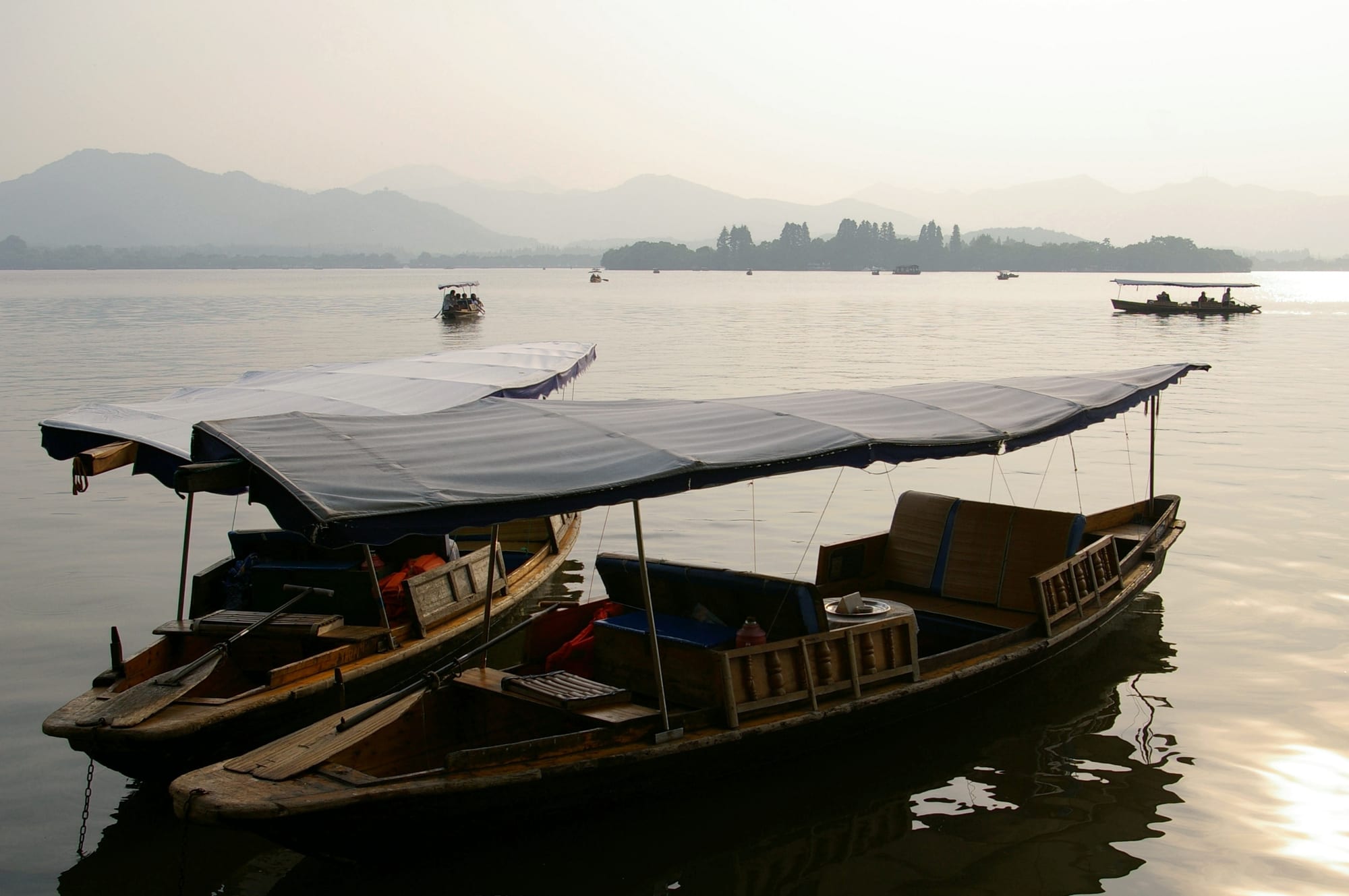
Two canopied wooden boats moored on calm water, with other boats, a wooded island and misty hills beyond

China

Shanghai & the East Coast

Pleasure boats on West Lake in Hangzhou, Zhejiang, in the late-afternoon haze. (Jakub Hałun / Wikimedia Commons · CC BY-SA 3.0)

The wealthy eastern seaboard from the Yangtze delta to the Shandong peninsula — Shanghai, Jiangsu, Zhejiang and Shandong — where canal towns, classical gardens and old imperial capitals sit beside China's largest city, its busiest ports and its densest high-speed rail network, and where Confucius was born.

Explore Shanghai & the East Coast

History

The lower Yangtze was home to one of China's earliest complex societies, the Liangzhu culture near Hangzhou, whose jade-working city of around 3000 BC is a UNESCO World Heritage Site. To the north, Shandong was the land of the states of Lu and Qi, and Confucius was born at Qufu in 551 BC. The southern kingdoms of Wu and Yue, based at Suzhou and Shaoxing, fought famous wars in the 5th century BC.

The Grand Canal, completed under the Sui in the early 7th century, tied the rice and silk of the delta to the northern capitals, and the south grew richer than the north. When the Jurchens took northern China, the Southern Song made Hangzhou their capital, and it became one of the largest cities in the world. Nanjing was the first Ming capital, and in the Ming and Qing eras Suzhou and Yangzhou were centres of trade, scholarship and garden-building.

The Opium War ended with the Treaty of Nanking in 1842, and Shanghai, then a modest county town, grew into a treaty port of foreign concessions, banks and factories — the city where the Chinese Communist Party held its first congress in 1921. The Taiping rebels ruled from Nanjing from 1853 to 1864, Germany seized Qingdao in 1897, and Nanjing became the Nationalist capital in 1927. Japanese forces took Shanghai and Nanjing in 1937, massacring civilians in Nanjing. Shanghai led the reform-era boom after Pudong was opened for development in 1990, and the delta is now China's economic core.

Culture & Customs

South of the Yangtze, the local languages are forms of Wu Chinese — Shanghainese, Suzhounese and many Zhejiang varieties — largely unintelligible to Mandarin speakers and spoken less by the young, while Shandong people speak northern Mandarin dialects. The delta has a reputation for refinement, commerce and soft speech; Shandong for Confucian values, bluntness, hospitality and heavy toasting.

Performing arts are rich. Kunqu, the classical opera that took shape around Kunshan, is recognised by UNESCO as intangible heritage; Suzhou's pingtan storytellers perform with the pipa and sanxian; and Yue opera, known for actresses playing male roles, began in Zhejiang. Crafts include Suzhou silk embroidery, Hangzhou silk, Yixing purple-clay teapots, Dongyang woodcarving and Weifang kites, celebrated in an April kite festival.

Religion and ritual are visible in the Confucian ceremonies at Qufu, the Buddhist pilgrimage island of Putuoshan off Zhejiang, and the Daoist temples of Laoshan near Qingdao. Shanghai's culture looks outward: its old shikumen lane houses, jazz-era cafés, and a style-conscious, fast-paced life that other Chinese both envy and mock. Zhejiang's private businesses — from Wenzhou's traders to the wholesale markets of Yiwu — are a national model of entrepreneurship.

Daily Life

More than 270 million people live in the four provincial units. Shanghai has about 25 million; Jiangsu's main cities are Nanjing, Suzhou and Wuxi; Zhejiang's are Hangzhou, Ningbo and Wenzhou; and Shandong, one of China's most populous provinces, is centred on Jinan and the port city of Qingdao.

The region generates a large share of China's output. Shanghai is the financial centre and home of the world's busiest container port, Ningbo-Zhoushan is another giant port, Suzhou and Wuxi are manufacturing and electronics hubs, and Hangzhou is the base of Alibaba and a cluster of technology firms. Shandong mixes heavy industry, petrochemicals and farming, and grows much of China's fruit and vegetables.

Life in the delta cities is fast, crowded and expensive: long commutes by metro, high property prices, intense schooling, weekend escapes to the water towns and hills, and an older generation that still dances and plays mahjong in the parks. Shanghai's long lockdown in 2022 left a deep impression on residents. Rural Zhejiang and southern Jiangsu are among China's richest countrysides.

Food

The delta's cooking is sweet, delicate and soy-braised. Shanghai is known for xiaolongbao, the soup-filled steamed dumplings associated with Nanxiang, pan-fried shengjian buns, and hongshao rou, pork belly red-braised with soy, sugar and rice wine. In autumn the hairy crabs of Yangcheng Lake near Suzhou are the season's prize, steamed and eaten with ginger and vinegar.

Hangzhou's dishes include Dongpo pork, named after the Song poet Su Dongpo, West Lake fish in sweet vinegar sauce, and river shrimp stir-fried with Longjing tea leaves. Suzhou serves squirrel-shaped mandarin fish, deep-fried and glazed; Nanjing its salted duck; and Yangzhou the elaborate Huaiyang cuisine of lion's head meatballs and Yangzhou fried rice. Zhenjiang makes black rice vinegar and Jinhua a dry-cured ham, and Shaoxing produces huangjiu, amber rice wine served warm, alongside strong-smelling fermented stinky tofu.

Shandong's Lu cuisine, one of China's classic regional schools, favours braising, clear broths and scallions, as in braised sea cucumber with scallion; Shandong jianbing, a crisp pancake rolled around raw green onions, is its humble staple. Qingdao drinks Tsingtao beer, first brewed by an Anglo-German company in 1903, with clams, and Yantai grows apples and wine grapes. Longjing green tea from the Hangzhou hills and Biluochun from Lake Tai are among China's most famous teas.

Attractions & Natural Wonders

Shanghai's set pieces are the Bund's waterfront of banks and hotels, the towers of Lujiazui across the river, including the twisting Shanghai Tower, the Shanghai Museum, the Yu Garden and old town, and the plane-tree streets of the former French Concession. Zhujiajiao is the city's own canal town.

Suzhou's classical gardens — the Humble Administrator's Garden, the Lingering Garden and the Master of the Nets among them — are a UNESCO World Heritage Site, and the city also has Tiger Hill's leaning pagoda and canal-side Pingjiang Road. The water towns spread across the delta: Zhouzhuang and Tongli in Jiangsu, Wuzhen and Xitang in Zhejiang. Hangzhou's West Lake has the Su and Bai causeways, Leifeng Pagoda and Lingyin Temple, with tea villages in the hills behind; Shaoxing, Putuoshan and Qiandao Lake lie further afield.

Nanjing has one of the world's longest surviving city walls, the Ming Xiaoling tomb and Sun Yat-sen's mausoleum on Purple Mountain, the Qinhuai river quarter and the Nanjing Massacre Memorial Hall; Yangzhou has its Slender West Lake. In Shandong, Qingdao keeps German villas and churches, the Tsingtao Beer Museum and beaches, with Laoshan behind. Inland, Mount Tai's stone stairway climbs to temples where emperors made sacrifices to heaven, and Qufu has the Temple, Mansion and Cemetery of Confucius.

Cities in Shanghai & the East Coast

Planning basics

Budget

Shanghai is China's most expensive city for hotels, bars and Western-style dining, though local noodle shops and dumpling houses remain cheap. Hangzhou and Suzhou are close behind at weekends, and the water towns charge entry fees. Shandong is noticeably cheaper outside Qingdao's summer season, and Mount Tai's tickets and cable car are the main extras.

Daily Budget Midrange
USD 120–240 (mid-range hotel, restaurant dinners, garden and water-town tickets, taxis)
Daily Budget Shoestring
USD 35–60 (hostel, dumpling and noodle shops, metro and second-class high-speed rail)

Visit the Suzhou gardens and the water towns on weekdays and early in the morning, when prices and crowds are lower.

Safety

The region is very safe. The main nuisances are tea-house and overpriced-bar scams on Shanghai's Nanjing Road and the Bund, fake goods in markets, crowding on holiday weekends, and typhoon disruption to flights and ferries in late summer. Mount Tai's stairway is long and steep, and summit weather can turn cold.

Ignore invitations from friendly strangers near the Bund, follow typhoon warnings in August and September, and carry warm layers for a Mount Tai sunrise. Check current official travel advice before travelling.

Climate

The Yangtze delta is humid subtropical: hot, sticky summers, a rainy "plum rain" season in June and early July, and damp, chilly winters in homes that were often built without central heating. Typhoons can strike the Zhejiang and Shanghai coast in late summer. Shandong, further north, is drier and colder in winter, and Qingdao is cooled by the sea in summer.

Summer
hot and humid, 30–36°C in Shanghai and Hangzhou; milder on the Qingdao coast
Winter
raw and damp, 0–10°C in the delta; colder and drier in Shandong, often below freezing at night

Transportation

This is China's best-connected region. Shanghai has two major airports and a maglev line to Pudong, and high-speed trains reach Suzhou in about half an hour, Hangzhou in about an hour and Nanjing in around one to two. The Beijing–Shanghai line passes Nanjing, Qufu, Tai'an for Mount Tai and Jinan, with a branch to Qingdao. Every major city has a metro; water towns are reached by bus or taxi from Shanghai, Suzhou or Hangzhou.

Use Shanghai Hongqiao for most high-speed trains and domestic flights; it is far closer to the city than Pudong airport.

Best Time to Visit

April and May, and late September to November, are the best months, with spring blossom in the gardens, the Longjing tea harvest around Hangzhou in spring and the osmanthus scent and hairy-crab season in autumn. Summer is hot and wet but suits Qingdao's beaches. Avoid the national holiday weeks, when West Lake and the water towns are overwhelmed.