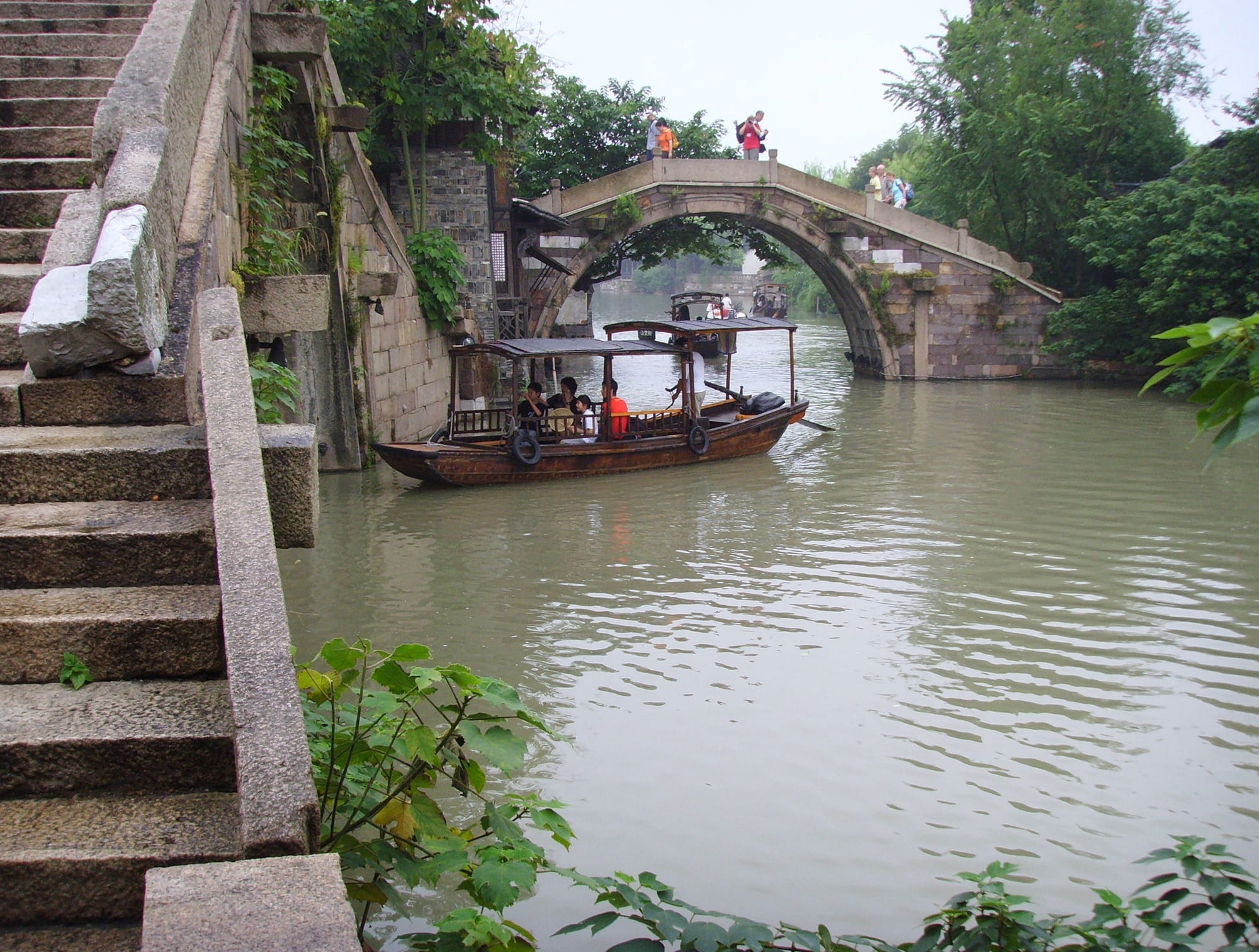
A canopied wooden boat passing under a humpbacked stone arch bridge on a green canal lined with old houses

Shanghai & the East Coast, China

Wuzhen

A boat on the canal in the Xizha quarter of Wuzhen, Zhejiang. (Gerbil / Wikimedia Commons · CC BY-SA 3.0)

A canal town in northern Zhejiang, part of Tongxiang and set on the Grand Canal between Hangzhou and Suzhou. More than a thousand years old, it was a market and silk town of stone bridges, wooden houses built out over the water and indigo dye workshops. Restored and ticketed since the late 1990s, it is now one of the best known water towns of the Yangtze delta.

Neighbourhoods

  • Dongzha, the east quarter
    • First-time visitors
    • Historic district
    • Workshops

    The smaller and older of the two ticketed quarters, a single canal lined with wooden houses, workshops and small museums of dyeing, woodcarving and beds. It is busy with day visitors from Shanghai and Hangzhou and can be walked end to end in a morning.

    Open in Maps
  • Xizha, the west quarter
    • Staying overnight
    • Evening walks
    • Quiet

    A much larger restored quarter of a dozen islets linked by stone bridges, where the former residents were moved out and the houses converted to guesthouses, bars, theatres and galleries. It stays open after dark, when the waterfront is lit and far calmer than by day.

    Open in Maps
  • The modern town
    • Cheaper stays
    • Local life

    The everyday town outside the scenic gates, with ordinary shops, noodle places and hotels, and the bus station for Tongxiang, Jiaxing and Hangzhou. It has none of the canal-town scenery but is where prices drop.

    Open in Maps

Things to do

In and around the town

  • Former Residence of Mao Dunmuseum

    The Mao family home of many generations, built in the mid-19th century, restored in 1984 and open to the public since 1985; renamed the Mao Dun Museum of the City of Tongxiang in 1994, it adjoins the old Lizhi Academy where the novelist went to school.

    Open in Maps
  • Mu Xin Art Museummuseum

    A museum in Xizha open since November 2015 and devoted to Mu Xin, the painter, poet and writer who was born in the town in 1927 and died here in 2011; it was designed by a pupil of I. M. Pei.

    Open in Maps
  • Bridge within a Bridgelandmark

    Two old arch bridges meeting at right angles over the canals, the 28-metre Tongji Bridge running east to west and the shorter Renji Bridge north to south, each framed in the arch of the other.

    Open in Maps
  • Grand Canallandmark

    The historic waterway that made the town, running past it on its way between Hangzhou and the north; it is a UNESCO World Heritage Site.

    Open in Maps

Short trips from the town

  • Zhouzhuangattraction

    A Jiangsu water town of canals and arched bridges, with the 1742 Shen House at its heart, classed as a top-grade scenic area and among the most visited of the delta towns.

    Open in Maps
  • Xitangattraction

    A canal town in Jiashan County north-east of Wuzhen, known for a covered waterside walkway of nearly a kilometre and its quieter lanes.

    Open in Maps
  • Tongxiangattraction

    The county-level city Wuzhen belongs to, home of hangbaiju white chrysanthemum tea and its annual chrysanthemum festivals, and a centre of silk and leather.

    Open in Maps
  • Jiaxingattraction

    The nearest large city, on South Lake, where the founding congress of the Chinese Communist Party finished aboard a boat in 1921.

    Open in Maps
  • Hangzhouattraction

    Zhejiang's capital, about an hour away, with West Lake, its causeways and pagodas, and the tea villages behind them.

    Open in Maps
  • Suzhouattraction

    The Jiangsu canal city north of Wuzhen, whose walled classical gardens are a UNESCO World Heritage Site.

    Open in Maps

Seasonal events

  • Wuzhen Theatre FestivalOctober

    First held in 2013 and staged in Xizha each autumn, it runs invited productions in the town's theatres alongside a young-artists competition and an outdoor carnival along the canals.

  • World Internet ConferenceNovember

    Also called the Wuzhen Summit, an annual conference hosted by the Cyberspace Administration of China and the Zhejiang provincial government, held here since 2014 and filling the town's hotels.

  • Wuzhen Contemporary Art Exhibitionvaries, usually spring or autumn

    A periodic exhibition of contemporary art installed in old buildings and along the water in Xizha.

  • Lunar New Year customslate January or February

    The town revives old festival practices around the new year, with lanterns, temple offerings and folk performances on the opera stage.

Eat and drink

Long-standing places and food districts in Wuzhen. Hours, ratings and directions come from your maps app, always current.

Wuzhen classics

  • Sanbai winemarket

    A clear rice spirit distilled in the town and sold from a courtyard workshop where the jars stand in rows in the open air.

    Open in Maps
  • Red-braised lambrestaurant

    Lamb slow-braised with soy and rock sugar until dark and soft, eaten in the cold months across this part of Zhejiang.

    Open in Maps
  • Hangbaiju chrysanthemum teamarket

    Hangbaiju, the dried white chrysanthemum that originates in Tongxiang, steeped as a pale, slightly sweet tea and sold in the town's shops.

    Open in Maps

Where to eat

  • The Dongzha canal streetneighborhood

    Small kitchens along the old street serving noodles, freshwater fish and river shrimp, with snack stalls selling dingsheng rice cakes and savoury bean tea.

    Open in Maps
  • Xizha waterfront restaurantsneighborhood

    Restaurants and bars set in converted houses along the west quarter's canals, most serving delta cooking of braised pork, lake fish and seasonal greens.

    Open in Maps

Experience Wuzhen

History

A settlement grew here where the waterways of the delta met, and the town takes its recorded history from the Tang period, when the name Wuzhen came into use; local accounts trace habitation back much further. For centuries a boundary ran through the middle of it, dividing the town between two counties and even two prefectures, which is why it developed as four quarters — east, west, south and north — around the crossing of its canals.

The Grand Canal, completed under the Sui and repeatedly rebuilt, carried grain, salt and silk past the town and made it a market of some consequence. Wuzhen grew rich on silk and cotton cloth, on indigo-dyed calico printed with paper stencils, on rice wine distilling and on the rice trade, and its merchants built the timber houses that stand on stone piles directly over the water. It produced scholars in the imperial examinations and, in the 20th century, the novelist Mao Dun, who was born here in 1896 and used the delta towns as settings; the painter and writer Mu Xin was born here in 1927 and died here in 2011.

Like most water towns, Wuzhen declined in the 20th century as road and rail replaced the canals; its houses decayed and its workshops closed. Restoration began in the late 1990s, first at Dongzha and then on a much larger scale at Xizha, where buildings were repaired, wiring buried, and residents moved out so the quarter could be run as a hotel and cultural district. The theatre festival began in 2013 and the World Internet Conference the following year, giving the town a second identity as a venue.

Culture & Customs

Wuzhen belongs to the Wu-speaking delta, where the local speech is close to that of Jiaxing and Hangzhou and unintelligible to Mandarin speakers from the north, though Mandarin is universal among the young. The town's older culture is that of the Jiangnan market settlement: craft workshops, guild temples, an opera stage facing a temple square, and folk performances at festivals.

Crafts define its image. Blue calico, cotton cloth dyed with indigo through cut paper stencils, is hung out to dry in tall lengths in a dye-house courtyard that has become the town's most photographed corner. Other workshops show woodcarving, distilling and the making of carved beds. Shadow-puppet plays and huagu opera are performed for visitors in small theatres, and the year keeps a calendar of temple fairs and new-year customs.

Its modern culture is deliberately constructed. The theatre festival brings Chinese and international productions into small venues and out onto the water each autumn, the Mu Xin Art Museum gives the town a serious collection, and contemporary art exhibitions are installed in disused buildings. Residents and commentators debate how much of the result is a living town and how much a stage set; what is not in doubt is that Wuzhen set the pattern other Chinese heritage towns have followed.

Daily Life

Wuzhen counts about 60,000 people in all, of whom some 12,000 are permanent residents, while Tongxiang, the county-level city it belongs to, had just over a million at the 2020 census. Most people live outside the scenic gates in the modern streets and surrounding villages, in flats and farmhouses among mulberry fields and greenhouses, and commute into Tongxiang or Jiaxing for work.

Tourism dominates the local economy. The scenic areas are run by a single company, and a large share of jobs are in hotels, restaurants, boats, ticketing and maintenance, alongside the conference business that arrives with the internet conference each year. Outside that, the district lives on silk and textiles, leather, chemical works and agriculture, including the white chrysanthemums grown for tea and the mulberries that fed the old silk trade.

The daily rhythm is set by opening times. Coaches arrive through the morning, the lanes fill by midday, and the day quarter empties in the late afternoon, leaving the overnight guests to the lit canals. Residents fish, cycle and dry washing along the outer waterways where the tickets do not reach, and the older generation still keeps the small habits of the delta: an early market, tea in the afternoon and mahjong in the evening.

Food

Wuzhen eats the cooking of the northern Zhejiang plain: freshwater fish and river shrimp, soy-braised meat, bamboo shoots, greens and rice, sweeter and lighter than food further north. The best-known local dish is red-braised lamb, made with the local sheep and cooked slowly with soy, rock sugar and rice wine, a winter dish sold at early-morning stalls across Tongxiang and Jiaxing.

The town is also a drinking town. Sanbai wine, a clear rice spirit, has been distilled here for generations and is sold from a workshop where the jars stand in rows in the open air; rice wine of the softer Shaoxing kind is served warm with meals. With it come pickles and the savoury salted-bean tea of the delta, a drink of dried orange peel, sesame and salted beans in hot water rather than a tea in the usual sense.

Snacks fill the canal streets: dingsheng cakes of pink and white glutinous rice, sticky rice wrapped in reed leaves, dried bean curd, sesame sweets and rice-flour dumplings. Seasonal specialities follow the delta calendar — hairy crab and osmanthus in autumn, spring bamboo shoots, and chrysanthemum tea from the fields around the town at any time of year.

Planning tools

Budget

Wuzhen runs on entrance tickets: the two quarters are charged separately, with a combined ticket available, and staying inside Xizha means using its own hotels and guesthouses, which cost far more than rooms in the modern town outside. Food inside the gates is priced for visitors; noodle shops outside are cheap. Weekends and holidays raise every rate.

Daily Budget Midrange
USD 120–240 (hotel inside Xizha or a comfortable town hotel, restaurant dinners, both tickets, taxis)
Daily Budget Shoestring
USD 35–60 (guesthouse outside the gates, noodle and snack shops, one scenic-area ticket, buses)

Sleeping inside Xizha is the main reason to pay its higher rates: the quarter is open in the evening and early morning, when the day visitors have gone.

Best Time to Visit

Late March to May and late September to November are the most comfortable seasons, with mild air and the canals at their best in morning mist. Summer is hot, humid and crowded; winter is damp and raw but quiet, and the town revives new-year customs then. National holiday weeks are extremely busy.

Suggested Number of Days

A day covers both quarters at a brisk pace; an overnight stay is what most people recommend, for the empty streets after dark and before breakfast. Three or four days allow the other delta towns and cities nearby.

First Visit
1–2 days
With Surroundings
3–4 days

Transportation

There is no railway station in the town. Buses run from Tongxiang's high-speed rail station, about 15 kilometres away, and direct coaches come from Hangzhou, Shanghai, Suzhou and Jiaxing. Inside the scenic areas there are no cars: movement is on foot, by ferry along the canal and by electric shuttle between the two quarters.

Luggage is awkward on the canal lanes and bridges; guesthouses inside Xizha are reached from a reception point rather than by car.

Airport & Station Connections

Most visitors arrive by road from Shanghai, Hangzhou or Suzhou, each roughly one to two hours away by coach or car. By rail, the nearest high-speed stations are at Tongxiang and Jiaxing, with buses and taxis on to the town. The closest large airports are Hangzhou Xiaoshan and Shanghai's two airports.

Walkability

Both quarters are walked end to end, on stone lanes, waterside paths and humpbacked bridges with steps, and there is no motor traffic inside them. Distances are short but the surfaces are uneven and slippery in rain, and the bridges make wheeled luggage and pushchairs difficult. The two quarters are a couple of kilometres apart, linked by a shuttle.

Safety

The town is very safe, and the realistic risks are physical: low railings along deep canals, wet and worn stone steps, and dense crowds on bridges during holidays. Summer heat and mosquitoes near the water are the other nuisances.

Watch children closely near unfenced canal edges, wear shoes that grip on wet stone, and avoid national holiday weeks if crowds matter. Check current official travel advice before travelling.

Climate

Humid subtropical, like the rest of the Yangtze delta: hot sticky summers, a rainy plum season in June and early July, and damp, chilly winters in buildings that are often unheated.

Summer
hot and humid, usually 30–35°C, with heavy rain and occasional typhoon weather
Winter
cold and damp, roughly 2–9°C, with grey skies and mist on the canals

Local Customs

Tipping is not expected. Much of Wuzhen is a managed attraction rather than a living village — many of Xizha's original residents were resettled — so the etiquette is that of a museum town: keep out of private guesthouse courtyards, ask before photographing craftspeople at work, and keep noise down on the water in the evening. Queue systems at the ferries and shuttles are enforced.

Keep the entry ticket and wristband to hand, since they are checked at gates and again at the shuttle between quarters.

Common Payment Methods

The currency is the renminbi, counted in yuan. Tickets, hotels, boats and most shops are paid by QR code through Alipay or WeChat Pay, which foreign visitors can link to an overseas card before arrival; foreign cards are accepted at the larger hotels and the main ticket office but rarely in small shops. Cash still works at snack stalls, and ATMs are in the modern town.