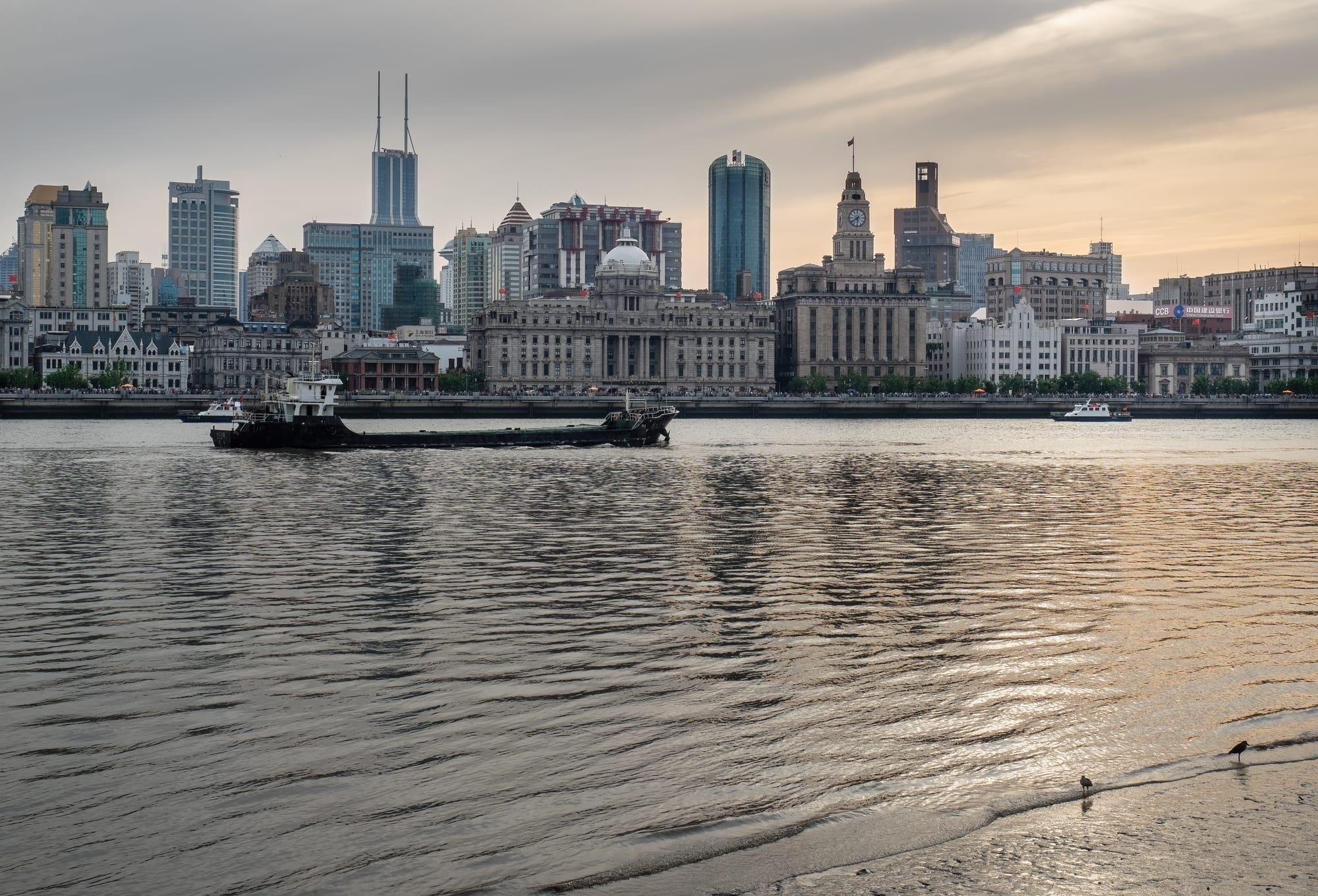
The Bund's stone banks and clock tower along the Huangpu River at dusk, with a tug passing and modern towers behind

Shanghai & the East Coast, China

Shanghai

The Bund seen across the Huangpu River from Pudong at dusk. (Ermell / Wikimedia Commons · CC BY-SA 4.0)

China's largest city, at the mouth of the Yangtze on the Huangpu River. A county town until the treaty of 1842 made it a port of foreign concessions, it became the country's commercial and industrial capital, then boomed again after Pudong was opened for development in 1990. Today the Bund's old banks face a skyline of towers across the water.

Neighbourhoods

  • The Bund and People's Square
    • First-time visitors
    • Architecture
    • Close to public transport

    The riverfront row of 1920s and 1930s banks, customs house and hotels, with the pedestrian stretch of Nanjing Road running inland to People's Square and the city's main museums. It is the busiest part of Shanghai for visitors, and much of it is walkable.

    Open in Maps
  • The former French Concession
    • Best for food
    • Walks
    • Cafés and bars

    Plane-tree streets of villas, lane houses and low shopfronts spreading west and south-west of the centre across Huangpu and Xuhui districts. Cafés, small restaurants, boutiques and bars fill the ground floors, and the pace is slower than anywhere else in the inner city.

    Open in Maps
  • Jing'an
    • Shopping
    • Business travellers
    • Close to public transport

    A central district built around West Nanjing Road and the golden roofs of Jing'an Temple, mixing office towers, malls and hotels with quiet lanes behind. Several metro lines cross here, which makes it a practical base.

    Open in Maps
  • Lujiazui and Pudong
    • Skyline views
    • Families
    • Modern architecture

    The financial district on the east bank, where the Oriental Pearl Tower and the Shanghai Tower stand together above elevated walkways and riverside parks. Wide, modern and easy to reach, with the ferry and tunnel crossings to the Bund.

    Open in Maps
  • Hongkou and North Bund
    • History
    • Quiet and residential
    • Local life

    North of Suzhou Creek, an old working district of lane housing that sheltered thousands of Jewish refugees in the Second World War and is linked with the writer Lu Xun. The riverfront has been rebuilt with promenades and towers.

    Open in Maps
  • Xintiandi and the old town
    • Nightlife
    • Historic district
    • First-time visitors

    Xintiandi is a restored block of shikumen stone-gate lane houses turned into restaurants and bars; a short way east, the crowded lanes of the old walled city surround Yu Garden and the City God Temple. The two sit within a couple of kilometres of each other and show the city at its most and least polished.

    Open in Maps

Things to do

Famous landmarks

  • The Bundlandmark

    A kilometre-and-a-half of banks, trading houses and hotels built in the concession era along the Huangpu, best known for the view across to Pudong.

    Open in Maps
  • Shanghai Towerlandmark

    A twisting 632-metre tower in Lujiazui, the tallest building in China, with observation floors near the top.

    Open in Maps
  • Oriental Pearl Towerlandmark

    The television tower of 1994 whose pink spheres on splayed legs became the symbol of the new Pudong.

    Open in Maps
  • Yu Gardenattraction

    A Ming-dynasty scholar's garden of rockeries, ponds, halls and dragon-topped walls in the old town, begun in the 1550s.

    Open in Maps
  • City God Temple of Shanghailandmark

    The Daoist temple at the heart of the old walled city, surrounded by the bazaar lanes that grew up around it.

    Open in Maps
  • Jing'an Templelandmark

    A Buddhist temple with gilded halls standing among the office towers of West Nanjing Road.

    Open in Maps
  • Longhua Templelandmark

    The largest ancient temple complex in the city, in the south-west, with a 40-metre brick and timber pagoda and a famous peach-blossom season.

    Open in Maps

Museums and galleries

  • Shanghai Museummuseum

    One of China's leading collections of ancient art, strongest in bronzes, ceramics, painting and calligraphy, on People's Square, in a building of 1996.

    Open in Maps
  • Shanghai Museum Eastmuseum

    The museum's second and much larger building, in Pudong opposite the Science and Technology Museum, which has taken over a large part of the collection.

    Open in Maps
  • Power Station of Artmuseum

    A contemporary art museum in a converted riverside power plant on the west bank, host of the Shanghai Biennale.

    Open in Maps
  • Rockbund Art Museummuseum

    A contemporary gallery in a restored 1930s Art Deco building just behind the northern end of the Bund.

    Open in Maps
  • Shanghai Natural History Museummuseum

    A large natural history collection in a spiralling modern building beside Jing'an Sculpture Park.

    Open in Maps
  • Shanghai Jewish Refugees Museummuseum

    In Hongkou, around the former Ohel Moishe Synagogue, telling the story of the refugees from Nazi Europe who found shelter in the district.

    Open in Maps

Parks and the waterfront

  • Fuxing Parkpark

    A French-laid-out park of 1909 in the former concession, with formal flowerbeds and crowds of dancers, card players and musicians in the mornings.

    Open in Maps
  • People's Squarepark

    The civic centre of the city, built over the old racecourse, with a park, the museum and the main theatre around it.

    Open in Maps
  • Lu Xun Parkpark

    A Hongkou park with lakes, a memorial and the tomb of the writer Lu Xun, who lived nearby in his last years.

    Open in Maps
  • Century Parkpark

    The largest park in Shanghai, laid out in Pudong between 1996 and 2000, with lawns, lakes and cycle paths on an open plan unlike the city's older gardens.

    Open in Maps

Streets and markets

  • Nanjing Roadneighborhood

    The city's main shopping street, pedestrianised between People's Square and the Bund and lined with department stores dating back a century.

    Open in Maps
  • Tianzifangneighborhood

    A warren of narrow lane-house alleys in the former French Concession filled with small shops, studios, bars and cafés.

    Open in Maps
  • Xintiandineighborhood

    A block of shikumen houses rebuilt as a restaurant and nightlife quarter, next to the site of the Chinese Communist Party's first congress.

    Open in Maps

Short trips from the city

  • Zhujiajiaoattraction

    Shanghai's own canal town, about 40 km west in Qingpu district, with 36 stone bridges, waterside lanes and boat rides.

    Open in Maps
  • Qibaoattraction

    A small old water town absorbed into the western suburbs and reachable by metro, with a short canal, a temple and a street of snack stalls.

    Open in Maps
  • Sheshan Basilicalandmark

    A Roman Catholic pilgrimage church on Sheshan hill in Songjiang, west of the city, made a minor basilica in 1942 and standing beside an old observatory.

    Open in Maps

Seasonal events

  • Longhua Temple fairspring, the third day of the third lunar month

    A fair held at Longhua Temple since the Ming dynasty, on a date that falls with the peach blossom in the temple gardens.

  • Chinese Grand Prixspring

    A Formula One race at the Shanghai International Circuit in Jiading, in the north-western suburbs, run there since 2004 and back on the calendar since 2024.

  • Shanghai International Film FestivalJune

    The largest film festival in Asia, held over ten days each June, with screenings in cinemas across every district of the city.

  • China Shanghai International Arts Festivalautumn

    Several weeks of theatre, dance, opera and concerts in venues across Shanghai.

  • Hairy crab seasonOctober and November

    Restaurants and markets fill with steamed freshwater crabs from the lakes of the delta, eaten with ginger and vinegar.

Eat and drink

Long-standing places and food districts in Shanghai. Hours, ratings and directions come from your maps app, always current.

Shanghai classics

  • Soup dumplings and pan-fried bunsrestaurant

    Xiaolongbao, thin-skinned steamed dumplings filled with pork and hot broth, and shengjian mantou, thicker buns fried crisp on the bottom, are sold in dumpling houses all over the city.

    Open in Maps
  • Yu Garden bazaar snack lanesneighborhood

    The lanes around the old town temple sell dumplings, sweet soups, stinky tofu and sesame pastries to large crowds, at their busiest at holidays.

    Open in Maps
  • Bars and dining rooms along the Bundneighborhood

    The restored banks and hotels of the waterfront hold bars, tea rooms and dining rooms with river views, and one of the hotels keeps a long-running jazz band playing standards from the dance-hall era.

    Open in Maps

Food districts and cafés

  • The former French Concessionneighborhood

    The densest concentration of small restaurants, coffee roasters, wine bars and bakeries in the city, spread along shaded streets such as Wukang, Anfu and Yongkang roads.

    Open in Maps
  • Noodle and wonton shopsrestaurant

    Neighbourhood kitchens serving scallion oil noodles, wontons in clear broth and braised pork over rice — the city's ordinary breakfast and lunch food.

    Open in Maps
  • Hongkou lane foodneighborhood

    Old lane districts north of Suzhou Creek keep breakfast stalls selling fried dough sticks, sticky rice rolls and soy milk in the early morning.

    Open in Maps

Experience Shanghai

History

Shanghai began as a fishing and cotton-trading settlement on the Huangpu, part of Huating county, and was walled in 1554 against raids by Japanese pirates. It was prosperous but provincial until the Treaty of Nanking ended the First Opium War in 1842 and opened it to foreign trade. British, American and French settlements grew north of the old city; the British and American areas merged into the International Settlement, which ran its own council, police and courts, while the French Concession stayed separate.

Refugees from the Taiping war in the 1850s and 1860s poured into the settlements, and the city became China's commercial capital: banks and trading houses on the Bund, cotton mills along the creeks, the country's first railways, newspapers and film studios. By the 1920s and 1930s it was one of the world's great ports, known for its nightlife, gangs, publishing and politics. The Chinese Communist Party held its first congress here in 1921. Japanese forces fought battles for the city in 1932 and again in 1937, and Hongkou sheltered thousands of Jewish refugees from Europe, some 30,000 of whom reached the city in the 1930s.

After 1949 many businesses and families left for Hong Kong and Taiwan, and Shanghai became a disciplined industrial city that sent most of its revenue to the central government. The turn came in 1990, when the farmland of Pudong across the river was opened for development; within two decades it held a financial district, and the city hosted the World Expo in 2010. Shanghai is now China's financial centre and the site of the world's busiest container port.

Culture & Customs

Shanghai's own idea of itself is captured in the term haipai — a style formed by mixing foreign and Chinese, commercial and modern, as against the scholarly traditions of the north. It showed in 1930s cinema and popular song, in the qipao dress, in publishing and advertising, and in the jazz bands of the riverfront hotels; it shows today in design, fashion weeks, contemporary galleries along the western riverbank and a café scene of unusual size.

The city has a long literary record. Lu Xun spent his last years in Hongkou, Eileen Chang set her stories in its apartment blocks and lanes, and generations of writers have described the shikumen, the stone-gate lane houses where families shared courtyards, kitchens and gossip. Wu-language performing arts survive alongside: Shanghai opera, known as huju, and Yue opera from neighbouring Zhejiang, both performed in the city's theatres.

Shanghainese is the marker of local identity, distinct enough from Mandarin to be unintelligible to outsiders and spoken less by each generation. Residents have a reputation across China for being commercially sharp, careful with money, precise and a little superior, and for taking food and clothes seriously. Morning life in the parks is a fixture — tai chi, ballroom dancing, badminton, choirs and the marriage market in People's Park, where parents advertise their children's details on umbrellas.

Daily Life

About 25 million people live in the municipality, roughly two-fifths of them migrants from other provinces without local household registration, which affects access to schooling and housing. The centre is dense and mid-rise; most residents live in high-rise estates in the outer districts and commute long distances on the metro, and property prices are among the highest in the country.

The economy runs on finance, trade, professional services and technology, alongside a large industrial base making cars, chemicals, ships, aircraft parts and semiconductors, and a port complex at Yangshan and along the Yangtze that handles more containers than any other. Headquarters, exchanges and the free trade zone concentrate national business here, and the city draws graduates from across China.

Daily rhythms are urban and fast: breakfast bought at a stall on the way to the metro, a canteen or delivery lunch, long working hours, and shopping and eating that continue late. Older residents dominate the mornings in the parks and the wet markets. The two-month lockdown of 2022 left a strong mark on how people talk about the city. Ageing, the cost of housing, the pressure of schooling and the steady demolition and rebuilding of old lane neighbourhoods are the recurring concerns.

Food

Shanghai cooking, benbang cai, is sweeter and more soy-heavy than most Chinese regional styles. Hongshao rou, pork belly red-braised with soy sauce, sugar and rice wine until it glazes, is the archetype; so are braised gluten with mushrooms, drunken chicken steeped in wine, and river shrimp. Autumn belongs to hairy crabs from the delta lakes, steamed whole and eaten with ginger and vinegar.

The snack tradition is what most visitors meet first. Xiaolongbao, the soup-filled steamed dumplings associated with Nanxiang in the western suburbs, are eaten with vinegar and shredded ginger; shengjian mantou are thicker buns fried until the base is crisp and the filling still liquid. Wontons come large with greens and pork or small in clear soup; congyou banmian is noodles tossed in oil infused with slowly fried spring onion. Breakfast is the 'four heavenly kings' — fried dough sticks, soy milk, sticky rice rolls and griddled sesame flatbread — sold from lane stalls.

The city eats from everywhere else too: hotpot and spicy Sichuan kitchens, Cantonese dim sum, Japanese and Korean restaurants in the western districts, and the Western dishes adapted a century ago into Haipai cuisine, such as breaded pork cutlet and borscht thickened with tomato. Coffee has become a local habit rather than an import, with roasteries dense in the former concession, and huangjiu, the amber rice wine of the region, is still drunk warm with crab.

Planning tools

Budget

Shanghai is China's most expensive city. International-standard hotels, cocktail bars and Western restaurants cost as much as in Europe, while dumpling houses, noodle shops, the metro and museum entry remain cheap, so the daily total depends almost entirely on where a visitor sleeps and drinks. Prices rise around the major trade fairs and the national holidays.

Daily Budget Midrange
USD 150–300 (mid-range hotel, restaurant dinners, museum and garden tickets, taxis)
Daily Budget Shoestring
USD 45–80 (hostel or budget hotel, noodle and dumpling meals, metro, free riverfront walks)

Many of the best hours cost nothing — the Bund at night, the concession streets, the parks at dawn — and most public museums are free or inexpensive.

Best Time to Visit

Late March to May and late September to November are the comfortable seasons, with blossom in spring and clear, mild days and hairy crab in autumn. June and early July bring the plum rains, high summer is hot and humid with a typhoon risk, and winter is raw and damp rather than snowy. The national holiday weeks in early May and early October are extremely crowded.

Suggested Number of Days

Three or four days covers the central districts at a reasonable pace. A week allows for the outer museums, the canal towns and a night or two in the neighbouring cities of the delta, which are less than an hour away by fast train.

First Visit
3–4 days
With Surroundings
5–7 days

Transportation

The metro is the backbone: a very large network covering almost everywhere a visitor goes, cheap, signed in English and busy at peak times. Taxis and ride-hailing are inexpensive but slow in traffic, buses are extensive, ferries cross the Huangpu between the Bund and Pudong, and bike share is widespread on the flat streets. A maglev line runs between Pudong airport and Longyang Road station in Pudong, where it meets the metro, at a cruising speed of 300 km/h.

Metro tickets, taxis and bike share are all normally paid through Alipay or WeChat Pay, so setting up an app before arrival saves a great deal of trouble.

Airport & Station Connections

Pudong International Airport, about 30 km east of the centre, handles most international flights and is linked by maglev, metro and coach; Hongqiao Airport, in the west, takes mainly domestic traffic and sits beside Hongqiao railway station. High-speed trains run to Suzhou in around half an hour, Hangzhou and Nanjing in one to two hours and Beijing in about four and a half.

Walkability

The centre is flat and rewarding on foot: the Bund, Nanjing Road, People's Square and the old town connect in a single walk, and the former French Concession is one of the most pleasant walking districts in any Chinese city. The scale defeats walking between districts, however — Pudong's distances are long and hot — so the metro fills the gaps. Pavements are wide and crossings are signalled, though scooters use both.

Safety

Violent crime is rare and the city is safe to walk at night. The realistic problems are scams aimed at foreigners around the Bund and Nanjing Road — the 'tea ceremony' and 'art student' approaches by friendly English-speaking strangers — along with taxi overcharging, pickpocketing in crowds and summer typhoons that disrupt flights. Many foreign internet services are blocked, so arrangements for access need to be made before arrival.

Invitations from strangers near the Bund to a tea house, bar or gallery are best declined, metered taxis or ride-hailing should be used instead of touts, and a passport must be carried at all times. Check current official travel advice before travelling.

Climate

Humid subtropical, with four clear seasons. The plum rain season brings weeks of drizzle in June and early July, high summer is hot and sticky with occasional typhoons, and winter is cold and damp in buildings that often lack central heating.

Summer
hot and humid — daily means stay above 30°C for about three weeks from mid-July, with heavy downpours and around 21 days a year above 35°C
Winter
raw and damp, usually 1–10°C, with occasional frost and about five days of snowfall a year

Local Customs

Tipping is not practised. Shanghai is cosmopolitan and used to foreign visitors, but daily transactions assume a mobile payment app and a Chinese phone number for some services. Shanghainese, a Wu language distinct from Mandarin, is still spoken by older residents. Meals are shared from communal dishes, queues are orderly, and temples ask for modest dress and no photography of people at prayer.

Politics, Taiwan, Tibet and Xinjiang are sensitive subjects, and photographing police, soldiers or protests should be avoided.

Common Payment Methods

The currency is the renminbi, its unit the yuan. Alipay and WeChat Pay run almost everything, including transport and market stalls, and both now allow foreign cards to be linked; foreign credit cards work in international hotels and large stores but often nowhere else. Cash is accepted by law but handled reluctantly, and ATMs at major banks take international cards.