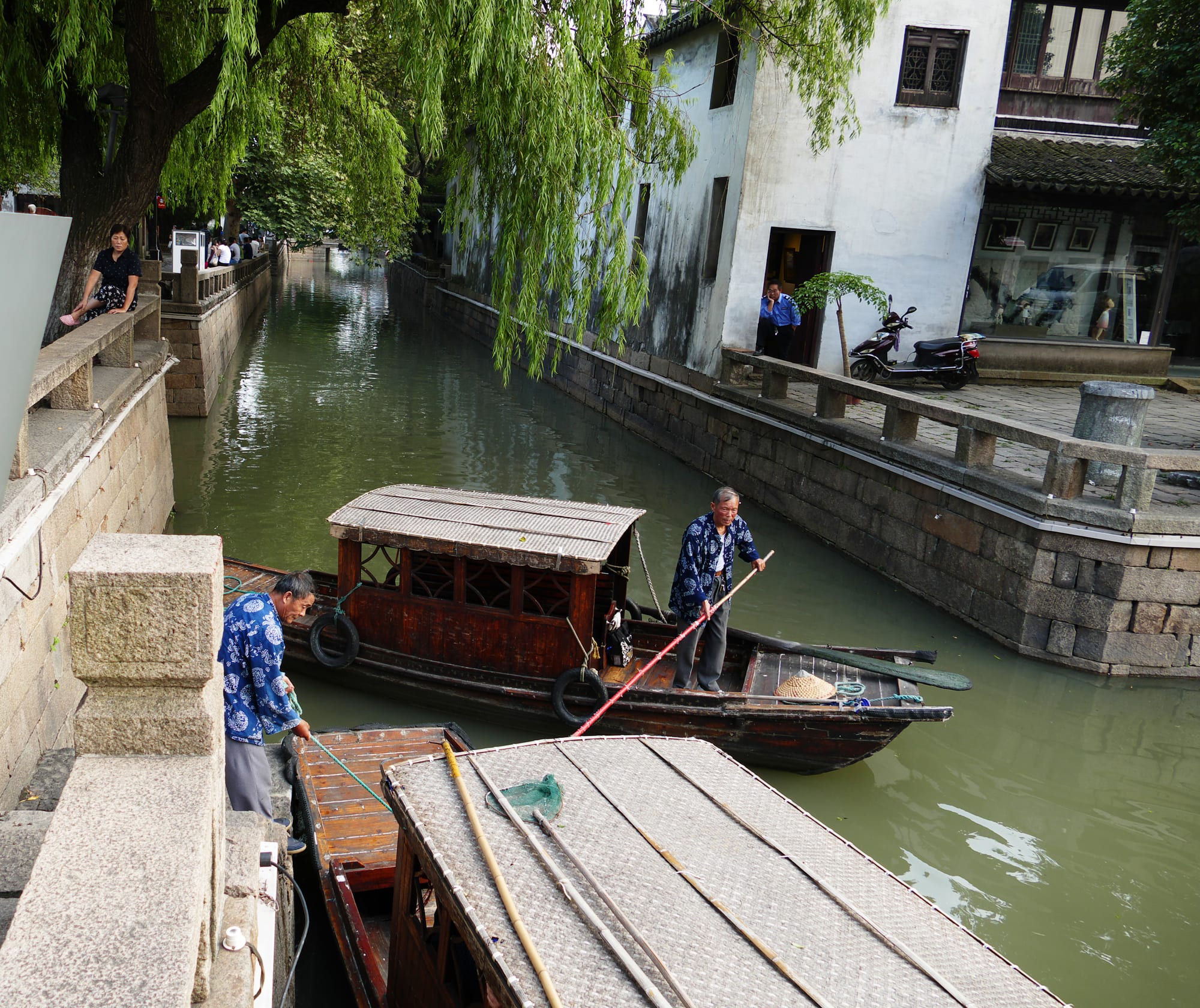
Wooden boats poled along a narrow green canal in Suzhou between stone embankments, willows and whitewashed houses

Shanghai & the East Coast, China

Suzhou

Boats on a canal beside Pingjiang Road in the old town of Suzhou. (Zossolino / Wikimedia Commons · CC BY-SA 4.0)

A canal city in southern Jiangsu, founded as the capital of the Wu state in 514 BC and enriched for centuries by silk weaving and Grand Canal trade. Its walled old town keeps its waterways, stone bridges and scholars' gardens, eight of which were inscribed with one more nearby as a UNESCO World Heritage Site, while a large modern manufacturing city has grown around it.

Neighbourhoods

  • Pingjiang and the eastern old town
    • First-time visitors
    • Walks
    • Historic district

    The best-preserved quarter of the walled city, where a canal runs the length of a stone-paved lane past whitewashed houses, tea rooms, workshops and small museums. Several of the classical gardens are a short walk away, and the grid of side lanes still holds ordinary homes.

    Open in Maps
  • Shantang and the north-west
    • Evenings
    • Street food
    • Canals

    A canal street laid out in the Tang dynasty, running from the old city towards Tiger Hill, lined with shops, snack stalls and lantern-lit frontages that draw crowds after dark. Boats work the water between the bridges.

    Open in Maps
  • Guanqian Street and the centre
    • Shopping
    • Close to public transport
    • Best for food

    The commercial heart of the old city, a pedestrian area of department stores, confectioners and restaurants around the Daoist Xuanmiao Temple, with metro stations at either end.

    Open in Maps
  • Suzhou Industrial Park and Jinji Lake
    • Modern architecture
    • Business travellers
    • Waterfront

    The planned district east of the old city, developed with Singaporean involvement from the 1990s, arranged around a large lake with promenades, malls, offices and international hotels. Modern, green and quite unlike the old town.

    Open in Maps
  • The western hills and Tai Lake shore
    • Nature
    • Quiet and residential
    • Day trips

    Beyond the western suburbs the land rises into low hills of tea, plum and loquat orchards above the shore of Lake Tai, with villages, temples and the old market town of Mudu.

    Open in Maps

Things to do

The classical gardens

  • Humble Administrator's Gardenattraction

    The largest of the classical gardens at about five hectares, created from 1513 around ponds, islands and pavilions, and the best known of the UNESCO-listed group.

    Open in Maps
  • Lingering Gardenattraction

    A Ming garden in the west of the old city, famous for its covered walkways, latticed windows and a towering weathered rock.

    Open in Maps
  • Master of the Nets Gardenattraction

    A small garden first laid out in 1140, a masterpiece of compressed space around a central pond, near the southern canal.

    Open in Maps
  • Lion Grove Gardenattraction

    A garden made in 1342 by a Chan Buddhist monk, built around a maze of limestone rockeries said to resemble lions.

    Open in Maps
  • Canglang Pavilionattraction

    The oldest of the listed gardens, built in 1044 by the Song poet Su Shunqin and keeping its Song layout, entered over a bridge and open to the canal outside.

    Open in Maps
  • Garden of the Couple's Retreatattraction

    A quieter garden in the east of the old town, built as two linked gardens either side of a residence, with canals on three sides.

    Open in Maps

Temples, pagodas and the old walls

  • Tiger Hilllandmark

    A wooded mound north-west of the city, said to hold the tomb of the Wu king Helü, crowned by a seven-storey brick pagoda that leans more than two metres from the vertical.

    Open in Maps
  • Hanshan Templelandmark

    A Buddhist temple west of the old city made famous by a Tang poem about its night bell, still rung to see in the new year.

    Open in Maps
  • Beisi Pagodalandmark

    A pagoda 76 metres tall at Bao'en Temple in the north of the old city, its brick core ringed by wooden eaves and balustrades; once eleven storeys, it now rises nine.

    Open in Maps
  • Panmenlandmark

    The restored south-western city gate, unusual for combining a land gate and a water gate, beside the Grand Canal and the Ruiguang Pagoda, the oldest in the city.

    Open in Maps
  • Xuanmiao Templelandmark

    A Daoist temple founded in the 3rd century at the centre of the city, its great hall surrounded by the Guanqian shopping streets.

    Open in Maps

Museums and crafts

  • Suzhou Museummuseum

    The city collection in a white-walled building designed by I. M. Pei, whose family came from Suzhou, next to a Taiping-era palace complex.

    Open in Maps
  • Suzhou Silk Museummuseum

    A museum of the industry that made the city rich, opened in 1991, covering sericulture, old looms and silk patterns from about 2000 BC onwards.

    Open in Maps

Canals and streets

  • Pingjiang Roadneighborhood

    A canal-side lane of more than a kilometre that follows the layout shown on a stone city map of 1229, lined with tea houses, bookshops and pingtan performance rooms.

    Open in Maps
  • Shantang Streetneighborhood

    A Tang-dynasty canal street running north-west from the old city towards Tiger Hill, busiest in the evening when the lanterns are lit.

    Open in Maps
  • Grand Canalattraction

    The waterway that carried grain, salt and silk between the Yangtze delta and the north, still worked by barge trains past the city walls.

    Open in Maps
  • Jinji Lakepark

    The lake at the centre of the industrial park district, ringed by promenades, sculpture, bridges and towers, a favourite evening walk.

    Open in Maps

Short trips from the city

  • Tongliattraction

    A canal town south-east of Suzhou of stone bridges and waterside houses, with the Retreat and Reflection Garden at its centre.

    Open in Maps
  • Zhouzhuangattraction

    The best known of the delta water towns, built around a crossroads of canals, with the Ming-dynasty Double Bridges as its emblem.

    Open in Maps
  • Muduattraction

    An old town in Wuzhong District below Lingyan Mountain, visited six times by the Qianlong Emperor, with gardens, mansions and a Shantang Street of its own.

    Open in Maps
  • Lake Taiattraction

    A large shallow lake west of the city, source of the weathered rocks used in the gardens, with orchards, tea hills and islands along its Suzhou shore.

    Open in Maps

Seasonal events

  • Spring blossom in the gardensMarch and April

    Magnolia, peach and wisteria come out in the classical gardens and the western hills, the busiest and prettiest weeks of the year in the old town.

  • Biluochun tea pickingspring, around late March

    The green tea grown on Dongting hills by Lake Tai is picked and hand-rolled among the fruit trees it is grown beside.

  • Hairy crab seasonOctober and November

    Crabs from Yangcheng Lake, north-east of the city, are steamed and eaten with ginger and vinegar in restaurants across the region.

  • New Year bell at Hanshan TempleNew Year's Eve

    The temple bell is rung to see in the new year, a pilgrimage and tourism event that draws visitors from Japan and Korea as well as from China.

Eat and drink

Long-standing places and food districts in Suzhou. Hours, ratings and directions come from your maps app, always current.

Suzhou classics

  • Songhelourestaurant

    A long-established restaurant on Guanqian Street, known for its braised duck and for squirrel-shaped mandarin fish, in which the fish is boned, carved, fried and dressed in sweet-and-sour sauce.

    Open in Maps
  • Suzhou noodle housesrestaurant

    Breakfast and lunch are a bowl of fine white noodles in clear broth with a topping chosen at the counter — braised pork, smoked fish or spring eel, eaten early and quickly.

    Open in Maps

Streets, markets and tea houses

  • Guanqian Street snacks and sweet shopsneighborhood

    The old centre's pedestrian streets are lined with confectioners selling pine-nut sweets, sesame cakes, candied fruit and Suzhou-style mooncakes with flaky pastry.

    Open in Maps
  • Pingjiang Road tea roomscafe

    Canal-side rooms serving Biluochun green tea and small sweets, some with afternoon pingtan storytelling sung to the pipa.

    Open in Maps
  • Shantang Street food stallsneighborhood

    Evening stalls along the canal street sell skewers, sweet glutinous rice cakes, stinky tofu and freshwater snacks to the crowds.

    Open in Maps

Experience Suzhou

History

Suzhou dates its founding to 514 BC, when the kingdom of Wu built a walled capital here under King Helü, whose tomb is traditionally placed under Tiger Hill. The rectangular plan of moats, gates and canals laid down then survived in outline for more than two thousand years, and a stone map carved in 1229 shows a city recognisable in today's lanes. The completion of the Grand Canal in the 7th century put Suzhou on the main artery between the rice-growing south and the northern capitals.

Silk was the making of the city. From the Song dynasty onwards Suzhou wove and traded it on a great scale, with imperial silk workshops under the Ming and Qing, and the wealth it produced paid for the gardens that retired officials and merchants built behind high walls — private compositions of water, rock, plants and architecture meant for scholarly retreat. The city also became a centre of publishing, painting and connoisseurship, its taste setting fashion across the empire.

The 19th century brought disaster. Taiping forces held Suzhou from 1860 to 1863, and the fighting and fires destroyed much of the city and killed or scattered a large part of its population. Recovery was slow, and the city was opened to direct foreign trade by the Treaty of Shimonoseki in 1895. Modern Suzhou changed course in 1994, when China and Singapore began developing the industrial park east of the old town; the city is now one of China's largest manufacturing centres, while the old town is height-restricted and protected, and eight of the gardens were inscribed by UNESCO in 1997 and 2000.

Culture & Customs

Suzhou's reputation rests on refinement. The old saying that heaven above is matched by Suzhou and Hangzhou below is quoted constantly, and the local idea of a good life — a garden, a tea room, a storyteller, fine embroidery — has shaped Chinese taste for centuries. The gardens are not simply parks: each was composed like a scroll painting, with borrowed views, framed windows and paths that reveal scenes in sequence.

Two performing traditions are central. Kunqu, the classical opera that took shape in nearby Kunshan in the Ming dynasty and was proclaimed by UNESCO in 2001 among the first Masterpieces of the Oral and Intangible Heritage of Humanity, is sung in slow, ornamented Wu; pingtan, the city's storytelling, pairs a singer with pipa and sanxian in small rooms and tea houses, and performances still run on Pingjiang Road. The Suzhou dialect they use is famous nationally for its softness.

Craft is the other pillar: Su embroidery, one of China's four great styles, worked so finely that double-sided pieces read from both faces; silk weaving; fan making; jade and sandalwood carving; and the cultivation of penjing miniature trees. Residents are known as courteous, indirect and attached to small pleasures — tea, sweets, canal walks, early morning noodles — and the city treats its heritage rules and its pace of life as a distinction from noisier Shanghai an hour away.

Daily Life

Suzhou is a prefecture-level city of six urban districts and four county-level cities — Kunshan, Changshu, Zhangjiagang and Taicang — and counted about five million registered residents in 2023, with many more living there without local registration; the protected old town holds a small fraction of that, and its population has aged as families moved to newer flats. A large share of residents are migrants from other provinces working in the factories and services of the eastern and western districts.

The economy is one of the strongest in China. Electronics, machinery, chemicals, precision manufacturing, biomedicine and nanotechnology cluster in the industrial park and the high-tech zone, much of it foreign-invested, and Kunshan alone was the first county-level economy in China to pass 500 billion yuan of output. Silk and embroidery survive as small-scale and luxury trades, and tourism supports the old town.

Daily life divides between the two cities. In the old town people shop in small markets, eat noodles at dawn, exercise in the garden squares and move by bike or metro through lanes where new building is tightly controlled. In the park districts life is that of a modern planned city: towers, international schools, malls and lakeside promenades. Housing costs, long commutes from the outer districts and the pressure of tourism on the canal streets are the everyday complaints.

Food

Suzhou cooking is the refined end of the Jiangsu school: sweet, seasonal and precise, built on freshwater fish, shrimp, lotus root, water chestnuts and bamboo shoots. The signature dish is songshu guiyu, mandarin fish scored, fried until the flesh opens like a squirrel's tail and dressed in a sweet-sour sauce. Watermelon chicken, braised pork with cherry-red glaze and stir-fried river shrimp with eggs belong to the same tradition, and autumn brings hairy crabs from Yangcheng Lake.

Everyday eating means noodles. Suzhou noodle houses serve fine white noodles in a clear, carefully made broth with a topping ordered separately — braised pork belly, smoked fish, eel fried with garlic, or shredded chicken — and regulars specify the amount of broth, the firmness and whether they want spring onion. Sanxia wontons, sweet fermented rice soup and pan-fried buns fill the rest of the breakfast repertoire.

Sweets are a Suzhou speciality: pine-nut candy, osmanthus-scented cakes, sesame crisps, candied fruit and the flaky, layered local mooncakes filled with pork as well as sweet pastes, sold in confectioners that have traded for generations near Guanqian Street. Biluochun, the green tea grown among the fruit trees of the Dongting hills on Lake Tai, is the drink that goes with them, and the region's yellow rice wine appears with crab in autumn.

Planning tools

Budget

Suzhou is cheaper than Shanghai for hotels and meals but charges for its main attractions: each classical garden has its own ticket, and the most famous cost more in the spring and autumn high seasons. Boat rides, water-town entry fees and taxis to the outer sights are the other regular costs.

Daily Budget Midrange
USD 100–180 (mid-range hotel, restaurant dinners, several garden tickets, taxis and a water town)
Daily Budget Shoestring
USD 35–60 (hostel or budget hotel, noodle houses and street food, metro and buses)

Gardens are calmest at opening time and on weekdays; the lesser-known ones cost less and are far quieter than the largest.

Best Time to Visit

Late March to May and late September to November. Spring brings blossom, wisteria and the tea harvest; autumn brings clear days, osmanthus and hairy crab. Summer is hot, humid and crowded, and winter is damp and grey, though the gardens are almost empty and look their best in a rare snowfall.

Suggested Number of Days

Two days is enough for the old town, a few gardens and the canal streets without rushing. Three or four suit visitors who also want the hills and lake shore to the west and one or two of the water towns nearby.

First Visit
2 days
With Surroundings
3–4 days

Transportation

A metro network of several lines crosses the city and links the old town with the railway stations and the industrial park; buses fill the gaps and bike hire works well on the flat streets. Taxis and ride-hailing are cheap. Tourist boats run on the outer moat and the canals, more as sightseeing than transport.

The old town is a rectangle of about four kilometres by three, so a single metro line plus walking covers most of what visitors want to see.

Airport & Station Connections

Suzhou has no airport of its own. The nearest with scheduled flights is Wuxi Shuofang, and Shanghai's Hongqiao and Pudong airports are reached from a city air terminal in Suzhou. Nearly everyone arrives by train: the fastest high-speed services take about 25 minutes from Shanghai and under an hour from Nanjing, arriving at Suzhou station on the northern edge of the old town or at Suzhou North on the Beijing–Shanghai high-speed line.

Walkability

The old town is flat, compact and made for walking, with canal lanes, bridges and gardens within a couple of kilometres of one another; Pingjiang and Shantang are pedestrian in feel even where traffic is allowed. The newer districts east and west are built to a much larger scale and need the metro or a taxi. Lanes are uneven and slippery after rain.

Safety

Suzhou is a very safe city with little violent crime. The main hazards are crowds in the gardens and canal streets during national holidays, summer heat and humidity, typhoon rain in late summer, and unfenced canal edges that are worth watching after dark or with children.

Holiday weeks in early May and early October fill every garden to capacity and are best avoided, and tickets for the most popular gardens are often booked online in advance. Check current official travel advice before travelling.

Climate

Humid subtropical with four distinct seasons: a mild damp spring, a hot sticky summer with the June plum rains, a warm clear autumn and a raw winter in buildings that frequently lack central heating.

Summer
hot and humid, often 30–35°C in July and August, with heavy showers
Winter
cold and damp, usually 1–9°C, with occasional light snow

Local Customs

Tipping is not practised. The Suzhou dialect, a Wu variety, is known across China for its softness and is still heard among older residents and in pingtan storytelling. Gardens and temples expect quiet, and visitors are asked not to climb the rockeries or touch the furniture in the halls. Meals are shared, and a host will keep serving guests.

Politics, Taiwan, Tibet and Xinjiang are sensitive subjects, and photographing police, soldiers or worshippers at prayer should be avoided.

Common Payment Methods

The currency is the renminbi, its unit the yuan. Alipay and WeChat Pay are used for almost everything, including garden tickets, metro fares and street stalls, and both now allow foreign cards to be linked. Foreign cards are accepted at international hotels but rarely elsewhere; cash is accepted by law though handled reluctantly, and bank ATMs take international cards.