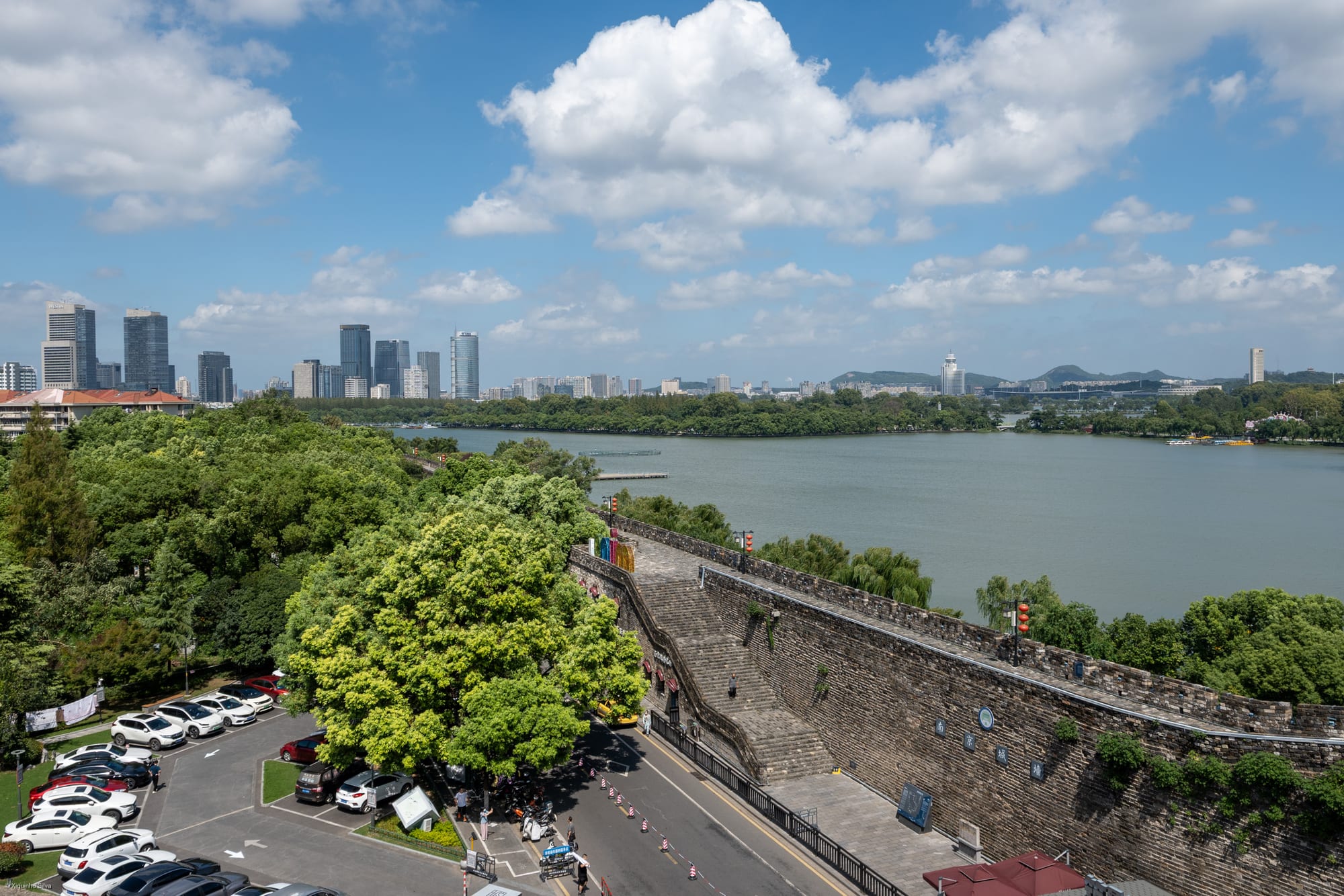
The grey brick Ming city wall of Nanjing curving above a road, with water, wooded ground and high-rise towers beyond

Shanghai & the East Coast, China

Nanjing

The Ming city wall of Nanjing, with the modern city behind it. (xiquinhosilva / Wikimedia Commons · CC BY 2.0)

The capital of Jiangsu province, on the lower Yangtze between Purple Mountain and the river. Capital of a series of dynasties and of the early Ming, and again of the Republic from 1927, it keeps one of the world's longest surviving city walls, imperial tombs on the wooded mountain, and a river quarter of temples, examination halls and lantern-lit streets.

Neighbourhoods

  • The Qinhuai and Confucius Temple quarter
    • First-time visitors
    • Street food
    • Evenings

    The old riverside district in the south of the walled city, around the rebuilt Confucius Temple and the examination halls, where the Qinhuai River is lined with restaurants, snack stalls and boat piers. Crowded and brightly lit at night, and the traditional centre of Nanjing's pleasure quarter and literary life.

    Open in Maps
  • Xinjiekou
    • Shopping
    • Close to public transport
    • Business travellers

    The commercial centre, a circle of department stores, banks and office towers around a statue of Sun Yat-sen where the city's main roads meet. Several metro lines interchange beneath it, which makes it a convenient base.

    Open in Maps
  • Gulou and the university district
    • Cafés and bars
    • Students and nightlife
    • Architecture

    North of the centre around the Drum Tower, with the campuses of Nanjing University and Southeast University, plane-tree avenues, 1920s and 1930s villas along Yihe Road and a scatter of bookshops, bars and small restaurants.

    Open in Maps
  • Xuanwu Lake and the northern walls
    • Walks
    • Parks
    • Scenery

    A large lake with linked islands just outside the wall in the north-east, backed by the Jiming Temple and a long climbable stretch of Ming rampart. The most popular place in the city for an evening walk.

    Open in Maps
  • Purple Mountain and the east
    • Nature
    • History
    • Day trips

    The wooded hills east of the walls, holding the Ming and Republican mausoleums, monasteries, an observatory and a botanical garden among the trees, with hotels and quieter residential streets below.

    Open in Maps
  • Hexi New Town
    • Modern architecture
    • Sport and events
    • Quiet and residential

    The planned district between the old city and the Yangtze in the south-west, built around a sports centre and conference venues, with wide avenues, towers and riverside parks.

    Open in Maps

Things to do

Walls, gates and the old city

  • City Wall of Nanjinglandmark

    The Ming rampart raised under the Hongwu Emperor from 1360, built by some 200,000 labourers over twenty-one years and one of the largest ever constructed in China, with long walkable stretches above the lake and the southern streets.

    Open in Maps
  • Zhonghua Gatelandmark

    The largest of the city's thirteen Ming gates, a fortress of successive courtyards and vaulted chambers that could hide soldiers.

    Open in Maps
  • Fuzi Miaolandmark

    The Confucius Temple on the Qinhuai, rebuilt several times, at the centre of a quarter of halls, shops and waterfront pavilions.

    Open in Maps
  • Jiangnan Examination Hallmuseum

    The largest of the imperial examination compounds, where candidates sat for days in tiny cells; the Imperial Examination Museum now occupies what survives.

    Open in Maps
  • Presidential Palacemuseum

    A walled complex of gardens, offices and halls used by Qing viceroys, the Taiping leadership and the Republican government, now a museum of modern Chinese history.

    Open in Maps
  • Qinhuai Riverattraction

    The river that runs through the southern city, crossed by old bridges and worked by lantern-hung tourist boats after dark.

    Open in Maps

Purple Mountain

  • Ming Xiaoling Mausoleumlandmark

    The tomb of the Hongwu Emperor, founder of the Ming, approached by a spirit way lined with stone elephants, camels and officials; a UNESCO World Heritage Site.

    Open in Maps
  • Sun Yat-sen Mausoleumlandmark

    The 1929 tomb of the founder of the Republic, reached by a stairway of almost 400 steps under blue-tiled roofs.

    Open in Maps
  • Linggu Templelandmark

    A monastery in the forest with a vaulted brick hall built without beams, and a nine-storey pagoda raised in the 1930s.

    Open in Maps
  • Purple Mountain Observatoryattraction

    An observatory established in 1934 on the ridge above the city and now run by the Chinese Academy of Sciences, which calculates the official Chinese calendar.

    Open in Maps

Museums and memorials

  • Nanjing Museummuseum

    One of China's largest museums, in a 1930s hall beside the eastern gate, with bronzes, jade, porcelain and a recreated Republican-era street.

    Open in Maps
  • Nanjing Massacre Memorial Hallmuseum

    A memorial and museum built in 1985 at Jiangdongmen, where remains of victims were excavated, recording the killing of civilians and disarmed soldiers by Japanese forces after the city fell in December 1937.

    Open in Maps
  • Nanjing Yangtze River Bridgelandmark

    The double-deck road and rail truss bridge opened in 1968, the first heavy bridge designed and built with Chinese expertise and long a symbol of the era.

    Open in Maps

Parks and lakes

  • Xuanwu Lakepark

    A lake whose five islands are linked by arched bridges, outside the north-eastern wall, with gardens, temples, pavilions and teahouses in the park around it.

    Open in Maps
  • Jiming Templelandmark

    One of the oldest Buddhist temples in Nanjing, on a hill by the wall, its yellow buildings and seven-storey pagoda looking out over Xuanwu Lake.

    Open in Maps
  • Mochou Lakepark

    A smaller lake park in the west of the old city, with pavilions, willows and a Ming-era garden layout.

    Open in Maps

Short trips from the city

  • Qixia Templelandmark

    A monastery about 20 km north-east of the centre, built in 489, beside the Thousand Buddha Rock, the only Southern Dynasties Buddhist grottoes in China.

    Open in Maps
  • Yangshan Quarryattraction

    The quarry east of the city where a colossal Ming stele was cut but never moved, its three unfinished pieces still lying in the rock.

    Open in Maps

Seasonal events

  • Qinhuai lantern displayLunar New Year, late January or February

    Lantern displays fill the Confucius Temple quarter and the riverbanks for the new year, a custom recorded in the city for centuries.

  • Plum blossom seasonFebruary and March

    Plum Blossom Hill below the Ming tomb on Purple Mountain, said to hold the largest plum collection in China, runs an international plum blossom festival, and the city's parks follow.

  • Cherry blossom seasonlate March

    Cherry trees flower along the wall walk beside Jiming Temple and through the city's parks, the shortest of Nanjing's blossom seasons.

  • Autumn colour at Qixia HillNovember

    The wooded slopes around Qixia Temple turn red and gold, a popular late-autumn outing from the city.

  • National Memorial Day13 December

    A national memorial day, established in 2014 and held at the memorial hall for those killed after the city fell in 1937, with air-raid sirens sounded across the city.

Eat and drink

Long-standing places and food districts in Nanjing. Hours, ratings and directions come from your maps app, always current.

Nanjing classics

  • Salted duck and duck blood souprestaurant

    Nanjing is a duck city — yanshuiya, lightly brined and poached until the meat is pale and firm, is bought by weight from shops all over town, and yaxue fensi tang, a soup of duck blood curd, offal and sweet potato noodles, is eaten at any hour.

    Open in Maps
  • Qinhuai snacksrestaurant

    The traditional set of local small dishes served around the Confucius Temple — sesame pancakes, beef dumplings, savoury bean curd, five-spice eggs and sweet sticky rice.

    Open in Maps

Food streets and markets

  • Shiziqiao food streetneighborhood

    A pedestrian street off Hunan Road in the north of the city lined with restaurants, barbecue and snack shops, busy from early evening.

    Open in Maps
  • The Confucius Temple quarterneighborhood

    Riverside restaurants, dumpling houses and stalls packed into the lanes around the temple, at their liveliest after dark.

    Open in Maps
  • University district cafés and noodle shopscafe

    Cheap noodle and rice kitchens, bakeries and coffee shops serving students around the Gulou campuses, among the plane trees.

    Open in Maps

Experience Nanjing

History

Settlement on the site goes back to the Warring States period, but Nanjing's history as a capital begins in 229, when the Eastern Wu kingdom established its court here at Jianye. For three centuries afterwards, as northern China fell to invaders, a succession of southern dynasties ruled from the city under the name Jiankang, and it grew into one of the largest cities in the world, a centre of Buddhism, poetry and painting. The Southern Tang made it a capital again in the 10th century.

Its greatest transformation came in 1368, when Zhu Yuanzhang, founder of the Ming, made Nanjing the capital of a reunified empire. He built the city wall — an irregular circuit following the hills and water rather than a grid, and among the longest ever constructed — a palace, and his own tomb on Purple Mountain. The court moved to Beijing in 1421, but Nanjing kept a secondary administration and its status as the cultural capital of the south.

Modern history fell heavily on the city. The Treaty of Nanking ended the First Opium War here in 1842; the Taiping rebels made it their capital from 1853 until its recapture in 1864, with vast loss of life; and in 1927 it became the capital of the Nationalist republic, gaining ministries, boulevards and the Sun Yat-sen Mausoleum. Japanese forces took the city in December 1937 and massacred civilians and disarmed soldiers over the following weeks. After 1949 the capital moved to Beijing, and Nanjing settled into its present role as the provincial capital of Jiangsu, a university and industrial city of the Yangtze.

Culture & Customs

Nanjing thinks of itself as a city of books and trees, on the strength of a long literary record — the poetry of the Six Dynasties, the Ming and Qing novels written or set here, the examination halls that drew scholars from across the south, and one of China's oldest publishing traditions. Nanjing University and Southeast University keep the student population large, and secondhand bookshops and reading cafés are part of the city's self-image.

The tree-lined boulevards laid out in the Republican decades are treated almost as monuments, and the pruning or removal of their planes causes public argument. Blossom seasons are civic events: plum on Purple Mountain in February, cherry by Jiming Temple in March, and an osmanthus festival at Linggu Temple in autumn. The city's crafts include Yunjin brocade, a gold-threaded silk woven on drawlooms for imperial robes and recognised by UNESCO, and the polished Yuhua pebbles collected south of the walls.

Memory shapes public life in a way it does not elsewhere. The events of 1937 are commemorated annually on 13 December, a national memorial day since 2014, when air-raid sirens sound across the city, and the memorial hall is visited by school groups and officials as a matter of course. Everyday manners are those of the lower Yangtze — direct but polite, food-centred, with long evenings out — and the local dialect, Jianghuai Mandarin, is heard readily in markets and taxis.

Daily Life

About 9.4 million people lived in 2021 in the municipality, eleven districts spreading over both banks of the Yangtze and includes farmland and hills as well as dense urban districts. Students are a large presence: the city has dozens of universities and colleges, and their campuses shape whole neighbourhoods in the north and south-west.

The economy combines heavy industry and services. Petrochemicals, steel, vehicles and electronics occupy the river districts, while software, telecommunications and pharmaceutical firms cluster in the newer zones, and the provincial government, hospitals and universities employ a great many people. The port on the Yangtze handles ocean-going ships despite being far inland, and high-speed rail has made commuting to Shanghai a daily reality for some residents.

Life runs on the metro and the delivery scooter. Mornings start with duck blood soup or a sesame cake from a street shop; evenings fill the lake paths, the wall walks and the barbecue streets, and weekends take families up Purple Mountain. Summer heat pushes activity into the night, and the whole city moves outdoors during blossom season. Housing costs, school competition and the traffic squeezed through the old gates are the familiar complaints.

Food

Nanjing's cooking is Huaiyang in character — mild, savoury and precise — with duck at the centre of it. Yanshuiya, the salted water duck, is dry-cured, salted and then roasted and boiled so that the meat stays pale and tender, and is sold by the half bird from specialist shops; roast duck in a sweet sauce is common alongside it. Yaxue fensi tang, a broth of duck blood curd, gizzard and liver with sweet potato vermicelli, is the city's comfort food, eaten from breakfast until late at night.

The Qinhuai quarter preserves a whole tradition of small dishes: savoury bean curd in spiced broth, beef soup dumplings, thin sesame pancakes, pan-fried buns, dried bean curd knots, and sticky rice dumplings sweetened with osmanthus. Beef guotie, fried until the bases are crisp, and pidu noodles topped with kidney and eel are ordinary lunches, and steamed crab and river fish appear in autumn.

The region's other staples reach the table too — Zhenjiang black vinegar from up the river, Yangzhou-style fried rice, hairy crabs from the lakes, and the sweet pastries of the delta. Yuhua tea, a green tea named after the Yuhuatai terrace south of the old walls, is the local leaf, and osmanthus flavours wine, cakes and syrups through the autumn. Jiangsu rice wine and a growing number of craft beer bars around the universities round out the drinking.

Planning tools

Budget

Nanjing costs less than Shanghai or Hangzhou. Hotels are reasonable outside the holiday weeks, street food is cheap, and several of the best sights — the lake, the wall walks, the riverside quarter — cost little or nothing. The main ticketed costs are the Purple Mountain sites, which are charged separately, and boats on the Qinhuai.

Daily Budget Midrange
USD 90–170 (mid-range hotel, restaurant dinners, mountain and museum tickets, taxis)
Daily Budget Shoestring
USD 30–55 (hostel or budget hotel, snack streets and noodle shops, metro and buses)

The Purple Mountain sites are spread out and each charges its own entry, so a combined ticket is usually the cheaper option for anyone seeing more than one.

Best Time to Visit

March to May and late September to November. Spring brings plum and cherry blossom, which the city treats as a festival; autumn brings clear skies and red maples at Qixia. Summer is notoriously hot and humid, winter is cold and damp with occasional snow on the mountain, and the national holiday weeks are extremely crowded.

Suggested Number of Days

Two to three days suits the walled city and the mountain at a steady pace, since the sights are widely spread and involve a good deal of walking. Longer stays leave room for the outlying temples and the river.

First Visit
2–3 days
With Surroundings
4 days

Transportation

The metro is extensive and reaches the airport, both main railway stations, the mountain and the new districts; buses and cheap taxis cover the rest, and bike hire suits the flat old city. Sightseeing buses and a cable car serve parts of Purple Mountain, which is too large to cross on foot in one go.

Distances inside the old walls are longer than they look on a map, so it is worth pairing each district with the nearest metro station.

Airport & Station Connections

Nanjing Lukou International Airport lies over 35 km south of the centre, linked by expressway and by metro line S1 to Nanjing South. Most arrivals are by high-speed rail: the city is a stop on the Beijing–Shanghai high-speed line, roughly an hour and a quarter from Shanghai and under five hours from Beijing, at Nanjing South, claimed as the largest railway station in Asia, or at the older Nanjing station by Xuanwu Lake.

Walkability

The old city is flat and walkable in parts — the Qinhuai quarter, the lake shore, the wall walks and the university streets are all pleasant on foot — but the walled area is large and the roads between districts are wide and busy. Purple Mountain involves real climbing, including the long stairway to the Sun Yat-sen Mausoleum, and summer heat makes midday walking hard.

Safety

Nanjing is a safe city with very little violent crime. The realistic concerns are heat and humidity in summer, crowds at the blossom sites and during national holidays, uneven paving and steep steps on the wall and the mountain, and pickpocketing in the busiest tourist lanes.

Water and sun protection matter in July and August, memorial sites should be treated as places of mourning rather than sightseeing, and valuables should be kept close in crowds. Check current official travel advice before travelling.

Climate

Humid subtropical, with four strong seasons and a reputation for hard summers. The plum rains fall in June, July and August are hot and sticky, autumn is the most settled season, and winter is damp and cold with a few snowfalls.

Summer
hot and humid, frequently 30–36°C, with warm nights and heavy rain
Winter
cold and damp, usually 0–9°C, with occasional snow on Purple Mountain

Local Customs

Tipping is not practised. The local speech is a Jianghuai Mandarin dialect, closer to the standard language than the Wu of Suzhou or Shanghai. Residents are attached to their trees, their wall and their history; the events of 1937 are remembered seriously, and the memorial sites call for quiet dress and behaviour and no photographs of other visitors.

Politics, Taiwan, Tibet and Xinjiang are sensitive subjects, wartime history is discussed with care, and photographing police or soldiers should be avoided.

Common Payment Methods

The currency is the renminbi, its unit the yuan. Alipay and WeChat Pay cover almost every transaction, from metro fares to snack stalls, and both now allow foreign cards to be linked before arrival. Foreign cards are taken at international hotels and some large stores but seldom in small shops; cash is accepted by law, and bank ATMs in the centre take international cards.