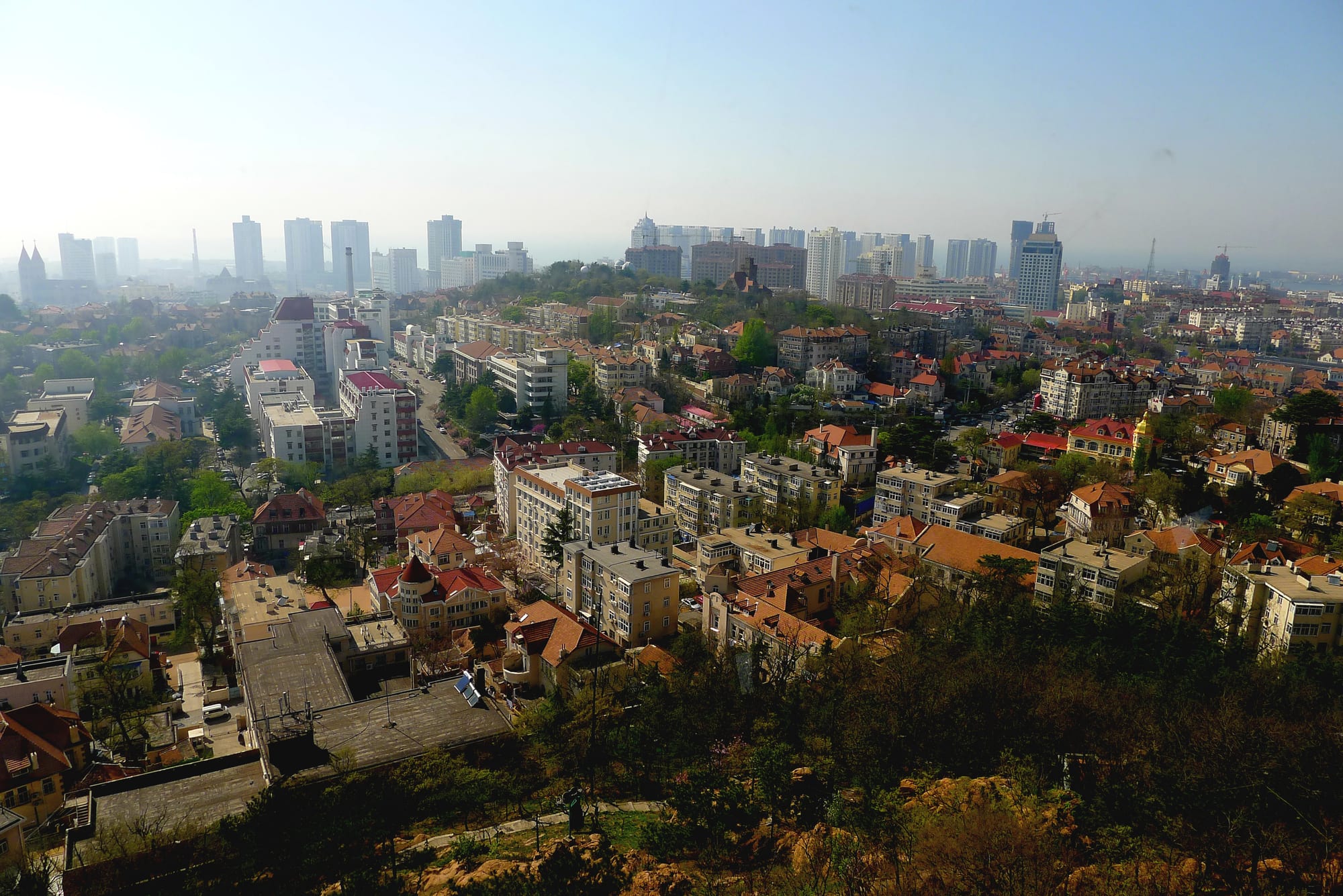
Red-tiled roofs and wooded streets of old Qingdao seen from a hill, with tower blocks and hazy sea beyond

Shanghai & the East Coast, China

Qingdao

The red-roofed older quarters of Qingdao below the towers of Shinan district, Shandong. (CHO EUNSEONG being_es / Wikimedia Commons · CC0)

A port city on the southern coast of Shandong's peninsula, built around a deep bay and a line of sandy beaches. A German leased territory from 1897 until the First World War, it kept red-tiled villas, a granite cathedral and the brewery that makes Tsingtao beer, and grew into one of northern China's largest ports and a centre for household-appliance manufacturing.

Neighbourhoods

  • Shinan and the old town
    • First-time visitors
    • Historic district
    • Close to public transport

    The southern waterfront district holding the German-era core — the cathedral, the old governor's residence, the pier at Zhanqiao and the first bathing beach. Streets climb steeply between granite and stucco buildings, and most of the city's hotels and sights are within a few metro stops.

    Open in Maps
  • Badaguan
    • Quiet and residential
    • Walks
    • Architecture

    A villa quarter near the coast east of the old town, where each street is lined with a single species of tree and named after one of the eight great passes of old military fortification. Large houses in German, Russian, Japanese and British styles stand behind walls, and the roads end at small rocky beaches.

    Open in Maps
  • Shibei
    • Local life
    • Best for food
    • Markets

    The district north of the old town, historically the Chinese quarter under German rule and still densely lived-in. It holds the brewery on Dengzhou Road, street markets and seafood restaurants, and is less polished than the seafront.

    Open in Maps
  • Laoshan District and Fushan Bay
    • Modern city
    • Waterfront
    • Nightlife

    The eastern extension of the city around Fushan Bay, with the towers of the newer business district, the sailing marina built for the 2008 Olympic regatta and a long promenade. Mount Lao rises behind it, and the beaches here are quieter than those downtown.

    Open in Maps
  • West Coast New Area (Huangdao)
    • Beaches
    • Quiet stays

    Across the mouth of Jiaozhou Bay, reached by an undersea tunnel or the long bay bridge. It is the industrial and port side of the city but also has long sandy beaches and newer hotels away from the crowds.

    Open in Maps

Things to do

German-era landmarks

  • St Michael's Cathedrallandmark

    A twin-towered granite and brick Catholic cathedral finished in 1934 to a German design, standing on a rise above the old town.

    Open in Maps
  • Zhanqiao Pierlandmark

    A stone pier 440 metres long reaching into the bay, built in 1891 as the city's first wharf, ending in the octagonal Huilan Pavilion of 1930 that appears on Tsingtao beer labels.

    Open in Maps
  • Xiaoqingdao Islandlandmark

    A small islet joined to the shore by a causeway, with a white marble lighthouse built in 1904; early Chinese maps labelled the islet Qingdao, the name the Germans then gave the whole territory.

    Open in Maps
  • Tsingtao Brewerylandmark

    Founded on Dengzhou Road in 1903 as the Germania Brewery by an Anglo-German company under German master brewers, and now the second largest brewery in China, with its original red-brick buildings still at the centre of the works.

    Open in Maps

The seafront

  • May Fourth Squareattraction

    A large seafront plaza in the newer eastern centre, named for the 1919 movement that began over Qingdao, with the red spiral sculpture known as the May Wind.

    Open in Maps
  • Qingdao Olympic Sailing Centreattraction

    The marina on Fushan Bay built for the sailing events of the 2008 Beijing Olympics, now a public waterfront of pontoons and promenades.

    Open in Maps
  • Jiaozhou Bay Bridgelandmark

    A 26.7 km roadway bridge opened in June 2011 across the bay to the western districts, listed by Guinness World Records as the longest bridge over water.

    Open in Maps

Museums and old streets

  • Badaguanneighborhood

    A quarter of mansions in European styles east of the old town, where each street is lined with a single species of tree and named after one of the eight great passes.

    Open in Maps
  • Zhanshan Templelandmark

    The city's principal Buddhist temple, completed in 1945 on a wooded slope in Shinan, with a Buddhist college attached to it.

    Open in Maps
  • Ocean University of Chinalandmark

    The marine science university whose Yushan campus stands on the site of the German Bismarck Barracks, in German-style buildings of the early 1920s on a hill above the old town.

    Open in Maps
  • Qingdao railway stationtransit hub

    The clock-towered terminus of 1901, rebuilt in the German style, standing a short walk from the pier and the first beach.

    Open in Maps

Short trips from the city

  • Mount Laotrail

    A granite massif about 30 km north-east of the centre and the highest coastal mountain in China, rising to 1,133 m at Jufeng, with Taoist temples, waterfalls and paths from the sea to the summit.

    Open in Maps

Seasonal events

  • Qingdao International Beer FestivalAugust

    First held in 1991, it starts on the second weekend of August and runs for sixteen days, with tented halls, brewery stands, parades and music at sites across the city rather than in the old town.

  • Cherry blossom season in Zhongshan ParkApril

    Crowds fill Zhongshan Park, in the western part of Shinan, for the few weeks the cherries are out, the city's main spring outing.

  • Sailing season on Fushan Baysummer

    Regattas and training fleets use the Olympic marina through the warmer months, when the bay is busy with small boats.

Eat and drink

Long-standing places and food districts in Qingdao. Hours, ratings and directions come from your maps app, always current.

Qingdao classics

  • Tsingtao draught beermarket

    Fresh unpasteurised beer is sold by weight straight from the barrel and carried away in a clear plastic bag with a straw, a habit particular to the city.

    Open in Maps
  • Clams and seafoodrestaurant

    Stir-fried clams with chilli and garlic, grilled squid, sea snails and shrimp make up the standard summer table, eaten with beer.

    Open in Maps
  • Shandong jianbingmarket

    A thin crisp pancake of mixed grains, rolled around raw spring onions and fermented bean paste, sold from morning stalls.

    Open in Maps

Markets and food streets

  • Pichaiyuan marketmarket

    A covered lane of stalls in Shibei where customers buy raw seafood and have it cooked to order alongside dumplings and grilled skewers.

    Open in Maps
  • Dengzhou Road beer streetneighborhood

    The street beside the brewery, lined with restaurants serving barrel beer with shellfish, busiest during the August festival.

    Open in Maps
  • Zhanshan and Yunxiao Road restaurantsneighborhood

    A concentration of seafood and Shandong restaurants in the eastern part of Shinan, popular with residents rather than tour groups.

    Open in Maps

Experience Qingdao

History

The bay was a minor fishing and garrison site until the late 19th century, when the Qing government built a small naval station at Jiaoao. In November 1897 Germany seized the bay after the killing of two missionaries in Shandong, and the following year forced a lease of the Jiaozhou concession. German planners laid out a new town of separate European and Chinese quarters, with granite streets, a sewer system, a harbour and a railway inland to Jinan, and the Germania brewery opened in 1903.

Japan took the territory in 1914 after a siege at the start of the First World War. The Versailles conference awarded Germany's rights in Shandong to Japan rather than returning them to China, and the news set off the student demonstrations in Beijing on 4 May 1919 that gave the May Fourth Movement its name — an episode still marked by the square on the Qingdao seafront. The city returned to Chinese control in 1922, and was occupied by Japan again from 1938 to 1945 before Communist forces took the city in June 1949.

Under the People's Republic it grew as a port and an industrial city, and after the reforms of the 1980s it became the home of Haier and Hisense, two of China's largest appliance and electronics makers. The port expanded across the bay, the eastern districts were rebuilt with high-rise offices around Fushan Bay, and the city hosted the sailing events of the 2008 Beijing Olympics. The older German quarter, long neglected, has been progressively restored.

Culture & Customs

Qingdao's identity rests on the sea and on beer. The brewery founded under German rule is the best-known Chinese beer brand abroad, and locally beer is an everyday drink poured from barrels into bags rather than a special occasion; the August beer festival is the city's largest event. Seafood, the summer beach season and sailing shape the calendar in a way unusual for northern China.

The city sits within Shandong's Confucian and northern Mandarin culture, with a reputation for straight talking, generous hospitality and heavy toasting at dinner, yet its architecture and its history as a leased territory give it an outward-facing edge. The local dialect is a Jiaoliao Mandarin variety, noticeably different from the speech of inland Shandong and a source of local humour.

Higher education and marine science are part of the character too: the Ocean University of China and a cluster of national marine research institutes are based here, and the city has long been a summer retreat for writers and academics, among them Lao She, who lived and wrote in Qingdao in the 1930s. Church buildings from the German and Japanese periods remain in use, and the old villa quarters are protected heritage areas, filmed and photographed constantly for weddings and television.

Daily Life

The seven urban districts that make up the built-up area held about 7.2 million people at the 2020 census, running from Huangdao in the west through Shinan and Shibei to Laoshan and Jimo in the east. Growth has pushed the centre of gravity eastwards and across the bay; the old town has an older, poorer population than the tower districts around Fushan Bay.

The economy rests on the port, among the ten busiest in the world by cargo volume, on manufacturing — appliances, electronics, rubber and shipbuilding — and on beer, which is exported worldwide. Marine research, higher education and tourism add to it, and the western districts hold a large free trade and industrial zone. Wages and property prices are high for Shandong but well below Shanghai's.

Daily rhythms follow the coast. Residents swim from the city beaches from early summer, and older people swim year-round; markets sell the morning's catch; evenings in summer are spent outdoors at plastic tables with shellfish and barrel beer. Traffic is the common complaint, along with summer crowds from the rest of the country, and the long commutes created by a city shaped like a ribbon along the sea.

Food

The kitchen here is a coastal branch of Lu cuisine, Shandong's classic school, which favours clear broths, braising and heavy use of scallion and garlic. Seafood dominates: clams — gala in the local pronunciation — stir-fried with chilli, sea snails, razor clams, squid grilled on skewers, mantis shrimp steamed in spring, and sea cucumber, the region's luxury ingredient, braised with scallion. Fish is often simply steamed or stewed with soybean paste.

Beer accompanies almost all of it. Unpasteurised draught is sold by weight from barrels at small shops and carried home in plastic bags, and restaurants along the street beside the brewery serve it with shellfish. Other staples are northern rather than coastal: jiaozi dumplings, often filled with mackerel or with pork and sea-urchin roe, steamed wheat buns, and Shandong jianbing, the thin grain pancake rolled around raw spring onion and bean paste.

Street food runs to grilled squid and lamb skewers, fried dough sticks with soy milk for breakfast, and seasonal fruit from the peninsula — peaches, cherries and the apples grown around Yantai and Laiyang. Markets such as Pichaiyuan in Shibei let customers choose raw shellfish and have it cooked at a nearby stall, a form of eating particular to the city, and sweetened fried sugar cakes and steamed cakes appear at the autumn festivals.

Planning tools

Budget

Qingdao is cheaper than Shanghai but expensive by Shandong standards in July and August, when room rates near the beaches rise sharply and the beer festival fills the city. Seafood is the main variable: a table of clams and draught beer costs little, while a tank-fresh fish dinner does not. Museum and temple tickets are modest, and the metro is cheap.

Daily Budget Midrange
USD 110–220 (mid-range hotel near the seafront, restaurant dinners, entry tickets, taxis)
Daily Budget Shoestring
USD 35–60 (hostel or budget hotel, seafood stalls and noodle shops, metro and buses)

Travel outside the July–August peak if possible; the same hotels cost far less in spring and autumn and the beaches are still pleasant.

Best Time to Visit

May, June, September and early October are the most comfortable months, with warm sea air and clear light. July and August are the swimming and festival season but also the busiest and most humid, with sea fog common in early summer. Winter is cold and windy, though the old town is quiet and photogenic.

Suggested Number of Days

Two to three days suit the central districts. Allow four or five to take in the mountains and coast beyond the city. Visits in summer tend to run longer, because the beaches invite a slower pace.

First Visit
2–3 days
With Surroundings
4–5 days

Transportation

A growing metro network links the old town, the eastern business districts, the airport and the western side of the bay, and is the simplest way to cross a city that stretches a long way along the coast. Buses are frequent but slow in summer traffic, and ride-hailing through Didi is widely used. Ferries cross Jiaozhou Bay, and an undersea tunnel and the bay bridge carry road traffic west.

Distances along the coast are longer than they look on a map; check which district a hotel is in before booking.

Airport & Station Connections

Qingdao Jiaodong International Airport, which opened in August 2021 in place of the old Liuting airport, lies about 39 km from the centre and is the largest airport in Shandong, connected by metro and airport buses and served by a dozen airlines on domestic, regional and international routes. High-speed trains run from Qingdao and Qingdao North stations on the Jinan–Qingdao line, with through services to Beijing and Shanghai.

Walkability

The old town is walkable but hilly, with steep granite streets between the cathedral, the churches and the pier, and a seafront promenade that runs for several kilometres past the beaches. Badaguan is best seen on foot. The newer eastern districts are built to a much larger scale and need the metro or a taxi between points.

Safety

Qingdao is a safe city with little violent crime. The realistic hazards are sea-related: strong currents and jellyfish at the beaches in late summer, slippery rocks along the shore, and sea fog. Crowding is heavy during the beer festival and national holidays, and seafood restaurants near tourist areas have a reputation for weighing and pricing shellfish unclearly.

Swim only at patrolled beaches and heed flag warnings, confirm the price and weight of seafood before it is cooked, and carry warm layers for the windy waterfront outside summer. Check current official travel advice before travelling.

Climate

A temperate monsoon climate strongly moderated by the sea, giving milder summers and later, damper springs than inland Shandong. Sea fog is common from April to July, and most rain falls in summer.

Summer
warm and humid rather than hot, usually 25–29°C by day, with frequent sea fog and occasional typhoon rain
Winter
cold, dry and windy, often around 0–5°C by day, with little snow

Local Customs

Tipping is not customary. Shandong has a strong drinking culture, and beer is drunk at meals rather than after them; toasts are made to the table and it is polite to acknowledge them, though declining on health grounds is accepted. Beachwear belongs on the beach. The German buildings are ordinary workplaces and homes as well as sights, so photograph courtyards and residents with care.

Take shoes off where a household asks, keep voices low in the temples on Mount Lao, and expect elaborate hospitality if invited to a local dinner.

Common Payment Methods

The currency is the renminbi, counted in yuan. Almost everything is paid by QR code through Alipay or WeChat Pay, which foreign visitors can link to an overseas card before arrival; foreign cards work in larger hotels and some big stores but rarely elsewhere. Carry a little cash for market stalls and small beer shops, and use bank ATMs for withdrawals.