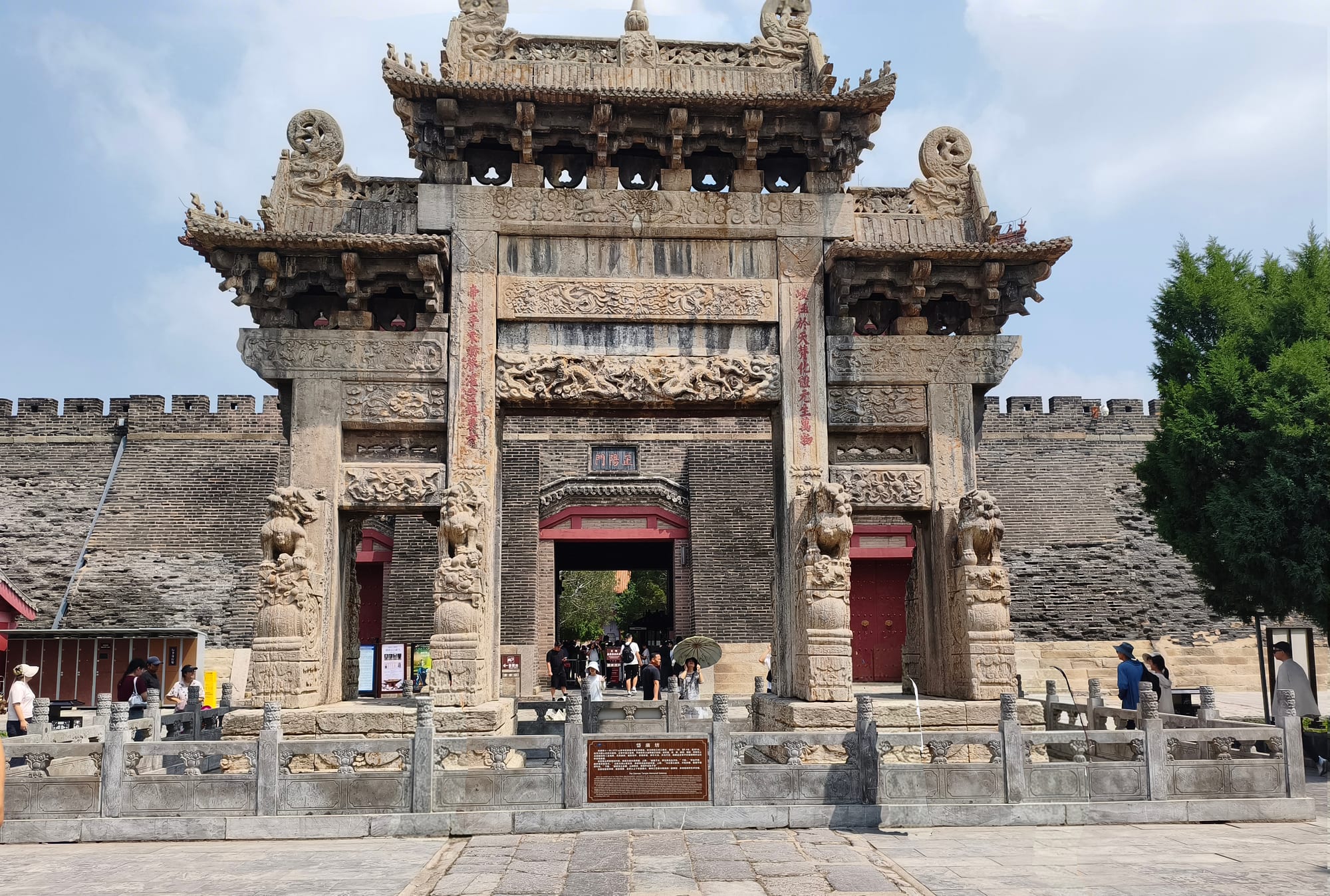
A heavily carved stone archway with tiled roofs and lion statues standing before a battlemented temple wall and gate

Shanghai & the East Coast, China

Tai'an

The carved stone archway in front of the Dai Temple in Tai'an, Shandong. (祝鱼贵 / Wikimedia Commons · CC BY-SA 4.0)

A city in central Shandong that exists because of the mountain above it. Tai'an grew as the pilgrim town at the foot of Mount Tai, the most revered of China's five sacred peaks, where emperors made sacrifices to heaven and a stone stairway of thousands of steps climbs past shrines to the summit. The Dai Temple stands at the start of the route through the old centre.

Neighbourhoods

  • The old centre around the Dai Temple
    • First-time visitors
    • Historic district
    • Best for food

    The heart of the city, where the walled Dai Temple faces a pedestrian street of shops and snack stalls. The pilgrim route runs north from here towards the mountain, and most of the older hotels and restaurants are within walking distance.

    Open in Maps
  • Hongmen and the mountain foot
    • Walkers
    • Early starts
    • Quiet

    The northern edge of the city where the streets end and the stone stairway begins at the Red Gate. Guesthouses, outdoor shops and noodle places cluster near the trailhead, and the air is cooler than in the centre.

    Open in Maps
  • Tianwai Village
    • Cable car access
    • Coach travellers

    The road-head in the valley west of the stairway, where buses climb to the halfway gate and the cable car runs to the summit ridge. It is a transport interchange with hotels rather than a neighbourhood, useful for anyone not walking up.

    Open in Maps
  • Taishan station and the new districts
    • Close to public transport
    • Modern hotels

    The southern and western parts of the city around the railway stations and newer avenues, with chain hotels, shopping centres and offices. It is convenient for high-speed trains but a bus or taxi ride from the mountain.

    Open in Maps

Things to do

The sacred mountain

  • Mount Taitrail

    The most revered of China's five sacred mountains, a UNESCO World Heritage Site, climbed by a stone stairway of several thousand steps past gates, shrines and carved inscriptions to a summit ridge of temples.

    Open in Maps
  • Dai Templelandmark

    The great walled temple in the city where emperors prepared their sacrifices to the mountain, surrounded by cypresses said to date from the Han dynasty, with stone tablets and halls rebuilt and greatly extended under the Song.

    Open in Maps

Lakes and country near the city

  • Dongping Lakepark

    Shandong's second largest freshwater lake, west of the city, the only surviving water of the marshes described in the classic novel Water Margin, and now a reservoir on the eastern route of the South-North Water Transfer Project.

    Open in Maps

Short trips from the city

  • Qufuattraction

    The birthplace of Confucius, about 70 kilometres south, with the temple, mansion and cemetery of the Kong family.

    Open in Maps
  • Jinanattraction

    Shandong's provincial capital about 50 kilometres north, known for its artesian springs, Daming Lake and the Thousand Buddha Mountain.

    Open in Maps
  • Baotu Springpark

    The best known of Jinan's springs, set in a walled garden of pools and pavilions, historically ranked first among them.

    Open in Maps
  • Thousand Buddha Mountainpark

    A hill park on the southern edge of Jinan with Sui-period carved Buddhas cut into the rock and a temple on its slope.

    Open in Maps
  • Daming Lakepark

    The lake at the centre of Jinan, fed by the city's springs and ringed by willows, pavilions and gardens.

    Open in Maps

Seasonal events

  • Feicheng peach blossom festivalspring

    An annual festival in Feicheng, the peach-growing county-level city west of Tai'an, held when the orchards are in flower.

  • Summer sunrise seasonJune to August

    The busiest months for the overnight climb, when walkers set out in the evening or small hours to reach the summit ridge before dawn.

  • Temple fairs at the Dai Templespring and autumn

    Traditional fairs in and around the temple precinct, with opera, stalls and incense offerings, following an old market calendar.

  • Lunar New Year pilgrimageslate January or February

    Families climb to the summit shrines around the new year to burn incense and pray for fortune, in thick winter clothing.

Eat and drink

Long-standing places and food districts in Tai'an. Hours, ratings and directions come from your maps app, always current.

Tai'an classics

  • Mount Tai tofu souprestaurant

    Soft white tofu simmered in clear mountain water with cabbage, the dish most associated with the city and eaten as a whole-table soup.

    Open in Maps
  • Shandong jianbingmarket

    A crisp pancake of mixed grains rolled around raw spring onion and fermented bean paste, sold from morning stalls across the province.

    Open in Maps
  • Mountain vegetables and chestnutsmarket

    Wild greens, walnuts and chestnuts gathered on the slopes are sold dried along the pilgrim route, along with Feicheng peaches in summer.

    Open in Maps

Food streets

  • The pedestrian street by the Dai Templeneighborhood

    Snack stalls and small restaurants around the temple gates, selling skewers, dumplings, pancakes and stewed dishes to visitors and residents alike.

    Open in Maps
  • Hongmen Road near the trailheadneighborhood

    Noodle shops, breakfast kitchens and cheap restaurants near the foot of the stairway, open early for walkers starting the climb.

    Open in Maps

Experience Tai'an

History

The mountain came first. Mount Tai was worshipped as the eastern peak long before there was a city below it, and the feng and shan sacrifices made there by rulers from the Qin and Han onwards required a permanent establishment at its foot: priests, officials, stonemasons and inns for pilgrims. The Dai Temple, where emperors prepared before climbing, grew from Han foundations into the walled precinct that still occupies the centre of the city, rebuilt many times, most grandly under the Song.

The town below the peak takes its name from the mountain itself, from the old saying that if Mount Tai is stable then the four seas are at peace, and it became a prefecture seat under the Ming and Qing. Its economy was built on pilgrimage: the mountain drew crowds every year, particularly women praying to the goddess of the summit for children, and the town lived on lodging, incense, sedan chairs, porters and stone carving.

Railways reached Tai'an in 1909, when a station was built on the line between Tianjin and Pukou, and the city was bombed and then occupied by Japanese forces at the end of 1937. Under the People's Republic it became a prefecture-level city with industry alongside farming. Mount Tai was inscribed as a UNESCO World Heritage Site in 1987 for both its cultural and natural value, tourism grew rapidly, and the high-speed line from Beijing to Shanghai, opened in 2011, put the city within a few hours of both.

Culture & Customs

Almost everything distinctive here comes from the mountain's place in Chinese religion. Mount Tai was regarded as the point where heaven and earth met, the source of life and the seat of the god of the eastern peak, and later as the home of Bixia Yuanjun, the goddess whose temple stands near the summit. Pilgrims climb to burn incense, leave red ribbons and locks, and pray for children, health and examination success; the saying that a person is as steady as Mount Tai is common across the language.

The mountain is also one of the great galleries of Chinese calligraphy. Cliffs and boulders along the route carry inscriptions cut over two thousand years, more than a thousand cliff inscriptions and hundreds of stone steles in all, and rubbings and stone carving remain local crafts. The Dai Temple's cypresses, tablets and murals make it a record of imperial ritual in its own right.

Tai'an sits in the Confucian heartland of Shandong, close to Qufu, and local manners reflect it: formal politeness to elders, emphatic hospitality, and a dinner culture of repeated toasts in which the host sets the pace. Folk traditions include temple fairs, shadow puppetry and the Taishan stone amulets that are sold as protective charms. Residents are used to visitors and to the sight of strangers setting off up the steps at midnight.

Daily Life

About five and a half million people lived in the prefecture at the 2010 census, of whom about 1.7 million were in the two urban districts below the mountain. The city is laid out on the plain south of the peak, older and denser around the Dai Temple, newer and wider towards the high-speed station, and villages run up the valleys on either side of the mountain.

Tourism is the most visible industry, employing guides, drivers, hotel staff and the porters who carry supplies up the steps on shoulder poles, but it is not the whole economy: the wider prefecture has mining and manufacturing alongside a substantial agriculture of wheat, maize, vegetables, walnuts and the peaches grown around Feicheng. Water for Shandong's dry plain comes partly from reservoirs in these hills.

Life follows the mountain's timetable in summer, when buses run through the night and breakfast stalls open long before dawn for descending walkers. The rest of the year is an ordinary provincial rhythm: markets in the morning, square dancing in the evening, university students in the northern districts, and weekend walks on the lower slopes. Congestion at the trailheads during national holidays is the standing local complaint.

Food

Tai'an cooking belongs to Lu cuisine, Shandong's classic school — to its Jinan branch, which covers Jinan, Dezhou and Tai'an — and leans on clear broths, braising, vinegar and a heavy hand with scallion and garlic. Its own speciality is tofu: soft white curd made with water from the mountain streams, simmered with cabbage in a plain soup that is served by the potful and regarded as the local dish.

Wheat rather than rice is the staple, as across northern Shandong — steamed buns, flatbreads, hand-pulled noodles and boiled dumplings. Jianbing, the thin crisp grain pancake rolled around raw spring onion and fermented bean paste, is the standard breakfast from a street cart. Braised and stewed meat dishes, freshwater fish from the reservoirs and river carp appear at larger meals, and the drinking is beer and baijiu.

The slopes supply a trade in mountain produce: wild greens and herbs, walnuts, chestnuts, dried mushrooms and a bitter local tea, sold dried in shops along the pilgrim route. Feicheng, north-west of the city, is known across China for its peaches, and Shandong's apples, pears and spring onions fill the markets. Snack streets near the temple sell skewers, fried dough, sweet potato and stewed offal late into the evening.

Planning tools

Budget

Tai'an is inexpensive apart from the mountain itself: the scenic-area ticket, the shuttle bus and the cable car are the main costs, and summit hotels charge far more than anything in the city because supplies are carried up by porters. Food and city hotels are cheap by East Coast standards, and prices rise in summer and around holidays.

Daily Budget Midrange
USD 100–200 (mid-range city hotel, restaurant meals, mountain ticket, bus and cable car)
Daily Budget Shoestring
USD 30–55 (budget hotel or hostel in the city, noodle and pancake stalls, the climb on foot)

Carry water and food up the mountain; everything sold on the stairway and the summit is hauled up on foot and priced accordingly.

Best Time to Visit

April to June and September to October are the most comfortable, with clearer air and moderate temperatures on the summit. July and August bring heat, haze, rain and the largest crowds, though the sunrise season is at its peak then. Winter is cold and icy on the steps, with occasional snow and spectacular clear views.

Suggested Number of Days

Two days suit most visits, since the mountain takes the better part of one and the city the other. Allow three or four to add the towns and lakes nearby. Anyone staying at the summit for a sunrise needs the extra night.

First Visit
2 days
With Surroundings
3–4 days

Transportation

City buses link the railway stations, the Dai Temple and the two mountain approaches, and taxis and ride-hailing are cheap for short distances. Cars may not drive up the mountain: a scenic-area shuttle bus climbs from Tianwai Village to the halfway gate, where cable cars continue to the summit ridge, and the eastern route is walked from the Red Gate.

Plan the climb as a one-way walk with the cable car or bus for the other direction if knees or time are limited; the descent on stone steps is harder than it looks.

Airport & Station Connections

Taishan station in the city centre is on the conventional railway, while Tai'an's high-speed station on the Beijing–Shanghai line sits west of the centre, about 20 minutes away by bus or taxi; fast trains reach Jinan in around 20 minutes, Beijing in about two hours and Shanghai in roughly three and a half. The nearest major airport is Jinan Yaoqiang International, about 120 kilometres north.

Walkability

The old centre is flat and easy on foot, with a pedestrian street running from the Dai Temple towards the mountain. Beyond it the city is laid out on wide modern avenues and buses are quicker. The mountain is an entirely different matter: the eastern route is a stone stairway of several thousand steps climbing well over a kilometre in height, and takes most walkers four to six hours up.

Safety

The city is safe, with little crime affecting visitors. The risks are on the mountain: long flights of worn stone steps, crowds on the narrow Eighteen Bends, sudden cold, wind and fog at the summit even in summer, and slippery ice in winter. Overnight climbers face darkness and low temperatures at the top.

Take warm layers, a torch and grippy shoes for a night climb, keep to the marked routes, and check the weather for the summit rather than the city. Check current official travel advice before travelling.

Climate

A temperate continental monsoon climate, with hot wet summers and cold dry winters. The summit is far colder and windier than the city — often more than ten degrees lower — and is in cloud for much of the summer.

Summer
hot and humid in the city, with July averaging about 26°C and most of the year's rain falling in July and August
Winter
cold and dry, with January averaging about -2°C in the city and well below freezing on the summit

Local Customs

Tipping is not customary. Mount Tai is an active place of worship as well as a walk: people burn incense, tie red ribbons and padlocks along the railings and pray at the summit shrines, and visitors are expected to be quiet and unobtrusive inside temple halls. Shandong hospitality involves generous toasting at dinner, and elders are seated and served first.

Do not photograph worshippers at the shrines without asking, remove hats inside temple halls, and follow signs where photography is restricted.

Common Payment Methods

The currency is the renminbi, counted in yuan. Tickets, buses, shops and restaurants are almost all paid by QR code through Alipay or WeChat Pay, which foreign visitors can link to an overseas card before arrival. Foreign cards work at larger hotels but rarely elsewhere, so carry some cash for stalls on the mountain, and use bank ATMs in the city centre.