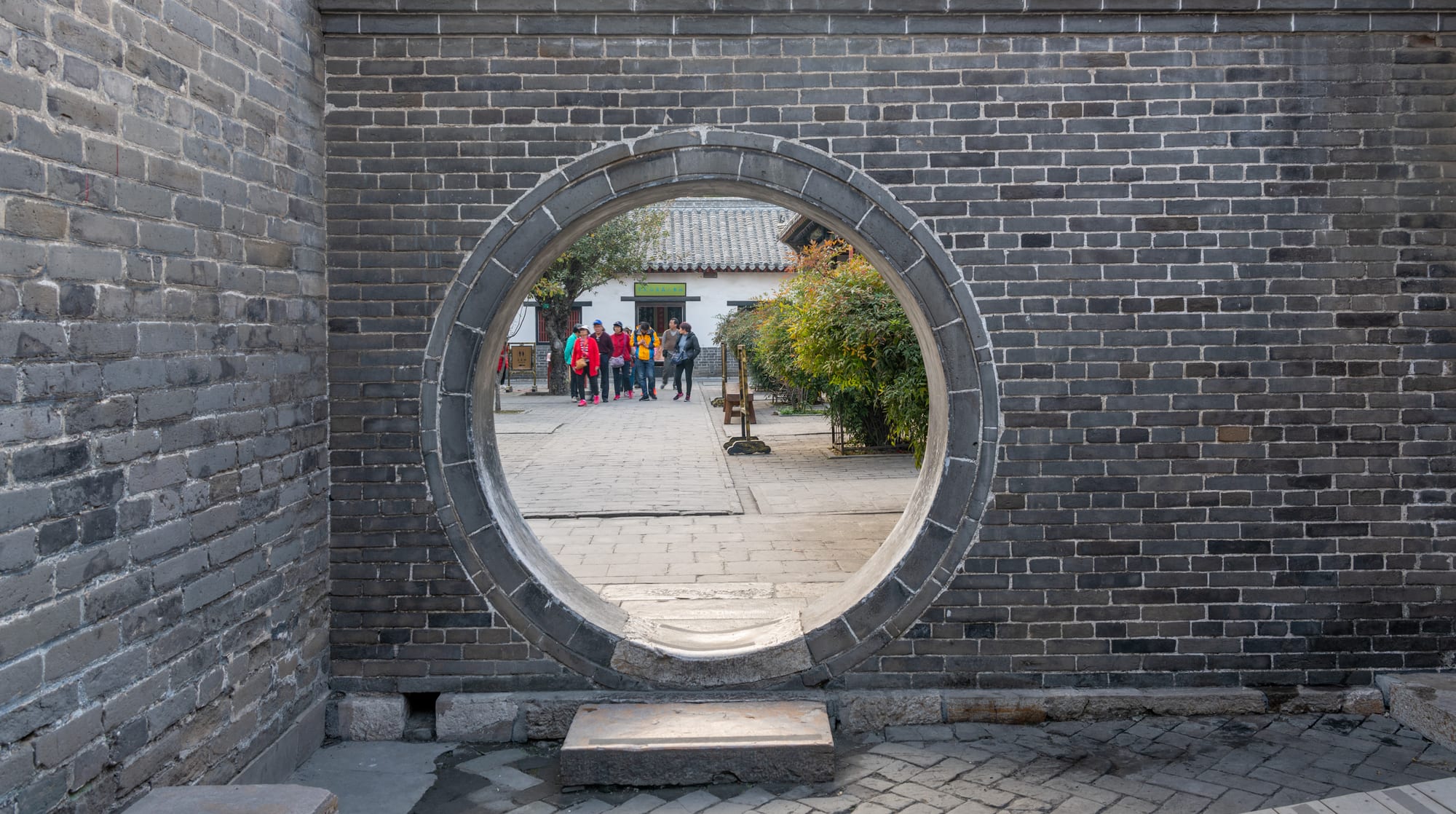
A circular moon gate cut through a grey brick wall, looking onto a paved courtyard with low tiled buildings beyond

Shanghai & the East Coast, China

Qufu

A moon gate in the Kong Family Mansion, the ancestral home of Confucius's descendants in Qufu. (xiquinhosilva / Wikimedia Commons · CC BY 2.0)

A small walled city in south-western Shandong, the capital of the ancient state of Lu and the birthplace of Confucius in 551 BC. His descendants, the Kong family, lived here for more than seventy generations, and the temple built in his honour, their mansion beside it and the walled family cemetery outside the north gate form a UNESCO World Heritage Site.

Neighbourhoods

  • The walled old town
    • First-time visitors
    • Historic district
    • Walks

    The rectangular Ming-era town, rebuilt in recent decades with gates, moat and grey brick walls, holding the temple, the mansion and the main shopping streets. Almost everything a visitor comes for is inside it, and distances are short.

    Open in Maps
  • Gulou Street and the temple approach
    • Best for food
    • Shopping

    The pedestrian streets running from the drum tower towards the temple gates, lined with tea and calligraphy shops, souvenir stalls and small restaurants. It is the liveliest part of town in the evening.

    Open in Maps
  • Outside the north gate
    • Quiet
    • Parks

    The road leading to the Kong family cemetery, with an avenue of old trees, guesthouses and a much quieter feel than the centre. The walled woodland of the cemetery itself takes up a large area beyond.

    Open in Maps
  • Qufu East and the new town
    • Close to public transport
    • Modern hotels

    The area around the high-speed railway station, about seven kilometres south-east of the walls, with newer hotels, wide roads and apartment blocks. It is convenient for trains but has none of the old town's atmosphere.

    Open in Maps

Things to do

The Confucian sites

  • Temple of Confuciuslandmark

    The largest and best known temple of Confucius in East Asia, built and rebuilt over two millennia on the site of his house, with nine courtyards on a north-south axis, cypresses and stele pavilions leading to the Dacheng Hall, whose front columns are carved with coiled dragons.

    Open in Maps
  • Kong Family Mansionlandmark

    The walled compound next to the temple where the senior line of Confucius's descendants lived and administered their estates, with official halls in front and family quarters and a garden behind.

    Open in Maps
  • Cemetery of Confuciuspark

    A walled woodland of about 1.8 square kilometres north of the town where Confucius and, over some two thousand years, more than a hundred thousand of his descendants are buried among old trees, spirit paths and stone figures.

    Open in Maps
  • Temple of Yan Huilandmark

    A quieter temple in the old town honouring Yan Hui (521–490 BC), the favourite disciple of Confucius.

    Open in Maps

The ancient city and its surroundings

  • Mount Nitrail

    A hill just over 20 kilometres south-east of the town traditionally held to be Confucius's birthplace, with a temple to his father, a Confucian academy and a 72-metre statue of Confucius completed in 2016.

    Open in Maps
  • Tomb of Shaohaolandmark

    A walled compound of old trees on the eastern outskirts honouring the legendary emperor Shaohao, best known for Shou Qiu, the stone-clad pyramidal mound in front of the tomb, faced with slabs in 1111 under the Song.

    Open in Maps

Short trips from the town

  • Tai'anattraction

    The city at the foot of Mount Tai, about 70 kilometres north, from which the sacred peak is climbed.

    Open in Maps
  • Zouchengattraction

    A county-level city about 20 kilometres south, the birthplace of Mencius, with its own Mencius temple, family mansion and family cemetery.

    Open in Maps
  • Jiningattraction

    The prefecture city west of Qufu, on the Grand Canal, a transport and coal-mining centre with canal-era streets.

    Open in Maps

Seasonal events

  • Confucius memorial ceremonylate September

    A formal ritual with music, robes and dance performed in the temple on the anniversary of Confucius's birth, the centrepiece of an annual cultural festival.

  • Spring and autumn temple ritesspring and autumn

    Smaller sacrificial ceremonies held at the temple following the classical calendar, attended by scholars and descendants of the Kong family.

  • Lunar New Year temple fairlate January or February

    Stalls, opera and lanterns fill the streets around the temple gates over the new year holiday, when families come to pray for examination success.

Eat and drink

Long-standing places and food districts in Qufu. Hours, ratings and directions come from your maps app, always current.

Qufu classics

  • Confucian family cuisinerestaurant

    The banquet cooking developed in the Kong Family Mansion for imperial guests, a formal branch of Shandong's Lu tradition with elaborately named braised and steamed dishes.

    Open in Maps
  • Qufu tofu and mountain vegetablesrestaurant

    Everyday Shandong cooking of braised tofu, wild greens, boiled dumplings and clear soups, served in small restaurants inside the walls.

    Open in Maps
  • Shandong jianbing and wheat breadsmarket

    Crisp grain pancakes rolled around spring onion and bean paste, steamed buns and flatbreads, the standard northern breakfast sold from morning stalls.

    Open in Maps

Food streets

  • Gulou Streetneighborhood

    The main pedestrian street near the drum tower, with restaurants, snack stalls, tea shops and sellers of local liquor and sweets.

    Open in Maps
  • The night market near the south gateneighborhood

    Evening stalls of grilled skewers, noodles and fried snacks just outside the town wall, busiest in the warmer months.

    Open in Maps

Experience Qufu

History

Qufu was the capital of Lu, one of the states of the Zhou period, founded in the 11th century BC for the family of the Duke of Zhou. The walls of that ancient city, far larger than the present town, can still be traced in banks of earth in the fields around it. Lu was a small state but a conservative and scholarly one, which kept the rites of the Zhou court more carefully than its neighbours, and it was into this that Confucius was born in 551 BC.

He taught here, travelled for years in search of a ruler who would apply his ideas, and returned to Qufu to teach and edit the classics until his death in 479 BC. His house became a shrine almost at once. Successive dynasties enlarged it and granted land and hereditary titles to his descendants: the temple grew to nine courtyards and more than four hundred rooms, and the mansion beside it ran a great estate with its own officials.

The present walled town is Ming, its wall built in 1522 around the temple rather than on the older city site. The family left the mansion in 1937, fleeing to Chongqing during the war with Japan and then to Taiwan during the civil war, where the head of the family still lives. The complexes were badly damaged in November 1966, when Red Guards from Beijing dug up graves in the cemetery, smashed stelae and felled old pines; they were repaired afterwards. UNESCO inscribed the temple, mansion and cemetery in 1994, and the Chinese state has since promoted Confucius as a national symbol, rebuilding parts of the town and reviving the ceremonies.

Culture & Customs

Qufu's identity is entirely bound to one family and one philosopher. Confucian ritual is performed here as living practice rather than reconstruction alone: the autumn memorial ceremony involves ranks of dancers with feather wands, ancient instruments including stone chimes and bells, robed officiants and set texts, and smaller rites follow the classical calendar. Visiting students and parents leave wooden prayer tablets asking for success in the national university entrance examination, a modern continuation of the old link between the sage and scholarship.

The Kong surname is extremely common in the town, and genealogy is taken seriously; the family's records run to dozens of generations and are periodically updated. Calligraphy, stele rubbing, woodblock printing and the carving of stone are traditional crafts sustained by the temple, and the town has research institutes and academies devoted to Confucian studies, with visiting scholars from Korea, Japan and Vietnam, where the tradition also took root.

Everyday manners are Shandong manners, noticeably formal by Chinese standards: careful seating by age and rank at dinner, insistent hospitality, frequent toasts, and a directness that outsiders sometimes read as bluntness. The town is quieter and more conservative than the coastal cities of the province, and it is unusually full of school groups, since visits to Qufu are a staple of the national curriculum.

Daily Life

About 653,000 people live in the county-level city, of whom some 188,000 are in urban areas; the rest are spread across farming villages on the plain. Inside the walls the population is older and the buildings low, while newer housing, schools and offices have spread east towards the high-speed railway station.

Tourism and education dominate the local economy. Hotels, restaurants, guides, cart drivers and souvenir workshops depend on the flow of visitors, and the city has universities and teacher-training colleges as well as Confucian research bodies. Beyond that the district lives on wheat and maize farming, vegetables, orchards, food processing and light manufacturing, with coal mining in the wider Jining area.

The rhythm is small-town. Markets open early, school groups arrive by coach through the morning, the temple streets fill in the afternoon, and the evening belongs to food stalls, square dancing and children in the squares by the wall. Cycle rickshaws and electric carts are the everyday transport of the old town. Residents complain about ticket prices for their own landmarks, summer crowds and the slow drift of younger people to Jinan, Qingdao and further afield.

Food

Qufu eats Lu cuisine, the classic Shandong school, in two registers. The famous one is Confucian family cooking, developed in the Kong Family Mansion over centuries of entertaining imperial visitors: a formal banquet style of braised and steamed dishes with auspicious names taken from the classics, careful knife work, clear stocks and dishes such as braised sea cucumber, stuffed bean curd and slow-cooked meats. Several restaurants in the town cook versions of it, and it is best understood as ceremonial food rather than everyday fare.

The everyday register is northern and wheat-based. Steamed buns, flatbreads, boiled dumplings and hand-pulled noodles replace rice at most tables; jianbing, the thin crisp pancake of mixed grains rolled around raw spring onion and fermented bean paste, is the usual breakfast. Tofu, braised or in clear soup, mutton soup, freshwater fish and pork with garlic and scallion make up the usual dishes, with vinegar and raw garlic on the table.

Local products are sold along the temple streets: grain liquor, dried mountain vegetables, walnuts and chestnuts, and sweets and pastries sold as souvenirs. Shandong's fruit reaches the markets in season — peaches, apples, pears and persimmons — and the evening stalls outside the walls grill skewers of lamb and sell fried snacks and cold noodles well into the night.

Planning tools

Budget

Qufu is cheap by East Coast standards. The main costs are the combined ticket to the three Confucian sites, which is not trivial, and hotels in the old town, which rise around the September ceremony and national holidays. Food, taxis and guesthouses are inexpensive, and the new town near the railway station is cheaper again.

Daily Budget Midrange
USD 90–180 (hotel in or near the old town, restaurant meals, tickets, taxis and a driver for Mount Ni)
Daily Budget Shoestring
USD 30–50 (guesthouse or hostel, noodle and pancake stalls, the combined site ticket, local buses)

A single ticket covering the temple, the mansion and the cemetery costs much less than three separate ones, and the cemetery is large enough to justify a cart or a bicycle.

Best Time to Visit

April to early June and September to October are the pleasantest months, with mild weather and the cypresses and old trees at their best. Late September brings the birthday ceremony and the crowds that go with it. Summer is hot, humid and busy with school groups; winter is cold and dry, and the courtyards are almost empty.

Suggested Number of Days

One full day covers the three main complexes at a steady pace, and two allow for the smaller temples and a slower look at the cemetery. Add a further day for the towns and hills nearby.

First Visit
1–2 days
With Surroundings
2–3 days

Transportation

The old town is small enough to cross on foot, and cycle rickshaws, electric carts and taxis fill the gaps. City buses connect the walls with the high-speed station several kilometres east and with the ordinary railway station; taxis or hired cars are the practical way to reach Mount Ni and the outlying sites.

Agree a fare before setting off in a cycle rickshaw or electric cart, as the carts have no meter.

Airport & Station Connections

Qufu East station, on the Beijing–Shanghai high-speed line, is a few kilometres south-east of the old town and reaches Beijing in roughly two and a half hours, Shanghai in about three and Jinan in half an hour. The original Beijing–Shanghai railway also passes through the city, and Qufu South station on the Rizhao–Lankao high-speed line opened in 2021; buses run from Tai'an, Jining and Zoucheng. The old Jining Qufu airport closed at the end of 2023 when Jining Da'an airport replaced it, and Jinan has the province's main airport.

Walkability

Qufu is one of the easier Chinese cities to walk: the walled town is roughly a kilometre across, flat, and largely pedestrianised around the temple gates. The cemetery lies a short distance beyond the north gate and is a long walk in itself, being a walled wood of considerable size. The new town by the railway station is a bus or taxi ride away.

Safety

Qufu is a quiet and safe town with very little crime affecting visitors. The practical issues are crowding during the September ceremony and holiday weeks, persistent souvenir and guide touts near the temple gates, summer heat in the open courtyards, and uneven stone paving in the older complexes.

Buy tickets at official counters rather than from people offering them outside, and take sun protection and water for the long walk round the cemetery. Check current official travel advice before travelling.

Climate

A temperate continental monsoon climate: hot, wet summers, cold and dry winters, short springs with dust and wind, and clear, settled autumns.

Summer
hot and humid, with daytime temperatures usually around 30°C and most of the year's rain in July and August
Winter
cold and dry, with January averaging around 0°C and little snow

Local Customs

Tipping is not customary. The temple is a place of reverence as well as a monument: people bow before the halls, burn incense and leave wooden tablets asking for success in examinations, and it is polite to keep quiet and avoid walking across ritual platforms. Shandong manners are formal about seniority at table, and toasts at dinner are frequent and expected.

Dress modestly in the temple complexes, do not touch the stone stelae or carved columns, and follow the marked routes through the cemetery, which is a burial ground still in use by the family.

Common Payment Methods

The currency is the renminbi, counted in yuan. Tickets, restaurants, shops and taxis are paid by QR code through Alipay or WeChat Pay, which foreign visitors can link to an overseas card before arrival; foreign cards work at the larger hotels but rarely elsewhere. Keep some cash for market stalls and rickshaws, and use bank ATMs in the new town or near the main streets.