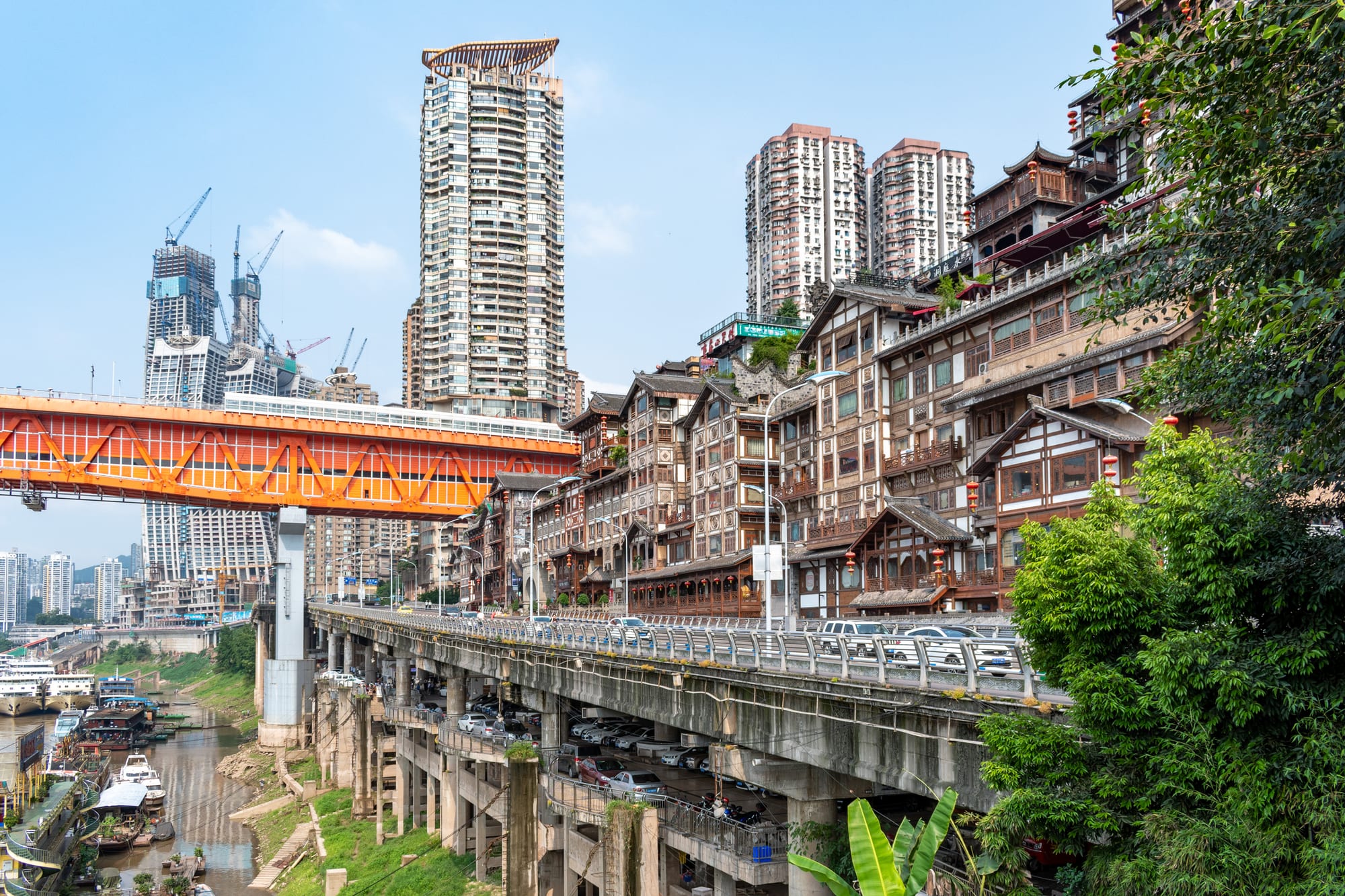
Tiers of wooden stilt buildings stacked against a cliff above an elevated road, with an orange bridge and towers behind

Sichuan, Yunnan & the Southwest, China

Chongqing

The Hongya Cave stilt complex built against the cliff above the Jialing River in Chongqing. (xiquinhosilva / Wikimedia Commons · CC BY 2.0)

A mountain city built on ridges and cliffs where the Jialing River meets the Yangtze in south-west China. An old Ba settlement and river port, it served as China's wartime capital from 1938 and was made a municipality separate from Sichuan in 1997. Its dense, vertical centre of towers, stairways, cable cars and monorails is now known for hotpot and for river cruises towards the Three Gorges.

Neighbourhoods

  • Yuzhong District
    • First-time visitors
    • Views
    • Close to public transport

    The peninsula between the two rivers and the historic core, holding the Liberation Monument shopping district, Hongya Cave, Chaotianmen at the confluence and the Yangtze cableway station. It is the densest and most vertical part of the city, with streets stacked on several levels.

    Open in Maps
  • Jiangbei District
    • Shopping
    • Nightlife
    • Modern architecture

    The north bank opposite the peninsula, where the Jiangbeizui financial district and the Raffles City towers stand at the point of the confluence. The Guanyinqiao pedestrian area inland is a busy centre for shops, restaurants and bars.

    Open in Maps
  • Nan'an District
    • Views
    • Quiet and residential
    • Riverside

    The south bank, rising steeply to the wooded ridge of Nanshan. The Nanbin Road riverfront looks across at the illuminated skyline, and the hill above holds gardens, villas built during the war years and the city's best-known night viewpoints.

    Open in Maps
  • Shapingba District
    • Historic district
    • Students
    • Best for food

    West of the centre along the Jialing, home to the restored riverside town of Ciqikou and to several universities. It mixes old lanes of snack shops and teahouses with student streets and large residential areas.

    Open in Maps
  • Yubei District
    • Business travellers
    • Close to the airport

    The northern district holding Jiangbei International Airport and a great deal of recent development — new residential towers, exhibition centres and hotels along the metro lines out of the centre.

    Open in Maps

Things to do

Famous landmarks

  • Hongya Cavelandmark

    A complex of stilt-house style buildings stacked eleven storeys against a cliff above the Jialing River, lit up at night and full of shops and restaurants.

    Open in Maps
  • People's Liberation Monumentlandmark

    The clock-tower monument at the centre of Yuzhong's pedestrian shopping district, built after the Second World War as a victory monument and rededicated in 1950 as the People's Liberation Monument.

    Open in Maps
  • Chaotianmen Bridgelandmark

    A long steel arch carrying road and rail across the Yangtze beside Chaotianmen, the dock area at the tip of the peninsula where the Jialing meets the Yangtze and river cruises depart.

    Open in Maps
  • Chongqing People's Auditoriumlandmark

    A domed auditorium of the early 1950s in traditional imperial style, also known as the Great Hall of the People, facing a broad square with the Three Gorges Museum opposite.

    Open in Maps
  • Raffles City Chongqinglandmark

    A group of towers at the confluence linked near the top by a horizontal sky bridge with an observation deck.

    Open in Maps

Rides and viewpoints

  • Yangtze River Cablewayviewpoint

    A cable car that has crossed the Yangtze since 1987, once commuter transport and now the classic way to see the gorge-like river and the towers on both banks.

    Open in Maps
  • Liziba stationtransit hub

    A monorail station built into the sixth to eighth floors of a residential block, with trains passing through the building.

    Open in Maps
  • Eling Parkpark

    A hilltop park on the spine of the peninsula, laid out in 1909, giving long views down onto both rivers and the city below.

    Open in Maps

Museums and old quarters

  • Chongqing China Three Gorges Museummuseum

    The main city museum, covering the Ba culture, the Yangtze gorges before the reservoir filled, and Chongqing's years as wartime capital.

    Open in Maps
  • Stilwell Museummuseum

    The wartime residence of the American general Joseph Stilwell, now a museum of the alliance against Japan and of the Burma Road supply route.

    Open in Maps
  • Ciqikouneighborhood

    A riverside town of stone lanes and old shophouses named for its porcelain trade, now a crowded street of snack stalls, teahouses and craft shops.

    Open in Maps

Short trips from the city

  • Dazu Rock Carvingsattraction

    Cliff carvings of Buddhist, Taoist and Confucian subjects made between the ninth and thirteenth centuries, a UNESCO World Heritage Site about 90 kilometres west.

    Open in Maps
  • Wulong Karstattraction

    Natural stone bridges, sinkholes and caves in the mountains to the south-east, part of the South China Karst UNESCO World Heritage Site.

    Open in Maps

Seasonal events

  • Chinese New YearJanuary or February

    The city's largest holiday, with temple fairs, lanterns along the rivers and a rare quiet in the centre as migrant workers return home.

  • Dragon Boat FestivalMay or June

    Zongzi and dragon-boat racing on the rivers, marked across the municipality in early summer.

Eat and drink

Long-standing places and food districts in Chongqing. Hours, ratings and directions come from your maps app, always current.

Chongqing classics

  • Hotpot in Yuzhong and Jiangbeirestaurant

    Hotpot is the city's defining meal — a bubbling pot of beef tallow, dried chillies and Sichuan peppercorn, often divided into compartments, into which diners dip tripe, beef, duck blood, mushrooms and greens.

    Open in Maps
  • Xiaomian stallsrestaurant

    Chongqing's breakfast noodles, served in a chilli-and-pepper sauce with pea or pork toppings, sold from small shops and pavement stalls all over the city from early morning.

    Open in Maps

Food streets and markets

  • Snack lanes by the Liberation Monumentneighborhood

    Lanes of snack stalls behind the Liberation Monument selling skewers, sour-and-spicy sweet potato noodles, grilled squid and local sweets.

    Open in Maps
  • Ciqikouneighborhood

    The old riverside lanes are lined with stalls selling chilli chicken, glutinous rice cakes, peanut sweets and hand-pulled candy.

    Open in Maps

Experience Chongqing

History

The site at the confluence of the Jialing and the Yangtze was the centre of the Ba, a people absorbed by the Qin in the fourth century BC. The city took its present name in 1189, when the Song prince who became Emperor Guangzong marked a double promotion — Chongqing means double celebration. Its position made it the transfer point between the Yangtze gorges downstream and the Sichuan plain upstream, and for centuries it lived on salt, timber, silk and the porters who carried goods up its cliffs.

Chongqing was opened to foreign trade in the late nineteenth century, and steamers began working through the gorges. Its transformation came with war: after the fall of Nanjing in 1937 the Nationalist government retreated first to Wuhan and then, in 1938, to Chongqing, which served as China's wartime capital and was formally declared the second capital in 1940. Japanese aircraft bombed it repeatedly over several years, and the population sheltered in tunnels cut into the sandstone, many of which still open onto the streets as shops and restaurants. Allied missions, including the American general Joseph Stilwell's, were based in the city.

After 1949 Chongqing became an industrial centre for steel, machinery and defence production. In 1997 it was separated from Sichuan as a directly administered municipality, a unit larger than many countries, partly to manage resettlement as the Three Gorges Dam reservoir filled and more than a million people were moved. Since then it has grown at extraordinary speed, building bridges, tunnels, monorails and towers into terrain that had long limited it, and becoming a centre for cars, motorcycles and laptop manufacture.

Culture & Customs

Chongqing calls itself shancheng, the mountain city, and wucheng, the fog city, and both shape how it feels. Buildings are entered from different levels, staircases substitute for streets, and the skyline is seen through haze more often than not. Until recently goods were carried up the slopes by porters with bamboo poles, known locally as bangbang, who waited for work at the bottom of stairways; they are far fewer now and have become a symbol of the city's older, harder life.

The local character is thought of, in China, as blunt, hot-tempered and generous, and food and heat are held to explain it. Hotpot is not simply a meal but the city's main social form, eaten loudly in large groups, on pavements in summer, and defended as hotter and more honest than the Chengdu version. Local people enjoy the comparison with their neighbour: Chengdu is slow and comfortable, Chongqing fast, steep and forthright.

Wartime memory runs through the city, in preserved residences, air-raid tunnels and museums, and is treated as a matter of pride. Sichuan opera and its face-changing tradition are performed here too, and the rivers still order the year — boats, bridges, the level of the Yangtze in flood, and evenings on the riverfront when the towers on both banks light up.

Daily Life

The municipality contains more than 30 million people, but it covers an area roughly the size of Austria and takes in several separate urban areas along with a large rural population; the continuous city around the confluence, densely packed onto the ridges, holds a good deal less. That distinction matters: Chongqing is regularly called the world's largest city, which is true of the municipality as an administrative unit rather than of the urban area.

Work is industrial and increasingly technical. The municipality makes cars and motorcycles, led by Changan, assembles a large share of the world's laptops, and runs a river port that links inland China to the coast; rail freight also leaves here for Europe. Older state factories have closed or moved, and service industries and tourism have grown quickly.

Everyday life is shaped by slope and heat. People climb, take lifts between streets, ride the metro across bridges, and eat late when the day cools. Air-conditioned shopping centres serve as public space through the worst of summer, and riverside promenades fill in the evening. Persistent issues include summer heat and drought years on the Yangtze, air quality trapped by fog, uneven development between the core and the distant counties, and the pressure of visitor numbers on a few very photogenic streets.

Food

Chongqing's cooking is fiercer and oilier than Chengdu's, built on beef tallow, dried chillies, Sichuan peppercorn and fermented bean paste. Hotpot is the centre of it: a pot of beef tallow, chillies and peppercorn, often divided into compartments, in which tripe, beef, duck intestine, luncheon meat, potato, mushrooms and greens are cooked for seconds at a time and dipped in sesame oil with garlic. Maoxuewang, a bowl of duck blood, tripe and vegetables in the same broth, is its restaurant cousin.

Breakfast is xiaomian, thin wheat noodles dressed with chilli oil, pepper, pickles and peanuts, topped with stewed peas or minced pork and eaten at a low stool on the pavement. Other local dishes are unceremonious and strongly flavoured: laziji, fried chicken buried in dried chillies; grilled fish finished in a spiced broth; and suanlafen, sour-and-hot sweet potato noodles sold from snack stalls.

Sweet and cooling foods balance the heat — bingfen jelly with brown sugar and peanuts, sour plum drink, and iced soya milk. Tea is drunk in old teahouses on the peninsula and in Ciqikou, and local baijiu and cold beer are the usual accompaniment to a hotpot table. Peppercorn and chilli aside, the rivers still supply fish and the surrounding countryside citrus, bamboo shoots and cured pork.

Planning tools

Budget

Chongqing is inexpensive for a city of its size. Noodles and street snacks cost very little, hotpot is a modest price for a long meal, and metro and cable-car fares are low. Hotels are cheaper than in Chengdu for a similar standard, and many of the best experiences — the riverfront at night, the stairways, the viewpoints — are free. The main extra costs are Three Gorges cruises and the day trips out of the municipality.

Daily Budget Midrange
USD 75–160 (mid-range hotel with a river view, hotpot and restaurant meals, taxis, a day trip to Dazu or Wulong)
Daily Budget Shoestring
USD 25–45 (hostel bed, noodle shops and street food, metro and buses)

Cruises through the Three Gorges are booked separately and take several days; check what the fare includes before committing.

Best Time to Visit

Late March to May and October to early December are the comfortable months. Summer is extreme — Chongqing is one of China's hottest cities, with weeks above 35°C and high humidity — and winter is mild but damp and persistently foggy, which softens the views but suits the food. Autumn gives the clearest air.

Suggested Number of Days

Two days is enough for the central peninsula and the river views, which are best seen both by day and after dark. Four allows a trip out into the municipality, and longer if joining a river cruise downstream.

First Visit
2 days
With Surroundings
4 days

Transportation

The metro and monorail network is the best way around, climbing and tunnelling through terrain that defeats buses, with lines crossing both rivers on high bridges. Cable cars, ferries and long public escalators and lifts form part of the transport system rather than being novelties. Taxis and ride-hailing are cheap but slow in the tunnels at peak times, and navigation apps struggle where roads stack on several levels.

Ground level is a relative idea here: a building entrance on one street may be several floors above another, so allow extra time when finding an address.

Airport & Station Connections

Jiangbei International Airport lies about 20 kilometres north of the centre and is linked to it by metro, with flights across China and to regional international destinations. High-speed trains reach Chengdu in about an hour and Xi'an, Guiyang and Wuhan in a few hours more, from the Chongqing West and Chongqing North stations. Yangtze cruise boats to the Three Gorges and Yichang leave from the docks near Chaotianmen.

Walkability

Walking in Chongqing means climbing. The peninsula is compact in map distance but built on steep slopes, with long flights of steps, alleys that emerge several storeys above or below where they began, and lifts and escalators used as public streets. Short distances take longer than expected and are exhausting in summer heat, but the centre rewards walking more than almost any Chinese city. Comfortable shoes are essential.

Safety

Chongqing is a safe city with low violent crime, and the central districts are busy late into the night. The practical risks are the terrain — steep wet steps, unfenced drops and long stairways — along with traffic in tunnels and on multi-level roads, heat exhaustion in summer, and crowding at the best-known viewpoints in the evening.

Take the stairways slowly in wet or hot weather, keep to lit routes at night, and carry water in summer. Check current official travel advice before travelling.

Climate

Humid subtropical, with a reputation for fog and for extreme summer heat in the river basin. Rain falls mostly between May and September, often at night, and clear sunny days are uncommon in winter.

Summer
very hot and humid, frequently 33–40°C from July to early September, with little night-time relief
Winter
mild, damp and foggy, usually 6–12°C, with heavy cloud and drizzle

Local Customs

Tipping is not expected. Hotpot is shared from a communal pot, and diners dip into a personal bowl of sesame oil and garlic to cool and season each mouthful; a divided pot with a mild broth on one side is normal and not thought timid. Chongqing people have a reputation for directness and volume that visitors sometimes mistake for anger. Temples ask for quiet and covered shoulders and knees.

Politics, Taiwan, Tibet and Xinjiang are sensitive subjects; avoid photographing police, soldiers or government buildings, and ask before photographing people.

Common Payment Methods

The currency is the renminbi, counted in yuan. Payment is overwhelmingly by QR code through Alipay or WeChat Pay, and international cards can be linked to those apps; foreign cards are otherwise accepted only at some hotels and larger stores. Small stalls still take cash, and ATMs at major bank branches accept foreign cards.