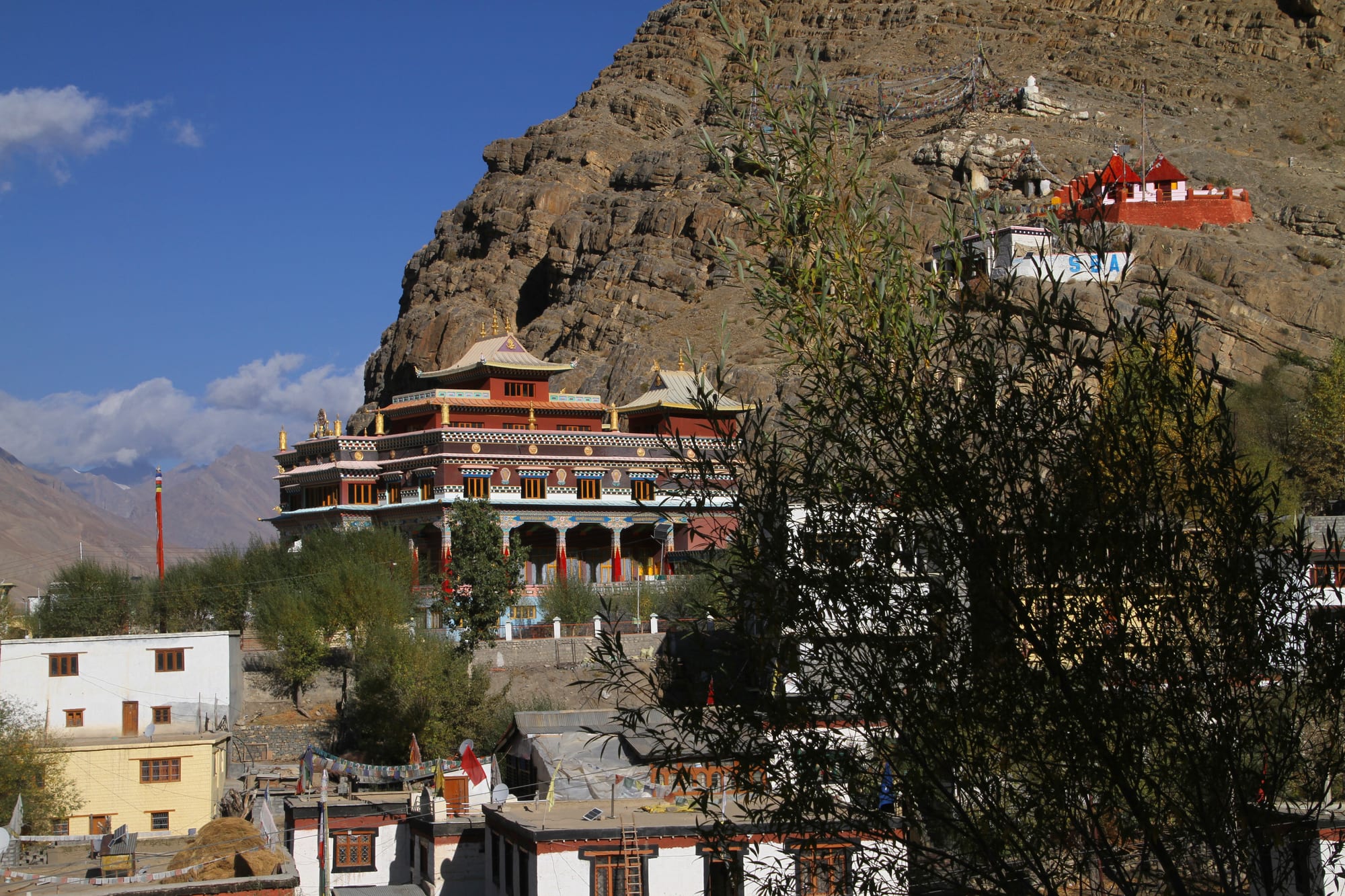
The red and gold Sakya monastery of Kaza above whitewashed flat-roofed houses, with a bare rock mountain and prayer flags behind

Delhi, the Himalaya & the North, India

Kaza

The Sakya Tangyud monastery above the houses of Kaza in the Spiti valley. (Gerd Eichmann / Wikimedia Commons · CC BY-SA 4.0)

The administrative centre and largest settlement of the Spiti valley in Himachal Pradesh, a village of flat-roofed houses and a Sakya monastery at about 3,650 metres on the bank of the Spiti River. It is the supply town and base for the valley's high villages and monasteries, cut off from the Manali side by snow for much of the year, and the centre of a short, busy summer of road-trip tourism.

Neighbourhoods

  • Old Kaza (Kaza Khas)
    • Historic district
    • Monastery
    • Local life

    The original village on the slope above the river, a cluster of whitewashed mud-brick houses. Lanes are narrow and unpaved, prayer flags cross between roofs, and this is where most of the traditional homestays are.

    Open in Maps
  • New Kaza (Kaza Soma)
    • Close to public transport
    • Hotels and guesthouses

    The newer half across the stream, which holds the administrative buildings of the Spiti subdivision and many of the guesthouses and cafés that have opened for the summer trade.

    Open in Maps
  • The main bazaar
    • Best for food
    • Shopping
    • Cafés

    The short commercial street between the two halves, where the valley's shops, trekking agencies, cafés and dhabas stand side by side. As the valley's main commercial centre it is the place to stock up on supplies, and the meeting point for drivers, trekkers and motorcyclists.

    Open in Maps

Things to do

In the village

  • Sakya Tangyud Monasterylandmark

    A monastery of the Sakya school of Tibetan Buddhism, a branch of the old Tangyud Gompa of Komic, inaugurated by the Dalai Lama in 2009 and the centre of the village's religious life.

    Open in Maps
  • Spiti Riverattraction

    The glacier-fed river that runs past the village from north-west to south-east, at its fullest in late summer when the glaciers melt.

    Open in Maps

Short trips from the village

  • Key Monasterylandmark

    The largest monastery in Spiti, a stacked, fortress-like Gelugpa gompa on a conical hill above the river about 12 km up-valley, founded about a thousand years ago and home to a community of monks.

    Open in Maps
  • Kibberattraction

    A high village at about 4,270 metres, one of the highest villages in the world inhabited year round, and the base for the Kibber Wildlife Sanctuary, home to about 30 snow leopards, where sighting tours are popular in winter.

    Open in Maps
  • Komicattraction

    A tiny village with a Sakya monastery, often described as one of the highest villages in the world reached by a motorable road.

    Open in Maps
  • Langzaattraction

    A small village at the base of the peak of Chau Chau Kang Nilda, known as the fossil village of Spiti.

    Open in Maps
  • Hikkimattraction

    A village at about 4,400 metres whose small post office is claimed as the highest in the world; visitors send postcards from it.

    Open in Maps
  • Dhankar Monasterylandmark

    A fort monastery on a 300-metre spur above the meeting of the Spiti and Pin rivers, about 32 km down-valley by road, the valley's capital in the 17th century, with a high-altitude lake about an hour's walk above it.

    Open in Maps
  • Pin Valley National Parkpark

    A cold-desert national park in the side valley of the Pin River, home to snow leopards, Siberian ibex and bharal.

    Open in Maps
  • Tabo Monasterylandmark

    A monastery inside a high mud-brick wall, founded in 996 AD lower down the valley towards Kinnaur, famous for its murals and clay sculptures and known as the Ajanta of the Himalayas.

    Open in Maps
  • Chandra Taalattraction

    A crescent-shaped lake at about 4,300 metres on the Manali side of the Kunzum Pass, reached from late May to early October by a road ending about 1 km from the shore, with camping nearby.

    Open in Maps

Seasonal events

  • Ladarcha FairAugust, usually the third week

    Spiti's largest annual event, once a trade fair near Chichim village for traders from Ladakh, Tibet, Bushahr and Kullu, revived in the 1980s and now held at Kaza as a cultural fair.

  • LosarAround November

    Spiti's own new-year festival, one of the main festivals celebrated in Kaza, held as the valley closes in for winter.

Eat and drink

Long-standing places and food districts in Kaza. Hours, ratings and directions come from your maps app, always current.

Spitian classics

  • Main bazaar dhabas and cafésneighborhood

    The bazaar's small eating places serve thukpa, thenthuk and momos alongside dal, rice and parathas for drivers and trekkers, with a few summer cafés offering coffee, pancakes and sea-buckthorn tea.

    Open in Maps
  • Homestay kitchensrestaurant

    The most authentic Spitian food is cooked in homestays in old Kaza and the villages: barley tsampa, butter tea, local peas and potatoes, and chhang, the home-brewed barley beer.

    Open in Maps

Experience Kaza

History

Kaza grew up as a village on the main valley floor of Spiti, the 'middle country' between Tibet, Ladakh and Kinnaur, on the bank of the Spiti River. The valley has been Buddhist since the second spread of the faith across the western Himalaya around the tenth and eleventh centuries, when the great monasteries of Tabo and Key were founded; Kaza's own Sakya monastery is a much later building, but the Sakya school has been present in the valley for centuries. For most of its history the village lived on barley, peas and yaks, and on the summer trade that crossed the passes to Ladakh and Tibet.

Spiti came briefly under Dogra rule, as part of the Sikh Empire, from 1842, and under the Treaty of Amritsar of 1846 passed to direct British administration. The Sino-Indian war of 1962 ended the old trade with Tibet, and the valley was opened to tourism only in 1992. After Lahaul and Spiti became a district in 1960, Kaza became the headquarters of the Spiti subdivision of Lahaul and Spiti district, which brought the offices, the health centre and the bus stand and made it the valley's one town.

The road over the Kunzum Pass from Manali and the slow improvement of the Kinnaur road, together with the opening of the Atal Tunnel below the Rohtang Pass in 2020, have transformed the last fifteen years. Road-trip tourism from the Indian cities now fills Kaza every summer, guesthouses and cafés have multiplied, and the village is working out how to manage water, waste and traffic in a cold desert.

Culture & Customs

Kaza is a Spitian village, and Spiti is culturally Tibetan: the people speak a Bhoti dialect, practise Tibetan Buddhism, and build whitewashed, flat-roofed houses of mud brick. The monasteries, Key above all, set the religious calendar. Kaza's Sakya monastery, inaugurated by the Dalai Lama in 2009, is the village's own centre, and he held Kalachakra ceremonies at Tabo in 1983 and 1996.

The Ladarcha fair in August, once a trade fair near Chichim with traders from Ladakh and Tibet, was revived in the 1980s and is now held in Kaza as the valley's largest annual event. Spiti Losar, the new year, falls around November, and Dachang around February. Everyday manners are those of the Buddhist Himalaya: clockwise around anything sacred, shoes off, a cup of butter tea or chhang offered to guests, and a strong tradition of hospitality that the homestay movement has turned into a livelihood.

The village's newer identity is as a base for travellers: motorcyclists on the Manali–Kaza circuit, photographers, trekkers heading over the Parang La to Ladakh, and winter visitors tracking snow leopards near Kibber. Cafés have appeared along the bazaar, and the mix of monks, government clerks, farmers and visitors on one short street is what Kaza feels like in summer.

Daily Life

Kaza is a small place that fills up in summer, when seasonal workers, drivers and guesthouse staff arrive from elsewhere. Government jobs are a mainstay: the subdivisional offices, the school, the health centre and the police draw families from across the valley. Farming is still the base, and green peas, grown as a cash crop, have largely replaced the barley and black peas of the past, in a short growing season. Tourism is the third main source of income.

The day runs with the sun and the cold. Summer mornings are bright and still, afternoons bring a hard wind up the valley, and by evening the temperature drops sharply even in July. Winter closes the Manali road, buries the lanes, and reduces the village to its residents, who spend the months on prayer, weaving and repairs with the stove as the centre of the house.

The current issues are those of a fragile place under new pressure: water, in a cold desert fed by glacier streams; the plastic and sewage that tourism brings; electricity and mobile networks that fail for days; and the question of how much building the village and its river bank can take. Homestays spread the benefit of visitors to the outlying villages.

Food

Spitian food is the cooking of a cold desert at high altitude: barley, which grows where wheat will not, roasted and ground into tsampa and stirred into tea or kneaded into dough; peas and potatoes from the terraces; mutton and yak when an animal is slaughtered; and dairy from cows, yaks and dzos. Butter tea, salted and churned, is drunk through the day, and chhang, a cloudy barley beer brewed at home, is offered to guests and poured at festivals. Dried foods see families through the winter.

The dishes a visitor meets are shared with Ladakh and Tibet: thukpa, a noodle soup with vegetables or meat; thenthuk, its hand-pulled cousin; momos steamed or fried; tingmo, a steamed bread; and skyu, a stew of thumbed pasta and root vegetables. Sea buckthorn, a high-altitude berry that grows in the valley, is made into a tea and juice sold in the bazaar as a local speciality.

Kaza's bazaar also feeds the drivers and road-trippers on north Indian dhaba food, parathas and omelettes for breakfast, dal, rice and sabzi at lunch, and chai everywhere. A handful of summer cafés serve coffee, pancakes and pizza to a backpacking crowd. The best meals are in the homestays, where the family cooks what it grows, and in the monasteries' kitchens at festival time.

Planning tools

Budget

Rooms and food are cheap, but everything has to be trucked in over mountain passes, so supplies cost more than in the plains, and transport is the big expense: a hired jeep for a day in the high villages costs far more than a night's lodging. Homestays in the villages are often the best value and include meals.

Daily Budget Midrange
USD 40–100 (better guesthouse, café meals, a hired jeep with driver for the villages)
Daily Budget Shoestring
USD 15–30 (homestay or guesthouse bed, dhaba meals, local buses and shared jeeps)

Carry enough cash for the whole stay; the village's few ATMs often run out or go offline, and card machines are rare.

Best Time to Visit

Mid-June to September, when both roads are usually open, the days are warm and the barley fields are green. July and August are the busiest months, with Indian road-trippers filling the guesthouses. October is cold but clear and quiet before the Manali road closes. From roughly November to May only the long Kinnaur road is open, often with snow and ice, and most guesthouses shut; a few winter visitors come for snow leopard watching near Kibber.

Suggested Number of Days

The village itself needs a day, and a rest day on arrival helps the body adjust to the altitude. Four to six days allow the monasteries and high villages up and down the valley at a sensible pace; the roads are slow, and the journey in and out adds two days or more at either end.

First Visit
2 days
With Surroundings
4–6 days

Transportation

Kaza is the hub of Spiti's thin transport network. State buses run from Kaza down the valley towards Tabo and Rekong Peo, up to Key and Kibber, and in summer to Manali, once a day; in winter there are no buses to the villages. Shared taxis and hired jeeps fill the gaps, and most visitors arrive in their own car, on a motorcycle or with a tour driver. The village is walked.

Fuel up here — Kaza has the only petrol station in the valley — and fix a jeep price for the day before setting out.

Airport & Station Connections

Two roads reach Kaza. From Manali, about 200 km over the Kunzum Pass at roughly 4,550 metres, takes nine to twelve hours and is open only from about June or July to October or November. From Shimla through Kinnaur, about 470 km along the Sutlej and Spiti rivers, is usually broken with overnight stops in Kinnaur and stays open for most of the year, apart from short closures for landslides or heavy snow. The nearest airport is Bhuntar near Kullu, beyond Manali. Foreign nationals need an inner line permit to visit the Spiti valley.

Walkability

The whole village can be crossed on foot in twenty minutes, old Kaza to the bazaar to the offices of new Kaza. Lanes are steep, dusty and unlit, and at this altitude even short climbs leave newcomers breathless until they have acclimatised. There is no pavement on the main road.

Safety

The dangers are the altitude and the roads. At about 3,650 metres, altitude sickness is common in people who drive up from Manali in a day; the Kinnaur approach climbs more gradually. The roads are narrow, unfenced and subject to landslides and rockfall, especially in the monsoon. Kaza has only a community health centre, larger hospitals are far away, and mobile coverage, from BSNL, Airtel and Jio, can fail.

Ascend slowly, drink plenty, do not drive the passes after dark, and carry warm clothing in any month. Check current official travel advice before travelling.

Climate

A cold desert in the rain shadow of the Himalaya: very little rain, hard sun by day, sharp cold at night, and a long winter of deep snow and temperatures far below freezing. Summer days are mild and dry.

Summer
mild and dry — July, the warmest month, averages about 15°C, with strong sun, and nights can still fall to freezing
Winter
severe — January minimums can reach −30°C, with snow closing the Manali road

Local Customs

Spiti is Tibetan Buddhist in language, faith and manners, and visitors are expected to walk clockwise around monasteries, stupas and mani walls, remove shoes inside temples, ask before photographing monks, shrines or villagers, and dress modestly. Tipping is not expected but small sums for drivers and homestay families are welcome.

Water is precious and plastic waste is a serious problem: carry a refillable bottle, take rubbish out of the valley, and respect village requests about where to camp and park.

Common Payment Methods

The currency is the Indian rupee, and Kaza is a cash economy. UPI phone payments work when the network does, cards are rarely accepted, and the village's ATMs can be unreliable, so money is best withdrawn in Manali or Rekong Peo.