History
The plain north of Delhi has been a battlefield for millennia. Kurukshetra in Haryana is the setting of the Mahabharata war, and Panipat saw three decisive battles: Babur's victory in 1526 that founded the Mughal empire, Akbar's in 1556 and the Afghan defeat of the Marathas in 1761. Delhi itself was rebuilt as a capital again and again — by the Delhi Sultanate from the 1190s, whose Qutb Minar still stands, and by Shah Jahan, who built the walled city of Shahjahanabad and its Red Fort in the 1640s. The British moved their capital here from Calcutta in 1911, and Edwin Lutyens' and Herbert Baker's New Delhi was inaugurated in 1931.
Punjab is the homeland of Sikhism, founded by Guru Nanak in the early 16th century; Amritsar grew around the pool and temple laid out by the fourth and fifth Gurus. Maharaja Ranjit Singh built a Sikh empire in the early 19th century that the British annexed in 1849, and at Amritsar's Jallianwala Bagh in 1919 British troops fired on an unarmed crowd, killing hundreds. Partition in 1947 cut Punjab in two and sent millions across the new border. A Sikh separatist insurgency in the 1980s brought the army into the Golden Temple in 1984.
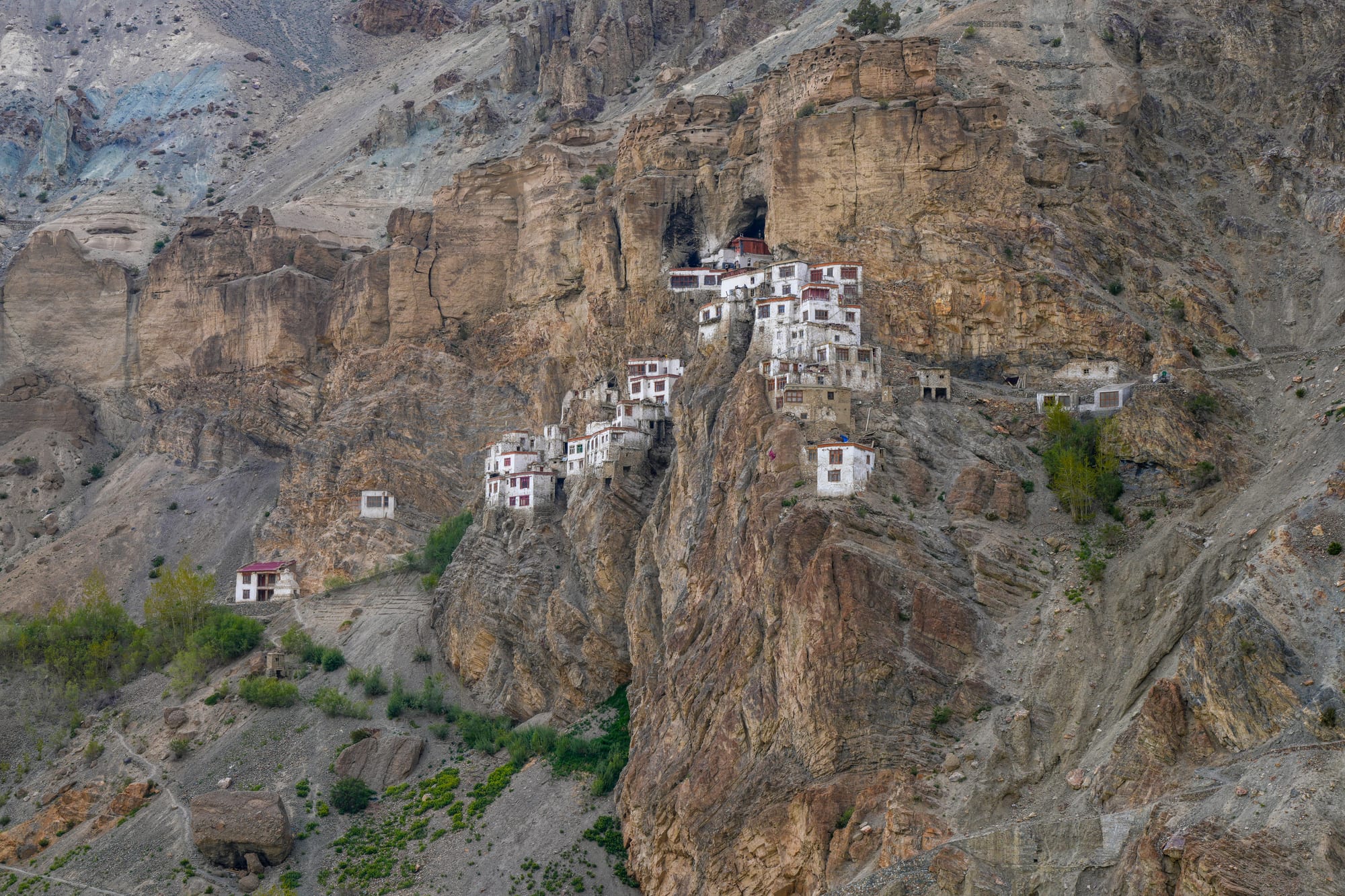
The mountains followed other paths. Shimla became the summer capital of British India, while Ladakh long remained a Buddhist kingdom tied to Tibet. The princely state of Jammu and Kashmir, whose ruler acceded to India in 1947, has been claimed in full by both India and Pakistan ever since, with wars in 1947, 1965 and 1999; India administers Jammu and Kashmir and Ladakh, Pakistan administers Azad Kashmir and Gilgit-Baltistan, and China administers Aksai Chin, which India claims as part of Ladakh. In 2019 India revoked the state's special status and split it into two union territories. Himachal Pradesh became a state in 1971, and Uttarakhand was carved from Uttar Pradesh in 2000.