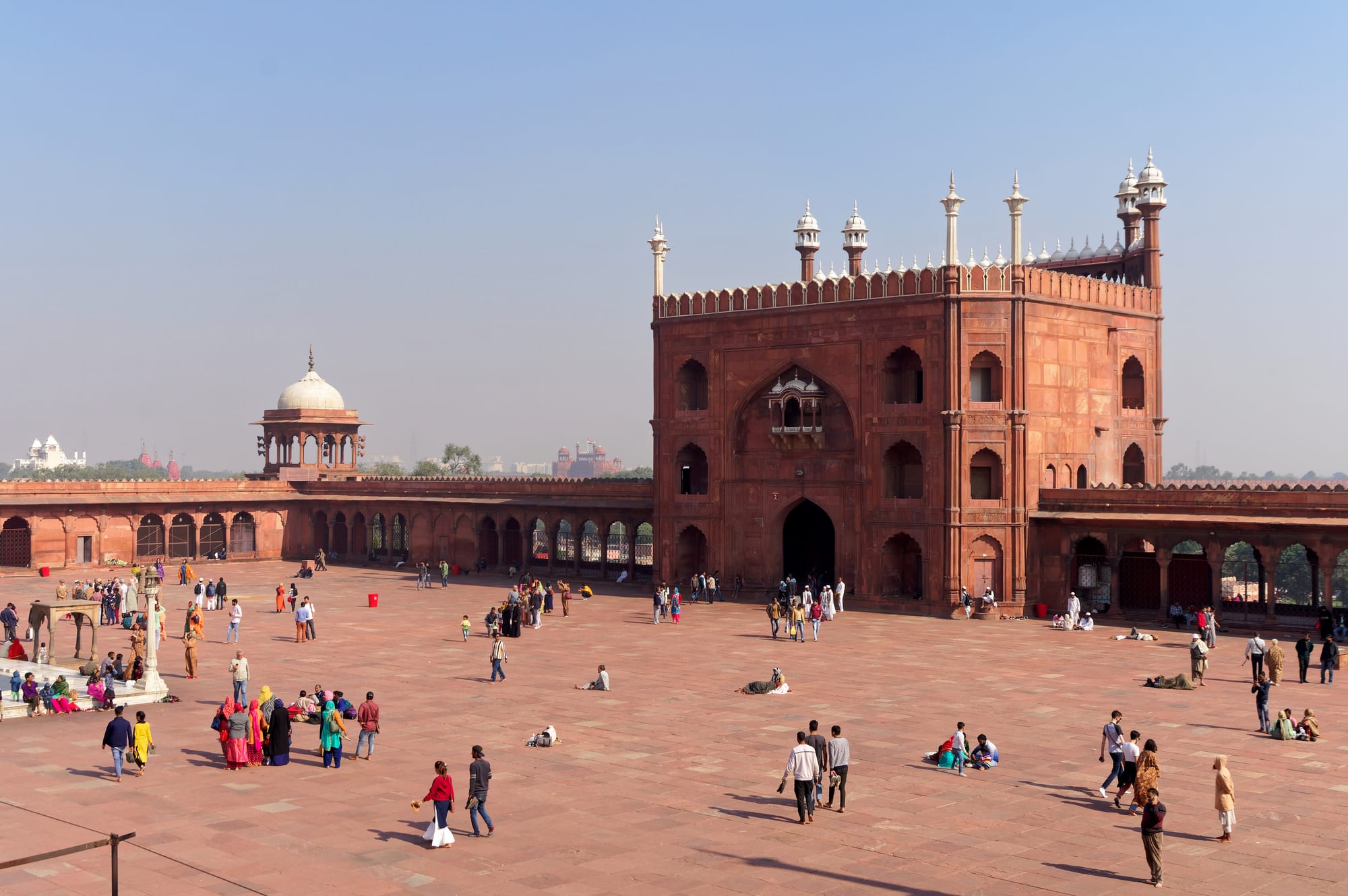
A wide red sandstone courtyard with people crossing it, in front of a tall arched gateway topped by white-domed pavilions

Delhi, the Himalaya & the North, India

Delhi

The courtyard and eastern gate of the Jama Masjid in Old Delhi. (Jakub Hałun / Wikimedia Commons · CC BY-SA 4.0)

India's capital, spread across the plain beside the Yamuna river in the north of the country. Successive dynasties built their capitals here, leaving the Qutb Minar, Humayun's Tomb, the Red Fort and the walled lanes of Shahjahanabad; the British added the wide avenues of New Delhi. It is now the centre of national government and one of the largest urban areas on earth.

Neighbourhoods

  • Old Delhi
    • Historic district
    • Best for food
    • Markets

    Shah Jahan's walled city of Shahjahanabad, laid out in the 1640s around the Red Fort and the Jama Masjid. Its lanes are packed with wholesale bazaars, kebab shops and sweet stalls, and cycle rickshaws are the usual way through them. The Chandni Chowk metro station puts it within easy reach of the rest of the city.

    Open in Maps
  • Connaught Place
    • First-time visitors
    • Close to public transport
    • Shopping

    The white colonnaded circles at the centre of New Delhi, built in the 1930s as the commercial heart of the imperial capital. Shops, offices, restaurants and airline counters fill the arcades, two metro lines cross beneath it at Rajiv Chowk, and many mid-range hotels stand in the streets around.

    Open in Maps
  • Lutyens' Delhi
    • Architecture
    • Quiet and residential
    • Parks

    The low-rise government quarter of wide avenues, roundabouts and bungalows laid out by Edwin Lutyens and Herbert Baker. Rashtrapati Bhavan, the ministries and India Gate stand along the central axis, and the district is green, formal and unusually quiet for Delhi.

    Open in Maps
  • Paharganj
    • Budget travellers
    • Close to public transport

    The crowded grid of guesthouses, cheap restaurants and shops opposite New Delhi railway station, long the main backpacker district. It is noisy, dense and convenient for trains and the airport express, and touts are a constant presence.

    Open in Maps
  • Hauz Khas and South Delhi
    • Nightlife
    • Best for food
    • Historic district

    A southern district built around a medieval reservoir and the ruins of a 14th-century madrasa and tomb. Hauz Khas Village beside them holds bars, boutiques and restaurants, and the wider South Delhi colonies are the city's more affluent residential areas.

    Open in Maps
  • Mehrauli
    • Historic district
    • Ruins and gardens

    The oldest continuously inhabited part of Delhi, in the far south, grown up around the Qutb Minar and the first of the city's medieval capitals. Tombs, stepwells and mosque ruins are scattered through an archaeological park and the surrounding lanes.

    Open in Maps

Things to do

Famous landmarks

  • Red Fortlandmark

    Shah Jahan's red sandstone palace-fortress of the 1640s, a UNESCO World Heritage Site and the place where the prime minister addresses the nation each Independence Day.

    Open in Maps
  • Jama Masjidlandmark

    One of India's largest mosques, completed in 1656 in red sandstone and white marble, with a courtyard that holds tens of thousands of worshippers.

    Open in Maps
  • Qutb Minarlandmark

    A 72.5-metre victory tower begun in 1199, the tallest minaret in the world built of brick, standing in a UNESCO-listed complex with the Quwwat-ul-Islam mosque and an uncorroded ancient iron pillar.

    Open in Maps
  • Humayun's Tomblandmark

    The garden tomb of the second Mughal emperor, finished in 1572, a UNESCO World Heritage Site whose design led towards the Taj Mahal.

    Open in Maps
  • India Gatelandmark

    A 42-metre memorial arch of 1931 at the end of Kartavya Path, inscribed with the names of Indian soldiers who died in the First World War and the Third Anglo-Afghan War.

    Open in Maps
  • Rashtrapati Bhavanlandmark

    Lutyens' vast presidential palace of 1929, with a copper dome over a sandstone facade and the terraced gardens behind it, renamed Amrit Udyan in 2023.

    Open in Maps
  • Lotus Templelandmark

    A Baháʼí house of worship completed in 1986, built as twenty-seven marble petals and open to people of any faith for silent prayer.

    Open in Maps
  • Akshardhamlandmark

    A large carved stone Hindu temple complex on the east bank of the Yamuna, opened in 2005 by the Swaminarayan organisation BAPS.

    Open in Maps
  • Purana Qilalandmark

    A 16th-century fort on a mound by the Yamuna's old course, associated with the emperors Humayun and Sher Shah Suri and with the legendary city of Indraprastha.

    Open in Maps

Museums and galleries

  • National Museummuseum

    India's principal museum, holding Indus Valley finds, Buddhist relics, miniature paintings, bronzes and textiles from across the subcontinent.

    Open in Maps
  • National Gallery of Modern Artmuseum

    Modern and contemporary Indian art in a former princely house near India Gate, with major holdings of Amrita Sher-Gil and Rabindranath Tagore.

    Open in Maps
  • Gandhi Smritimuseum

    The house where Mahatma Gandhi spent his last months and was assassinated in January 1948, kept as a memorial with his rooms preserved.

    Open in Maps
  • National Rail Museummuseum

    Steam locomotives, royal saloons and rolling stock from across the Indian railway network, displayed outdoors in Chanakyapuri.

    Open in Maps
  • Crafts Museummuseum

    Folk and tribal crafts, textiles and village architecture gathered from every Indian state, beside Purana Qila.

    Open in Maps

Gardens, tombs and quiet corners

  • Lodhi Gardenspark

    A landscaped park in central Delhi scattered with the domed tombs and mosques of the Sayyid and Lodi rulers of the late Delhi Sultanate, busy with walkers at dawn.

    Open in Maps
  • Sunder Nurserypark

    A restored 16th-century Mughal garden beside Humayun's Tomb, with monuments, lakes and an arboretum, opened to the public in 2018.

    Open in Maps
  • Mehrauli Archaeological Parkpark

    More than a hundred monuments spread through scrub and woodland near the Qutb Minar, among them the Jamali Kamali mosque and Balban's tomb.

    Open in Maps
  • Safdarjung's Tomblandmark

    The last of the great Mughal garden tombs, built in the 1750s for a Nawab of Awadh, set in a walled charbagh.

    Open in Maps
  • Agrasen ki Baolilandmark

    A deep stone stepwell of a hundred-odd steps hidden between office towers off Connaught Place.

    Open in Maps
  • Jantar Mantarlandmark

    Large masonry astronomical instruments built in the 1720s for Maharaja Jai Singh II, used to measure time and track the heavens.

    Open in Maps

Places of worship

  • Nizamuddin Dargahlandmark

    The shrine of the 14th-century Sufi saint Nizamuddin Auliya, reached through a lane of shops, where qawwali is sung on Thursday evenings.

    Open in Maps
  • Gurdwara Bangla Sahiblandmark

    Delhi's principal Sikh temple, with a gilded dome, a large sacred tank and a community kitchen that serves free meals all day.

    Open in Maps
  • Laxminarayan Templelandmark

    A Hindu temple built by the Birla family between 1933 and 1939 and inaugurated by Gandhi on condition that it admit people of all castes.

    Open in Maps

Markets and bazaars

  • Chandni Chowkmarket

    The main street of Old Delhi, laid out in the 17th century and now a wholesale bazaar whose side lanes specialise in silver, spices, saris, paper and wedding goods.

    Open in Maps
  • Khari Baolimarket

    A spice market west of Chandni Chowk, often described as the largest in Asia, where sacks of chilli, turmeric and dried fruit fill the arcades.

    Open in Maps
  • Dilli Haatmarket

    An open-air craft and food market near INA where artisans from different states take stalls in rotation.

    Open in Maps
  • Janpath and Connaught Place shopsmarket

    A street of textile, handicraft and souvenir stalls running south from Connaught Place, beside the state emporiums on Baba Kharak Singh Marg.

    Open in Maps

Seasonal events

  • Republic Day parade26 January

    A military and cultural procession down Kartavya Path past the president and invited heads of state, with rehearsals closing central roads for days beforehand.

  • HoliFebruary or March

    The spring festival of colours, when coloured powder and water are thrown in the streets and most of the city takes the day off.

  • Ramlila and DussehraSeptember or October

    Open-air dramatisations of the Ramayana staged across the city for several nights, ending with the burning of giant effigies of Ravana.

  • DiwaliOctober or November

    The festival of lights, when the bazaars trade late, buildings are hung with lamps, and fireworks add to the autumn smog.

  • New Delhi World Book Fairwinter

    India's second-oldest book fair after Kolkata's, first held in 1972 and now staged annually at the Pragati Maidan exhibition grounds.

Eat and drink

Long-standing places and food districts in Delhi. Hours, ratings and directions come from your maps app, always current.

Delhi classics

  • Karim'srestaurant

    A Mughlai kitchen in the lanes beside the Jama Masjid, founded in 1913 by a family who traced their cooking to the imperial kitchens, known for mutton korma, seekh kebabs and nihari.

    Open in Maps
  • Moti Mahalrestaurant

    The Daryaganj restaurant opened by Punjabi refugees after Partition, credited with popularising tandoori chicken, butter chicken and dal makhani.

    Open in Maps
  • Paranthe Wali Galineighborhood

    A narrow lane off Chandni Chowk where a handful of long-established shops fry stuffed parathas to order and serve them with pickles and chutneys.

    Open in Maps

Food districts and markets

  • Chandni Chowk street foodneighborhood

    Chaat, jalebi, kachori, kebabs and milk sweets sold from shopfronts and carts along the main street and its side lanes, many of the shops several generations old.

    Open in Maps
  • Khan Marketneighborhood

    A compact U-shaped market of bookshops, delicatessens, cafés and restaurants in Lutyens' Delhi, built in 1951 for refugees from the North-West Frontier.

    Open in Maps
  • Majnu-ka-tillaneighborhood

    The Tibetan settlement in north Delhi, where small restaurants serve momos, thukpa and butter tea.

    Open in Maps
  • Hauz Khas Villageneighborhood

    Bars, cafés and restaurants packed into the converted houses of an urban village beside the medieval reservoir and its ruins.

    Open in Maps

Experience Delhi

History

Delhi's site, where the Aravalli ridge meets the Yamuna, has carried a succession of capitals rather than one continuous city. Tradition places the Mahabharata's Indraprastha here, and the earliest firm remains are those of the Tomara and Chauhan Rajput forts at Lal Kot and Qila Rai Pithora in the south. After the defeat of Prithviraj Chauhan in 1192, Qutb al-Din Aibak founded the Delhi Sultanate and began the Qutb Minar; his successors built new walled capitals at Siri, Tughlaqabad, Jahanpanah and Firozabad, whose ruins are scattered across the modern city.

The Mughals took Delhi in 1526, though Agra was their chief seat until Shah Jahan built Shahjahanabad in the 1640s, with the Red Fort at its edge and the Jama Masjid at its centre. Nader Shah's invasion of 1739 and repeated Maratha and Afghan campaigns left the empire a shadow, and the last emperor, Bahadur Shah Zafar, was deposed and exiled after the rebellion of 1857, during which the British stormed the walled city.

In 1911 the British announced the transfer of the capital from Calcutta, and Edwin Lutyens and Herbert Baker laid out New Delhi to the south of the old city; it was inaugurated in 1931. Partition in 1947 transformed Delhi again: much of its Muslim population left for Pakistan and hundreds of thousands of Hindu and Sikh refugees arrived from West Punjab, founding whole new colonies and reshaping the city's commerce and cooking. Anti-Sikh violence followed the assassination of Indira Gandhi in 1984. Since the 1990s the capital has expanded far beyond its old limits into the satellite cities of the National Capital Region.

Culture & Customs

Delhi is a city of arrivals, and its culture reflects that. Urdu poetry flourished here under the later Mughals, and the ghazals of Mirza Ghalib, who lived and is buried in the old city, are still recited; Hindustani classical music, Kathak dance and qawwali all have deep roots, the last heard most famously at the Nizamuddin shrine on Thursday evenings. Modern Delhi supports a dense arts scene, with the national academies, repertory theatre, literature festivals and large book fairs.

Punjabi culture dominates much of the city's public life after the refugee influx of 1947 — in food, in wedding customs and in the loud confidence Delhi is known for across India. The Sikh gurdwaras, the Sufi shrines, the Jain temples of the old city, the churches of the colonial quarter and the newer Baháʼí and Swaminarayan complexes give a fair picture of the range of faiths practised here. Festivals run through the year, and the calendar effectively pauses for Holi, Diwali and Eid.

Manners follow national patterns: shoes off at shrines and in homes, the right hand for eating and giving, modest dress at religious sites, and a broad reluctance to say a plain no. Cricket is followed obsessively and played on every scrap of open ground. Delhiites have a reputation elsewhere in India for being brash, status-conscious and quick to talk about property prices and government appointments — a caricature, but one residents enjoy repeating.

Daily Life

The National Capital Territory recorded about 16.8 million residents at the 2011 census and has grown since; the wider metropolitan region, taking in Gurugram, Noida, Faridabad and Ghaziabad, is among the largest urban areas in the world with more than 28 million people. Government is the defining employer, along with services, retail, construction, information technology in the satellite cities and enormous wholesale trade in the old city.

Housing ranges from the bungalows of Lutyens' Delhi and the gated towers of Gurugram through the planned colonies of South and West Delhi to urban villages and unauthorised settlements where services are thin. Long commutes are the norm, and the metro carries millions of passengers a day. Mornings begin early, with walkers in the parks by sunrise; shops open late morning and trade into the evening, and dinner is eaten late.

Two problems shape daily life more than any other. Air pollution peaks between November and February, when cold, still air traps vehicle and industrial emissions along with smoke from crop burning in neighbouring states, closing schools in the worst weeks. Water supply and groundwater depletion are a chronic strain, and the Yamuna within the city is heavily polluted. Summer heatwaves, flooding during the monsoon and pressure on the metro and roads are all part of the same picture of a city growing faster than its infrastructure.

Food

Delhi's cooking is the product of its migrations. From the Mughal kitchens and the old city come slow-cooked meats: nihari, a beef or mutton stew simmered overnight and eaten at breakfast with khameeri roti; korma; seekh and galouti kebabs; and biryani. From Punjab, after 1947, came the tandoor and the dishes now served worldwide as Indian food — tandoori chicken, butter chicken, dal makhani and the breakfast of chole bhature, spiced chickpeas with a large puffed fried bread.

Street food is a discipline of its own. Chaat covers a family of tangy snacks built on fried dough, potato and chickpea with yoghurt, tamarind and mint chutneys: aloo tikki, papri chaat, dahi bhalla and golgappa, the hollow crisp spheres filled with spiced water. The lanes off Chandni Chowk fry stuffed parathas, kachori and jalebi, and sell milk sweets, rabri and, in winter, daulat ki chaat, a frothed milk confection sold only in the cold months.

Kebab rolls, momos brought by Tibetan and north-eastern migrants, and South Indian dosas are all everyday street food here. Drinks run from sweet milky chai to lassi, sugarcane juice, nimbu pani and, in winter, hot carrot kanji. Khan Market, Hauz Khas and the hotel districts hold the more expensive restaurants, several of them serving reworked regional Indian cooking, while Old Delhi keeps to what it has always made.

Planning tools

Budget

Delhi covers the full range, from Paharganj guesthouses to international luxury hotels, and street food and metro travel keep daily costs low. The main variables are the standard of hotel and how much is spent on taxis rather than the metro. Monument entry fees for foreign visitors are several times the Indian rate but still modest.

Daily Budget Midrange
USD 60–140 (mid-range hotel, restaurant meals, monument entry fees, taxis or a car with driver)
Daily Budget Shoestring
USD 15–30 (guesthouse or dormitory, street food and dhaba meals, the metro and autorickshaws)

Use prepaid or app-based taxis rather than negotiating at stations, agree an autorickshaw fare or insist on the meter before setting off, and eat one meal a day at a gurdwara langar or a busy street stall for very little.

Best Time to Visit

October to March is the comfortable half of the year, with warm days and cool nights, though December and January bring dense fog that delays flights and trains, and the winter months have the worst air pollution. March and October are the most balanced months. April to June is very hot, and the monsoon from July to September is humid with heavy downpours and flooded roads.

Suggested Number of Days

Delhi's monuments are spread over a very large area and traffic eats into the day, so three or four days is a realistic minimum. Add two or three more to combine the city with the towns of the surrounding plain. Interest in Mughal architecture, museums or shopping lengthens a stay considerably.

First Visit
3–4 days
With Surroundings
5–7 days

Transportation

The Delhi Metro is the quickest way around: it is extensive, cheap, air-conditioned and signed in English and Hindi, with women-only carriages at the front of each train. App-based taxis and autorickshaws fill the gaps, buses are slow and crowded, and cycle rickshaws are the practical way through Old Delhi's lanes. Traffic is heavy and driving oneself is not advisable.

Buy a rechargeable metro smart card on arrival, avoid the roads between about 8am and 11am and again from 5pm to 9pm, and ignore anyone at a station who says a hotel or tourist office has moved or closed.

Airport & Station Connections

Indira Gandhi International Airport is India's busiest, about 15 kilometres south-west of the centre, and the Airport Express metro line reaches New Delhi railway station in about fifteen minutes. Fast trains run from the city's several large stations to Agra, Jaipur, Amritsar, Chandigarh and Haridwar, and long-distance buses use terminals at Kashmere Gate and in the south of the city.

Walkability

Individual districts walk well — Old Delhi's bazaar lanes, Connaught Place's arcades, Lodhi Gardens and the Mehrauli ruins — but the distances between them are large and best covered by metro. Pavements are patchy or parked on, crossings are scarce and traffic does not yield, so walking along main roads is unpleasant. Summer heat and winter smog both limit how much time is comfortable outdoors.

Safety

Delhi has India's usual urban risks at a larger scale: touts and scams around New Delhi railway station and Paharganj, overcharging by drivers, pickpocketing in crowded markets, and a poor record of harassment of women in public. Violent crime rarely involves visitors. Winter air pollution is a genuine health hazard, and summer heat can be dangerous.

Book accommodation and transport in advance rather than through anyone who approaches in the street, take registered taxis or a ride-hailing app after dark, and women travellers may prefer the front metro carriage and to avoid empty streets at night. Check air quality readings between November and February and consider a mask on bad days. Check current official travel advice before travelling.

Climate

A humid subtropical climate with extremes in both directions. Spring is brief, summer is intensely hot and dusty before the monsoon breaks in late June or early July, autumn is clear and warm, and winter is cool, foggy and heavily polluted.

Summer
very hot — April to June regularly reaches 40–45°C, with dust storms before the monsoon and high humidity once it arrives
Winter
cool and foggy — December and January days of about 15–20°C with nights near 5°C, and thick smog on still mornings

Local Customs

Shoes are removed before entering temples, mosques, gurdwaras and many homes, and the head is covered in Sikh and Muslim places of worship — cloths are provided at the gurdwaras. Modest clothing covering shoulders and knees attracts less attention, particularly for women and in Old Delhi. Greetings are made with palms together and 'namaste'; the right hand is used for eating and giving. Photographing people, and especially at shrines, calls for permission.

Tipping is not obligatory but 5 to 10 per cent is usual in restaurants; alcohol is sold in licensed shops and restaurants only, with dry days on some national holidays, and drinking in public is not allowed.

Common Payment Methods

The currency is the Indian rupee. Cards are accepted in hotels, larger shops and restaurants, and the UPI mobile payment system is used almost everywhere by residents, but visitors will need cash for rickshaws, street food and market stalls. ATMs are plentiful; small notes are worth keeping for drivers and tips.