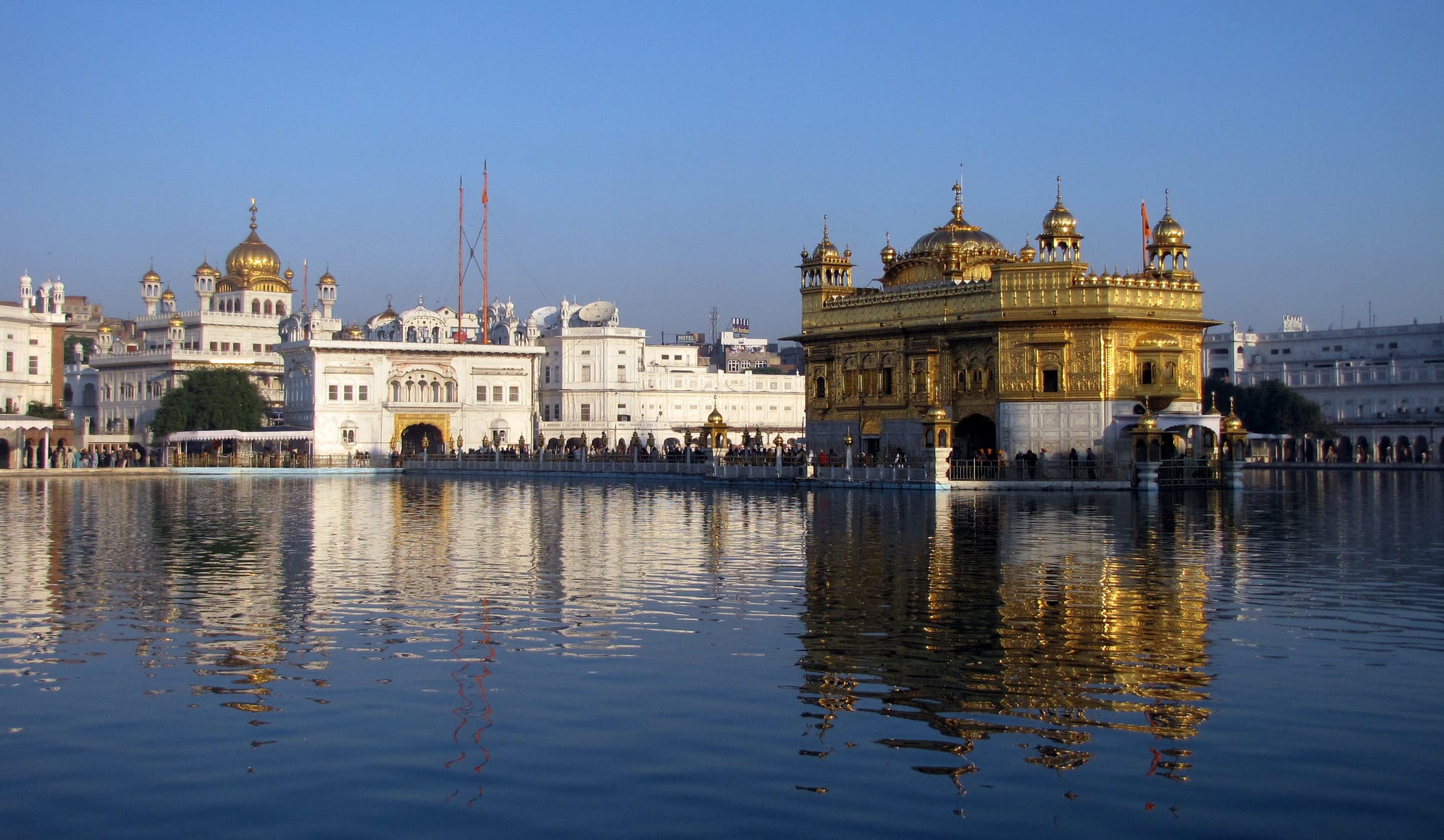
A gilded temple standing in a still pool of water, reflected alongside white marble buildings under a clear blue sky

Delhi, the Himalaya & the North, India

Amritsar

The Harmandir Sahib and the Akal Takht reflected in the sacred pool at the centre of Amritsar. (Jasleen Kaur / Wikimedia Commons · CC BY-SA 2.0)

Punjab's second-largest city and the holiest place in Sikhism, built around the sacred pool and gilded temple begun by the Sikh Gurus in the 16th century. It grew as a trading town on the route to Lahore, suffered the 1919 Jallianwala Bagh killings and the violence of Partition, and now lives on pilgrimage, farming trade and a strong food culture.

Neighbourhoods

  • The Golden Temple quarter
    • First-time visitors
    • Pilgrimage
    • Best for food

    The heart of the old city, reached along a pedestrianised sandstone plaza lined with shops and eating houses. Jallianwala Bagh, the Partition Museum and the Town Hall are all within a few minutes' walk of the temple gates, and most visitors stay somewhere in these lanes.

    Open in Maps
  • The walled city bazaars
    • Markets
    • Historic district
    • Street food

    The dense grid of katras and galis around Hall Bazaar, where cloth, shoes, spices, papad and wari, and religious goods are sold from narrow shopfronts. Traffic is a scrum of scooters and cycle rickshaws, and dhabas and sweet shops are scattered throughout.

    Open in Maps
  • Civil Lines and The Mall
    • Quiet and residential
    • Architecture

    The spacious colonial-era district north of the railway line, with broad roads, government offices, churches and older bungalows. It is calmer than the walled city and holds the Ram Bagh gardens and several of the larger hotels.

    Open in Maps
  • Ranjit Avenue and the newer suburbs
    • Shopping
    • Quiet and residential

    Planned residential blocks laid out east of the centre from the late 20th century, with wide streets, shopping malls, restaurants and much of the city's middle-class housing. It is a car or autorickshaw ride from the old city.

    Open in Maps

Things to do

Sacred sites

  • Golden Templelandmark

    Harmandir Sahib, the central shrine of Sikhism, a gold-plated building standing in the Amrit Sarovar pool, open to visitors of any faith with head covered and feet bare.

    Open in Maps
  • Akal Takhtlandmark

    The seat of temporal authority in Sikhism, founded by the sixth Guru in 1606, facing the Golden Temple across the causeway.

    Open in Maps
  • Durgiana Templelandmark

    A Hindu temple rebuilt in 1921 in the middle of a tank of its own, its plan and gilded roof modelled on the Golden Temple.

    Open in Maps

History and memory

  • Jallianwala Baghlandmark

    The walled garden where British Indian Army troops fired on an unarmed gathering in April 1919, killing hundreds; the bullet marks and a memorial well are preserved.

    Open in Maps
  • Partition Museummuseum

    A museum in the old Town Hall devoted to the 1947 division of Punjab and Bengal, built largely on oral histories of those who crossed the new border.

    Open in Maps
  • Gobindgarh Fortlandmark

    A brick and mud fort strengthened by Maharaja Ranjit Singh in the early 19th century, held by the army for many years and opened to the public as a heritage site in 2017.

    Open in Maps
  • Khalsa Collegelandmark

    A college founded in 1892 on the Grand Trunk Road, its long Indo-Saracenic facade one of the city's best-known buildings.

    Open in Maps

Parks and getting around

  • Ram Baghpark

    A walled garden laid out for Maharaja Ranjit Singh on the model of Lahore's Shalimar Bagh, a large green space near the city centre, with his summer palace at its heart.

    Open in Maps
  • Amritsar Junction railway stationtransit hub

    The city's main station, a short distance north of the walled city, and the terminus of the busy line from Delhi and Jalandhar.

    Open in Maps

Short trips from the city

  • Attari–Wagah border ceremonyattraction

    The daily flag-lowering drill performed by Indian and Pakistani border guards before crowded stands, about 28 kilometres west of the city.

    Open in Maps
  • Tarn Taran Sahiblandmark

    A gurdwara founded by the fifth Guru around a very large sacred tank, in a small town roughly 25 kilometres south of Amritsar.

    Open in Maps
  • Goindval Sahiblandmark

    A town on the Beas river with a baoli of eighty-four steps built by the third Guru, a place of pilgrimage since the 16th century.

    Open in Maps
  • Baba Bakalalandmark

    A gurdwara town east of Amritsar associated with Guru Tegh Bahadur, the ninth Guru, and drawing large crowds at its annual fair.

    Open in Maps

Seasonal events

  • BaisakhiApril

    The Punjabi harvest festival and the anniversary of the founding of the Khalsa in 1699, marked at the Golden Temple with processions and large crowds.

  • Bandi Chhor Divas and DiwaliOctober or November

    The Sikh festival marking the sixth Guru's release from imprisonment, when the temple and its pool are lit with lamps and fireworks.

  • Guru Nanak GurpurabNovember

    The birth anniversary of the first Guru, preceded by processions and continuous readings of the Guru Granth Sahib.

  • Ram Tirath fairNovember

    An annual fair at the Ram Tirath complex about 12 kilometres west of the city, a site linked to the sage Valmiki and the Ramayana.

Eat and drink

Long-standing places and food districts in Amritsar. Hours, ratings and directions come from your maps app, always current.

Amritsar classics

  • Amritsari kulcha shopsrestaurant

    Stuffed flatbreads baked in a tandoor until blistered, brushed with butter and eaten with chole and an onion salad, sold from specialist shops across the city.

    Open in Maps
  • Kesar da Dhabarestaurant

    A long-established vegetarian dhaba in the walled city, known for dal, thick parathas and firni served in clay bowls.

    Open in Maps
  • Guru Ram Das Langarrestaurant

    The free community kitchen inside the Golden Temple complex, where volunteers cook and serve more than 100,000 simple vegetarian meals a day.

    Open in Maps

Food districts and markets

  • The Heritage Street food shopsneighborhood

    The sandstone approach to the Golden Temple, lined with sweet shops, lassi stalls and kulcha bakeries.

    Open in Maps
  • Lawrence Roadneighborhood

    A newer strip of restaurants, ice cream parlours and fast-food counters north of the centre, busy in the evenings.

    Open in Maps
  • Hall Bazaar sweet and papad shopsmarket

    Shops in and around the main bazaar selling jalebi, barfi, and the papad and wari — spiced lentil crisps and dumplings — that the city sends across India.

    Open in Maps

Experience Amritsar

History

The city dates from the 1570s, when Guru Ram Das, the fourth Sikh Guru, acquired land here and began excavating a pool — the Amrit Sarovar, the pool of nectar, which gave Amritsar its name. His successor, Guru Arjan, built the Harmandir Sahib at its centre and installed the Adi Granth there in 1604. A settlement of traders and craftsmen grew around the tank, organised into the walled katras that still shape the old city, and it became Punjab's commercial capital on the road between Delhi and Lahore.

Afghan invaders damaged the temple repeatedly in the 18th century. Maharaja Ranjit Singh, who took Amritsar in 1802 and ruled a Sikh empire from Lahore, rebuilt it in marble and copper from 1809 and overlaid the sanctum with gold leaf in 1830, and strengthened Gobindgarh Fort to guard the city. The British annexed Punjab in 1849. On 13 April 1919 troops under Brigadier General Reginald Dyer fired on a crowd penned inside Jallianwala Bagh, killing hundreds; the massacre became a turning point in the independence movement.

Partition in 1947 cut the city off from Lahore, barely 50 kilometres away, and turned it into a border town. Its Muslim population left, refugees arrived from West Punjab, and the trade routes that had sustained it were severed. The Sikh separatist insurgency of the 1980s centred on the Golden Temple, which the Indian army entered in June 1984, an event that still shapes Punjabi politics. Since the 1990s the city has grown steadily on pilgrimage, agriculture and trade, and the approach to the temple was rebuilt as a broad sandstone plaza in recent years.

Culture & Customs

Amritsar's identity is inseparable from Sikh practice. Hymns from the Guru Granth Sahib are sung in the Harmandir Sahib from before dawn until late at night, broadcast across the complex; the scripture is carried in procession to and from the Akal Takht each day. Seva, voluntary service, is visible everywhere — visitors wash dishes, peel vegetables, sweep marble and hand out water, and the langar embodies the principle that everyone eats the same food sitting in the same rows.

Beyond the temple, the city is thoroughly Punjabi. Bhangra and giddha are danced at weddings and at Baisakhi, the dhol is the sound of any celebration, and Punjabi and Hindi are heard alongside the Gurmukhi script on every sign. Hindu and Sikh families are closely intertwined here, and the Durgiana Temple and the gurdwaras draw from overlapping congregations. Wrestling, kabaddi and cricket are all followed, and Punjabi music from the diaspora circulates back into the city.

Memory is a large part of local culture. Jallianwala Bagh, the Partition Museum and the events of 1984 are discussed openly, and many families still have relatives on the other side of a border they cannot easily cross. The evening ceremony at Attari–Wagah, theatrical and loudly patriotic, is part of the same inheritance. Visitors are treated with considerable warmth, and invitations to eat are frequent and sincere.

Daily Life

About 1.1 million people lived in the city at the 2011 census, with more in the surrounding district. The economy rests on pilgrimage and tourism, on the agriculture of the Majha plain around it, and on trade and small manufacturing — textiles, shawls, carpets, food processing and the printing of religious books. Government offices, colleges and hospitals employ many, and remittances from relatives in Canada, Britain and Australia support a great many households.

The rhythm of the day follows the temple. The first recitation begins in the early hours and pilgrims arrive before sunrise; the bazaars open in the mid morning; trade continues until late evening, and the temple complex is at its busiest and most atmospheric after dark. Weekends, festivals and school holidays bring enormous numbers of Indian visitors, and hotel rooms near the old city fill quickly.

Most residents live in the crowded lanes of the walled city or in the newer colonies spreading east and south, and the contrast between the two is sharp. Current concerns are those of Punjab generally: falling groundwater, the cost and sustainability of wheat and rice farming, drug addiction among young men, winter air pollution worsened by crop stubble burning, and the steady emigration of graduates. Border closures interrupt what little formal trade with Pakistan there is, and the city has never fully recovered the commercial position it lost in 1947.

Food

Amritsar is one of the great eating cities of north India. Its signature is the Amritsari kulcha, a leavened flatbread stuffed with spiced potato, paneer or onion, slapped onto the wall of a tandoor and served blistered and dripping with butter beside chole, chickpeas in a dark gravy, and a tamarind chutney. Breakfast is often chole bhature or puri with chana, and thick lassi in a tall steel tumbler.

Punjabi home cooking is well represented in the dhabas of the walled city: dal makhani simmered overnight, sarson da saag with makki di roti in winter, paneer dishes, and stuffed parathas cooked on a griddle. Amritsari fish, river fish coated in gram flour and carom seed and deep fried, is a local speciality, and tandoori meats are widely eaten outside the temple precinct, where all food is vegetarian. The langar itself serves dal, vegetables, roti and kheer.

Sweets and preserved foods are a serious local trade. Shops sell jalebi fried in the street, barfi and pinni, and firni, a set rice pudding served in clay bowls. The city is known across India for its papad and wari, sun-dried lentil crisps and spiced dumplings made in courtyards in the old town. Milky masala chai is drunk all day, and sugarcane juice and sweet lassi are the standard answer to the summer heat.

Planning tools

Budget

Amritsar is inexpensive by Indian standards. Rooms near the Golden Temple range from pilgrim accommodation to comfortable hotels, food is cheap and plentiful, and most of the main sights charge nothing. The largest variable costs are a hotel in the newer districts and hired cars for the border ceremony or the gurdwaras outside town.

Daily Budget Midrange
USD 45–110 (mid-range hotel, restaurant meals, a car with driver for the border and nearby towns)
Daily Budget Shoestring
USD 12–25 (guesthouse or pilgrim room, dhaba and langar meals, autorickshaws and local buses)

The Golden Temple, Jallianwala Bagh and the langar are free; budget mainly for a room, transport to Attari and the small entry fees at the fort and museums.

Best Time to Visit

October to March is the pleasant season, with warm days and cold nights, and the festivals of Diwali and Guru Nanak's birthday fall in that period. December and January can be foggy, which delays trains and flights. April to June is very hot on the Punjab plain, and the monsoon from July to September brings humidity and heavy rain.

Suggested Number of Days

Two days covers the temple, the walled city, the museums and the evening border ceremony without rushing. Another day or two allows the gurdwara towns of central Punjab and a slower return to the temple at different hours. Pilgrims often stay longer.

First Visit
2 days
With Surroundings
3–4 days

Transportation

The old city is best covered on foot and by cycle rickshaw, which can thread the lanes that cars cannot. Autorickshaws and app-based taxis serve the newer districts and the airport, and shared vehicles run to Attari for the border ceremony. Local buses are cheap but crowded, and a car with driver is the usual way to reach the surrounding towns.

Agree an autorickshaw fare before setting off, and allow well over an hour to reach the border in the late afternoon, when traffic to the ceremony is heavy.

Airport & Station Connections

Sri Guru Ram Dass Jee International Airport lies about 11 kilometres north-west of the centre, with domestic flights and some international services. Amritsar Junction railway station is close to the walled city and is reached from Delhi by fast daytime trains in around six hours, with overnight services as well. Long-distance buses use the terminal near the railway station.

Walkability

The core is genuinely walkable: the pedestrianised approach to the Golden Temple, Jallianwala Bagh, the Partition Museum and the bazaars are all within a small area, and the temple precinct itself is walked barefoot. Beyond that, traffic is heavy, pavements are irregular and the newer districts are spread out. Summer heat makes midday walking difficult.

Safety

Amritsar is a calm and heavily visited pilgrimage city with low levels of crime against visitors; the usual risks are petty theft in crowds, overcharging by drivers and commission touts around the temple and station. It stands close to the international border, where the security presence is substantial and the crossing and ceremony can be suspended at times of tension between India and Pakistan.

Leave shoes and large bags at the free counters before entering the temple, keep valuables close in the bazaars, and check whether the Attari–Wagah ceremony is being held before making the trip. Check current official travel advice before travelling.

Climate

A semi-arid climate with sharp seasons on the Punjab plain: a short spring, a long hot summer, a humid monsoon and a cold, foggy winter.

Summer
very hot and dry — May and June often reach 40°C or more before the monsoon arrives in early July
Winter
cold and often foggy — December and January days of about 15°C with nights near freezing

Local Customs

Entering any gurdwara means removing shoes, washing the feet, covering the head and refraining from tobacco and alcohol inside the complex; scarves are available at the entrances. Modest dress is expected, and photography is restricted inside the sanctum. Sitting on the floor in the langar alongside everyone else is part of the point of the institution. Punjabi hospitality is emphatic, and refusing food outright can seem curt.

Cover the head and remove shoes and socks at the Golden Temple, do not smoke or carry tobacco into the complex, and dress modestly in the walled city.

Common Payment Methods

The currency is the Indian rupee. Cards work in hotels, larger restaurants and shops, and UPI mobile payments are widespread among residents, but cash is needed for rickshaws, bazaar stalls and street food. ATMs are easy to find near the temple and on the main roads.