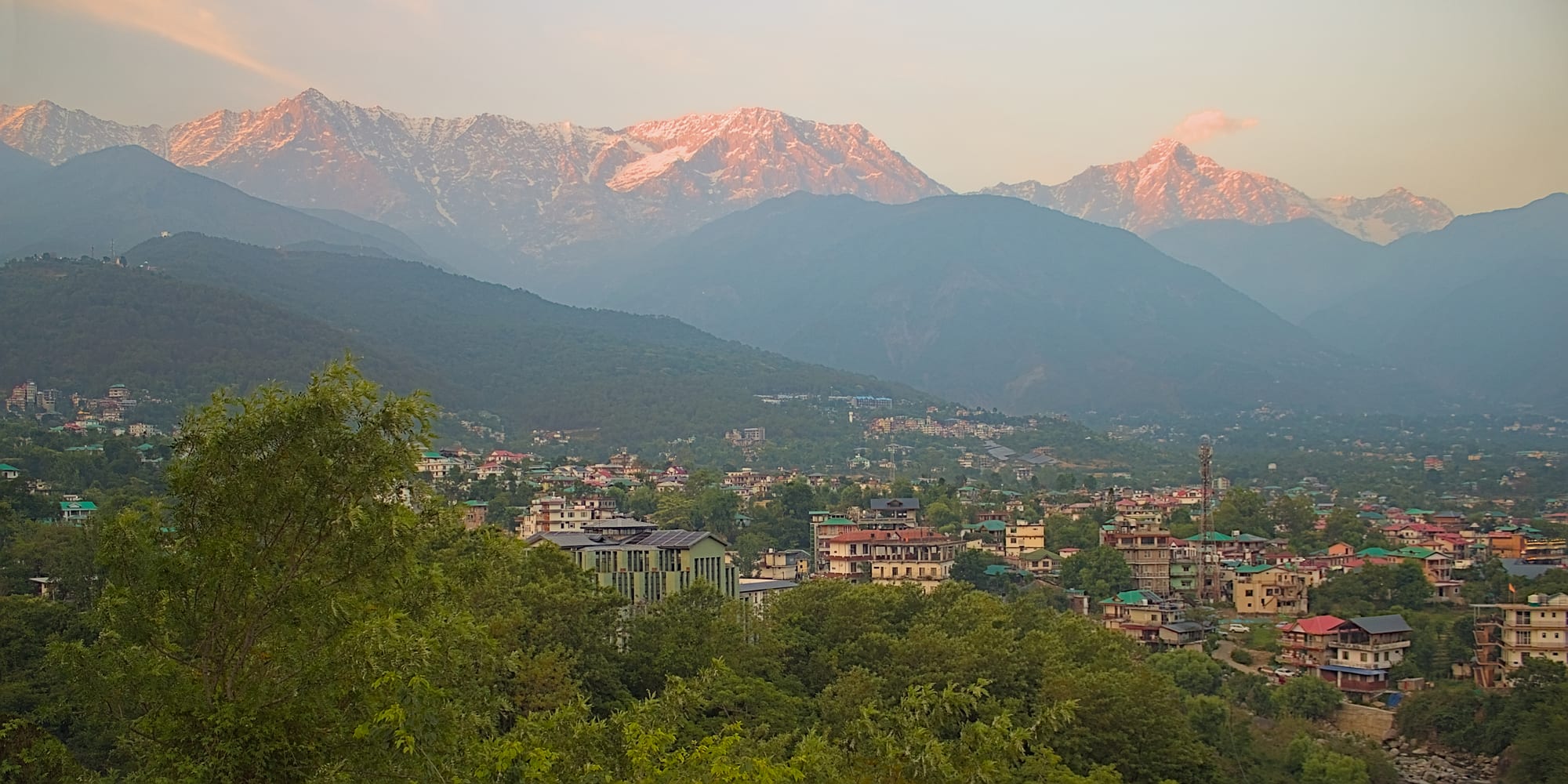
A green hillside town of small buildings below a wall of snow-streaked peaks glowing pink at sunset

Delhi, the Himalaya & the North, India

Dharamshala

The Dhauladhar range at sunset above the town of Dharamshala in the Kangra valley. (UnpetitproleX / Wikimedia Commons · CC BY-SA 4.0)

A hill town in the Kangra valley of Himachal Pradesh, built on slopes below the sharp wall of the Dhauladhar range. It has two halves — the lower administrative town, a winter seat of the state government, and McLeod Ganj above it, where the Dalai Lama has lived since 1960 and where the Tibetan community in exile has its monasteries, institutions and schools.

Neighbourhoods

  • McLeod Ganj
    • First-time visitors
    • Tibetan culture
    • Cafés

    The upper town at about 2,080 metres, a few kilometres above lower Dharamshala by a winding road. Its few streets hold the main Tibetan temple complex, monasteries, craft shops, guesthouses and cafés, and prayer flags line the paths out of it in every direction.

    Open in Maps
  • Lower Dharamshala and Kotwali Bazaar
    • Local life
    • Close to public transport
    • Shopping

    The working town, with the bus stand, government offices, banks and the long Kotwali Bazaar. Few visitors stay here, but it is where the Kangra valley does its business and where transport connections start.

    Open in Maps
  • Dharamkot and Bhagsu
    • Quiet and residential
    • Walking
    • Budget travellers

    Villages on the slope above McLeod Ganj, reached by steep lanes through cedar and pine. Bhagsu has an old Shiva temple and a waterfall; Dharamkot, higher still, is a long-stay quarter of guesthouses, meditation courses and forest paths towards Triund.

    Open in Maps
  • Naddi and the western ridge
    • Views
    • Quiet and residential

    A small settlement on a spur west of McLeod Ganj facing the Dhauladhar, with hotels built for the mountain view and a sharp drop to the valley below.

    Open in Maps
  • Sidhpur and Sidhbari
    • Arts and crafts
    • Quiet and residential

    Villages on the flatter ground below the town, holding Tibetan institutions, monasteries and craft workshops among rice terraces, close to the cricket stadium and the road to Palampur.

    Open in Maps

Things to do

Tibetan Dharamshala

  • Tsuglagkhang and Namgyal Monasterylandmark

    The main temple complex in McLeod Ganj, with the Dalai Lama's residence alongside, a monastery relocated from Tibet, and a circular pilgrim path hung with prayer flags.

    Open in Maps
  • Tibet Museummuseum

    The Central Tibetan Administration's museum in McLeod Ganj, telling the story of Tibet and of the exile community through photographs, documents and testimony.

    Open in Maps
  • Norbulingka Instituteattraction

    A centre at Sidhpur founded in 1995 to keep Tibetan arts alive, with workshops in thangka painting, woodcarving, metalwork and appliqué set in Japanese-influenced gardens.

    Open in Maps

Colonial and Kangra heritage

  • Himachal Pradesh Cricket Association Stadiumattraction

    A cricket ground at about 1,450 metres with the Dhauladhar range as its backdrop, used for international and Indian Premier League matches.

    Open in Maps
  • Kangra Fortlandmark

    A large hill fort above the Banganga river about 20 kilometres south, held by the Katoch rajas, besieged repeatedly and damaged by the earthquake of 1905.

    Open in Maps
  • Masroor Templeslandmark

    A group of 8th-century temples cut from a single sandstone ridge above a pool, about 45 kilometres from the town.

    Open in Maps

Walks and mountains

  • Triundtrail

    A grassy ridge reached by a steep half-day walk from McLeod Ganj, looking straight at the Dhauladhar wall and back over the Kangra valley.

    Open in Maps

Short trips from the town

  • Palampurattraction

    A tea-growing town about 35 kilometres east, surrounded by plantations laid out in the 19th century, below the same mountain wall.

    Open in Maps
  • Baijnathlandmark

    A small town about 50 kilometres away built around a stone Shiva temple of 1204 in the Nagara style, still in daily worship.

    Open in Maps
  • Kangra Valley Railwaytransit hub

    A narrow-gauge line opened in 1929 that runs slowly along the valley between Pathankot and Joginder Nagar, crossing bridges and ravines below the Dhauladhar.

    Open in Maps

Seasonal events

  • LosarFebruary or March

    Tibetan New Year, marked with monastery rituals, masked dances and family visits across the exile community.

  • Tibetan Uprising Day10 March

    A commemoration of the 1959 uprising in Lhasa, with a march through McLeod Ganj and speeches by exile leaders.

  • The Dalai Lama's birthdayJuly

    Ceremonies and cultural performances at the main temple complex on 6 July each year.

  • International cricket seasonspring and autumn

    Matches at the Dharamshala stadium fill the town's hotels for a few days at a time.

  • Monsoon and the green seasonJuly to September

    Heavy rain turns the valley intensely green, waterfalls run full and the town is at its quietest.

Eat and drink

Long-standing places and food districts in Dharamshala. Hours, ratings and directions come from your maps app, always current.

Tibetan and Himachali food

  • Tibetan kitchens of McLeod Ganjneighborhood

    Family restaurants serving momo dumplings, thenthuk and thukpa noodle soups, tingmo steamed bread and butter tea, many run by refugee families and some attached to institutions that train cooks.

    Open in Maps
  • Himachali dhamrestaurant

    The Kangra valley's festive meal of rice with madra, sour lentils and yoghurt curries, cooked by hereditary chefs and served on leaf plates at weddings and temple feasts.

    Open in Maps

Food streets and markets

  • Temple Road and Jogiwara Roadneighborhood

    The two lanes running down from the McLeod Ganj square hold most of the upper town's cafés, bakeries and rooftop restaurants, from Tibetan canteens to Italian and Korean cooking for long-stay visitors.

    Open in Maps
  • Kotwali Bazaarmarket

    The main market of the lower town, with sweet shops, dhabas, fruit stalls and tea counters used by residents rather than travellers.

    Open in Maps
  • Bhagsu and Dharamkot cafésneighborhood

    Small terraces and garden cafés on the paths above McLeod Ganj, serving breakfasts, juices and baked goods to walkers and people on long meditation or yoga courses.

    Open in Maps

Experience Dharamshala

History

The slopes below the Dhauladhar were part of the Katoch kingdom of Kangra, whose fort stands a short way south and whose rulers claimed one of the oldest dynasties in the region. The Sikh empire took the valley in the early 19th century, and after the Anglo-Sikh wars it passed to the British, who made it the headquarters of Kangra district in 1855 and a cantonment soon after. The name dharamshala refers to a rest house for pilgrims, and the town grew around one.

Dharamshala became a small British hill station with a church in the woods, St John in the Wilderness, where the viceroy Lord Elgin was buried in 1863. There was talk of making it the summer capital of British India, but the Kangra earthquake of 4 April 1905 destroyed much of the valley and killed around 20,000 people, wrecking the station and ending its ambitions. It remained a quiet administrative town for half a century.

The town's modern identity dates from 1960, when the government of India offered the upper settlement of McLeod Ganj to the 14th Dalai Lama, who had fled Tibet the previous year, and to the Tibetan administration in exile. Monasteries, schools, a medical institute and craft centres followed, and a refugee population settled on the hillside. Foreign visitors came for Buddhist teaching and stayed for the mountains. In 2017 Himachal Pradesh named Dharamshala its second, winter capital, and state offices moved into the lower town.

Culture & Customs

Dharamshala is best understood as two communities sharing a mountainside. The Kangra valley is Hindu and Pahari-speaking, with its own temple fairs, nati dancing, and the Kangra school of miniature painting, which flourished in the 18th century and gave its name to the wider Pahari school. Village life below the town still turns on rice and tea terraces, the Shiva temples of Baijnath and Bhagsu, and long family ties to the Indian army.

Above it, McLeod Ganj functions as the cultural capital of the Tibetan diaspora. Monks and nuns in maroon robes, the pilgrim circuit around the main temple, debating courtyards, thangka painting and appliqué workshops, Tibetan-language schools and the Tibetan Institute of Performing Arts all belong to an effort to keep a culture intact away from its homeland. Losar, Tibetan New Year, and the commemorations each March are the fixed points of its year.

A third layer is the international one: students of Buddhism, yoga and meditation, volunteers teaching English, and travellers who came for a week and stayed a season. The mix gives the upper town cafés, bookshops and noticeboards in several languages. Visitors are expected to behave with restraint around religious life — walking clockwise, keeping quiet in temples and asking before photographing anyone in robes.

Daily Life

The municipal town has grown quickly and now counts about 53,000 residents, spread between the lower administrative centre, McLeod Ganj and the villages between them, with a substantial Tibetan community among them. Government work, tourism, education and the institutions of the exile administration are the main employers, along with farming and tea growing further down the valley.

Daily rhythms differ by altitude. The lower town runs on office hours, bus timetables and the bazaar; the upper town runs on monastic schedules, tour groups arriving mid-morning and cafés that stay open late in season. Schools, including Tibetan boarding schools, draw children from across the region, and many young people from the valley leave for Chandigarh, Delhi or the Gulf for work.

The pressures are familiar in Himalayan towns: building on steep ground, water supply under strain in the dry months, traffic on a road never designed for it, and waste disposal. The earthquake risk is taken seriously in a valley that remembers 1905. State offices arriving with winter-capital status have brought new building to the lower town, while McLeod Ganj remains built around the institutions of the exile community.

Food

Tibetan cooking is what most visitors come for. Momos, dumplings of minced meat or vegetables, are steamed, fried or served in soup; thukpa and thenthuk are noodle soups, the second with hand-pulled pieces of dough; tingmo is a plain steamed bread eaten with stews. Butter tea, churned with salt, is an acquired taste, and sweet milky Tibetan tea is the alternative. Laphing, a cold spicy mung-bean noodle, is sold from small counters in the upper town, and bakeries run by the community make brown bread, apple pie and cheesecake, a legacy of decades of foreign visitors.

The Kangra valley's own food is quieter and harder to find in restaurants. The dham, cooked for weddings and temple feasts, is a sequence of rice with madra of chickpeas or kidney beans in yoghurt, sour lentil preparations and a sweet rice dish; siddu, a steamed stuffed bread eaten with ghee, is a hill winter staple. Rajma with rice, maize roti and local red rice appear on valley tables.

Kangra tea, grown on plantations around Palampur since the 1850s, is the district's best-known product, lighter than Assam and sold loose in the bazaars. Street food in Kotwali Bazaar runs to samosas, pakoras and jalebi, and in McLeod Ganj to fresh juices, thukpa from a pot and chai from glasses on the square.

Planning tools

Budget

Dharamshala is one of the cheaper Himalayan towns. Guesthouses in McLeod Ganj, Bhagsu and Dharamkot are inexpensive and many travellers stay for weeks; comfortable hotels cluster at Naddi and on the road to Sidhpur. Prices rise in May and June, around the new year and when a cricket match is on. Taxis between the lower and upper town and out to the valley sights are the main recurring cost.

Daily Budget Midrange
USD 50–130 (mid-range hotel, restaurant meals, a car and driver in the hills)
Daily Budget Shoestring
USD 15–30 (guesthouse room, Tibetan and dhaba meals, local buses and shared taxis)

Long stays are cheaper by the week or month in Dharamkot and Bhagsu, and local buses up and down the hill cost a fraction of a taxi.

Best Time to Visit

March to June is mild and clear, with rhododendron on the slopes and the snow still visible on the Dhauladhar. The monsoon from July to early September is one of the wettest in India and brings cloud, leeches on the trails and road slips, though the valley is at its greenest. October and November are the most settled months; winter is cold, with snow in the upper town in some years.

Suggested Number of Days

Two or three days are enough for the upper town and a walk on the ridge. Allow longer to take in the wider Kangra valley, to trek in the Dhauladhar or to join one of the meditation and language courses that bring many visitors here for weeks.

First Visit
2–3 days
With Surroundings
4–6 days

Transportation

Local buses and shared taxis link lower Dharamshala with McLeod Ganj on a steep winding road, and the Dharamshala Skyway cable car, opened in 2022, also connects the two. Within McLeod Ganj everything is walkable, though the lanes are steep and narrow, and taxis are the practical way to reach Norbulingka, the stadium or the valley towns. Long-distance buses to Delhi, Chandigarh, Shimla and Manali leave from the lower town.

The road between the two towns is narrow and busy: journeys take longer than the distance suggests, especially at weekends.

Airport & Station Connections

Kangra airport at Gaggal, about 15 kilometres from the lower town, takes small aircraft on domestic routes and is often disrupted by weather. Overnight buses run from Delhi, roughly 480 kilometres and eleven to thirteen hours, and from Chandigarh in about seven. Trains reach Pathankot, about 90 kilometres away, where the narrow-gauge Kangra Valley Railway continues slowly up the valley.

Walkability

McLeod Ganj is small and best seen on foot, but almost every route involves gradient and steps, and the main square is congested with cars, taxis and buses. The pilgrim path around the temple complex and the trails to Bhagsu, Dharamkot and Naddi are the pleasant walking. Lower Dharamshala is more spread out and generally reached by vehicle.

Safety

The town is calm and the Tibetan community keeps a quiet public life, with low levels of crime against visitors. The real hazards are in the mountains: the walk to Triund and the routes above it are exposed to sudden weather, and people get into difficulty each year by setting out late, alone or unequipped. Monsoon rain brings landslides, and the region lies in an active earthquake zone.

Start mountain walks early, take warm and waterproof clothing even in summer, and use a local guide for anything beyond Triund. Check current official travel advice before travelling.

Climate

A temperate mountain climate that changes markedly with height between the lower town and McLeod Ganj. Summers are warm and increasingly humid before the monsoon, which is exceptionally heavy here from July to early September. Autumn is clear, and winters are cold, with snow on the upper slopes.

Summer
warm — often 25–32°C in the lower town and several degrees cooler in McLeod Ganj
Winter
cold — typically 5–15°C by day, with frost and occasional snow above 1,800 metres

Local Customs

Two sets of customs overlap. At Tibetan temples the pilgrim path and prayer wheels are walked clockwise, hats and shoes come off inside, and photography of ceremonies is often restricted; at Hindu temples in the valley shoes and leather are left outside. Political discussion about Tibet is part of daily life here but is sensitive, and monks and nuns should not be photographed without asking.

Dress modestly in temples and monasteries, ask before photographing people or rituals, and walk clockwise around shrines and stupas.

Common Payment Methods

The currency is the Indian rupee. Cards are accepted by hotels and larger restaurants, and mobile QR payments are common even at small cafés and shops. ATMs are in Kotwali Bazaar and McLeod Ganj and occasionally run out at busy times, so it is worth carrying some cash for buses, taxis and village stalls.