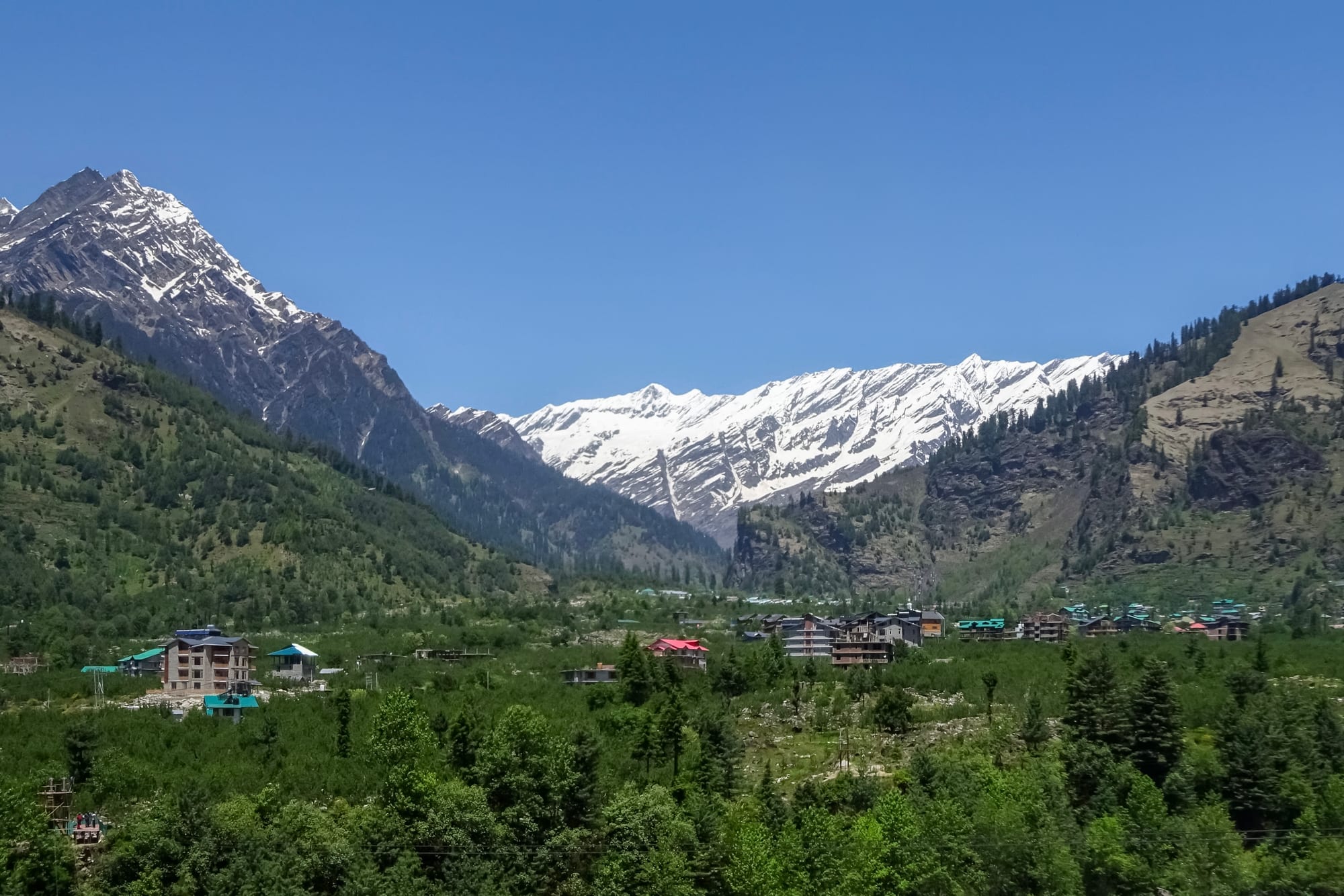
A green wooded valley with scattered village houses below a snow-covered mountain ridge under a clear blue sky

Delhi, the Himalaya & the North, India

Manali

The upper Kullu valley north of Manali, below the snow of the Pir Panjal range. (UnpetitproleX / Wikimedia Commons · CC BY-SA 4.0)

A resort town at the head of the Kullu valley in Himachal Pradesh, set among deodar forest and apple orchards beside the Beas River at about 2,000 metres. Long a stop on the trade route over the Himalaya, it became one of India's best-known mountain holiday towns, and is the starting point for the road over the Rohtang Pass towards Lahaul, Spiti and Ladakh.

Neighbourhoods

  • Manali town and the Mall
    • First-time visitors
    • Shopping
    • Close to public transport

    The commercial centre around the Mall Road and the bus stand, packed with hotels, woollens shops, travel agents and restaurants. It is busy and loud in season, but everything practical — buses, taxis, banks, gear hire — is here.

    Open in Maps
  • Old Manali
    • Cafés and nightlife
    • Budget travellers
    • Atmosphere

    A village on the slope above the Manalsu stream, two kilometres uphill from the centre, where old wood-and-stone houses stand among guesthouses and cafés. It has been the backpacker quarter for decades and empties out in winter.

    Open in Maps
  • Vashisht
    • Hot springs
    • Quiet and residential
    • Budget travellers

    A stone village across the river on the eastern slope, built around a temple to the sage Vashishtha and natural hot springs used as public baths. Narrow lanes, terraced fields and guesthouses look back over the valley.

    Open in Maps
  • Aleo and Prini
    • Quiet and residential
    • Views

    The left bank of the Beas, south-east of the centre, where orchards and newer hotels spread along the road towards Naggar. It is quieter than the town and gives the wide views of the valley and its ring of peaks.

    Open in Maps
  • Palchan and the upper valley
    • Mountains
    • Skiing and snow

    The last villages before the road climbs to Solang, the Atal Tunnel and the Rohtang Pass, about ten kilometres north. Hotels and camps here are surrounded by forest and glacier-fed streams rather than shops.

    Open in Maps

Things to do

Temples and the old town

  • Hidimba Devi Templelandmark

    A four-tiered wooden pagoda temple of 1553 in the cedar forest above the town, dedicated to Hidimbi from the Mahabharata and carved with animals and dancers.

    Open in Maps
  • Vashishtattraction

    A hillside village across the river with sulphurous hot springs channelled into stone bathing tanks beside its temple.

    Open in Maps

Mountains and the valley

  • Solang Valleyattraction

    A side valley about 14 kilometres up the road, used for skiing and snow play in winter and for paragliding, zorbing and walking in summer.

    Open in Maps
  • Rohtang Passviewpoint

    The 3,980-metre pass on the ridge north of Manali, the old gateway to Lahaul, open roughly from May to November and thick with tourist traffic in season.

    Open in Maps
  • Atal Tunnellandmark

    A road tunnel of about nine kilometres opened in 2020 beneath the Rohtang ridge, giving Lahaul year-round access to Manali.

    Open in Maps

Short trips from the town

  • Naggarattraction

    A village about 20 kilometres down the valley, the old capital of the Kullu kings, with a castle of stone and timber and the house where the painter Nicholas Roerich lived.

    Open in Maps
  • Kulluattraction

    The valley's main town, about 40 kilometres south, known for its shawl weaving and for the seven-day Dussehra festival in October.

    Open in Maps
  • Manikaranattraction

    A pilgrimage village in the Parvati valley with hot springs, a Sikh gurdwara and Hindu temples, where food is cooked in the spring water.

    Open in Maps
  • Kasolattraction

    A riverside village in the Parvati valley, a base for treks towards Kheerganga and known for its Israeli travellers and cafés.

    Open in Maps
  • Great Himalayan National Parkpark

    A World Heritage Site of high ridges, glaciers and forest south-east of the valley, entered on foot from villages beyond Kullu.

    Open in Maps

Seasonal events

  • Hadimba Devi fairSpring

    A festival at the Hidimba Devi temple with village deities, drumming and dancing in the forest clearing around the shrine.

  • Kullu DussehraOctober

    A week-long festival in Kullu, down the valley, in which hundreds of village gods are carried to the maidan in palanquins.

  • Ski and snow seasonDecember to March

    Snow on the slopes above Solang draws Indian holidaymakers for sledging, skiing and snowboarding, and the town is at its busiest at new year.

Eat and drink

Long-standing places and food districts in Manali. Hours, ratings and directions come from your maps app, always current.

Manali classics

  • Himachali dham and siddurestaurant

    The hill kitchen of the Kullu valley — steamed siddu bread with ghee, rajma with rice, and the festive dham of rice, lentils and yoghurt curries served at weddings and temple feasts.

    Open in Maps
  • Tibetan kitchensrestaurant

    Momo dumplings, thukpa noodle soup and butter tea, cooked in small family places run by the Tibetan community settled around the monasteries.

    Open in Maps

Food streets and markets

  • The Mall and the bazaarneighborhood

    The main street and the lanes off it hold most of the town's North Indian restaurants, bakeries, juice stalls and sweet shops.

    Open in Maps
  • Old Manali cafésneighborhood

    The uphill village lane is a run of small cafés serving breakfasts, Israeli and Italian dishes and coffee to long-staying travellers, quiet in winter.

    Open in Maps
  • Vashishtneighborhood

    Rooftop kitchens above the hot springs, cooking cheap traveller food and Himachali dishes with a view over the valley.

    Open in Maps

Experience Manali

History

The Kullu valley has long been described as the end of the habitable world, and the town's name is linked to Manu, the lawgiver of Hindu myth who is said to have landed here after the flood and recreated human life; a temple to him stands in the town. For centuries the valley was ruled from Naggar and later Kullu by a line of rajas, and the settlement at the valley head was a cluster of farming hamlets on the trade route that crossed the Rohtang Pass towards Lahaul, Ladakh and Central Asia.

Sikh power reached the valley in the early 19th century, and the British took control of Kullu in 1846 as part of their settlement of the Punjab hills. They planted apple orchards, which transformed the valley economy, built a road up from the plains and used Manali as a small hill retreat; the wooden Hidimba Devi temple, already three centuries old, became its best-known landmark.

Modern Manali was made by travellers. Tibetan refugees settled here in the second half of the 20th century, and the valley became part of the overland hippie route in the 1960s, giving Old Manali and Vashisht their café culture. Indian domestic tourism then arrived on a far larger scale, and hotels spread down the valley from the 1980s onwards. The opening of the Atal Tunnel in 2020 cut the Rohtang barrier and made Manali a year-round gateway to Lahaul and Spiti.

Culture & Customs

Manali belongs to the Kullu valley, whose village religion is unusually visible. Almost every settlement has its own devta, a local deity with a temple, a hereditary medium and a palanquin carried by villagers to fairs. The greatest gathering is Kullu's Dussehra, when hundreds of these gods travel down the valley to meet the deity Raghunath, but smaller fairs happen through the year, announced by long horns, drums and the slow dancing of the nati, Himachal's line dance.

Craft is the other local mark. Kullu shawls and caps, woven in wool with bands of geometric colour at the ends, are made in cooperatives and homes throughout the valley and sold in every Manali shop; wooden architecture of alternating stone and cedar beams, known as kath-kuni, survives in Old Manali and the villages above.

Onto this is layered a floating culture of visitors. Tibetan monasteries, carpet workshops and prayer flags mark the refugee community; Old Manali's cafés, music and long-stay travellers give the town an international feel in summer; and Indian honeymooners and families fill the Mall in season, dressing in hired traditional Himachali costume for photographs against the snow. The two worlds mix without merging, and residents are used to both.

Daily Life

Manali is a small town — the municipality counts about 11,700 residents, although the wider valley holds many more and the seasonal population is far larger. Almost everything here depends on two things: apples and visitors. Orchards cover the terraces on both banks, harvested from August, and the fruit trade sets the rhythm of the late summer; hotels, taxis, guides and shops carry the rest of the year.

Work is highly seasonal. In May and June and again at new year the town is saturated, with traffic backed up along the single valley road and every room taken; in the deep monsoon and the late winter many businesses close and families return to farming or to jobs in the plains. Much of the service labour comes from Nepal and other Indian states.

The pressures are those of a small place carrying a very large load. Unplanned hotel building on steep, unstable ground, rubbish and sewage reaching the Beas, water shortages in peak weeks and traffic have all become public issues, and severe monsoon flooding in Himachal Pradesh in 2023 washed away riverside buildings and sections of road in the valley. Landslides and snow still isolate villages for days at a time, and the tunnel has made Lahaul, once cut off for half the year, part of everyday life.

Food

The valley's own cooking is plain hill food built on rice, wheat and pulses. Siddu is the local speciality: a steamed leavened bread, sometimes stuffed with ground walnuts, poppy seed or lentils, eaten with ghee or a chutney of green coriander and mint. Rajma, red kidney beans from the valley's own fields, are cooked with rice and are a point of pride; babru, a deep-fried bread stuffed with black gram, appears at festivals. The formal meal is the dham, cooked by hereditary chefs and served on leaf plates, with madra of chickpeas or beans in yoghurt, sour lentils and a sweet rice dish at the end.

Trout from the valley's cold rivers appears grilled or fried on many menus. Tibetan food is everywhere — momos steamed or fried, thukpa, and butter tea — and North Indian standards, from paneer curries to chole bhature, fill the restaurants of the Mall. Old Manali's cafés cook for foreign palates, with shakshuka, pizza, banana pancakes and espresso.

Apples run through everything: fresh from roadside stalls in autumn, and made into juice, cider, jam and vinegar. Mountain herbs and buckwheat appear in village dishes, and in the cold months hot sweet chai from a glass at a bazaar stall is the most common thing anyone consumes here.

Planning tools

Budget

Manali is cheap outside the peaks and expensive during them. Indian holiday weeks in May and June, the new year and long weekends fill the hotels and raise prices sharply; the rest of the year rooms are plentiful and heavily discounted. The main extras are taxis up the valley, permits and vehicle charges for Rohtang, and the cost of activities such as paragliding, rafting or a guided trek.

Daily Budget Midrange
USD 50–130 (mid-range hotel, restaurant meals, a car and driver in the hills)
Daily Budget Shoestring
USD 15–30 (guesthouse room in Old Manali or Vashisht, dhaba and café meals, buses)

Share a taxi or use the local bus for Solang and Naggar, and expect to pay more for anything beyond the Atal Tunnel.

Best Time to Visit

April to June brings mild weather, open passes and the largest Indian crowds. September to November is the clearest and quietest time, after the monsoon, which can bring landslides and road closures between July and early September. December to March is cold, with snow at the town in some weeks and skiing and snow play above it.

Suggested Number of Days

Two or three days cover the town and the near valley. Trekkers, skiers and anyone continuing to Lahaul, Spiti or Ladakh need longer, and road conditions over the passes can change plans at short notice.

First Visit
2–3 days
With Surroundings
4–6 days

Transportation

The town centre is small enough to walk, though the climb to Old Manali and the crossing to Vashisht are steep. Local buses run down the valley to Naggar and Kullu, and shared and private taxis handle Solang, the tunnel and trailheads. Motorbikes and scooters are widely hired, and the road north over the pass is a long-established motorcycling route.

Traffic on the single valley road jams badly in season, so allow far more time than the distance suggests.

Airport & Station Connections

Most people arrive by road from Delhi, about 540 kilometres and twelve to fourteen hours, usually on an overnight bus, or from Chandigarh in eight to ten hours. The nearest airport is at Bhuntar, about 50 kilometres down the valley near Kullu, with small aircraft and weather-dependent flights. The Manali–Leh highway north over the passes is open only in the summer months.

Walkability

The Mall, the bazaar and the riverside paths are easy on foot, and the walk through the cedar forest to the Hidimba Devi temple takes about twenty minutes from the centre. Beyond that the town is steep: Old Manali and Vashisht both involve a sustained climb, pavements are patchy, and the main road carries heavy traffic in season.

Safety

Manali is a low-crime town where the real risks are outdoors. The Beas River is fast and cold and has claimed lives; mountain weather turns quickly; the road to Rohtang is narrow and prone to landslides and snow; and altitude affects some visitors above the passes. Drug use is widespread in the valley and possession carries severe penalties under Indian law.

Keep well back from the river, use registered operators for rafting, paragliding and trekking, and check road and pass conditions before travelling north. Check current official travel advice before travelling.

Climate

A temperate mountain climate at about 2,000 metres, with big differences between sun and shade. Spring is mild, the monsoon from July to early September is wet and cloudy, autumn is clear and cool, and winter is cold with snow, heavier on the slopes above the town than in it.

Summer
mild — usually 20–28°C by day in May and June, cool nights
Winter
cold — often around 0–10°C by day, dropping below freezing at night, with snow from late December

Local Customs

The Kullu valley keeps a strong village religious life: local deities are carried in palanquins at festivals, and temples such as Hidimba Devi are active shrines where shoes come off and photography inside is often not allowed. Dress is modest by local standards, and leather is sometimes asked to be left outside temples. Hindi and the Kullui dialect are spoken, with English common in the tourist trade.

Ask before photographing villagers or religious processions, and do not buy or carry cannabis, which is illegal despite its local reputation.

Common Payment Methods

The currency is the Indian rupee. Hotels, larger restaurants and shops take cards, and mobile QR payments are accepted widely, including by many small cafés. ATMs are in the town centre but can be empty in peak weeks or after heavy snow, so carry cash for villages up the valley.