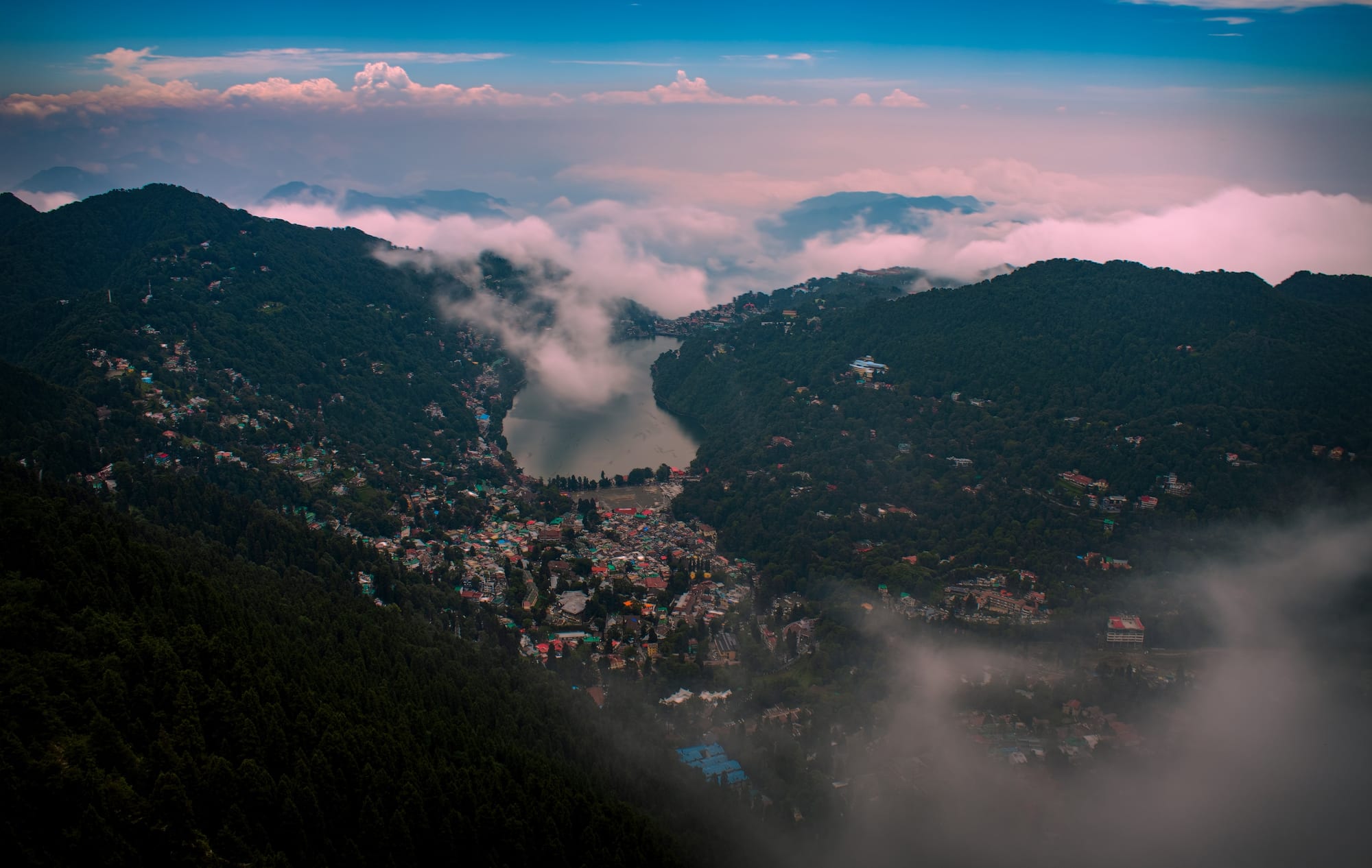
Nainital's lake and tightly packed town seen from above on a forested ridge, with cloud drifting over the surrounding hills

Delhi, the Himalaya & the North, India

Nainital

Naini Lake and the town of Nainital seen from Naina Peak, also called China Peak. (Harshit.S.R / Wikimedia Commons · CC BY-SA 4.0)

A hill station in the Kumaon hills of Uttarakhand at about 2,000 metres, built by the British from the 1840s around an eye-shaped lake and later made the summer capital of a province. Today it is a crowded resort town of boating, a lakeside Mall Road, colonial schools and churches, and ridge-top viewpoints facing the snow peaks of the Himalaya.

Neighbourhoods

  • Mallital
    • First-time visitors
    • Markets
    • Temples

    The northern, upper end of the lake, where the Naina Devi temple, the flats (the open ground used for games and fairs) and the Bara Bazaar crowd together below the ropeway station. It is the busiest part of town, with most of the cheap eating places and the start of the paths to Snow View and Naina Peak.

    Open in Maps
  • Tallital
    • Close to public transport
    • Budget stays

    The southern, lower end, where the road from the plains arrives at the bus stand and the taxi rank beside the lake's outflow. Many guesthouses sit on the slopes above it, and the walk to Mallital along either side of the water takes about twenty minutes.

    Open in Maps
  • The Mall Road
    • Walks
    • Shopping
    • Evening strolls

    The lakeside road that joins Tallital and Mallital, lined with shops, restaurants, hotels and the municipal library founded in 1934. In the evening it fills with holidaymakers walking the length of the lake; a quieter road runs along the opposite shore.

    Open in Maps
  • Ayarpatta
    • Quiet and residential
    • Views

    The wooded hill rising south-west of the lake, where colonial-era houses such as Gurney House stand among the trees. It is steep and quiet, with the lookout at Tiffin Top, also called Dorothy's Seat, on its slopes.

    Open in Maps
  • Sher-ka-Danda
    • Views
    • Walks

    The ridge on the eastern side above Mallital, climbing to the Snow View viewpoint. Hotels and cottages dot the lower slopes, and the ropeway rises straight up its face from the lake.

    Open in Maps

Things to do

The lake and the town

  • Naini Lakeattraction

    The crescent-shaped lake at the heart of the town, ringed by hills and busy with rowing boats, paddle boats and the yachts of the Nainital Boat Club, which holds a regatta in the third week of June.

    Open in Maps
  • Naina Devi Templelandmark

    The temple on the northern shore dedicated to the goddess whose eye, in Hindu tradition, fell here, which gives the lake and town their name; it was rebuilt after the landslide of 1880.

    Open in Maps
  • Lok Bhavan (Raj Bhavan)landmark

    The Governor's summer residence, formerly Raj Bhavan, a Gothic mansion built like a Scottish castle between 1897 and 1899, set in a 220-acre estate with a golf course laid out in 1936.

    Open in Maps
  • Gurney Houselandmark

    The cottage on Ayarpatta hill where the hunter-turned-conservationist Jim Corbett lived until 1947, now a private residence and museum with some of his memorabilia.

    Open in Maps

Viewpoints and walks

  • Snow Viewviewpoint

    A lookout on the Sher-ka-Danda ridge at about 2,270 metres, reached by ropeway from Mallital or on foot, with a view of the Himalayan snow peaks on clear mornings.

    Open in Maps
  • Naina Peakviewpoint

    The highest point around the town at about 2,600 metres, also called China Peak or Cheena Peak, about 5.5 km from the town, with the whole town below and the snow-covered Himalaya on the other side.

    Open in Maps
  • Tiffin Topviewpoint

    A lookout on Ayarpatta hill at about 2,290 metres, about 4 km from the town, also called Dorothy's Seat after a memorial to an Englishwoman.

    Open in Maps
  • Eco Cave Gardenspark

    A cluster of naturally formed rocky caves about 2 km above Mallital, laid out and maintained by the local administration.

    Open in Maps
  • Nainital Zooattraction

    A small high-altitude zoo on Sher Ka Danda hill about 2 km above the Tallital bus station, with Tibetan wolves, Himalayan bears, leopard cats and pheasants.

    Open in Maps
  • Aryabhatta Research Institute of Observational Sciencesattraction

    An astronomical observatory on Manora Peak, about 9 km from the town, started in 1954 and open to the public in the afternoons and on occasional moonlit nights with prior permission.

    Open in Maps

Short trips from the town

  • Bhimtalattraction

    A larger, lower lake about 22 km away with an island in the middle, quieter than Nainital and the centre of a group of lakes in the Kumaon foothills.

    Open in Maps
  • Sattalattraction

    A cluster of seven small interconnected lakes in oak and pine forest, known for birdwatching and for the quiet of its shores.

    Open in Maps
  • Naukuchiatalattraction

    A nine-cornered lake about 26 km from Nainital, the deepest lake in the Nainital region.

    Open in Maps
  • Kainchi Dhamlandmark

    The ashram of the guru Neem Karoli Baba beside the Almora road, about 17 km away, visited by pilgrims and famous for the Western disciples it drew in the 1960s and 1970s.

    Open in Maps
  • Mukteshwarattraction

    A small hill town at about 2,300 metres with an old Shiva temple, a veterinary research laboratory that moved there in 1893 and views of the Himalaya and Nanda Devi.

    Open in Maps
  • Jim Corbett National Parkpark

    India's first national park, established in 1936 and named after the Nainital-born hunter and writer, about 53 km south-west, known for tigers and elephants.

    Open in Maps
  • Ranikhetattraction

    A cantonment town about 29 km north, among pine, oak and deodar forest, with a nine-hole golf course and views of the western Himalayan peaks.

    Open in Maps
  • Almoraattraction

    The old seat of the Chand kings on a saddle-shaped ridge, with its market along the top, the Nanda Devi temple and the bazaar where the bal mithai sweet was invented.

    Open in Maps

Seasonal events

  • Nanda Devi MelaSeptember, around Nanda Ashtami

    The town's main fair, held every year in the Naina Devi temple complex on Nandashtami.

  • Kumaoni HoliFrom Basant Panchami (January or February) to March

    The hill version of the spring festival, celebrated over weeks with sung Holi (baithaki, khari and women's Holi), whose songs draw on Hindustani classical music and Kumaoni folk tradition.

Eat and drink

Long-standing places and food districts in Nainital. Hours, ratings and directions come from your maps app, always current.

Kumaoni classics

  • Bara Bazaar eating placesneighborhood

    The Bara Bazaar, one of the town's two main shopping areas, is where to look for Kumaoni dishes — bhatt ki churkani, aloo ke gutke with bhang chutney, madua rotis — alongside north Indian snacks and the sweet bal mithai in paper boxes.

    Open in Maps
  • Mall Road restaurantsneighborhood

    The lakeside road holds the town's long-established restaurants and bakeries, from Punjabi and Mughlai menus and Chinese-Indian noodles to momos, pastries and ice cream eaten on the walk between Tallital and Mallital.

    Open in Maps

Markets and cafés

  • Lakeside tea stallscafe

    Chai and snacks from stalls along the lake roads, the cheapest way to sit and watch the lake.

    Open in Maps

Experience Nainital

History

The Kumaon hills passed to the British East India Company in 1815, after the Anglo-Nepalese War, but the hill station was founded only in 1841, when P. Barron, a sugar trader from Shahjahanpur, built the first European house, Pilgrim Lodge, and wrote warmly of the site. Within a few years houses and a church, St John in the Wilderness (1846), had grown up on the slopes. The site was sacred long before that: in Hindu tradition it is one of the places where parts of the goddess Sati's body fell to earth, in this case her eye, which is what 'Nain' means, and a temple to Naina Devi stood by the water.

Nainital became the summer seat of the government of the North-Western Provinces, later the United Provinces, and the administration moved up from the plains every hot season. Boarding schools followed, and the town grew up the hillsides. On 18 September 1880 the hillside above the northern end gave way and buried the Victoria Hotel, the assembly rooms and the original Naina Devi temple, and 151 people were buried. The flats, the open ground at Mallital, were laid out on the site, a new temple was built, and storm-water drains and stricter building rules followed.

After independence the summer government left, but the schools, the High Court of the new state of Uttarakhand (established at Nainital in 2000) and tourism from Delhi and the plains took its place. The town is now one of the most visited resorts in northern India, and its problems are those of success: water shortages, traffic, unstable slopes built over, and a lake whose level and water quality have been a public worry for years.

Culture & Customs

Nainital is Kumaoni at its roots: the hill people of this part of Uttarakhand speak Kumaoni, a Pahari language, as well as Hindi, and their calendar of fairs, folk songs and dances survives under the resort. The Nanda Devi Mela, held each September on Nandashtami in the Naina Devi temple complex, is the main expression of it. Kumaoni Holi, sung rather than merely played, runs for weeks before the spring festival. The town also has a mosque, a gurdwara and several churches, among them St John in the Wilderness of 1846 and a Jama Masjid built in 1882 in Mallital.

The colonial inheritance is unusually visible. Sherwood College and St Joseph's College, founded in 1869 and 1888, are among India's best-known boarding schools, and the term-time rhythm of the schools, with their chapel bells and games on the flats, gives the town a life apart from the holiday trade. Jim Corbett, born here in 1875 and schooled here, is the local hero: the hunter of man-eating tigers who became a conservationist and writer. The Governor's residence, completed in 1899, is the grandest relic of the summer-capital years.

Sport is rowing and sailing: the Nainital Yacht Club, housed in the Boat House Club, sails a fleet of Half Rater yachts, and the annual Kingfisher regatta is held in the third week of June. For most visitors, though, the culture of Nainital is the Indian family holiday: the evening promenade along the Mall, a boat ride in a hired rowing boat, pony rides, candles and woollens bought in the bazaars, and a photograph against the snows from Snow View.

Daily Life

The town itself had about 41,000 residents at the 2011 census, and the number of people in it swells in the holiday season. Almost everyone depends on visitors: hotels and guesthouses, restaurants, boatmen, pony handlers, taxi drivers and shopkeepers in the two bazaars, with the schools, the High Court and the district administration providing the steady, year-round employment. The Uttarakhand High Court brings lawyers and clerks from across the state; Nainital district's headquarters is here too, though Haldwani, in the plains below, is the district's largest city.

Residents live on the slopes above the lake, in Mallital and Tallital and on the slopes of Sher-ka-Danda and Ayarpatta, where houses are stacked up stairways rather than streets. Mornings start with the temple bells and the schools' assemblies; the lake is quiet until the boats go out mid-morning, the Mall fills from the afternoon, and on winter nights the town empties and closes early. Water is the constant issue: wells beside the lake supply the town, and silting has made the lake markedly shallower.

The pressures of building on a landslide-prone hillside are the other daily reality. Many settlements around the lake stand in landslide areas, and the Balia Nala ravine below Tallital, where the lake drains out, has needed repairs and slope stabilisation. Plans to protect the lake have called for less traffic on the Mall and a ban on large new buildings in the town.

Food

Kumaoni food is plain, filling hill cooking, built on millets, lentils and whatever grows on terraced fields. Bhatt ki churkani is a thick soup of black soybeans; aloo ke gutke are potatoes fried with cumin, chilli and coriander, eaten with bhang ki chutney, a tangy sauce of roasted hemp seeds; kafuli is a thick dish of leafy greens; and madua, finger millet, goes into dark rotis served with ghee. Gahat, horse gram, is cooked into dal and into ras, eaten with rice as ras bhaat. Most of this is home food rather than restaurant food, but a few places in the Bara Bazaar and along the Mall serve Kumaoni thalis.

The sweets travel better. Bal mithai, a fudge of roasted khoya coated in tiny white sugar balls, was invented in Almora's Lal Bazaar and is sold in sweet shops across the town. Winter brings roasted peanuts, hot gulab jamun and bun- omelettes from the Mall's stalls, and momos are among the cheapest hot meals.

The restaurants along the Mall Road, many of them decades old, cook for the Delhi and Punjabi holiday trade: butter chicken, tandoori platters, chole bhature, Indian-Chinese noodles and Manchurian, and bakery cakes with tea in the afternoon. Tea itself is the everyday drink, and there are tea plantations at Ghorakhal near Bhimtal.

Planning tools

Budget

Nainital is a domestic resort, and prices follow Indian school holidays: rooms double or more in May and June, over Diwali and at New Year, and fall sharply in the monsoon and in January. Food, boat rides and local taxis are cheap by international standards; the main costs are the room and the car hire for trips to the other lakes and the national park.

Daily Budget Midrange
USD 50–120 (lake-view hotel, restaurant meals, a boat ride, a car and driver for a day trip)
Daily Budget Shoestring
USD 15–35 (guesthouse room, bazaar thalis and snacks, shared taxis and walking)

Visit outside Indian school holidays if possible — the town is far quieter and cheaper in late September and October, which also has the clearest views of the snows.

Best Time to Visit

March to June and September to November. Spring brings rhododendron blossom and mild days; May and June are the peak, when the plains are scorching and the town is packed. The monsoon, from July to mid-September, means heavy rain, mist and landslides on the approach roads. Autumn is clear and cool with the best views of the Himalaya; winter is cold and quiet, with occasional snow that draws crowds from Delhi.

Suggested Number of Days

Two days cover the town and its lake at an easy pace. Four or five days allow trips to the other lakes and hill towns of Kumaon and a stay in the foothills; the winding hill roads make each of those a slow day.

First Visit
2 days
With Surroundings
4–5 days

Transportation

The town is small enough to walk, and parking is scarce in busy periods. A few cycle rickshaws run between the two ends of the lake, a ropeway climbs from Mallital to Snow View, and paths climb to Tiffin Top and Naina Peak. Buses and taxis link the town with Kathgodam, Bhimtal and the surrounding hill towns.

Expect long queues at the ropeway and the lake boats in May and June; mornings are quieter and clearer than afternoons for the viewpoints.

Airport & Station Connections

The nearest railhead is Kathgodam, on the edge of Haldwani about 35 km below the town, with trains from most major Indian cities; taxis and buses then climb to Nainital. Pantnagar airport, about 70 km away, has flights to Delhi, Dehradun and Pithoragarh. By road the town is more than 300 km from Delhi, seven to eight hours by car, with daily buses from Delhi's Anand Vihar bus terminal via Haldwani and Kathgodam.

Walkability

The flat Mall Road and the road along the opposite shore make a loop of about 3 km around the lake. Everything else is steep: the lanes to the guesthouses, the churches and the schools climb hard from the shore, and the paths to Snow View, Tiffin Top and Naina Peak are hill walks of one to three hours. Monkeys are common along the forest paths. Pavements on the Mall are narrow and crowded in the evening.

Safety

Nainital is a safe family resort, with the usual holiday-town issues of pickpocketing in crowds and overcharging by touts around the boat landings. The real risks are the roads: the approach from the plains is narrow and winding, and landslides close it at times during the monsoon. The altitude is modest, but the air is thin enough to make the climbs tiring.

Avoid driving the hill roads at night or in heavy monsoon rain, keep food out of reach of the monkeys, and be wary of unlicensed boatmen and guides. Check current official travel advice before travelling.

Climate

A temperate hill climate, cool for India. Days are mild from March to June, the monsoon brings very heavy rain and mist from July to September, autumn is dry and clear, and winter is cold with frosty nights and occasional snowfall between late December and February.

Summer
mild — July, the warmest month, ranges from about 16°C at night to 24°C by day, and is wet and misty
Winter
cold — January ranges from about 2°C at night to 11°C by day, with occasional snow on the higher peaks

Local Customs

The town is a Hindu pilgrimage site as well as a resort, and the Naina Devi temple is treated with respect: shoes come off at the gate, and visitors dress modestly and keep photography discreet inside. Kumaonis make up most of the town's population, alongside people from all over India. Greetings are a 'namaste' with palms together. Tipping is modest — rounding up a taxi fare, a small sum for porters and hotel staff, around 10 per cent in restaurants if no service charge is added.

Alcohol is sold in licensed shops and hotel bars but not drunk in public; ask before photographing people, and expect the lake and viewpoints to be busy with families rather than solitary.

Common Payment Methods

The currency is the Indian rupee. Hotels and the larger Mall Road restaurants take cards, and UPI phone payments are accepted by almost every shop and stall, but foreign visitors without an Indian bank account will need cash for boat rides, ponies, rickshaws and bazaar stalls. ATMs are concentrated around the Mall Road and both bazaars.