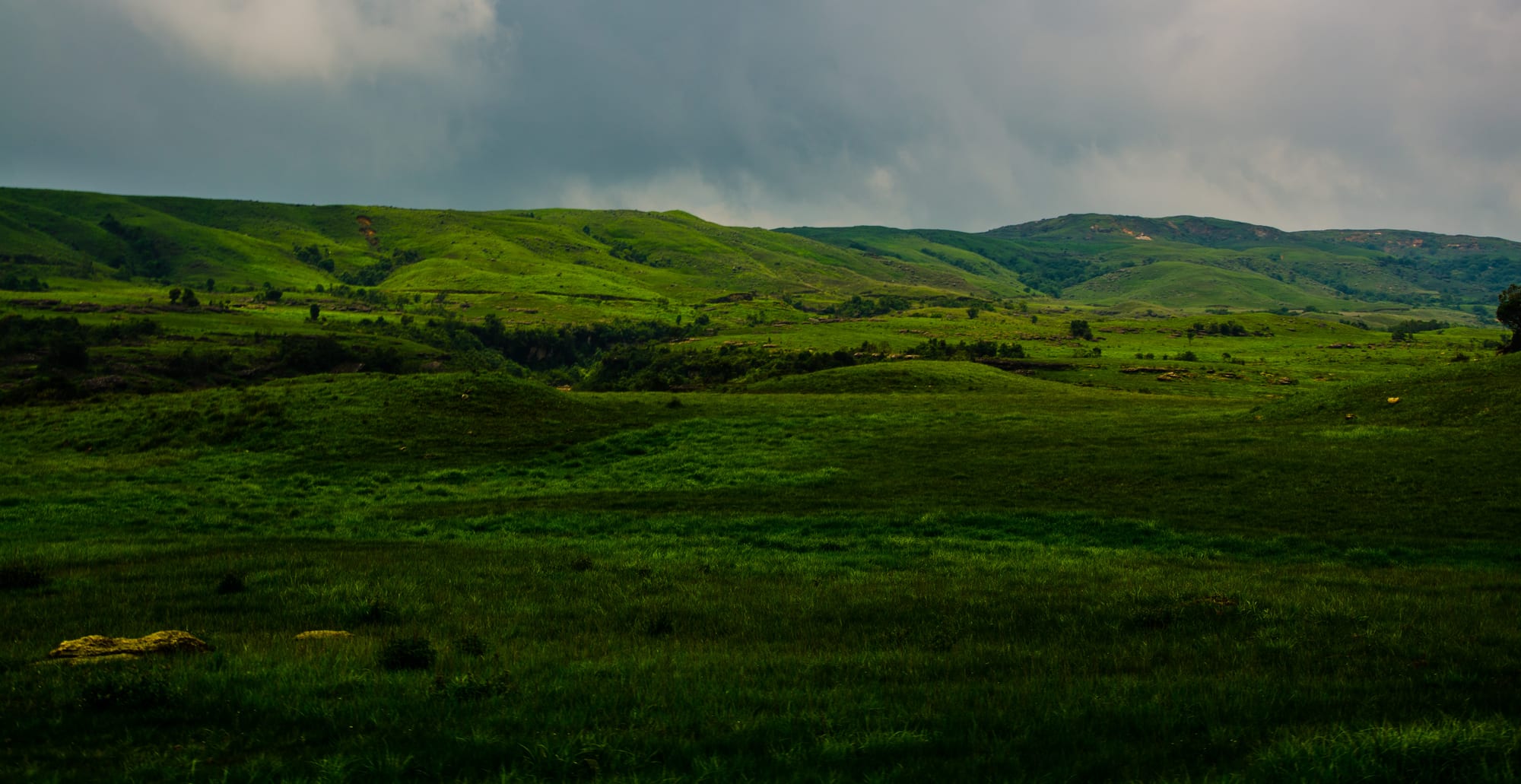
Rolling green grassy hills and scattered trees under a heavy grey monsoon sky in Meghalaya

India

The Northeast

Grassland hills around Cherrapunji (Sohra) on the Khasi Hills plateau of Meghalaya. (Ashwin Kumar / Wikimedia Commons · CC BY-SA 2.0)

The seven states east of the narrow Siliguri corridor — Assam, Arunachal Pradesh, Nagaland, Manipur, Mizoram, Tripura and Meghalaya — a region of the Brahmaputra valley, tea gardens, rainforested hills and Himalayan monasteries, home to hundreds of tribal communities and cultures closer to South-East Asia and Tibet than to the Gangetic plains.

Explore The Northeast

History

The Brahmaputra valley was the kingdom of Kamarupa in the first millennium AD, remembered in early inscriptions and in the pilgrim accounts of the Chinese monk Xuanzang. In 1228 the Tai prince Sukaphaa crossed the hills from upper Burma and founded the Ahom kingdom, which ruled Assam for some six centuries. The Ahoms held off repeated Mughal invasions, most famously under the general Lachit Borphukan at the river battle of Saraighat in 1671, and left brick palaces and temple tanks around their capital near Sivasagar. Manipur had its own Meitei kingdom centred on Imphal, and Tripura was ruled by the Manikya dynasty, while the hills of the Nagas, Khasis, Garos, Mizos and many others were governed by village chiefs and councils.

Burmese invasions devastated Assam in the 1810s and 1820s, and the Treaty of Yandabo in 1826 handed it to the British East India Company. The British planted tea on a vast scale from the 1830s, found oil at Digboi, and brought labourers from central India to the gardens, while Christian missionaries converted much of the hill population. In 1944 the Japanese advance on India was stopped at the battles of Imphal and Kohima.

After 1947 the region was carved into states: Nagaland in 1963 after an armed Naga independence movement, Meghalaya in 1972, and Mizoram and Arunachal Pradesh in 1987, the year after the Mizo Accord ended two decades of insurgency. Arunachal Pradesh is administered by India, and China claims nearly four-fifths of it as South Tibet; Chinese forces occupied parts of it in the 1962 war before withdrawing. Assam's agitation against migration from Bangladesh ended in the 1985 Assam Accord, and since 2023 Manipur has been torn by conflict between Meitei and Kuki-Zo communities.

Culture & Customs

The Northeast is the most ethnically varied part of India, with more than two hundred communities and languages from the Tibeto-Burman, Tai and Austroasiatic families alongside Assamese and Bengali. Assam's Hindu culture was shaped by the 15th- and 16th-century saint Srimanta Sankardev, whose Vaishnavite movement founded the sattras — monasteries that still keep alive Sattriya dance, devotional music and masked drama. Rongali Bihu in April, the Assamese new year, brings dancing, drumming, buffalo-horn pepa pipes and new clothes of muga silk, the golden wild silk of Assam.

Nagaland, Mizoram and Meghalaya have Christian majorities, and Sunday there is a day of church and closed shops. The Khasi and Garo of Meghalaya are matrilineal: family names and property pass through the youngest daughter or the mother's line. Naga identity is organised by tribe — Angami, Ao, Konyak, Sema and others — each with its own dress, shawls and village gates, and the Hornbill Festival brings them together each December. Manipur's Meitei follow Vaishnavism blended with the older Sanamahi faith, perform the graceful Manipuri Ras Lila dance, and claim sagol kangjei as an ancestor of modern polo. Tawang and western Arunachal are Tibetan Buddhist, home to the Monpa people.

Many people in the hill states feel distant from "mainland" India and speak of it that way. Visitors are generally met with warm hospitality, and it is polite to ask before photographing people or entering a village.

Daily Life

About 45 million people lived in the eight-state region, counting Sikkim, at the 2011 census; the seven states here held most of them, and Assam alone about 31 million. Guwahati, on the Brahmaputra, is the only large city, with around a million people and the region's airport, universities and wholesale markets. Shillong, Imphal, Agartala, Aizawl, Dibrugarh, Dimapur and Kohima are the other centres, and Aizawl, built along a steep ridge, is known for its orderly traffic and quiet streets.

Assam's economy runs on tea — the state grows roughly half of India's crop — along with oil and gas in Upper Assam, where Digboi has one of the oldest refineries still working, and rice farming across the flood plain. Tripura grows rubber, the hills live on shifting cultivation, bamboo, pineapples, ginger and oranges, and government jobs are the biggest employer in the smaller states. Many young people leave for work and study in Delhi and Bengaluru.

The day starts very early here: India keeps a single time zone, so the sun rises around five in summer and shops and offices close soon after dark. Current issues include the annual Assam floods, citizenship and migration politics, the Manipur conflict and the slow improvement of roads, railways and airports into the hills.

Food

Northeastern cooking uses little oil and few dried spices, relying instead on fermented, smoked and fresh ingredients and on some of the hottest chillies in the world, including the bhut jolokia or ghost pepper. In Assam a meal starts with khar, a mildly alkaline dish of vegetables or papaya cooked with water filtered through the ash of banana peel, and ends with masor tenga, a light sour fish curry soured with tomato or elephant apple. Pitha, rice cakes stuffed with coconut or sesame and jaggery, are made for Bihu, and Assam tea is the everyday drink.

The Naga table centres on pork smoked over the kitchen fire and cooked with bamboo shoot or with axone, a pungent fermented soybean paste, eaten with rice and fiery raja mircha chilli chutney. Nagaland is officially dry, though rice beer such as zutho is part of village life. In Meghalaya the Khasi staple is jadoh, rice cooked with meat.

Manipur is known for eromba, mashed boiled vegetables and chilli with ngari, fermented fish, and for chak-hao, a sticky black rice made into a purple pudding. Tawang and the Monpa areas eat Tibetan-style momos, thukpa noodle soup and salty butter tea.

Attractions & Natural Wonders

Assam's great sight is Kaziranga National Park, a UNESCO World Heritage Site of tall elephant grass, marsh and forest on the south bank of the Brahmaputra, explored by jeep and elephant-back safari for its greater one-horned rhinos, wild water buffalo, elephants and swamp deer. Manas National Park on the Bhutan border is also UNESCO-listed. Upstream, Majuli island is reached by ferry from Jorhat, with Vaishnavite sattras such as Auniati, Kamalabari and the mask-making workshops of Samaguri, and Sivasagar keeps the Ahom Rang Ghar pavilion and Talatal Ghar palace. In Guwahati the Kamakhya temple on Nilachal Hill is a major Hindu pilgrimage site.

Meghalaya's capital, Shillong, sits on a pine-covered plateau, with Ward's Lake, Police Bazar and a lively music scene. To the south, Sohra (Cherrapunji) has the Nohkalikai falls, deep limestone caves and the living root bridges, the most famous the double-decker at Nongriat; nearby lie the village of Mawlynnong and the clear Umngot river at Dawki.

In Arunachal Pradesh, the road over the Sela Pass, at about 4,170 metres, leads to Tawang and its great monastery, and the Apatani rice terraces of the Ziro valley lie further east. Nagaland's Hornbill Festival fills Kisama Heritage Village near Kohima each December, when the town's Second World War cemetery also draws visitors. Manipur's Loktak Lake is dotted with phumdis, floating islands of vegetation, and Keibul Lamjao National Park on its southern shore protects the sangai deer. Tripura has the Ujjayanta Palace in Agartala, the Neermahal water palace and the rock carvings of Unakoti.

Cities in The Northeast

Planning basics

Budget

The Northeast is inexpensive day to day — homestays, shared jeeps and local food cost little — but distances and logistics push up the bill. Kaziranga jeep safaris and lodges, private cars to Tawang or the Naga villages, permit fees and domestic flights into Guwahati, Imphal or Agartala are the main expenses. Cash is essential away from the cities.

Daily Budget Midrange
USD 50–130 (lodges and better hotels, a car with driver, park safaris, some flights)
Daily Budget Shoestring
USD 15–30 (homestay or guesthouse, shared jeeps and buses, local meals)

Share a car and driver for the Tawang road or the Meghalaya villages; it costs little more than several separate jeep seats and saves days.

Safety

Most of the region is calm for visitors, and the old insurgencies have largely subsided, but Manipur has seen serious ethnic violence since 2023, and travel there can be restricted at short notice. Special security laws still apply in some districts. The everyday risks are natural: landslides and washed-out roads in the monsoon, river floods in Assam, altitude on the Tawang road, and long drives on narrow mountain roads.

Follow local guidance on permits and curfews, avoid night driving in the hills, and plan Tawang in stages to acclimatise. Check current official travel advice before travelling.

Climate

The Northeast is one of the wettest parts of India. The monsoon arrives earlier than elsewhere and lasts from about May to September, flooding the Brahmaputra plain in most years, while Sohra and Mawsynram in Meghalaya are counted among the rainiest places on Earth. The Assam valley is hot and humid in summer; the hills are milder, and high Arunachal is alpine, with snow on the passes in winter.

Summer
hot and very humid in Assam and Tripura, 30–35°C; cooler and very wet in the hills; landslides and floods common
Winter
dry and pleasant, 10–25°C in the valleys; cold nights in Shillong and Kohima; sub-zero with snow around Tawang

Transportation

Guwahati is the gateway, with the region's busiest airport and long- distance trains from Kolkata and Delhi. Flights also serve Dibrugarh, Jorhat, Imphal, Agartala, Aizawl, Dimapur and Itanagar. Beyond the Assam valley, travel is by road — shared jeeps, buses and hired cars on winding hill roads where average speeds are low. Guwahati to Shillong is about three hours; Guwahati to Tawang is normally two long days via Bomdila. Majuli is reached by ferry across the Brahmaputra from Jorhat.

Foreign visitors need a special permit for Arunachal Pradesh and should check the permit rules for each state before setting out; allow spare days for landslides.

Best Time to Visit

October to April is the main season. Kaziranga is visited in the dry months after the monsoon floods; the Hornbill Festival runs in the first ten days of December; Rongali Bihu fills Assam in mid-April. Tawang is clearest in October and November and again in spring, as winter snow can close the Sela Pass. Meghalaya's waterfalls are at their fullest just after the monsoon.