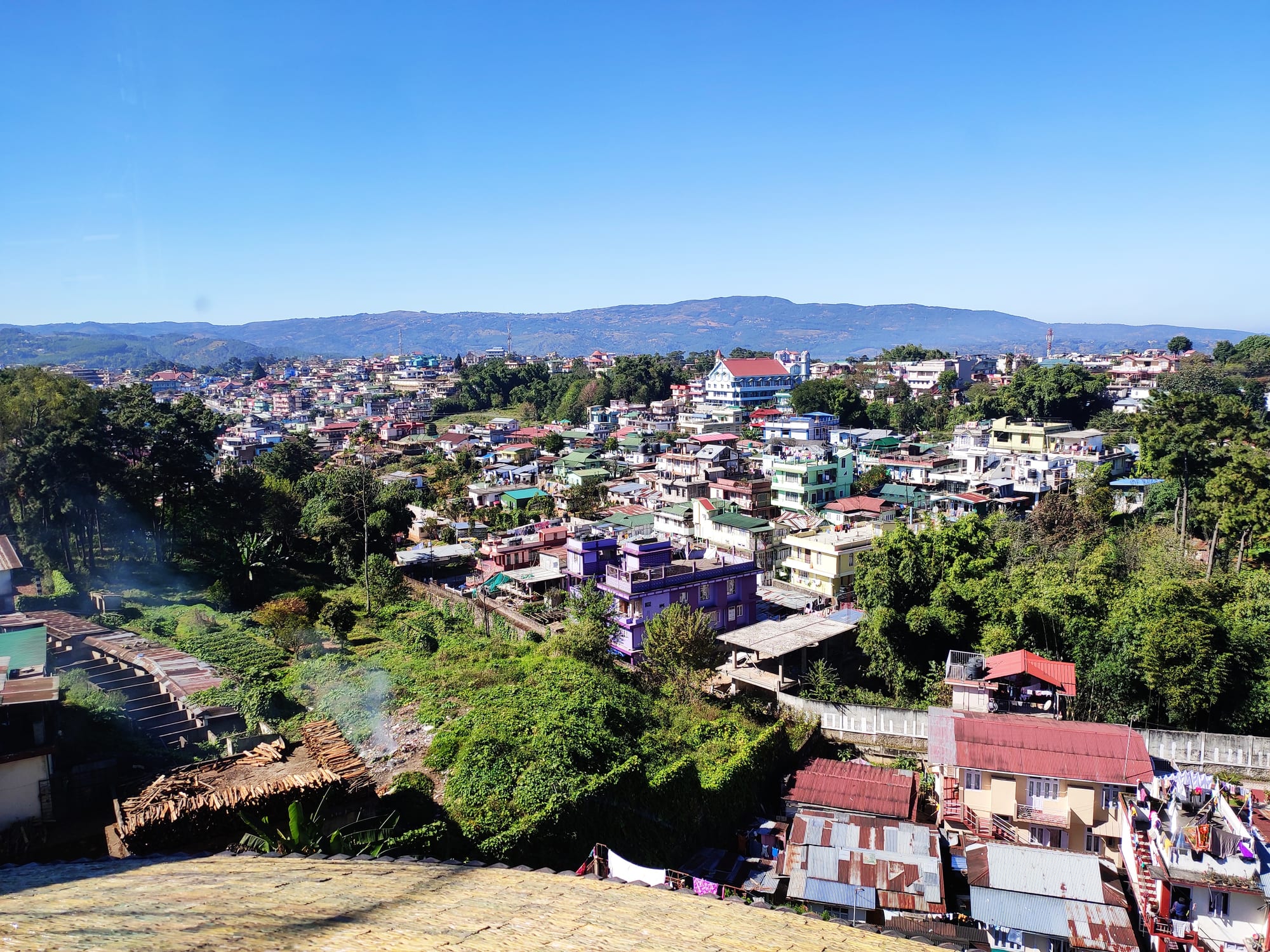
Brightly painted tin-roofed houses packed on a green hillside, with pine trees and a long blue ridge behind under a clear sky

The Northeast, India

Shillong

Houses spreading across the hillsides of Shillong, with the Khasi Hills plateau behind. (ANKAN / Wikimedia Commons · CC BY-SA 4.0)

The capital of Meghalaya, set at about 1,500 metres on the pine-covered Khasi Hills plateau south of the Brahmaputra valley. Built up by the British as a hill station and the seat of the Assam administration, it is now a Khasi-majority city known for its churches, markets, music scene and the waterfalls, caves and living root bridges of the hills around it.

Neighbourhoods

  • Police Bazar
    • First-time visitors
    • Best for food
    • Close to public transport

    The commercial centre, a knot of streets around a roundabout where most hotels, restaurants, bakeries, taxi stands and shops are concentrated. It is the point everyone gives directions from, busy until early evening and easy to reach from anywhere in the city.

    Open in Maps
  • Laitumkhrah
    • Students
    • Best for food
    • Nightlife

    A lively district east of the centre built around colleges and the cathedral, with cafés, small restaurants, bookshops and music shops. Student life gives it the city's most youthful feel.

    Open in Maps
  • Bara Bazar and Mawkhar
    • Markets
    • Local life

    The old Khasi heart of the city, where the vast Iewduh market spreads over several levels and streets. Meat, fish, vegetables, betel nut, brooms and cloth change hands here, and the lanes around it are dense and steep.

    Open in Maps
  • European Ward and the Golf Links
    • Historic district
    • Quiet and residential

    The colonial-era quarter around Ward's Lake and the Raj Bhavan, with bungalows, pine trees, government offices and the golf course laid out in a wooded valley. It is the quietest and greenest part of central Shillong.

    Open in Maps
  • Upper Shillong
    • Viewpoints
    • Quiet and residential

    The higher ground to the south-west on the road towards Sohra, with an air force station, pine forest and the approach to Shillong Peak. Cooler and often in cloud, it looks down over the whole city.

    Open in Maps

Things to do

In the city

  • Ward's Lakepark

    An ornamental lake in the centre of town, known locally as Pollock Lake or Nan Polok, with a wooden footbridge, gardens and boating, created during the British period.

    Open in Maps
  • North Eastern Hill Universityattraction

    A large central university campus spread over wooded hills west of the city, founded in 1973 and a centre of research on the region.

    Open in Maps

Viewpoints and waterfalls

  • Elephant Fallsattraction

    A three-stage waterfall in a wooded gorge on the edge of the city, reached by flights of steps and named by the British after a rock since destroyed by an earthquake.

    Open in Maps
  • Umiam Lakeattraction

    A large reservoir in the hills north of the city, created by a dam on the Umiam river in the 1960s, with viewpoints and water sports.

    Open in Maps

Short trips into the hills

  • Sohraattraction

    The plateau town long known as Cherrapunji, among the wettest inhabited places on earth, with gorges, caves and viewpoints over the plains of Bangladesh.

    Open in Maps
  • Nohkalikai Fallsattraction

    India's tallest plunge waterfall, dropping some 340 metres from the plateau edge near Sohra into a plunge pool of an unusual green.

    Open in Maps
  • Mawlynnongattraction

    A Khasi village near the Bangladesh border known across India for its cleanliness, flower-lined lanes and a nearby living root bridge.

    Open in Maps
  • Dawkiattraction

    A border town on the Umngot river, known for the clarity of its water in the dry season, with a suspension bridge and one of the few road crossings into Bangladesh.

    Open in Maps
  • Mawphlangattraction

    A village on the road south with one of the best-known Khasi sacred groves, a patch of untouched forest protected by custom, and standing stones on the grassland around it.

    Open in Maps
  • Living root bridgestrail

    Footbridges grown over decades from the roots of rubber fig trees by Khasi villagers, the best known the double-decker bridge at Nongriat below Sohra.

    Open in Maps
  • Mawsynramattraction

    A village west of Sohra that competes with it for the title of the rainiest place on earth, and the site of the Mawjymbuin cave, whose rock formations include one revered as a Shiva lingam.

    Open in Maps

Seasonal events

  • Shad Suk MynsiemSpring

    The Khasi spring thanksgiving dance, performed over several days in Shillong, with young women dancing in silk and gold and men carrying swords and whisks.

  • Ka Pomblang NongkremAutumn

    A harvest and thanksgiving festival at Smit, the seat of the Khyrim syiemship a short way from the city, with ceremonial dance and animal sacrifice.

  • Christmas and New YearDecember

    Meghalaya is a largely Christian state, and the season brings carol services, lights across the hills and packed churches, followed by a busy holiday week in the city.

  • Autumn music festivalsNovember

    The cool, clear weeks after the monsoon are when Shillong stages its largest open-air music events, drawing bands from across the northeast and beyond.

Eat and drink

Long-standing places and food districts in Shillong. Hours, ratings and directions come from your maps app, always current.

Shillong classics

  • Jadohneighborhood

    The Khasi staple of rice cooked with pork and its blood, served at small jadoh stalls with sides of offal, fried fish and a dry chilli chutney.

    Open in Maps
  • Khasi pork dishesneighborhood

    Dohneiiong, pork cooked with ground black sesame, dohkhlieh, a salad of boiled pork with onion and chilli, and tungrymbai, made from fermented soybean, served with local red rice.

    Open in Maps

Food districts and markets

  • Iewduh marketmarket

    The city's great market, where smoked meat, river fish, seasonal fruit, bamboo shoot and betel nut are sold and cooked food stalls feed the traders.

    Open in Maps
  • Police Bazar eating housesneighborhood

    Bakeries, tea rooms, Indian and Chinese restaurants and street stalls packed into the central streets, where the city eats out after work.

    Open in Maps
  • Laitumkhrah cafésneighborhood

    Coffee shops, bakeries and small restaurants around the colleges, popular with students and often the places where local bands play.

    Open in Maps

Experience Shillong

History

The Khasi Hills were governed for centuries not by a single kingdom but by a set of states, the syiemships, each with an elected chief and a council, and the area that became Shillong lay within the lands of Mylliem and Khyrim. The hills came to British attention in the 1820s and 1830s, when a road was pushed through from the Brahmaputra valley to Sylhet and conflict followed under the Khasi leader Tirot Sing, who resisted for several years before his capture.

The British valued the plateau for its cool climate. A small station grew from the 1860s, and in 1874, when Assam was made a separate province, Shillong became its capital — a hill town of bungalows, churches, a golf course and government offices that was frequently compared to Scotland. Welsh Presbyterian and later Catholic missionaries were central to its growth, giving the Khasi language a Roman script and building the schools that still dominate education here. On 12 June 1897 a great earthquake destroyed much of the town, after which it was rebuilt largely in timber and corrugated iron, a style still visible on its hillsides.

Shillong remained Assam's capital after Indian independence, and the movement for a separate hill state grew through the 1950s and 1960s. Meghalaya was created as an autonomous state in 1970 and a full state in 1972, with Shillong as its capital; Assam moved its own capital to Dispur, in Guwahati. The decades since have brought rapid growth, pressure on the city's water and roads, and periodic tension over migration and land, alongside the emergence of Shillong as the cultural centre of the Khasi, Jaintia and Garo peoples.

Culture & Customs

Khasi culture shapes everything here, starting with descent: clan names come from the mother, and the youngest daughter customarily inherits the house and cares for elderly parents, while a maternal uncle holds ritual authority. This matrilineal system is unusual in India and is a source of pride and of local debate. Traditional authority still functions through the syiems and their durbars, the village councils, and the Nongkrem festival at Smit is the clearest public expression of it.

The state is overwhelmingly Christian, and church life is central: choirs, Sunday services, wedding and funeral customs, and the lights and carols of Christmas across the hills. Older Khasi religious practice, Niam Khasi, continues alongside, with its sacred groves and seed and harvest rites, and the dance festivals in spring and autumn draw both communities.

Shillong's other reputation is musical. Missionary choral training, army bands and the radio produced a city unusually devoted to guitar music, and its rock, blues and gospel bands are known across India; a celebrated annual concert marks Bob Dylan's birthday. Cafés with live music, church choirs and open-air festivals in the autumn all belong to the same tradition. Football and archery are followed closely, the latter in the form of the daily arrow-shooting tradition of teer. Betel nut, kwai, is offered as a gesture of welcome, English is widely spoken alongside Khasi, and visitors are expected to ask before photographing people or entering a village.

Daily Life

About 143,000 people lived in the city proper at the 2011 census, and considerably more in the built-up area that spreads across the surrounding hills. Government is the largest employer — Meghalaya's secretariat, directorates and public agencies are here — followed by education, with a long list of colleges, the North Eastern Hill University and boarding schools that take students from across the region. Trade through Iewduh, tourism, small businesses and the informal economy account for much of the rest.

Housing climbs the slopes in tin-roofed terraces, and neighbourhoods are organised around localities with their own headmen and councils. Water supply is a recurring difficulty in a city that sits in one of the rainiest regions on earth, because storage and piping have not kept pace with growth; traffic on narrow hill roads is the other daily complaint, along with landslips in the monsoon and the pressure of coal and limestone economies in the districts beyond.

The rhythm is early. Sunrise comes before five in summer, offices and schools start early, the market is busiest in the morning, and shops close by evening; nightlife is modest, with cafés and live music rather than bars. Weekends belong to church, family and drives out to the waterfalls. Migration into the city from the districts, and the politics of residence and land in a state where most land is held under customary tenure, are constant subjects of public discussion.

Food

Khasi food is meat-heavy, lightly spiced and built on rice. Jadoh, the dish most associated with Shillong, is rice cooked with pork and blood until it takes on a deep colour, sold at small stalls with dohjem, offal sausage, fried fish and a fierce chutney of dried chilli and black sesame. Dohneiiong is pork simmered with ground black sesame; dohkhlieh is a salad of boiled pork and sliced onion with chilli and lime; and doh syiar is chicken cooked in similar ways. Tungrymbai, fermented soybean paste cooked with pork fat and ginger, is the most pungent of the local dishes and the one people miss most when away.

Vegetables and rice fill out the meal: local red rice, boiled greens, pumpkin and bamboo shoot, and putharo and pukhlein, steamed and fried rice cakes eaten with tea. Smoked meat and dried fish hang in the market and go into slow stews. Jaintia and Garo dishes appear in the city too, and the Bengali, Nepali, Bihari and Marwari communities have added their own kitchens, so a street in Police Bazar may offer momos, chow, puri and jadoh within a few doors.

The city has a strong tea and bakery culture inherited from the hill-station years, with sweet milky tea, buns and cakes sold from morning. Kwai — areca nut with betel leaf and lime — is chewed constantly and offered as a courtesy. Local rice beer is part of traditional Khasi ritual and hospitality, and cafés in Laitumkhrah and Police Bazar have brought filter coffee and a young restaurant scene to a city that eats early and well.

Planning tools

Budget

Shillong is cheap for food and local transport and moderate for rooms, with homestays and guesthouses well below hotel prices. The main costs are vehicles: shared taxis are inexpensive, but reaching the root bridges, Dawki or Mawsynram comfortably usually means hiring a car for the day. Prices rise in the Indian holiday seasons and around Christmas.

Daily Budget Midrange
USD 50–120 (mid-range hotel, restaurant meals, a car with driver for the hills)
Daily Budget Shoestring
USD 15–30 (guesthouse or homestay, jadoh stalls and market food, shared taxis)

Shared taxis run set routes around the city for a few rupees a seat; save hired cars for the villages and waterfalls, and share the cost where possible.

Best Time to Visit

October to April is the main season, with clear air, cool days and open roads; November brings the flowering cherry trees and the largest music events. The monsoon, from roughly May to September, is exceptionally wet on this plateau — the waterfalls are at their most powerful, but cloud, landslides and closed roads are common.

Suggested Number of Days

Two days covers the city itself, which is small. Four or five suit the surrounding hills, where the villages, caves and river valleys are spread out on slow roads. Monsoon weather and landslides can add time, and walkers heading down to the root bridges need an extra day.

First Visit
2 days
With Surroundings
4–5 days

Transportation

Shared taxis are the backbone of local transport, running fixed routes and picking up passengers along the way; private taxis and app-based cabs also operate, and buses connect the outer suburbs. Roads are narrow and steep, and the centre is heavily congested, so short distances can take a long time. Cars with drivers are the standard way to reach the hills.

Shared taxis are flagged down on the street and fill up with strangers; state the destination before getting in, since each car runs a set route.

Airport & Station Connections

Most visitors come by road from Guwahati, about 100 kilometres north and usually about two and a half hours by shared taxi or bus on the four-lane highway. Shillong airport at Umroi, roughly 30 kilometres away, has limited domestic flights, so Guwahati's airport and railway station serve as the practical gateways. Helicopter services between the two cities have operated at times.

Walkability

The centre is compact and best seen on foot: Police Bazar, Ward's Lake and the market are within a kilometre or so of each other. The city is built on hills, so almost every walk involves a climb, pavements are narrow or absent on many roads, and rain is frequent. Beyond the centre, distances and gradients mean most people take a taxi.

Safety

Shillong is a calm city and crime against visitors is uncommon, though pickpocketing happens in the market crowds. The real hazards are the roads and the weather: landslides and rockfalls during heavy rain, slippery paths at waterfalls and viewpoints, and long steep descents on the walks to the root bridges. Occasional local protests or strikes can close roads and shops at short notice.

Check road conditions before setting out in the monsoon, keep back from unfenced cliff edges at the falls, avoid night driving in the hills, and follow local advice during any strike or protest. Check current official travel advice before travelling.

Climate

A subtropical highland climate, mild all year because of the altitude and extremely wet in the monsoon, which on this plateau runs from about May to September and produces some of the world's highest rainfall totals just to the south. Cloud and mist are common even outside the rains.

Summer
mild and very wet, generally 16–25°C, with long spells of rain and cloud
Winter
cool and dry, generally 4–18°C, with cold nights and clear days

Local Customs

Khasi society is matrilineal: children take the mother's clan name and property usually passes to the youngest daughter, a system visitors often notice in the running of markets and households. Meghalaya is largely Christian, and Sunday is quiet, with shops shut and churches full. Sacred groves such as Mawphlang are protected by custom, and nothing may be taken out of them, not even a leaf or a stone.

Ask before photographing people, particularly in villages and at festivals, dress modestly in churches, and take a local guide into the sacred forests, where customary rules apply.

Common Payment Methods

The currency is the Indian rupee. Cards are accepted in hotels and larger restaurants in the city, and UPI mobile payments are common, but the market, shared taxis, homestays and village guides work in cash. ATMs are plentiful in Shillong and scarce in the hills, so it is worth drawing money before heading out.