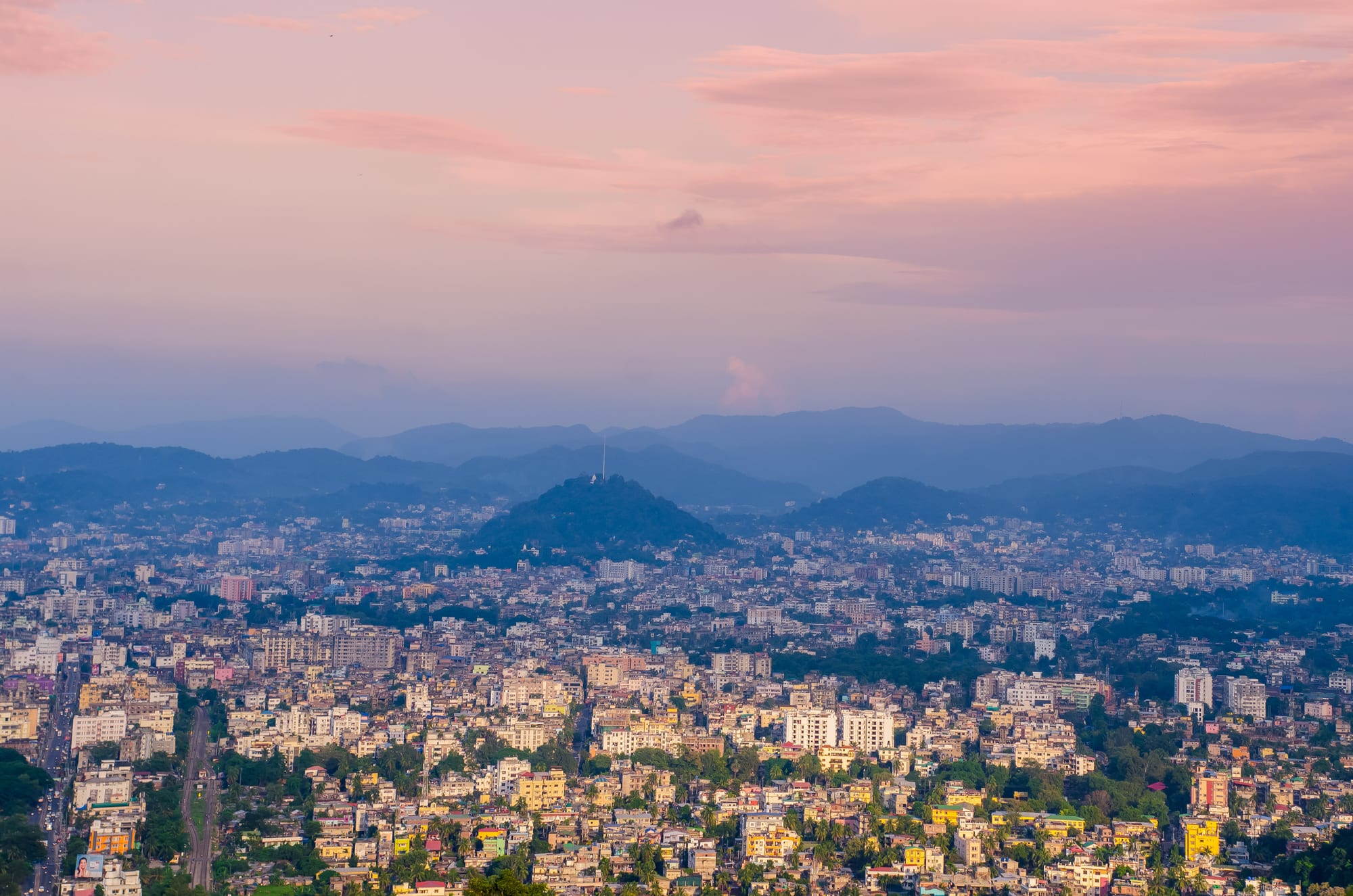
A dense low-rise city spreading to wooded hills and blue ridges under a pink and violet evening sky

The Northeast, India

Guwahati

Guwahati seen from Nilachal Hill, the ridge on which the Kamakhya temple stands. (Gitartha.bordoloi / Wikimedia Commons · CC BY-SA 4.0)

Assam's largest city and the gateway to India's northeast, spread along the south bank of the Brahmaputra beneath the wooded hills of the Kamakhya temple. An ancient settlement known in Sanskrit texts as Pragjyotishpura, it is now the region's centre for trade, education, air and rail links, with the state government seated in its Dispur quarter.

Neighbourhoods

  • Paltan Bazaar and Fancy Bazaar
    • First-time visitors
    • Close to public transport
    • Shopping

    The commercial core beside the railway station, a grid of wholesale and retail streets selling cloth, silk, spices and electronics. Most of the city's budget and mid-range hotels are here, along with bus stands and shared-taxi counters for the hill states.

    Open in Maps
  • Uzan Bazar and the riverfront
    • Walks
    • Historic district
    • Quiet and residential

    The older residential quarter east of the centre, with bungalows, schools and the ghats where ferries cross to Umananda island. The Brahmaputra promenade, Dighalipukhuri tank and the state museum are all within walking distance.

    Open in Maps
  • Kamakhya and Maligaon
    • Temples
    • Local life

    The western side of the city, below and around Nilachal Hill, where the Kamakhya temple draws pilgrims all year. Maligaon beside it is a railway town in its own right, with the Northeast Frontier Railway headquarters and its colonies.

    Open in Maps
  • Dispur and Ganeshguri
    • Close to public transport
    • Shopping

    The seat of the Assam government, an area of secretariat buildings, offices and busy junctions on the Shillong road. Ganeshguri's markets and flyover crossroads make it one of the city's main traffic and shopping points.

    Open in Maps
  • Zoo Road and Chandmari
    • Best for food
    • Nightlife

    Middle-class residential districts north-east of the centre, with the state zoo and botanical garden, restaurants, cafés and shops. Much of the city's eating out and evening life happens along these roads.

    Open in Maps
  • Khanapara and the southern edge
    • Quiet and residential
    • Short trips

    The suburbs where the city meets the Meghalaya border, with the veterinary and agricultural colleges, hotels on the highway and the starting point of the road climb to Shillong.

    Open in Maps

Things to do

Temples and sacred hills

  • Kamakhya Templelandmark

    One of the most revered Shakta temples in India, on Nilachal Hill above the river, its reconstruction completed in 1565 under the Koch king Nara Narayan, with a brick dome in the shape of a polygonal beehive.

    Open in Maps
  • Umananda Templelandmark

    A Shiva temple on Peacock Island, a rocky islet in the middle of the Brahmaputra reached by ferry from the Uzan Bazar ghat.

    Open in Maps
  • Basistha Templelandmark

    A temple and ashram at the southern edge of the city where three hill streams meet, set among boulders and forest.

    Open in Maps
  • Sukreswar Templelandmark

    A Shiva temple on the Sukreswar or Itakhuli hill above the river in Panbazar, holding a very large lingam, with a long flight of steps down to the ghat.

    Open in Maps

Museums and culture

  • Assam State Museummuseum

    The state collection beside Dighalipukhuri, founded in 1940 and strong on sculpture in stone, wood and metal from the Assam region, arms, crafts and displays on the state's communities.

    Open in Maps
  • Srimanta Sankaradeva Kalakshetramuseum

    A cultural complex named after the medieval Vaishnavite poet and reformer Srimanta Sankardev, with a museum of the region's peoples, open-air theatres and emporiums.

    Open in Maps

The river and green spaces

  • Dighalipukhuripark

    A long rectangular man-made tank in the city centre, said in legend to have been dug in the time of the ancient kings, now a park with boating.

    Open in Maps
  • Deepor Beelpark

    A large freshwater wetland on the south-western edge of the city, a Ramsar site important for migratory birds and for the elephants that cross it.

    Open in Maps
  • Saraighat Bridgelandmark

    The first rail and road bridge across the Brahmaputra, opened in 1962, named after the river battle fought near this reach in 1671.

    Open in Maps

Short trips from the city

  • Pobitora Wildlife Sanctuarypark

    A small grassland and wetland reserve east of the city holding one of Assam's largest populations of Indian rhinoceros, visited by jeep safari.

    Open in Maps
  • Hajoattraction

    A town across the river revered by Hindus, Muslims and Buddhists alike, with the Hayagriva Madhava temple on a hill and the Poa Mecca mosque.

    Open in Maps
  • Sualkuchiattraction

    A weaving town on the north bank, known as the Manchester of Assam, whose handloom households make the muga, pat and eri silks.

    Open in Maps
  • Madan Kamdevlandmark

    Scattered ruins and carved stone panels dated to about the 9th and 10th centuries, spread over a low wooded hill north of the river.

    Open in Maps

Seasonal events

  • Ambubachi MelaJune

    A festival at the Kamakhya temple drawing very large crowds of pilgrims and ascetics, held when the goddess is said to observe her annual period of seclusion.

  • Rongali BihuApril

    The Assamese new year and spring festival, with husori singing, dance competitions, drums and pipes, and new clothes of Assamese silk.

  • Magh BihuJanuary

    The harvest festival, marked by feasting, bonfires and temporary bamboo and thatch structures built to be burned at dawn.

  • Durga PujaSeptember or October

    Pandals, lights and processions across the city over several days, ending with immersion in the Brahmaputra.

Eat and drink

Long-standing places and food districts in Guwahati. Hours, ratings and directions come from your maps app, always current.

Guwahati classics

  • The Assamese thalineighborhood

    Rice with khar, a mildly alkaline dish, masor tenga, a sour fish curry, pitika mashes of potato or aubergine, greens and a pickle, served in the city's Assamese kitchens.

    Open in Maps
  • Assam teacafe

    The strong malty black tea grown on the plantations upriver, drunk with milk and sugar at roadside stalls and sold loose in the bazaars.

    Open in Maps

Food districts and markets

  • Fancy Bazaarmarket

    The central wholesale and retail market, where cloth and spice shops sit among sweet counters, snack stalls and rows of tea and puri sellers.

    Open in Maps
  • Paltan Bazaar eating housesneighborhood

    Cheap rice-and-curry places, Bengali and North Indian kitchens and juice stalls packed into the streets around the railway station.

    Open in Maps
  • Zoo Road restaurantsneighborhood

    The city's main eating-out strip, mixing Assamese and tribal cuisines from across the northeast with Chinese, Tibetan and Indian restaurants and cafés.

    Open in Maps
  • Uzan Bazar fish marketmarket

    Morning trade in river fish landed from the Brahmaputra, the source of the rohu, borali and small fish that fill Assamese kitchens.

    Open in Maps

Experience Guwahati

History

Guwahati is one of the oldest continuously settled places in eastern India. Sanskrit texts know it as Pragjyotishpura, the capital of the legendary king Naraka and later the seat of the Kamarupa kingdom, whose rulers from the seventh century onwards were described by the Chinese pilgrim Xuanzang and recorded in copper-plate grants. The Kamakhya temple on Nilachal Hill, the Navagraha on Chitrachal and the scattered stone carvings around the city are the physical remains of that long period, when the city's reputation for astronomy, tantra and learning spread across the subcontinent.

After Kamarupa broke up, the Brahmaputra valley became contested ground. The Koch king Nara Narayan rebuilt the Kamakhya temple in the 1560s after an earlier structure was destroyed, and from the 17th century Guwahati stood on the frontier between the Mughal empire and the Ahom kingdom, changing hands repeatedly. The decisive moment came in 1671 at Saraighat, just west of the city, where the Ahom general Lachit Borphukan defeated a much larger Mughal fleet in a battle on the river that remains central to Assamese identity.

The British annexed Assam in 1826 after the Treaty of Yandabo and made Guwahati the seat of their administration until 1874, when the headquarters moved to Shillong; the town meanwhile grew as a river port and railway centre. It became the state's main city after independence, and in 1972, when Meghalaya was separated from Assam, the state capital moved from Shillong to Dispur, inside Guwahati. Growth since then has been rapid and sometimes turbulent: the Assam Movement of 1979 to 1985 against migration from Bangladesh had its centre here, and the city has spread over hills and wetlands that once bounded it.

Culture & Customs

Guwahati is the meeting point of Assamese valley culture and the many hill cultures of the northeast. Its Assamese identity is rooted in the Vaishnavite reform of Srimanta Sankardev, whose namghars — prayer halls without images — stand in neighbourhoods across the city, and whose Sattriya dance, once performed only in monasteries, is now taught and staged here as a classical form. Bihu is the great common celebration: Rongali Bihu in April brings dance, dhol drums and the buffalo-horn pepa pipe out into fields and streets, and Magh Bihu in January is about feasting and bonfires.

The city is also the region's media and education centre, with Assamese newspapers, television, a lively music scene and university campuses drawing students from Nagaland, Manipur, Meghalaya and Arunachal Pradesh. That mix shows in restaurants serving Naga and Mizo food, in churches beside temples and mosques, and in a young cultural scene that has produced rock bands and film-makers with followings across the northeast.

Kamakhya sets the city's religious tone. It is one of the most important centres of Shakta worship in India, associated with tantric practice, and the Ambubachi Mela in June brings hundreds of thousands of pilgrims, including crowds of sadhus. Animal sacrifice is part of ritual at the temple, and visitors are asked to be respectful about it. Everyday courtesies include removing shoes indoors, using the right hand for food, and the offering of a gamosa to guests and honoured visitors.

Daily Life

About a million people live in Guwahati, and the wider urban area is larger still, making it by far the largest city in northeastern India. It functions as the northeast's hub: wholesale trade for eight states, the region's main airport and railway junction, its largest hospitals, and the Assam government offices at Dispur. Oil and gas from upper Assam, tea, plywood, cement and a growing information technology and services sector feed the economy, alongside a very large informal workforce of traders, drivers and day labourers.

Residential life ranges from the old bungalow streets of Uzan Bazar and the railway colonies of Maligaon to new apartment blocks climbing the hillsides in the south and east. Rents and land prices have risen fast, and settlements on hill slopes and around Deepor Beel are vulnerable to landslides and waterlogging. Students from across the region fill hostels and rented rooms around the universities.

Days start early, because India's single time zone puts sunrise before five in summer, and offices, schools and markets open and close correspondingly early. The shared problems are familiar: traffic on a road network squeezed between river and hills, urban flooding when hill streams and drains overflow after heavy rain, air quality in winter, and the annual Brahmaputra floods that affect the districts around the city more than the city itself.

Food

Assamese cooking is light, sour and lightly spiced, with little use of the heavy masalas found further west. A home meal is built on rice, with khar — a dish of vegetables, pulses or fish cooked with an alkaline filtrate traditionally made from burnt banana peel — served early in the sequence, and masor tenga, a sour fish curry soured with tomato, elephant apple or lemon, at the centre. Pitika, boiled potato, aubergine or fish mashed with mustard oil, onion and chilli, accompanies almost everything, along with a bowl of dal and seasonal greens.

Fish from the Brahmaputra is the everyday protein, and duck cooked with ash gourd or sesame, pigeon, pork with bamboo shoot and mutton appear at feasts and festivals. Bamboo shoot, fermented or fresh, and the sour fruit of the elephant apple are distinctive local ingredients, as is the use of mustard seed and ghost chilli in small quantities. Restaurants in the city also serve the food of the surrounding hill states — Naga smoked pork with axone, Manipuri eromba, Tibetan momos and thukpa — which makes Guwahati the easiest place to eat across the whole region.

Sweets and snacks follow the Bihu calendar: pitha, rice-flour cakes filled with sesame or coconut and jaggery, are steamed, fried or roasted for the festivals; laru are sweet balls of rice, coconut or sesame; and doi with gur, curd and palm jaggery, ends many meals. Tea is drunk all day, grown a few hours upriver in the plantations that made Assam's name, and the bazaars sell it loose alongside the pickles, dried fish and bamboo shoot that fill household stores.

Planning tools

Budget

Guwahati is inexpensive for a state capital: hotels around Paltan Bazaar and Zoo Road are cheap, local food costs little, and temple and museum entry is nominal. Costs rise with distance — hired cars for Pobitora or the hill states, and flights into the northeast — and hotel prices climb during Ambubachi Mela and Bihu.

Daily Budget Midrange
USD 50–120 (mid-range hotel, restaurant meals, a car with driver for day trips and transfers)
Daily Budget Shoestring
USD 15–30 (guesthouse, thalis and market food, city buses and shared autos)

Shared taxis and buses from the Paltan Bazaar area reach Shillong and other hill towns cheaply; hire a whole car only when several sights are combined in a day.

Best Time to Visit

October to April, when the weather is dry and mild and the roads into the hills and to the national parks are open. Bihu in April fills the city with music and dance. The monsoon from May to September brings heat, humidity, river floods and waterlogged streets, though the Ambubachi pilgrimage in June is the year's biggest gathering.

Suggested Number of Days

Two days is enough for the temples, the river and the museums. Four or five allows the wetlands, weaving and temple towns nearby and a first trip out towards the national parks or the hills, for which the city is the usual staging point. Festivals and monsoon travel both need slack.

First Visit
2 days
With Surroundings
4–5 days

Transportation

The city runs east to west along the river for some 20 kilometres, so most journeys involve a ride. City buses and privately run minibuses work the main corridors, app-based cabs and auto-rickshaws are widely used, and ferries cross to Umananda island and the north bank. Traffic is heavy on the arterial roads, particularly around Ganeshguri.

Allow extra time in the rush hours and during heavy rain, when low-lying junctions flood quickly.

Airport & Station Connections

Lokpriya Gopinath Bordoloi International Airport at Borjhar, about 28 kilometres west of the centre, is the largest in the northeast, with flights across India and a few regional international services. Guwahati railway station in Paltan Bazaar has long-distance trains from Kolkata, Delhi and across Assam. Shillong is about 100 kilometres south, roughly two and a half hours by road, and shared taxis leave through the day.

Walkability

Individual districts walk well — Paltan Bazaar, the riverfront at Uzan Bazar, the streets around Dighalipukhuri — but the city as a whole is spread out and divided by hills, so walking between areas is rarely practical. Pavements are uneven and often occupied by stalls, and the climb to Kamakhya is steep enough that most visitors take a vehicle.

Safety

Guwahati is generally safe for visitors, with petty theft in crowded markets and on trains the main crime risk. The greater hazards are natural and practical: traffic, flash flooding of city streets in heavy rain, Brahmaputra floods in the monsoon, and the seismic risk of a region that has had major earthquakes. Crowds at Ambubachi Mela are enormous.

Avoid the riverbank and low-lying roads during heavy rain, watch belongings in bazaars and at the railway station, and check permit rules before continuing into the other northeastern states. Check current official travel advice before travelling.

Climate

A humid subtropical climate with a long, very wet season. Rain begins in spring, often with thunderstorms, and the monsoon runs from about May to September, when the Brahmaputra rises and floods the plain. Winters are dry, mild and sometimes hazy.

Summer
hot and very humid, generally 25–35°C, with frequent heavy rain from May
Winter
mild and dry, generally 10–26°C, with cool mornings and river mist

Local Customs

Assamese manners are courteous and understated. Shoes come off at temple and house doors, and modest dress is expected at the Kamakhya temple, where photography inside the shrine is restricted. The gamosa, a white cotton cloth with red woven borders, is given as a mark of respect and appears at every ceremony. Assamese, Bengali, Hindi and English are all heard in the city.

Ask before photographing worshippers or animal rituals at Kamakhya, eat with the right hand, and accept the gamosa or a scarf with both hands when it is offered.

Common Payment Methods

The currency is the Indian rupee. Cards are taken in hotels, malls and larger restaurants, and UPI mobile payments are used widely, including by small shops. Cash remains essential for autos, ferries, temple offerings and markets, and for travel on into the smaller hill towns, where ATMs are scarce.