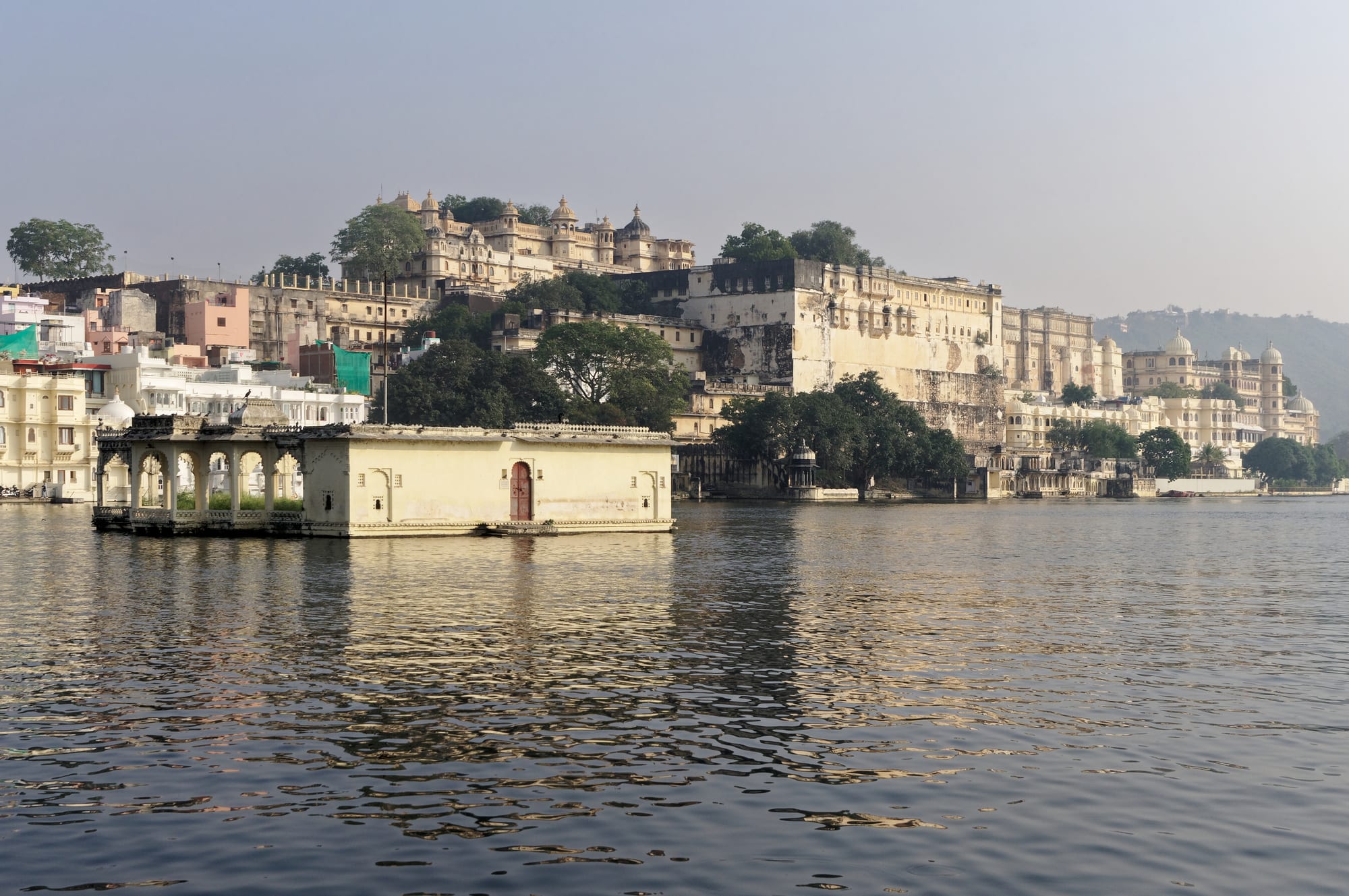
Cream-coloured palace buildings and domes above the calm water of a lake, with a small pavilion in the foreground

India

Rajasthan

The City Palace and the Mohan Temple on the shore of Lake Pichola in Udaipur. (Jakub Hałun / Wikimedia Commons · CC BY-SA 4.0)

India's largest state by area, stretching from the Aravalli hills west across the Thar Desert to the Pakistan border — the old Rajputana of warrior clans and princely states, whose hill forts, palaces and walled cities at Jaipur, Udaipur, Jodhpur and Jaisalmer have made it a centre of India's heritage tourism.

Explore Rajasthan

History

Rajasthan's ancient layers are thin on the ground — Harappan and later sites around Kalibangan, and early Buddhist remains at Bairat — but its medieval story is everywhere. From the 7th century onward the Rajput clans, who claimed descent from the sun, the moon and the sacrificial fire, carved out kingdoms: the Sisodias of Mewar at Chittorgarh and later Udaipur, the Rathores of Marwar at Jodhpur, founded by Rao Jodha in 1459, the Kachwahas at Amber, the Bhatis at Jaisalmer, and the Chauhans at Ajmer and Ranthambore.

Their history is told as one of sieges. Chittorgarh fell three times, most famously to Akbar in 1568, and Maharana Pratap of Mewar's resistance to the Mughals at Haldighati in 1576 remains a regional legend. Other houses, above all the Kachwahas of Amber, allied with the Mughals and grew rich serving them as generals. Sawai Jai Singh II moved the Kachwaha capital to a new planned city, Jaipur, in 1727. As Mughal power faded, the Marathas raided the region, and in the early 19th century the princes signed treaties that made them British allies under indirect rule, grouped as the Rajputana Agency.

At independence the princely states merged in stages between 1948 and 1956 into the state of Rajasthan, with Jaipur as capital. Many former rulers turned their palaces into hotels, beginning a heritage-tourism industry. India tested nuclear devices at Pokhran in the Jaisalmer desert in 1974 and 1998, and the Indira Gandhi Canal has since brought irrigated farming to parts of the north-west.

Culture & Customs

Rajput codes of honour, hospitality and martial pride still colour the region's self-image, alongside strong merchant communities: the Marwaris, originally from the Jodhpur and Shekhawati regions, became one of India's best-known business communities, and their painted havelis fill the Shekhawati towns. Rajasthani, with its Marwari, Mewari and Dhundhari varieties, is spoken alongside Hindi. Religion is mainly Hindu, with important Jain temples and a large Muslim population; the Sufi shrine of Moinuddin Chishti at Ajmer is one of South Asia's great pilgrimage sites.

Colour is part of daily dress: bright turbans whose styles mark caste and district, and women's mirrored skirts and veils. Folk music is carried by the hereditary Manganiyar and Langa musicians of the desert, and the Kalbelia snake charmers' dance is UNESCO intangible heritage; Ghoomar, the whirling women's dance, began among the Bhils and was taken up by the Rajputs. Puppetry with kathputli string puppets, miniature painting, blue pottery in Jaipur, and block printing at Sanganer and Bagru are living crafts.

Festivals include Teej and Gangaur, both centred on women's devotion to Parvati, Holi and Diwali, and the livestock fair of Pushkar. The Bishnoi community near Jodhpur is known for protecting trees and blackbuck, a tradition dating back to its 15th-century founder, Guru Jambheshwar.

Daily Life

Rajasthan had over 68 million people at the 2011 census. Jaipur, with over three million in its urban area, is the capital and a centre for gems, jewellery, textiles and tourism; Jodhpur and Kota each have about one and a half million people, Kota as a national hub for students preparing for engineering and medical entrance exams. Bikaner, Ajmer and Udaipur are the next-largest cities.

Most people still live in villages, farming millet, wheat, mustard and pulses and herding goats, sheep and camels. Water governs everything: traditional stepwells and tanks once stored the monsoon, and droughts, falling groundwater and pressure on desert grazing remain pressing issues. Marble from Makrana, sandstone, zinc and a growing solar-power industry in the desert add to the economy, and many households depend on men working in Gujarat, Mumbai or the Gulf.

Life in the old walled cities runs on bazaars that open mid-morning and stay busy late into the evening, with tea at every corner and a long afternoon lull in the heat. Social conservatism remains strong in the countryside, where child marriage and purdah, though declining, have not vanished.

Food

Desert cooking was built for scarce water and fresh vegetables, so it relies on pulses, gram flour, dried beans, ghee and buttermilk. Dal baati churma is the signature meal: hard wheat balls baked in coals and soaked in ghee, eaten with lentils and a sweet crumble of the same dough. Gatte ki sabzi is gram-flour dumplings in a curry, and ker sangri is another signature dish of the desert. Millet bajre ki roti is the village bread.

The Rajput courts added game and meat: laal maas is a fiery red mutton curry coloured with Mathania chillies, and safed maas a milder white version. Most of the state, though, eats vegetarian, and Jain cooking avoids onion and garlic.

Snacks are a speciality. Jodhpur is known for mirchi bada, fried stuffed green chillies, and pyaaz kachori, onion-filled pastries; Bikaner's bhujia, crisp gram-flour noodles, is sold across India. Sweets include ghevar, a honeycomb disc of fried batter soaked in syrup made for Teej, and Pushkar's malpua pancakes. Buttermilk and lassi cool the day, and masala chai keeps it going.

Attractions & Natural Wonders

Jaipur has the Hawa Mahal's latticed façade, the City Palace, the Jantar Mantar astronomical instruments and, just outside, Amber Fort above Maota Lake, with Nahargarh and Jaigarh forts on the ridge. The walled city, the Jantar Mantar and Amber are all within UNESCO World Heritage Sites.

To the south, Udaipur's lakes frame the City Palace, the Lake Palace hotel and Jag Mandir on Lake Pichola, with Fateh Sagar to the north. Kumbhalgarh's long walls, Chittorgarh's fort-city and the Jain temples of Ranakpur lie within reach, and Mount Abu holds the marble Dilwara temples.

In the west, Jodhpur's blue city spreads below Mehrangarh, with the Umaid Bhawan Palace on the opposite hill. Jaisalmer's fort, its havelis and the surrounding dunes lead into the Thar desert and the Desert National Park; the abandoned village of Kuldhara is nearby. Bikaner has Junagarh Fort and the rat temple at Deshnok.

In the centre, Pushkar surrounds its sacred lake, with the Brahma temple and the autumn camel fair, and neighbouring Ajmer has the Dargah Sharif. In the east, the tiger reserve at Ranthambore surrounds its hilltop fort, Keoladeo National Park at Bharatpur is a UNESCO-listed wetland for migratory birds, and the Shekhawati towns preserve their painted merchant havelis. Six of the state's hill forts — Chittorgarh, Kumbhalgarh, Ranthambore, Gagron, Amber and Jaisalmer — form a single UNESCO World Heritage Site.

Cities in Rajasthan

Planning basics

Budget

Rajasthan is good value by Indian standards but has more heritage hotels and palace stays than anywhere else, so costs depend on taste: a family haveli guesthouse is cheap, a palace hotel in Udaipur or Jaipur among the most expensive rooms in the country. Fort and palace tickets for foreign visitors, Ranthambore safaris and a car with driver are the main extras.

Daily Budget Midrange
USD 50–130 (heritage haveli hotel, restaurant meals, a car with driver, a safari or desert camp)
Daily Budget Shoestring
USD 15–25 (guesthouse or haveli dormitory, thalis and street food, buses and trains)

Book Ranthambore safaris and Pushkar Fair rooms well ahead; a car with driver shared between two or three travellers is the most efficient way to link the cities.

Safety

Rajasthan is one of India's easier regions to travel in, but it is also the most touristed, so touts, gem scams in Jaipur, commission-driven shops and inflated camel-safari offers are common. Heat is the real physical danger from April to June. Women travelling alone report persistent staring and harassment in the busier towns.

Never buy gems for resale, agree prices before any camel ride or rickshaw, and carry water and sun protection in the desert. Check current official travel advice before travelling.

Climate

Hotter and drier than most of India. The Thar Desert in the west gets little rain and swings from very hot days to cool nights; eastern Rajasthan around Jaipur and Ranthambore is greener and receives more of the monsoon. Mount Abu, the state's only hill station, is noticeably cooler. Winter nights in the desert can drop close to freezing.

Summer
extremely hot, often 42–48°C in the desert in May and June; the monsoon from July brings short, heavy showers
Winter
sunny and dry, 20–28°C by day, with cold nights near 0–5°C in Jaisalmer and Bikaner

Transportation

Jaipur is under five hours from Delhi by train or the expressway and has an international airport, and Udaipur, Jodhpur and Jaisalmer have domestic flights. Trains link the main cities, including overnight services to Jaisalmer, and buses fill the gaps. Distances are long: Jaipur to Jaisalmer is a full day by road.

Take the overnight train for the long desert legs, and use a car with driver for the rural loops between the forts.

Best Time to Visit

October to March is the season, with December and January the busiest and coldest at night. The Pushkar Camel Fair falls in October or November and Jaisalmer also holds a desert festival. April to June is fiercely hot, though Udaipur's lakes are fullest just after the monsoon.