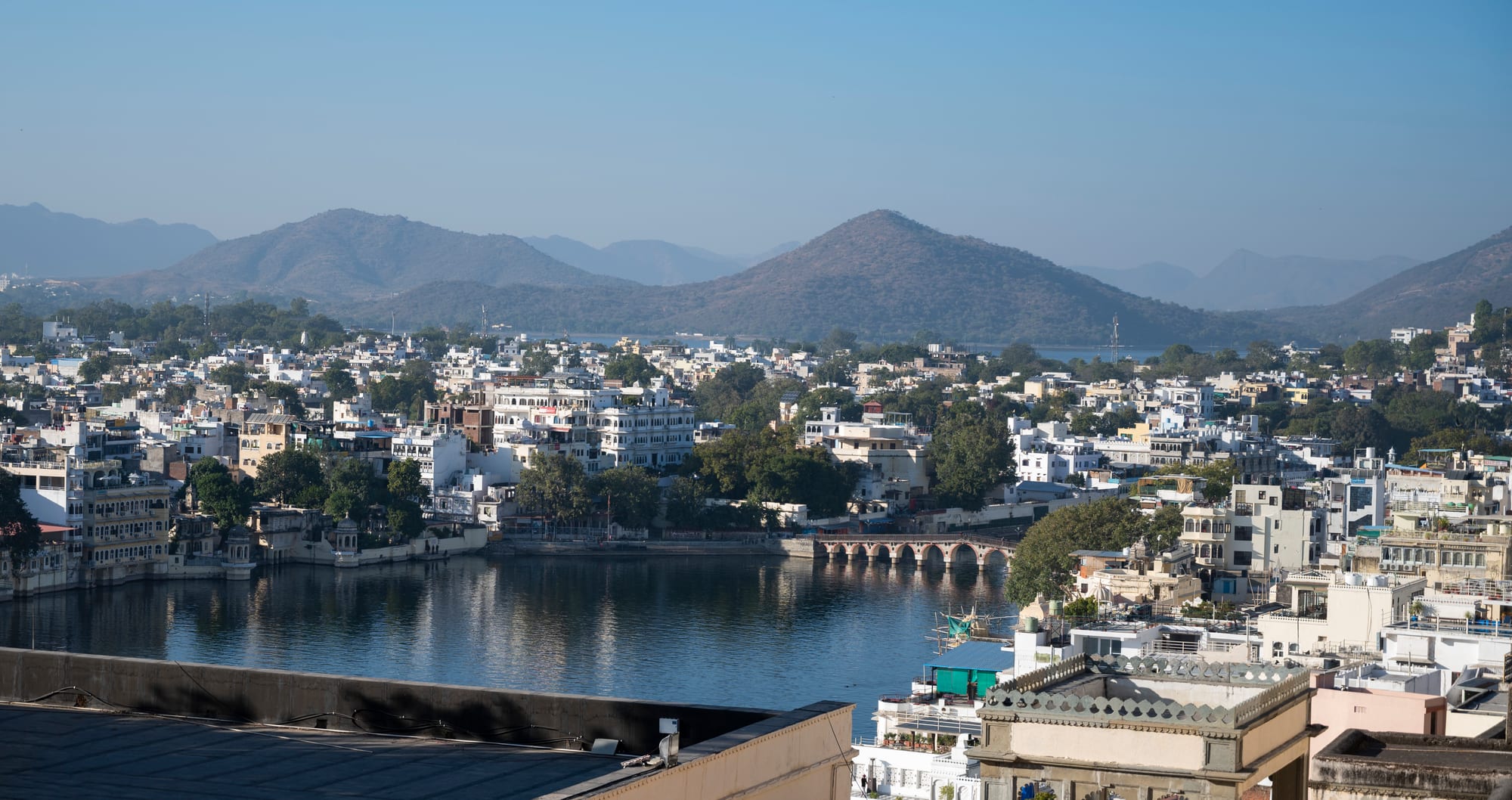
White and pale houses around a calm lake with an arched causeway, backed by dry green hills under a clear sky

Rajasthan, India

Udaipur

Udaipur's lakes and the Aravalli hills seen from the City Palace. (Navneet Sharma / Wikimedia Commons · CC BY-SA 4.0)

A city of linked artificial lakes in the Aravalli hills of southern Rajasthan, founded in 1559 by Maharana Udai Singh II when the rulers of Mewar left Chittorgarh. Whitewashed havelis, ghats and temples crowd the shore of Lake Pichola beneath a vast City Palace, and the island palaces on the water have made Udaipur one of India's best-known heritage destinations.

Neighbourhoods

  • The old city and Lal Ghat
    • First-time visitors
    • Historic district
    • Views

    The lanes east of Lake Pichola around the Jagdish Temple, packed with havelis converted into guesthouses, rooftop restaurants, miniature painting shops and the ghats where the city washes and bathes. It is the centre of everything a visitor is likely to do.

    Open in Maps
  • Hanuman Ghat and Ambrai
    • Quiet and residential
    • Views
    • Cafés

    The western shore of the lake, reached by a footbridge, looking back at the City Palace. Quieter and more residential, with music and art schools, a cremation ghat, small hotels and the best evening views across the water.

    Open in Maps
  • Fateh Sagar and Panchwati
    • Green streets
    • Local life
    • Walking

    The area around the larger northern lake, with a lakeside road used by walkers and cyclists, gardens, the solar observatory island and a mix of middle-class housing and newer hotels.

    Open in Maps
  • City Palace and Gulab Bagh
    • Museums
    • Historic district
    • Parks

    The southern edge of the old city, taken up by the palace complex, the royal gardens of Gulab Bagh and museums. Hotels here are larger and the streets wider than in the lanes to the north.

    Open in Maps
  • Hiran Magri and Sector 11
    • Quiet and residential
    • Local life

    Planned residential sectors south-east of the centre, near the university and the main hospitals, where much of the city's population lives and where the markets serve residents rather than travellers.

    Open in Maps

Things to do

Palaces and the lakes

  • City Palacelandmark

    The largest palace complex in Rajasthan, built up by successive Maharanas from 1553 above Lake Pichola, with mirrored rooms, courtyards and a museum; part of it remains the family's home.

    Open in Maps
  • Lake Picholaattraction

    The artificial lake dammed in the 14th century that shapes the old city, with ghats along its eastern shore and boats crossing to its islands.

    Open in Maps
  • Lake Palacelandmark

    The white marble palace of the 1740s covering an island in Lake Pichola, built as a royal summer residence and converted into a hotel in the 1960s.

    Open in Maps
  • Jag Mandirlandmark

    A second island palace of carved stone with a row of elephant sculptures, begun in the 17th century and used to shelter the rebellious Mughal prince Khurram.

    Open in Maps
  • Fateh Sagar Lakeattraction

    The larger lake north of the old city, rebuilt in the 1880s, with a lakeside drive, islands and hills behind it.

    Open in Maps
  • Monsoon Palaceviewpoint

    Sajjangarh, an unfinished hilltop palace of 1884 inside a wildlife sanctuary west of the city, built to watch the monsoon clouds and giving a wide view over the lakes.

    Open in Maps

Temples, havelis and museums

  • Jagdish Templelandmark

    A tall temple to Vishnu completed in 1651, on a plinth of steps above the old city, in continuous worship since it was built.

    Open in Maps
  • Bagore Ki Havelimuseum

    An 18th-century mansion on Gangaur Ghat, restored as a museum of household objects, costume and glass, with folk dance performed in its courtyard.

    Open in Maps
  • Saheliyon-ki-Baripark

    An 18th-century garden of lotus pools, marble elephants and fountains laid out for the queen's attendants.

    Open in Maps

Short trips from the city

  • Eklingjilandmark

    The temple of Mewar's tutelary deity about 22 kilometres north, rebuilt in the 15th century, where the Maharanas ruled as regents of the god.

    Open in Maps
  • Nathdwaralandmark

    A pilgrimage town about 48 kilometres north-east whose Shrinathji temple is one of the most important Krishna shrines in India, and the home of Pichwai painting.

    Open in Maps
  • Kumbhalgarhlandmark

    A 15th-century fort in the Aravallis with a perimeter wall many kilometres long, part of the Hill Forts of Rajasthan World Heritage Site.

    Open in Maps
  • Ranakpur Jain templelandmark

    A 15th-century marble temple with more than a thousand individually carved columns, in a wooded valley north of the city.

    Open in Maps
  • Chittorgarh Fortlandmark

    The enormous hill fort that was Mewar's capital before Udaipur, about 115 kilometres east, with towers of victory and fame and a long history of sieges.

    Open in Maps
  • Jaisamand Lakeattraction

    A 17th-century dammed lake about 50 kilometres south-east, once among the largest artificial lakes in Asia, with marble embankments and a sanctuary alongside.

    Open in Maps

Seasonal events

  • Mewar Festival and GangaurMarch or April

    Processions of decorated images of the goddess through the old city and down to the lake, with boats, music and fireworks at Gangaur Ghat.

  • HoliMarch

    The Mewar royal family lights the Holika bonfire at the City Palace on the eve of the festival, with horses, bands and a procession.

  • Shilpgram Utsavlate December

    A ten-day craft and folk-performance fair at the Shilpgram complex west of the city, bringing artisans and musicians from across western India.

  • Hariyali Amavasya fairJuly or August

    Fairs held around the city on the new moon of Shravan, marking the start of the monsoon and the return of green to the hills.

Eat and drink

Long-standing places and food districts in Udaipur. Hours, ratings and directions come from your maps app, always current.

Udaipur classics

  • Mewari thalirestaurant

    The local version of the Rajasthani plate — dal baati churma, gatte ki sabzi, kadhi and a sweet — served in traditional restaurants across the old city.

    Open in Maps
  • Laal maas and Rajput cookingrestaurant

    The fiery red mutton curry of the Rajput courts, cooked with Mathania chillies, is a Mewar speciality alongside milder safed maas and game-style preparations.

    Open in Maps
  • Kachori and mirchi bada stallsrestaurant

    Fried snacks eaten standing at counters in the bazaars — onion-stuffed pyaaz kachori, batter-fried chillies and samosas, with sweet lassi alongside.

    Open in Maps

Food districts and markets

  • Old city rooftopsneighborhood

    The lanes around Jagdish Temple and Lal Ghat are stacked with rooftop kitchens cooking Indian and international food, chosen mostly for their view over the lake.

    Open in Maps
  • Bapu Bazaar and Bada Bazaarmarket

    The main shopping streets of the old town, with sweet shops, spice sellers, snack counters and juice stalls among the textile and handicraft trade.

    Open in Maps
  • Hanuman Ghat cafésneighborhood

    Small cafés and bakeries on the quieter west bank, used by long-staying visitors, music students and artists.

    Open in Maps

Experience Udaipur

History

Udaipur exists because an older capital failed. The Sisodia rulers of Mewar had held Chittorgarh, a vast fortified hill to the east, for centuries, and their resistance to outside powers became the central legend of Rajput history. With Chittorgarh exposed to the artillery warfare of the age, Maharana Udai Singh II moved his court west into the folds of the Aravalli hills, where a lake already dammed in the 14th century offered water and defence. He founded his new city there in 1559 and named it after himself.

The move did not end the conflict: his son Maharana Pratap fought Akbar's army at Haldighati in 1576 and spent years in the hills rather than submit, a story still recited across Rajasthan. Mewar eventually came to terms with the Mughals, and successive Maharanas spent the 17th and 18th centuries building — the City Palace grew wing by wing, Jag Mandir and the Lake Palace rose on their islands, and gardens, ghats and temples filled the shore. Maratha raids weakened the state in the 18th century, and in 1818 it accepted British protection.

Mewar merged into independent India after 1947 and Udaipur became a district capital. The royal family turned parts of the palace into hotels and museums, and from the 1960s, helped by films shot on the lakes, the city built a tourism economy that now shapes it. Growth has spread east and south of the walls, while the old city and its lakes remain the centre of both civic life and the visitor trade.

Culture & Customs

Mewar's court traditions are unusually visible in daily life. The former ruling house still lives in part of the City Palace and takes a public role at Holi and at Gangaur, when the goddess is carried to the lake in procession. Rajput notions of lineage, hospitality and honour remain strong, and regional heroes — Maharana Pratap above all — are commemorated in statues, museums and school lessons.

The city has a long craft tradition. Miniature painting in the Mewar style, with bold colour and court scenes, is taught and sold throughout the old city; nearby Nathdwara produces Pichwai cloth paintings of Krishna; and puppetry, folk dance and the Manganiyar and Langa musical traditions of western Rajasthan are performed nightly at Bagore Ki Haveli and other venues. Silver, textile block printing and leather-bound papermaking all have workshops here.

Religion is mixed: mainly Hindu, with important Jain communities and temples, and a Muslim minority with mosques in the old bazaars. Shrines are working places of worship rather than monuments, and visitors are expected to dress modestly and keep out of rituals. Udaipur has also become one of India's favourite settings for large weddings, and in season the city fills with processions, bands and fireworks that have nothing to do with the tourist calendar.

Daily Life

About 650,000 people live in the city, making it the biggest centre of southern Rajasthan. Tourism and hospitality are the most visible employers, but the district economy also rests on marble and stone quarrying, zinc mining in the surrounding hills, cement, handicrafts and agriculture, and the city is a regional hub for hospitals, courts and universities.

Days are shaped by heat and water. The bazaars open mid-morning, close through the afternoon and come alive again after dark; the ghats are busiest at dawn with washing and bathing, and again at sunset when families gather on the steps. Much of the old city lives above its shops, in havelis divided between families, while newer suburbs to the south and east have the schools, malls and apartment blocks of a growing Indian city.

The lakes are the central public issue. They depend entirely on monsoon rain and on catchments increasingly built over; weak monsoons drop the water level sharply, and sewage, encroachment and silting have all been the subject of campaigns and court orders. Traffic in lanes never designed for vehicles, pressure on water supply in the dry months, and the balance between conservation of the old city and the demands of tourism are the recurring debates of local politics.

Food

Mewar's cooking sits inside the wider Rajasthani tradition but leans on the hills and the region's vegetarian majority. Dal baati churma is the standard feast: wheat balls baked hard in coals, cracked open and soaked in ghee, eaten with dal and a sweetened crumble of the same dough. Gatte ki sabzi, gram-flour dumplings in a yoghurt gravy, kadhi, and dried desert vegetables such as ker sangri fill the everyday thali, with maize and millet breads in winter.

The Rajput kitchens added meat cooked for a hunting court. Laal maas, mutton in a chilli-red gravy, is the best-known dish of the region; safed maas is its milder cousin in a cashew and yoghurt sauce. In the Mewar hills these dishes are associated with smoked preparations cooked over wood, and they appear on many restaurant menus even in a mostly vegetarian city.

Snacks and sweets are eaten all day. Pyaaz kachori and mirchi bada come hot from the fryer in the bazaars, while ghevar, feeni and milk-based sweets fill the shops before festivals. Sweet and salted lassi is served in clay cups, and masala chai is constant. In summer the city drinks chaas, thin spiced buttermilk, and in season the local mahua and custard apple appear in markets along with mangoes brought up from Gujarat.

Planning tools

Budget

Udaipur spans the widest range in Rajasthan: simple guesthouses in the old lanes cost very little, while the island and palace hotels are among the most expensive in India. Boat trips on Lake Pichola, palace and museum tickets, and a car with driver for the Aravalli sights are the main extras. Prices peak from November to February and around Indian wedding season, when the city is a favourite venue.

Daily Budget Midrange
USD 50–130 (heritage haveli hotel, restaurant meals, a car with driver, boat and museum tickets)
Daily Budget Shoestring
USD 15–25 (guesthouse room, thalis and street food, buses and shared autos)

Lake-view rooms cost considerably more than the same room facing inland, and a rooftop table gives much the same view for the price of a meal.

Best Time to Visit

October to March is the main season, dry and comfortable by day with cool nights. September and early October are attractive because the lakes are full after the monsoon and the hills are green. April to June is very hot, and in years of poor rain the lakes can drop noticeably by late spring.

Suggested Number of Days

Two or three days cover the old city and the lakes at an unhurried pace. Allow four or five to include the temples and forts in the surrounding Aravalli hills, which involve several hours of driving each.

First Visit
2–3 days
With Surroundings
4–5 days

Transportation

The old city is walked; auto-rickshaws and app-based taxis cover the rest of a compact city, and city buses run to the outer sectors. Boats cross Lake Pichola from the City Palace jetty to Jag Mandir, and a ropeway climbs from near Doodh Talai to the Karni Mata temple viewpoint. A car with driver is the practical way to reach Kumbhalgarh, Ranakpur or Chittorgarh.

Lanes in the old city are narrow and often one-way: drivers may set passengers down some distance from a hotel, which is normal.

Airport & Station Connections

Maharana Pratap Airport at Dabok, about 22 kilometres east, has domestic flights to several Indian cities. Trains connect Udaipur with Jaipur, Delhi and Ahmedabad, including overnight services, and buses run to Jodhpur, Mount Abu and Gujarat. By road Jaipur is roughly six to seven hours away and Jodhpur about five.

Walkability

The old city is one of the most walkable historic centres in Rajasthan: short distances, lake views at the end of most lanes, and a footbridge linking the two shores. The lanes are narrow and shared with scooters, cows and delivery carts, and the ground is uneven. The lakeside road at Fateh Sagar is the easiest long walk; anything further needs a rickshaw.

Safety

Udaipur is a calm city with low levels of serious crime, and the usual irritations are commercial — commission-driven guides and shops, and inflated prices for art and textiles. The lakes are deep and the ghats unfenced, boats are best taken with licensed operators, and heat from April to June is the main physical risk. Women report staring in crowded bazaars but generally find the city easy.

Buy miniature paintings and textiles only from shops chosen independently, take care on wet ghat steps, and carry water and sun protection in the hot months. Check current official travel advice before travelling.

Climate

A hot semi-arid climate, tempered slightly by the lakes and the hills. Winters are dry, sunny and pleasant with cool nights; the pre-monsoon months are very hot; and the monsoon from late June to September brings most of the rain and fills the lakes.

Summer
very hot — usually 36–42°C in May and June, with dry air
Winter
mild — around 24–28°C by day, falling to 8–12°C at night in December and January

Local Customs

Shoes and leather come off at temples, and photography inside shrines is often restricted; at the Jagdish Temple and lakeside ghats worship goes on all day and visitors are expected to keep their distance from rituals. Modest dress is normal. Alcohol is served in hotels and licensed restaurants, and much of the city eats vegetarian, with strong Jain traditions that avoid onion and garlic.

Ask before photographing people at the ghats or at cremation grounds, and bargain politely in the bazaars, where it is expected.

Common Payment Methods

The currency is the Indian rupee. Hotels, restaurants and shops take cards, and mobile QR payments are accepted almost everywhere, including by rickshaw drivers and small stalls. ATMs are common in the old city and near Fateh Sagar. Keep small notes for autos, boats and tips.